Why Does My Cat Meow So Much? Common Causes and Modern Solutions
By Demosthenes Staudinger | Updated August 25, 2026
Affiliate disclosure: This article contains affiliate links. As an Amazon Associate I earn from qualifying purchases. If you buy through one of these links, we may earn a commission at no additional cost to you. This does not affect our editorial recommendations.
A soft greeting when you return home can be charming. Repeated cries outside the bedroom at 4:00 a.m., a running commentary during every video call, or a sudden nighttime yowl from a previously quiet cat feels very different.
The first mistake is assuming every loud cat is misbehaving. A meow can request food, access, play, contact, or relief from an uncomfortable situation. It can also accompany stress, sensory decline, pain, hyperthyroidism, urinary disease, or cognitive dysfunction.
The second mistake is treating every meow as an emergency. Some cats are naturally talkative, and many become even more expressive because vocalizing has reliably made a person open a door, serve breakfast, or offer attention.
Context is therefore more useful than volume alone. When did the pattern begin? Where does it happen? What occurs immediately before and after it? What is the cat’s body doing? A meow beside an empty bowl tells a different story from crying while straining in the litter box.
Modern products can help when the underlying need is predictable. A timed feeder may separate breakfast from your alarm clock, an automatic litter box can keep an accepted toileting area cleaner, and a motion-based toy may add short periods of independent activity. None can diagnose illness, replace interactive play, or correct a stressful home by itself.
So, why does my cat meow so much? The most accurate preliminary answer is: your cat may be communicating a normal need, repeating a learned behavior, reacting to stress, or signaling a health problem—and a new or unexplained change should be medically assessed before it is treated as a training issue.
How we researched this guide: This is a research-based editorial guide, not a hands-on product test or a veterinary diagnosis. We compared current feline behavior and health guidance, peer-reviewed communication research, and official manufacturer information. Product claims are identified as manufacturer-listed features, and each recommendation is presented with its practical limitations.
Quick Verdict
- Editorial verdict: Frequent meowing is best managed by identifying its timing, trigger, body-language context, and consequences—not by trying to silence the cat. Rule out pain or illness first when the behavior is new, intense, persistent, or accompanied by other changes.
- Best for home management: Healthy cats whose vocalizing is predictably linked to meals, attention, insufficient play, blocked access, or an environmental stressor that can be changed.
- Seek veterinary care first if: Your cat cries while trying to urinate, produces little or no urine, suddenly becomes much more vocal, loses weight, eats or drinks differently, seems disoriented, shows pain, or develops a changed or raspy voice.
What Different Meowing Patterns May Suggest
This table is a starting point, not a diagnosis. More than one cause can be present at the same time.
| Pattern | Possible explanation | Best first response |
|---|---|---|
| Meows before the usual meal | Hunger, anticipation, or a reinforced routine | Confirm the ration; feed on a predictable schedule and reward calm behavior |
| Wakes you before dawn | Learned breakfast cue, activity pattern, boredom, or illness if new | Check health and appetite changes; add evening play and consider a timed feeder |
| Meows at a closed door | Access request, social contact, territorial checking, or frustration | Decide on a consistent access rule and provide an acceptable alternative |
| Cries beside a dirty box | Toileting preference or insufficient box care | Inspect, scoop, and improve the box setup |
| Cries or strains inside the box | Urinary or gastrointestinal pain; possible obstruction | Contact a veterinarian; little or no urine is an emergency |
| Yowls at windows | Outdoor-cat trigger, territorial arousal, prey interest, or mating behavior | Reduce the visual trigger and add safe play away from the window |
| Vocalizes when left alone | Distress, learned contact-seeking, or separation-related behavior | Record the pattern, improve predictability and enrichment, and seek professional advice if persistent |
| Senior cat wanders and yowls at night | Pain, sensory loss, hypertension, endocrine or kidney disease, or cognitive dysfunction | Schedule a veterinary examination rather than assuming “old age” |
| Suddenly raspy or unusually quiet | Throat, respiratory, pain, or other medical issue | Arrange veterinary advice, especially with breathing or swallowing changes |
Do Adult Cats Really Meow Only at Humans?
Not entirely. Research reviews describe the meow as rare in adult cat-to-cat interaction but common in cat-human communication.[1] That is more accurate than saying adult cats never meow at one another or reserve the sound exclusively for people.
Domestic cats also communicate through posture, facial expression, scent, touch, purring, growling, hissing, trilling, and other calls. A person usually hears the meow most because it is especially effective at attracting human attention.
There is no universal dictionary in which one pitch always means food and another always means pain. People can learn recurring patterns from their own cats, but sound should be interpreted alongside location, routine, facial expression, tail position, appetite, elimination, movement, and recent household changes.[1][2]
First Define “Too Much” for Your Cat
A Siamese cat may naturally vocalize more than a quiet individual of another background. Kittens, intact cats seeking mates, and cats accustomed to frequent conversation may also be more expressive.[2]
The clinically important question is often not “How many meows are normal?” but “Is this different from this cat’s baseline?” A talkative cat who has always announced dinner may be normal. A quiet 12-year-old who begins wandering and howling every night needs evaluation.
1. Your Cat Has Learned That Meowing Works
Cats repeat behaviors that produce useful outcomes. If a meow makes you look over, speak, get up, open the patio door, refill the bowl, or begin a game, the behavior has been reinforced—even when your response is “Stop meowing.”
FelineVMA guidance specifically notes that human-directed meows can solicit attention and that caregivers may unintentionally reinforce vocalizing by responding while it occurs.[4] This is learning, not spite or manipulation.
Before changing the response, make sure the request is not urgent and the cat’s essential needs are met. Then teach a clearer alternative:
- Anticipate predictable needs before the loud sequence begins.
- Wait for a brief natural pause rather than demanding prolonged silence.
- Mark that quiet pause with attention, access, play, or part of the measured food ration.
- Gradually lengthen the calm interval.
- Keep the rule consistent among household members.
Do not yell, spray water, shake objects, or physically intimidate the cat. Punishment can add fear without resolving hunger, pain, frustration, or environmental conflict. Reward-based training is more consistent with current feline behavior guidance.[4]
2. Your Cat Is Anticipating Food
Food-related meowing is common because meals are valuable and highly predictable. Your footsteps toward the kitchen, the sound of a cupboard, or the first movement after your alarm can become a cue.
Cats often show activity around dawn and dusk, but “my cat’s biology forces them to demand breakfast at 4:00 a.m.” is too simple. Indoor activity changes with light, meal timing, age, opportunities for play, and the household schedule. If you feed immediately after getting out of bed, your movement may be the strongest breakfast cue.
First check the daily ration, body condition, and meal plan with your veterinarian. New hunger is medical information. Hyperthyroidism commonly affects middle-aged and older cats and can cause weight loss despite increased appetite, along with increased thirst, urination, hyperactivity, vomiting, diarrhea, and coat changes.[7]
For a healthy cat whose breakfast demand is learned, try dividing the measured daily food into smaller meals, moving the final meal later, and scheduling a small pre-dawn portion without increasing total calories.
Modern Solution: PETLIBRO Granary 2 Vision Smart Feeder
The PETLIBRO Granary 2 Vision combines scheduled dry-food dispensing with a built-in bowl scale and camera. The manufacturer lists scheduled feeding and Smart Refill modes, gram-level bowl measurement, 1080p video with night vision, feeding trends, and alerts for low food or blockages.[10]
That combination can move the early-meal cue away from your bed and help show whether food was dispensed and consumed. It is more informative than a basic timer, but it is not a medical monitor.
Best for: A healthy, dry-food-fed cat with predictable meal-related vocalizing or a caregiver who wants scheduled portions and eating records.
Important limitations: The current Granary 2 range includes several models with different camera, recognition, multi-cat, and food-stealing-control features. Confirm the exact Amazon variant. The series is intended for compatible dry kibble, not wet food or medication. Some advanced alerts, recordings, and playback features require paid PETLIBRO services. Intake trends can prompt closer observation but cannot diagnose disease.[10]
Place a scale-equipped feeder on a hard, stable surface, verify that portions match the veterinary feeding plan, and retain daily visual checks. An automatic feeder does not replace fresh water, bowl cleaning, human supervision, or a pet sitter during travel.

3. Your Cat Wants Social Interaction
Some meows mean “Notice me.” Cats vary in how much petting, conversation, grooming, lap time, and play they prefer. FelineVMA emphasizes that social interaction should be positive, predictable, and tailored to the individual cat rather than forced.[3]
Attention-seeking becomes disruptive when the cat has no reliable way to obtain contact except escalating the volume. Instead of providing attention randomly during the loudest episodes, schedule several brief interactions while the cat is calm.
Offer a choice: a play session, a grooming ritual, a lap invitation, or simply sitting nearby. Reward calm approaches, a perch beside your desk, or waiting on a mat. If your cat meows while you work, a predictable five-minute interaction before the meeting may help more than repeatedly responding during it.
A cat who suddenly becomes unusually clingy and vocal may be distressed or unwell. Social contact is comforting, but it should not be used to explain away a major behavioral change.
4. Your Indoor Cat Needs More Play and Exploration
An indoor home can be safe yet behaviorally repetitive. Cats need opportunities to stalk, chase, pounce, climb, scratch, hide, observe, and search for food. When those outlets are limited, the person moving through the house may become the only interesting event.
VCA identifies play and environmental stimulation as relevant to some persistent and nighttime vocalization, while FelineVMA recommends interactive prey-like play, food puzzles, toy rotation, vertical space, and opportunities to catch the “prey.”[2][3]
Build two or more short interactive sessions around your cat’s natural daily rhythm. Move a wand toy like prey—not directly into the face—and allow repeated captures. End with a small meal or food-puzzle portion when appropriate. Put string and feather toys away after supervised use.
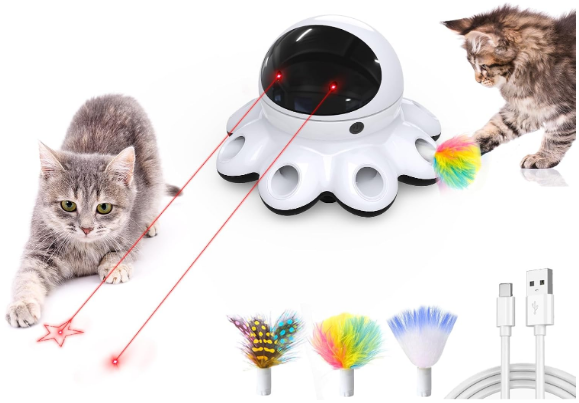
Modern Solution: ORSDA 2-in-1 Interactive Cat Toy
The ORSDA 2-in-1 Interactive Cat Toy combines moving laser patterns with feathers that appear through eight openings. ORSDA lists touch and voice activation, automatic 10-minute sessions every three hours, night mode, USB-C charging, and several days of standby under its stated conditions.[12]
Best for: Healthy, mobile cats attracted to movement that need occasional short activity while the caregiver is occupied.
What it cannot do: It cannot replace human-led play, solve anxiety, or guarantee quieter behavior. Light-based chasing lacks a physical object to capture, so transition to a tangible toy or a small food reward at the end.[3][9] The night mode is useful because overnight activation could disrupt sleep rather than improve it.
Use the toy in a clear area away from stairs, glass, fragile objects, and unsafe jumps. Never direct laser light toward eyes. Inspect feathers and openings frequently, stop use if parts loosen, and supervise until you understand how your cat interacts with the mechanism. Cats with mobility, vision, seizure, or frustration concerns need individualized advice.
5. A Resource Is Unavailable, Uncomfortable, or Poorly Located
A cat may vocalize because a door is closed, the water is empty, another cat blocks a hallway, the favorite perch is inaccessible, or the litter box no longer feels safe. The solution is not automatically to grant every request; it is to understand what the cat is trying to reach or avoid.
In multi-cat homes, resources that look plentiful to humans can still be functionally unavailable. Food, water, resting places, scratching surfaces, and toileting areas should be multiple, separated, and positioned so one cat cannot guard all access routes.[3]
For litter boxes, inspect cleanliness, size, entry height, litter depth and texture, location, noise, ambush risk, and the number of available boxes. A senior cat may cry because climbing into a high-sided pan hurts, not because the litter is insufficiently luxurious.
The critical litter-box distinction
A cat standing outside a soiled box and meowing may be objecting to the setup. A cat repeatedly entering the box, straining, crying, licking the genital area, or producing little or no urine may be in pain.
Cornell states that a urethral obstruction is an absolute emergency. Male and neutered male cats have greater risk because of their anatomy, but urinary pain in any cat warrants prompt veterinary attention.[8] Do not buy a new litter box and wait to see whether straining improves.
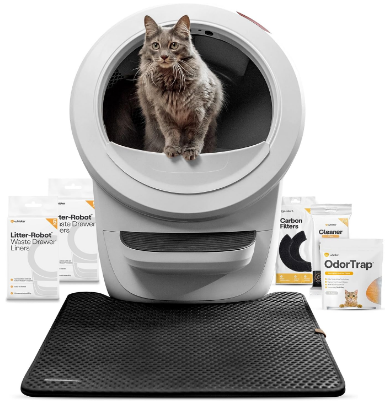
Modern Solution: Whisker Litter-Robot 4 Supply Bundle
For a medically healthy cat that objects to a box becoming dirty between scooping sessions, the Whisker Litter-Robot 4 can reduce how long clumps and stool remain exposed. It rotates after a qualifying visit and deposits waste into a lined drawer. The app can display recent visits, drawer status, litter level, and qualifying weight trends.[11]
Best for: Cats that comfortably fit the globe, accept automatic movement, use compatible clumping litter, and live with a caregiver who wants less repetitive scooping without abandoning monitoring.
Important limitations: It is self-sifting, not maintenance-free. You must inspect waste, empty and clean the drawer, add litter, wipe sensors, deep-clean components, and confirm that every cat is still urinating and defecating normally. Automatic cycling may startle a cautious cat, and trends do not diagnose urinary, kidney, gastrointestinal, or weight problems.
Whisker specifies a 3-pound minimum for automatic mode. Introduce the unit turned off beside the familiar box, add a small amount of used litter, and keep the old box until adoption is reliable. The linked Amazon listing has previously been offered as a Supply Bundle, so verify the model, color, accessories, seller, return terms, and current contents before ordering.[11]
6. Stress, Change, or Intercat Tension Is Raising Arousal
Cats value familiarity, control, safe retreat, and reliable access to resources. Moving, remodeling, guests, a new baby, unfamiliar smells, a schedule change, a new pet, conflict with another cat, or an outdoor cat at the window can increase vocalization.
Look beyond obvious fighting. One cat may silently stare, block a doorway, occupy the route to the litter box, or cause another cat to wait until nighttime to move through the home. Vocalizing may occur when the cat sees the rival, anticipates crossing a vulnerable area, or seeks the caregiver’s presence.
Practical changes include:
- Provide each cat with separated food, water, litter, scratching, resting, and hiding resources.
- Add elevated routes and refuges with more than one exit when possible.
- Block the lower portion of a window if outdoor cats trigger yowling.
- Preserve familiar bedding and scent-marked areas during changes.
- Introduce people, pets, sounds, and objects gradually.
- Maintain predictable meal and play schedules.
- Never force proximity between cats that are not comfortable together.
Separation-related distress is possible but should not be diagnosed from meowing alone. Video can help establish whether vocalizing begins after departure and whether it occurs with pacing, elimination changes, destructive behavior, reduced eating, or overgrooming. Persistent cases merit veterinary and qualified behavior support.
7. Your Cat Is Intact and Displaying Mating Behavior
An unspayed female in heat may call loudly, roll, become unusually affectionate, raise her hindquarters, and attempt to escape. Intact males may respond to females, roam, spray, or yowl. This vocalization is communication associated with reproduction, not a demand-training problem.[2]
Keep intact cats securely indoors and separated as necessary. Discuss spaying or neutering, reproductive timing, and individual medical considerations with your veterinarian. Do not use punishment or unprescribed sedatives to suppress mating-related behavior.
If a cat believed to be spayed shows repeated heat-like cycles, seek veterinary evaluation rather than assuming it is a personality change.
8. Aging, Sensory Loss, or Cognitive Dysfunction Is Affecting Orientation
Senior cats may vocalize more because they hear less, see less, hurt when moving, wake at different times, or feel less secure in a dark or changing environment. Cornell lists wandering, excessive meowing, disorientation, hearing loss, dental disease, arthritis, kidney disease, hyperthyroidism, and hypertension among relevant age-associated concerns.[5]
Cognitive dysfunction syndrome can include increased vocalization, altered interaction, sleep-wake changes, house soiling, disorientation, activity changes, anxiety, and learning or memory deficits. Merck emphasizes that medical and sensory causes must be investigated before cognitive dysfunction is diagnosed.[6]
After veterinary assessment, environmental adjustments may include:
- Night-lights along familiar routes
- Low-entry litter boxes on each level
- Food, water, and beds that do not require stairs or jumping
- Nonslip runners on slick floors
- A consistent furniture layout and bedtime routine
- Gentle daytime play and food-search activities suited to mobility
- Warm, easily reached resting areas
Do not isolate a disoriented senior simply to make the home quieter. Sudden nighttime yowling is a health change, not an inevitable feature of old age.
9. Pain or Illness Is Changing Your Cat’s Behavior
Excessive vocalization is nonspecific: it can occur with discomfort in many body systems. Possible contributors include dental pain, arthritis, injury, abdominal disease, urinary problems, hyperthyroidism, hypertension, kidney disease, sensory decline, and neurologic disorders.[2][5][6]
Arrange a veterinary visit when the meowing is new, increasing, persistent, or difficult to explain—especially in a middle-aged or senior cat. Bring a short video and a log of timing, location, appetite, water intake, litter-box output, activity, weight, medications, and recent environmental changes.
Seek emergency care now if vocalizing occurs with
- Repeated straining to urinate with little or no urine
- Open-mouth breathing or obvious breathing difficulty
- Collapse, severe weakness, seizure, or inability to stand
- Major trauma or uncontrolled bleeding
- A hard, painful abdomen with escalating distress
- Suspected toxin exposure
Contact your veterinarian promptly if you notice
- Weight loss despite a strong or increased appetite
- Increased thirst or urination
- Vomiting, diarrhea, constipation, or reduced appetite
- Limping, reduced jumping, hiding, or resistance to touch
- Disorientation, staring, getting trapped in corners, or sleep-wake reversal
- Blood in urine or stool
- A changed, raspy, or absent voice
- Poor grooming, a greasy coat, or new irritability
Never give human pain medication or a sedative unless a veterinarian specifically prescribes it for that cat.
How to Identify the Cause: A Seven-Step Plan
1. Triage for pain and emergencies
Observe breathing, mobility, urination, defecation, appetite, and general responsiveness. If the cat is straining without urine or showing another emergency sign, stop troubleshooting the environment and seek care.
2. Compare with the individual baseline
Write down when the pattern began and whether the sound, frequency, timing, or intensity changed. Include life stage and any known breed tendency, but do not let those labels dismiss a new symptom.
3. Keep an antecedent-behavior-consequence log
For several days, record:
| What happened before? | What did the cat do? | What happened afterward? |
| Alarm sounded at 5:30 a.m. | Meowed and pawed the bedroom door | Person got up and served food |
| Outdoor cat crossed the patio | Yowled at the glass with tail lashing | Caregiver approached and opened blinds further |
| Video meeting started | Meowed beside the desk | Cat received petting and treats |
Patterns often become clear when the consequence is visible. The log is also useful to a veterinarian or behavior professional.
4. Audit every essential resource
Check food, water, litter boxes, hiding places, scratching surfaces, vertical territory, resting areas, and play. In a multi-cat home, ask whether each cat can reach every resource without passing or being watched by another cat.
5. Add predictable activity before the problem time
If vocalizing peaks at 10:00 p.m., schedule interactive play and a measured meal earlier rather than waiting for the nightly chorus. Prevention is easier than changing a behavior at full intensity.
6. Reinforce the behavior you want
Reward a quiet pause, waiting on a mat, using a perch, playing independently, or settling in a bed. Keep training sessions short and use the reward that the individual cat values—food, play, brushing, or attention.[4]
7. Reassess rather than escalating punishment
If the plan does not help, ask whether the cause was identified correctly. Persistent vocalization after environmental changes may require diagnostic testing, pain assessment, or referral to a board-certified veterinary behaviorist.
Which Modern Solution Fits the Trigger?
Buy for an identified need, not for the loudness of the meow.
| Trigger after medical causes are addressed | Most relevant option | Lower-cost or manual alternative | Main limitation |
| Predictable early meal request | PETLIBRO timed feeder | A basic verified timer feeder | Dry-food compatibility and model-dependent app features |
| Box becomes dirty before you can scoop | Litter-Robot 4 | Large open boxes scooped at least daily | Adoption, space, cleaning, litter compatibility, and cost |
| Short periods of understimulation | ORSDA 2-in-1 toy | Supervised wand play and toy rotation | Automated play cannot replace interactive capture-based play |
| Attention-seeking | Scheduled social time and mat training | Free reward-based training | Requires consistency from every person |
| Outdoor-cat trigger | Window film, closed blinds, separated perch | Rearrange furniture and block the view | Does not solve intercat tension inside the home |
| Senior disorientation | Veterinary plan, night-lights, accessible resources | Reposition existing resources | Products do not diagnose or treat cognitive or medical disease |
The least expensive intervention is often the correct first one: move a box, close a blind, add a cardboard refuge, rotate toys, change the timing of play, or reward quiet behavior. Technology becomes valuable when it reliably supports that plan.
Mistakes That Can Make Excessive Meowing Worse
- Responding only at maximum volume: This teaches escalation. Meet predictable needs earlier and reward calm alternatives.
- Ignoring every meow: Blanket ignoring can miss pain, urinary obstruction, fear, hunger changes, or sensory decline.
- Feeding extra calories to buy silence: Food may reinforce the behavior and contribute to weight gain. Use the measured daily ration.
- Using punishment: Yelling, spraying, or frightening the cat can add stress and damage trust.
- Buying enrichment without using it: Static toys lose novelty. Rotate options and continue interactive play.
- Removing the old litter box too soon: A cautious cat may avoid the automatic replacement entirely.
- Assuming a senior cat has dementia: Cognitive dysfunction is a diagnosis reached after medical contributors are considered.
- Adopting another cat as a cure: A second cat can introduce competition and tension rather than companionship.
Frequently Asked Questions
Why does my cat meow at night?
Nighttime meowing can reflect a learned meal or attention routine, insufficient evening activity, outside-animal triggers, mating behavior, pain, sensory decline, or cognitive dysfunction. A new pattern—especially in a senior cat—deserves veterinary evaluation.
Why does my cat meow at 4:00 or 5:00 a.m. for food?
The cat may anticipate a practiced breakfast sequence. Confirm that increased hunger is not medical, schedule evening play and measured meals, and consider a timed feeder that releases a small portion before the usual disturbance without increasing daily calories.
Should I ignore my cat when they meow?
Not until you have checked safety, health, and essential needs. Once a veterinarian has cleared persistent or changed vocalization and the trigger is known, avoid rewarding demand meowing and reward brief quiet alternatives instead.
Why does my cat meow after using the litter box?
Some cats announce normal elimination, but vocalizing around the box can also indicate urinary or gastrointestinal discomfort. Straining, repeated trips, blood, or little to no urine requires immediate veterinary attention.
Why is my cat suddenly meowing more than usual?
A sudden change can result from pain, illness, stress, a new household trigger, sensory change, or a newly reinforced routine. Record accompanying changes and contact your veterinarian rather than assuming boredom.
Why does my senior cat wander and yowl at night?
Possible causes include pain, hypertension, kidney or thyroid disease, reduced hearing or vision, anxiety, and cognitive dysfunction. Your veterinarian should rule out treatable medical contributors before the behavior is labeled age-related.
Are some cat breeds naturally more vocal?
Yes. Siamese and some related breeds are often described as more vocal, but individual variation is substantial. Breed tendency does not explain a sudden change from the cat’s normal behavior.
Can an automatic feeder stop morning meowing?
It can help when breakfast anticipation is the confirmed trigger by transferring the food cue from the person to the device. It will not treat unexplained hunger, and some cats may simply wait and vocalize near the feeder.
Will a self-cleaning litter box stop litter-box meowing?
Only if cleanliness is truly the issue and the cat accepts the unit. It will not relieve urinary or gastrointestinal pain. You must still inspect output, maintain the machine, and provide an alternative during transition.
Can an automatic toy replace playing with my cat?
No. It can add short independent activity, but cats also benefit from responsive, prey-like interaction with successful captures. Automated toys require inspection, appropriate placement, and supervision during introduction.
Is excessive meowing a sign of separation anxiety?
It can occur in separation-related distress, but meowing alone is not enough for a diagnosis. Video the cat while away, note other behaviors, rule out medical problems, and seek veterinary or behavior guidance for persistent distress.
How long does it take to reduce learned meowing?
There is no fixed timeline. A behavior rewarded for months may initially intensify when the reward pattern changes. Consistent prevention, enrichment, and reinforcement of quiet alternatives matter more than trying to achieve immediate silence.
Final Thoughts: Why Does My Cat Meow So Much?
The goal is not a silent cat. It is a cat whose needs are met, whose health changes are recognized, and whose communication does not have to escalate to be understood.
For a medically healthy cat, the right intervention depends on the trigger. The PETLIBRO Granary 2 Vision may help separate breakfast from your wake-up routine, the Litter-Robot 4 may keep an accepted box cleaner between maintenance sessions, and the ORSDA 2-in-1 toy may add brief independent activity. Each remains a supporting tool, not a universal cure.
If the pattern is sudden, painful, confusing, or accompanied by physical changes, listen before you train. Sometimes the most important “modern solution” is not another device—it is noticing that your cat is asking for veterinary care.
Read more:
Why Your Cat Goes Crazy at 3 AM?
Why Does My Cat Follow Me Everywhere?
Why Your Indoor Cat Tries to Escape (And How to Keep Them Safe)
Sources and References
- Schötz S, van de Weijer J, Eklund R — Feline Vocal Communication. Review of feline call types and the predominance of meowing in cat-human rather than adult cat-cat interaction. View source
- VCA Animal Hospitals — Cat Behavior Problems: Vocalization. Common behavioral and medical contributors to persistent and nighttime vocalization. View source
- Feline Veterinary Medical Association and International Cat Care — Your Cat’s Environmental Needs: Practical Tips for Cat Caregivers. Safe places, separated resources, play, capture opportunities, and predictable social interaction. View source
- Feline Veterinary Medical Association — Setting Up the Environment for Success. Attention-seeking behavior, inadvertent reinforcement, reward-based training, and environmental management. View source
- Cornell Feline Health Center — The Special Needs of the Senior Cat. Age-related vocalization, sensory changes, pain, mobility, and medical differentials. View source
- Merck Veterinary Manual — Behavior Problems of Cats. Medical exclusion and signs associated with feline cognitive dysfunction syndrome. View source
- Cornell Feline Health Center — Hyperthyroidism in Cats. Current clinical signs, diagnosis, and relevance to appetite, weight, activity, thirst, and urination changes. View source
- Cornell Feline Health Center — Feline Lower Urinary Tract Disease. Urinary warning signs and the emergency status of urethral obstruction. View source
- International Cat Care — Playing With Your Cat. Capture-based play, frustration risk, and limitations of laser-only games. View source
- PETLIBRO — Granary 2 Series Feeder. Current model comparison, feeding modes, monitoring, compatibility, subscriptions, and manufacturer specifications. View source
- Whisker — Litter-Robot 4 Product Details and FAQ. Automatic sifting, app functions, litter compatibility, weight requirement, setup, and acclimation. View source
- ORSDA — 2-in-1 Cat Laser Toy. Manufacturer-listed activation, timing, charging, feather, laser, night-mode, return, and warranty features. View source
Sources, product specifications, subscription terms, prices, and retailer listings reviewed August 25, 2026. Features, policies, availability, and veterinary guidance may change. Verify critical product details with the manufacturer or retailer and seek veterinary advice for your individual cat.