Why Does My Cat Bite Me? 8 Common Reasons and What to Do
By Demosthenes Staudinger | Updated August 25, 2026
Affiliate disclosure: This article contains affiliate links. As an Amazon Associate I earn from qualifying purchases. If you buy through one of these links, we may earn a commission at no additional cost to you. This does not affect our editorial recommendations.
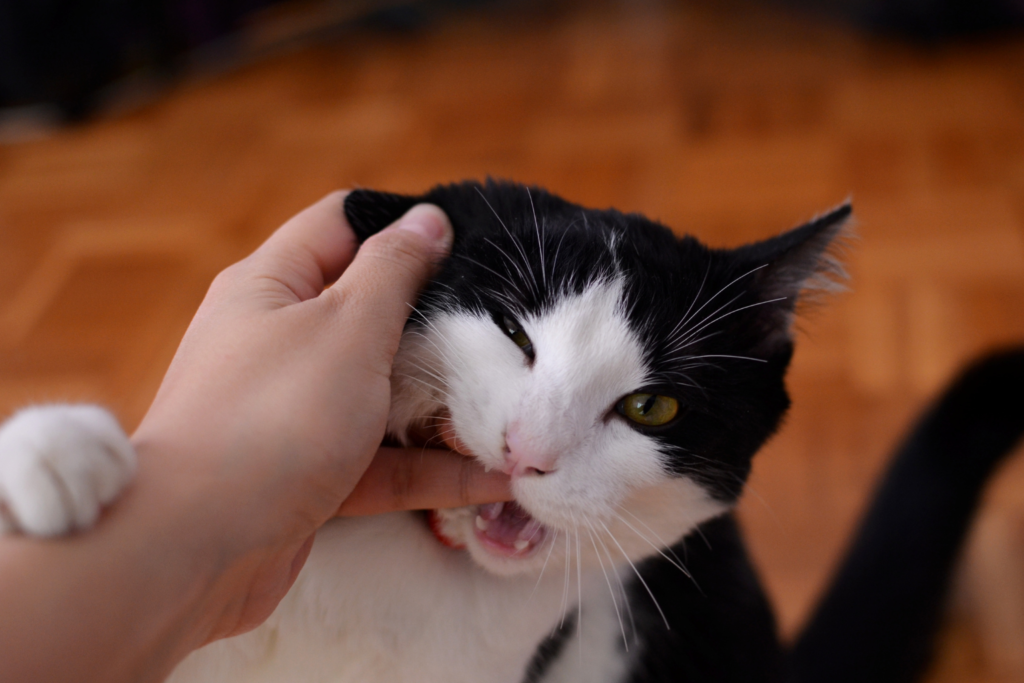
One moment your cat is purring on the sofa. The next, their teeth are around your hand. It is easy to describe that transition as unprovoked, spiteful, or completely unpredictable—especially when the warning lasted only a second.
In most cases, however, biting has a context. A cat may be ending unwanted touch, rehearsing hunting behavior, defending an escape route, reacting to pain, or redirecting intense arousal from something they cannot reach. Even a gentle, inhibited nibble and a bite that punctures skin should not be treated as the same behavior.
The useful question is therefore not simply, “Why does my cat bite me?” It is: What happened immediately before the bite, what did the cat’s body communicate, how much force was used, and what happened afterward? Those details separate petting intolerance from play, fear, frustration, redirected aggression, and medical discomfort.
The response matters too. Yelling, spraying water, scruffing, hitting, or holding a cat down can add fear and make future signals more intense. Reward-based management begins earlier: prevent the trigger, notice low-level warnings, give the cat a safe exit, and teach an acceptable behavior that earns the same outcome.[1][5][6]
Well-chosen products can support that plan. An interactive toy can give teeth and claws an appropriate target, while a stable cat tree can provide distance and choice. Neither product diagnoses pain, makes an aroused cat safe to handle, or replaces daily human-led play and professional help.
If the behavior is new, severe, escalating, directed toward a child, or triggered by touching one body area, arrange a veterinary examination before assuming it is “just personality.” If a bite breaks human skin, stop thinking about training for the moment and take care of the wound.
The encouraging news is that many biting patterns improve when caregivers stop rehearsing the problem and start responding to the cause. The goal is not to suppress every warning; it is to make biting unnecessary, reduce injury risk, and create more predictable interactions for everyone.
How we researched this guide: This is a research-based editorial guide, not a veterinary diagnosis or a hands-on product test. We reviewed current guidance from veterinary universities, veterinary manuals, feline professional organizations, public-health agencies, and current manufacturer or retailer information. Product claims are identified as manufacturer- or listing-provided features, and the recommendations include practical limitations and safety considerations.
Quick Verdict
- Editorial verdict: Cat biting is safest and most effectively addressed by identifying the trigger, ending interactions before the cat reaches threshold, ruling out pain or illness, and reinforcing appropriate alternatives. Punishment is not recommended.
- Best for home management: Predictable, low- to moderate-intensity biting linked to petting, rough play, attention, kitten behavior, or an environmental trigger that can be safely controlled.
- Seek professional help first if: The biting begins suddenly, causes deep wounds, appears unpredictable, occurs around children, follows touch to a specific body area, accompanies illness or disorientation, or continues despite careful prevention.
Why Does My Cat Bite Me? Start with Context
The same teeth can be used in very different situations. Before choosing a solution, write down the setting, the cat’s posture, the bite intensity, and the consequence. A short phone video taken before the usual trigger—not while provoking the cat—may help your veterinarian understand the sequence.
| When the bite happens | Signals that may appear first | Likely starting point | Safest immediate response |
|---|---|---|---|
| After several strokes | Tail flicking, ears rotating back, skin rippling, head turning toward the hand, body tension | Petting-induced overstimulation or low touch tolerance | Stop touching, keep still, and allow the cat to leave |
| During ankle ambushes | Stalking, crouching, pouncing, grabbing, bunny-kicking | Play or predatory behavior | Freeze, disengage without drama, and schedule appropriate play later |
| During licking or mutual grooming | Relaxed posture and a gentle, inhibited mouth contact | Social mouthing, sometimes called a “love bite” | End calmly if unwanted; do not encourage hand play |
| When approached, cornered, restrained, or startled | Crouching, ears back, dilated pupils, hissing, swatting, escape attempts | Fear or defensive aggression | Increase distance and restore an exit route |
| After a denied request | Repeated approach, vocalizing, pawing, escalating nip | Frustration or a learned attention strategy | Protect yourself, end the interaction, then reinforce a calm alternative later |
| While staring through a window or after a loud event | Fixed gaze, agitation, growling, tail lashing, inability to disengage | Redirected aggression | Do not touch, carry, or distract at close range; isolate the area safely |
| In a kitten around 3–7 months | Chewing, high play drive, loose body, frequent pouncing | Teething plus immature play skills | Offer supervised, size-appropriate toys and stop all hand wrestling |
| When one area is touched or movement is attempted | Flinch, guarding, hiding, reduced activity, altered appetite or grooming | Pain or illness | Stop handling and contact a veterinarian |
This table is not a diagnosis. Cats can experience more than one trigger at once. A kitten may be teething and under-stimulated; a senior cat may have low touch tolerance because arthritis makes a favorite petting position painful.
Learn the Warning Signs Before the Bite
Many caregivers say a bite came “without warning” because feline warnings can be brief and quiet. The cat may not hiss or growl. A single tail-tip twitch, a pause in purring, a head turn toward the hand, or a sudden freeze can be the whole message.
Common signs that an interaction is approaching the cat’s limit include:
- Ears rotating sideways or backward
- Tail-tip twitching, tail thumping, or rapid lashing
- Pupils becoming more dilated in the same lighting
- Whiskers tightening or moving forward
- Skin rippling along the back
- A sudden head turn toward the touching hand
- Body stiffening, crouching, leaning away, or freezing
- Purring stopping abruptly
- Repeated lip licking, staring, growling, or hissing
- Trying to leave, hiding, or blocking further contact
No single sign has one universal meaning. Dilated pupils can accompany fear, excitement, low light, or play. Interpret the whole body and situation. FelineVMA guidance emphasizes that changes in ears, pupils, whiskers, posture, vigilance, and movement can show increasing protective emotion before a stronger repelling response occurs.[5]
A cat that moves away has already answered. Following, holding, or placing the cat back on your lap removes the least confrontational option and makes teeth more likely. Respecting an early “no” is one of the most effective bite-prevention tools available.
1. Petting-Induced Overstimulation or Low Touch Tolerance
Petting-related bites are among the most common and confusing patterns. The cat may solicit contact, settle beside you, and appear relaxed—then turn and bite after a particular number of strokes.
The exact mechanism is not fully understood. It is more accurate to say that some cats have a low or context-dependent tolerance for physical contact than to claim that petting inevitably becomes painful because of unusually sensitive nerves. Cornell and Merck describe overstimulation and the cat’s attempt to end contact as possible explanations, while VCA notes that fear, restraint, skin discomfort, joint pain, and other medical problems can produce a similar sequence.[1][2][3]
Use a consent-pause routine
Try this low-pressure method with a medically healthy cat:
- Let the cat approach rather than reaching into a bed, hiding place, or meal.
- Offer one or two gentle strokes on areas the cat usually solicits, often the cheeks, chin, or head.
- Remove your hand and pause for several seconds.
- Continue only if the cat leans in, rubs against the hand, or clearly reinitiates contact.
- Stop at the first sign of tension—before a swat or bite.
The pause gives the cat control and helps you learn the individual threshold. If bites usually occur after ten strokes, do not aim for nine forever; begin well below that number. Several successful three-stroke interactions are more useful than one long session that ends in conflict.
Avoid sensitive regions unless your cat consistently welcomes them. Many cats tolerate head and cheek contact better than prolonged strokes over the back, belly, feet, or base of the tail. Preference varies, so the cat—not a generic petting chart—sets the rule.
If your cat bites only when a particular hip, tooth, ear, flank, or part of the spine is approached, stop testing it. Repeatedly touching the area to “make sure” can worsen pain and teach defensive anticipation. Arrange a veterinary examination.
2. Play Aggression and Hunting Behavior
Cats stalk, chase, pounce, grab, bite, rake, and kick as part of normal predatory play. A moving ankle under a blanket or wiggling fingers at the edge of a sofa can look like prey. The problem is not that the cat is “dominant”; it is that human skin has become part of the play sequence.
Play biting is especially common in kittens and energetic indoor cats, but adults can retain it. Merck notes that play-directed aggression toward people may reflect unmet play needs and can be unintentionally reinforced by the person’s response.[2] Running away, squealing, pushing with your hands, or returning for another wrestling round may keep the chase rewarding.
Replace hand play with a complete hunting sequence
Schedule two or more short sessions rather than waiting for an ankle attack. Use a long wand or lure that keeps teeth away from hands. Move it behind furniture, pause, change direction, and let the cat stalk before pouncing. Allow frequent captures; endlessly withholding the toy can create frustration.
Finish by letting the cat hold the toy briefly, then offer a small portion of the measured daily food if appropriate. Put string, wire, ribbon, and feather lures away after play. An effective session ends while the cat is engaged but before breathing, coordination, or arousal becomes concerning.
Automated toys can add variety between human-led sessions, but they should not become the only outlet. They cannot adjust to subtle fear or frustration as well as an attentive person, and motorized attachments can become damaged.
Modern Solution: Catpick 360° Automatic Spin Flying Bird Wand
The current Amazon listing for the Catpick 360° Automatic Spin Flying Bird Wand describes a USB-rechargeable motorized lure with a weighted base, suction-cup option, and a silicone-protected moving rod.[10] Its rotating movement may give a play-motivated cat an appropriate object to stalk and pounce on while the caregiver is occupied.
Best for: Healthy, mobile cats that enjoy moving feather-style targets and need short supplemental activity sessions.
Why it may help: A dedicated target can make the difference between “moving object means ankle” and “moving object means toy.” Place it in the room before the cat’s predictable high-energy period rather than presenting it immediately after a bite as a reward for biting.
Important limitations: This is a supplement, not a treatment for fear, pain, or severe aggression. The listed brand, seller, accessories, and exact features may change, so verify the current Amazon page. Inspect the attachment, rod, silicone covering, base, and charging area before every session. Use it on a clear, stable surface away from stairs and fragile objects. Supervise until you know how your cat interacts with it, and stop use if the cat chews through a covering, loosens a part, or becomes increasingly frustrated.
Do not place any automatic toy beside a highly aroused cat during a redirected-aggression event. Distance and safety come first in that situation.

3. Gentle Social Mouthing or “Love Bites”
“Love bite” is a popular description, not a formal diagnosis. Some cats use a soft, inhibited mouth contact during grooming, licking, or relaxed social interaction. It may be brief and leave no mark. The surrounding posture is loose, and the cat does not pursue when the person disengages.
That label should not be used to dismiss a painful bite. If the body stiffens, the tail lashes, the pupils change, the cat grips and kicks, or the pressure increases, reconsider petting intolerance or play. A bite can begin gently and still escalate.
If you do not want teeth on skin, remain calm and end the interaction consistently. Freeze for a moment, withdraw slowly when it is safe, and offer no exciting hand movement. Do not jerk your fingers away; sudden movement can intensify pursuit and may enlarge a puncture or scratch.
Later, provide a kicker toy or appropriate interactive play. The distinction is important: you are not punishing affection, and you are not teaching that biting summons a toy instantly. You are setting a predictable boundary—social contact continues while mouths remain gentle and stops when teeth touch skin.
4. Fear, Anxiety, or Defensive Biting
A frightened cat usually wants distance. Biting becomes more likely when escape seems blocked: a visitor reaches into a hiding place, a child hugs the cat, someone corners them for medication, or the cat is lifted despite struggling.
Defensive body language may include crouching, leaning away, flattened ears, dilated pupils, tucked limbs, hissing, growling, swatting, or an intense effort to escape. Some cats become very still instead. Freezing is not consent; it can be a high-stress response.
Restore choice before asking for cooperation
- Stop advancing and turn your body slightly sideways.
- Avoid direct staring, reaching overhead, and forced pickup.
- Give the cat an open path to a hiding or elevated area.
- Ask visitors and children to ignore the cat until the cat initiates contact.
- For necessary care, ask your veterinary team about gradual cooperative training and low-stress handling.
- Introduce new people, sounds, carriers, and household changes at an intensity the cat can tolerate.
Never drag a frightened cat from a refuge merely to socialize them. A hiding place works because it lets the cat control exposure. If fear biting is frequent, a veterinarian should check for pain and anxiety-related disease and help decide whether a qualified behavior professional is needed.
Modern Solution: Globlazer F70 Pro Cat Tree
An elevated station does not cure fear, but it can provide a safer choice than hiding behind appliances or remaining trapped at floor level. The Globlazer F70 Pro includes multiple perches, a condo, hammock, sisal scratching areas, and more than one climbing route. Globlazer lists the current light-gray version at 55 × 45 × 178 cm (about 70 inches tall), 16.5 kg, with sisal, plush, and particleboard construction.[11]
Best for: Healthy adult cats that seek height, hiding, scratching, and observation while remaining near household activity.
Why it may help: FelineVMA recommends safe places, raised resting options, hiding opportunities, and environmental resources that allow cats greater control.[4][5] A well-positioned tower can let a cat watch visitors without being cornered or followed.
Important limitations: The F70 Pro is not solid wood, despite the “architectural wood” language used in some earlier drafts. Measure the exact footprint and height, verify the current color and variant, assemble every component according to the manual, and use anti-tip hardware when supplied or appropriate. Keep it away from breakable objects and unsafe fall zones. Cats with arthritis, weakness, poor vision, or impaired balance may need lower, wider steps instead of a 70-inch tower.
A cat tree helps only if the refuge remains respected. Do not climb after the cat, reach into the condo, or use the tower as a place to trap them for handling.

5. Frustration or Learned Attention-Seeking
Some cats discover that a nip reliably produces a response. An ankle bite may make a person stand up, open a door, fill a bowl, or begin play. Even scolding supplies immediate attention. Over time, the cat may skip quieter requests and use the behavior that works fastest.
This does not mean you should simply ignore every bite. Safety and wound care come first. A cat who has latched on, a child at risk, or broken skin requires an immediate protective response. “Ignore it” is too vague when teeth are involved.
For low-intensity, predictable nipping, calmly end access to your attention without yelling, chasing, or wrestling. Then change the routine outside the biting moment:
- Identify what the bite usually obtains—food, play, access, or contact.
- Meet legitimate needs on a predictable schedule before escalation begins.
- Teach an incompatible behavior, such as going to a mat, touching a target, sitting on a perch, or playing with a designated toy.
- Reward that behavior generously while the cat is calm.
- Make sure every household member follows the same rule.
For example, if a cat bites your calf while dinner is prepared, put a perch or mat outside the kitchen work zone. Practice rewarding the cat for staying there at easy times. At mealtime, deliver measured treats or part of the ration to the station before the stalking begins. This gives the cat a clear way to succeed.
Do not withhold food, water, litter access, medical care, or necessary social contact to prove a point. Training works best after essential needs are secure and the alternative behavior is easier than biting.[5][6]
6. Redirected Aggression
Redirected aggression can produce some of the most intense and apparently inexplicable bites. The cat becomes highly aroused by an inaccessible target—often an outdoor cat through the window, a loud noise, a conflict with another pet, or an unfamiliar odor. A nearby person or animal then becomes the target.[1][2]
This is not the time to touch the cat, pick them up, stand between cats, toss a toy near them, or attempt an introduction. A normally affectionate cat may remain unsafe to approach while arousal is high, and recovery can take much longer than a few minutes.
What to do instead
- Keep people, children, and other pets away.
- Do not use bare hands to separate fighting animals.
- From a safe distance, close a solid door or barrier if you can do so without approaching the cat.
- Block the outdoor view later, once the area is safe—not by reaching across an aroused cat.
- Reduce noise and activity and allow the cat to settle without contact.
- Wait for fully relaxed posture and normal behavior before considering interaction.
- Contact a veterinarian if the event is severe, repeated, or difficult to manage safely.
Afterward, identify the trigger. Frosted film on the lower part of a window, closing blinds at predictable times, moving a perch, deterring roaming animals through humane property management, or separating household resources may reduce recurrence. In a multi-cat home, a redirected incident can damage the cats’ relationship; do not immediately place them together to “work it out.” A gradual reintroduction may be required.
7. Kitten Teething and Immature Bite Inhibition
Kittens explore with their mouths and practice predatory skills through play. Teething adds another reason to chew. VCA notes that adult incisors may begin appearing around three months, canines around five months, and premolars and molars between roughly four and seven months.[7]
Teething alone does not explain every kitten attack. Many kittens also need more appropriate play, more sleep, and consistent feedback that hands are not toys. A kitten raised without littermates during important social-learning periods may need especially patient teaching.
Set the rule from the first day
- Never wrestle with bare hands or invite a kitten to chase fingers under bedding.
- Use wand toys with adequate distance and sturdy kicker toys for grabbing and rabbit-kicking.
- Offer several brief play sessions each day and let the kitten capture the toy.
- If teeth touch skin, freeze and end the game calmly.
- Resume later with an appropriate toy, not instantly as payment for biting.
- Rotate toys and inspect them for loose strings, feathers, stuffing, wire, or pieces small enough to swallow.
Avoid hard sticks, brittle items, and improvised objects that can splinter or be swallowed. Silvervine may attract some cats, but a stick is not automatically a safe teething device. Ask your veterinarian about suitable products for your kitten’s size and chewing style, and supervise all new chew items.
Contact your veterinarian for persistent bleeding, a broken tooth, facial swelling, refusal to eat, foul odor, pawing at the mouth, or a baby tooth that appears retained beside an adult tooth.
8. Pain, Illness, or Sensory and Neurologic Changes
A sudden behavioral change deserves medical attention. Cats often conceal pain, and biting may be the first obvious sign that touch, lifting, grooming, or movement has become uncomfortable.
Potential contributors include dental disease, ear infection, skin inflammation, injury, arthritis, abdominal discomfort, urinary disease, neurologic conditions, sensory decline, and other illnesses. Pain-related bites often occur when one region is touched or when the cat anticipates being moved. Cornell, Merck, and VCA all advise considering pain or disease when aggression is new or touch-specific.[1][2][3]
Schedule a veterinary examination promptly if biting is accompanied by any of the following:
- Reduced appetite, weight change, vomiting, diarrhea, or altered thirst
- Hiding, reduced jumping, stiffness, limping, or reluctance to be picked up
- Overgrooming, a painful coat, skin lesions, or sensitivity along the back
- Bad breath, drooling, chewing changes, or dropping food
- Litter-box changes, straining, or vocalizing during elimination
- Disorientation, altered sleep, staring episodes, tremors, or seizures
- A sudden change in sociability, vocalization, grooming, or activity
Do not give human pain relievers or leftover veterinary medication. Some common human drugs are dangerous to cats, and treatment depends on the cause. Avoid repeatedly handling the painful area while waiting for the appointment.
Sudden severe aggression accompanied by collapse, seizure activity, difficulty breathing, major trauma, suspected toxin exposure, or profound disorientation warrants urgent veterinary care. Keep your hands away from the mouth and use the veterinary team’s instructions for safe transport.
What to Do in the First 10 Seconds After a Bite
Your first goal is to stop escalation without adding injury.
- Freeze rather than yank. Rapidly pulling a hand or foot may trigger pursuit and can tear punctured skin.
- Do not hit, yell, spray, or scruff. Punishment can increase fear and arousal and may suppress early warnings without changing the underlying trigger.[6]
- Create distance calmly. If the cat releases, move away slowly. Use a solid object such as a cushion or large piece of cardboard as a visual barrier only if needed and only without pressing it against the cat.
- Separate the area. Keep children and other animals away while the cat settles.
- Do not restart the interaction. No apology petting, forced cuddle, immediate toy, or attempt to “show who is boss.”
- Check your skin. Even a small puncture needs immediate cleaning and assessment.
If the cat is actively latched on or repeatedly attacking, prioritize escape and call for local emergency help if a person cannot get to safety. Do not attempt complicated restraint maneuvers based on an article.
Once everyone is safe, record what happened: time, location, trigger, body signals, target, bite severity, duration, and recovery time. This information is more useful than labeling the cat aggressive.
If the Bite Breaks the Skin
Cat teeth can create narrow punctures that look small at the surface. The CDC warns that bites and scratches can transmit germs even when the wound does not look deep and reports that a substantial proportion of reported cat bites and scratches become infected.[8]
Immediate care
- Wash the wound promptly with warm, running water and soap.
- Control bleeding with gentle pressure using a clean cloth.
- Cover with a clean dressing after washing.
- Do not allow the cat to lick the wound.
- Contact a healthcare professional for advice, especially for punctures or bites to the hand, fingers, face, foot, or near a joint; deep wounds; persistent bleeding; reduced movement or sensation; or if you have diabetes, immune suppression, poor circulation, or another condition that increases infection risk.[8][12]
Seek prompt medical care if the area becomes red, warm, swollen, increasingly painful, drains fluid, develops red streaks, or if you develop fever or feel unwell. Do not wait for a serious-looking infection before asking about a deep hand puncture.
Tell the clinician when the bite occurred, whether the cat is known and currently healthy, the cat’s rabies vaccination status, and when you last received a tetanus-containing vaccine. The clinician decides whether antibiotics, tetanus vaccination, imaging, or other treatment is appropriate.
Rabies decisions depend on the animal, location, vaccination record, exposure circumstances, and public-health rules. If the cat is stray, unavailable, acting abnormally, or has unknown rabies status, wash the wound thoroughly and contact a healthcare or public-health professional urgently. CDC rabies guidance recommends washing a possible rabies-exposure wound with soap and water for 15 minutes and obtaining prompt risk assessment.[9]
This article cannot determine whether your individual bite needs emergency care. When in doubt—especially with a puncture to the hand—err on the side of professional medical advice.
Special Safety Considerations for Children and Multi-Cat Homes
Children may miss subtle warning signs and may react by running, screaming, grabbing, or pursuing. CDC and Cornell both emphasize supervision around cats with a history of bites.[1][8]
Teach children to let the cat approach, stroke briefly on preferred areas, and stop if the cat turns away or the tail begins moving sharply. No hugging, carrying, waking, chasing, cornering, or reaching into hiding places. A young child and a cat with a bite history should not have unsupervised physical access.
In multi-cat homes, determine whether the human-directed bite follows tension between cats. Watch for staring, blocking, chasing, guarding stairs, and one cat waiting to use resources. Provide multiple, separated litter boxes, feeding stations, water sources, scratching surfaces, elevated routes, and resting areas.[4][5]
After a serious redirected incident, separate cats safely and consult the veterinary team about reintroduction. Putting them together immediately can trigger another event and turn a temporary conflict into a persistent association.
When to Contact a Veterinarian or Behavior Professional
Begin with your veterinarian because pain and disease can mimic or intensify behavioral problems. Bring your trigger log and any safely obtained video. The veterinarian may recommend examination, diagnostic tests, pain treatment, environmental changes, medication as part of a broader plan, or referral.
Ask for additional behavior support when:
- Bites are deep, frequent, escalating, or directed toward the face
- The cat gives little recoverable warning
- Children, older adults, or medically vulnerable people are exposed
- Redirected aggression involves other household animals
- Fear prevents routine veterinary or home care
- Avoidance and environmental changes are not enough
- The household is considering surrender or euthanasia because of safety concerns
A board-certified veterinary behaviorist has veterinary training and advanced behavior specialization. Your veterinarian can help locate an appropriate professional and coordinate medical and behavioral care. Do not rely on a trainer who recommends dominance, flooding, scruffing, physical correction, or deliberate provocation.
Frequently Asked Questions
1. Why does my cat bite me while I am petting them?
The cat may have reached an individual touch threshold, become overstimulated, felt restrained, or experienced pain. Stop at early signs such as tail flicking, ear rotation, body tension, head turning, or moving away. Use brief consent pauses and arrange a veterinary examination if the bite is new or linked to one body area.[1][3]
2. Why does my cat purr and then bite me?
Purring does not guarantee that every additional stroke is welcome. A cat can be relaxed initially and then reach their limit, and purring can occur in more than one emotional context. Interpret the full body and stop before the usual threshold rather than waiting for the bite.
3. Are cat “love bites” really affection?
“Love bite” is an informal label for a gentle, inhibited mouth contact that may occur during relaxed grooming or social interaction. It should be painless and leave no injury. If pressure increases, the body stiffens, or the cat pursues your hand, treat it as a boundary, play, or arousal issue instead of romanticizing it.
4. Why does my cat bite my ankles when I walk past?
Moving ankles can trigger stalking and pouncing, particularly in kittens and under-stimulated, high-play-drive cats. Stop using hands and feet as toys, schedule interactive wand play before the predictable ambush period, and reinforce an alternative station or toy.
5. Should I hiss at, spray, or tap my cat after a bite?
No. Physical and startling punishment can add fear, damage trust, and intensify aggression. It may also suppress warning signals without changing the trigger. Prioritize safety, end the interaction calmly, prevent repetition, and use reward-based alternatives.[6]
6. Should I ignore my cat when they bite for attention?
Do not ignore injury or remain within reach of an escalating cat. Calmly protect yourself and end the interaction without drama. Outside the biting moment, meet legitimate needs predictably and reward a specific alternative—such as sitting on a mat—before the cat escalates.
7. Why does my cat bite me but not my partner?
People differ in touch style, timing, scent, movement, reactions, and history with the cat. One person may pet longer, use hands in play, pick the cat up, or respond more dramatically. Compare the exact interaction sequences instead of assuming the cat likes one person less.
8. How can I tell play biting from true aggression?
Play often includes stalking, pouncing, grabbing, kicking, and repeated engagement with a relatively loose body. Fear or defensive aggression more often includes distance-seeking, crouching, flattened ears, hissing, or escape attempts. The categories can overlap, and any intense or injurious pattern deserves professional assessment.
9. Will getting another cat stop play biting?
Not reliably. A compatible cat may provide social play, but introductions can create stress and intercat tension, and the existing bite pattern may continue. Adopt another cat only because the household can support that individual, not as a behavior-treatment purchase.
10. Do kittens outgrow biting?
Teething and immature play commonly improve with development, but rehearsed hand biting can persist. Consistent toy use, appropriate play, calm game endings, sleep, and early reward-based teaching matter. Veterinary advice is appropriate if biting is extreme or oral discomfort is suspected.[7]
11. When is a cat bite a medical emergency for the person?
Seek urgent care for severe bleeding, deep injury, loss of movement or sensation, a bite to the face or near a joint, rapidly worsening pain or swelling, or systemic illness. Prompt professional advice is especially important for hand punctures and for people with conditions that increase infection risk. Unknown rabies status requires urgent public-health or medical guidance.[8][9]
12. When is sudden biting an emergency for my cat?
Urgent veterinary care is warranted when sudden aggression accompanies trauma, seizure activity, collapse, breathing difficulty, suspected toxin exposure, profound disorientation, or severe pain. Do not restrain the cat with bare hands; call the clinic for safe transport instructions.
Final Thoughts
If you keep asking, “Why does my cat bite me?”, begin with the seconds before the teeth appear. The location, trigger, posture, pressure, and consequence usually reveal more than the bite itself.
Petting bites call for shorter, consent-based contact. Play bites need appropriate hunting outlets and a permanent rule that skin is never prey. Fear requires distance and choice. Redirected aggression requires separation and time. Sudden, touch-specific, or escalating biting requires veterinary assessment.
An interactive toy or stable cat tree can make a thoughtful behavior plan easier to maintain, but neither is a cure. The strongest modern solution is also the simplest: notice early communication, prevent rehearsals, provide safe outlets, reward the behavior you want, and bring medical or behavior professionals in before anyone is seriously injured.
Read more:
Why Does My Cat Follow Me Everywhere?
Why Your Indoor Cat Tries to Escape (And How to Keep Them Safe)
Sources and References
- Cornell Feline Health Center — Feline Behavior Problems: Aggression
- Merck Veterinary Manual — Behavior Problems of Cats
- VCA Animal Hospitals — Cat Behavior Problems: Petting Aggression
- Feline Veterinary Medical Association and iCatCare — Your Cat’s Environmental Needs (2026)
- Feline Veterinary Medical Association — Setting Up the Environment for Success
- Feline Veterinary Medical Association — Training Techniques for Addressing Undesirable Behaviors
- VCA Animal Hospitals — How to Tell If Your Kitten Is Teething
- Centers for Disease Control and Prevention — Cats: Healthy Pets, Healthy People
- Centers for Disease Control and Prevention — Rabies Prevention and Control
- Amazon — Catpick 360° Automatic Spin Flying Bird Wand, ASIN B0FRSJQCB8
- Globlazer — F70 Pro Light-Gray Cat Tree, Official Product Information
- MedlinePlus — Animal Bites: Self-Care