Modern Cat Trees Review (2026): Which Sculptural Design Is Worth It?
By Demosthenes Staudinger | Updated August 30, 2026
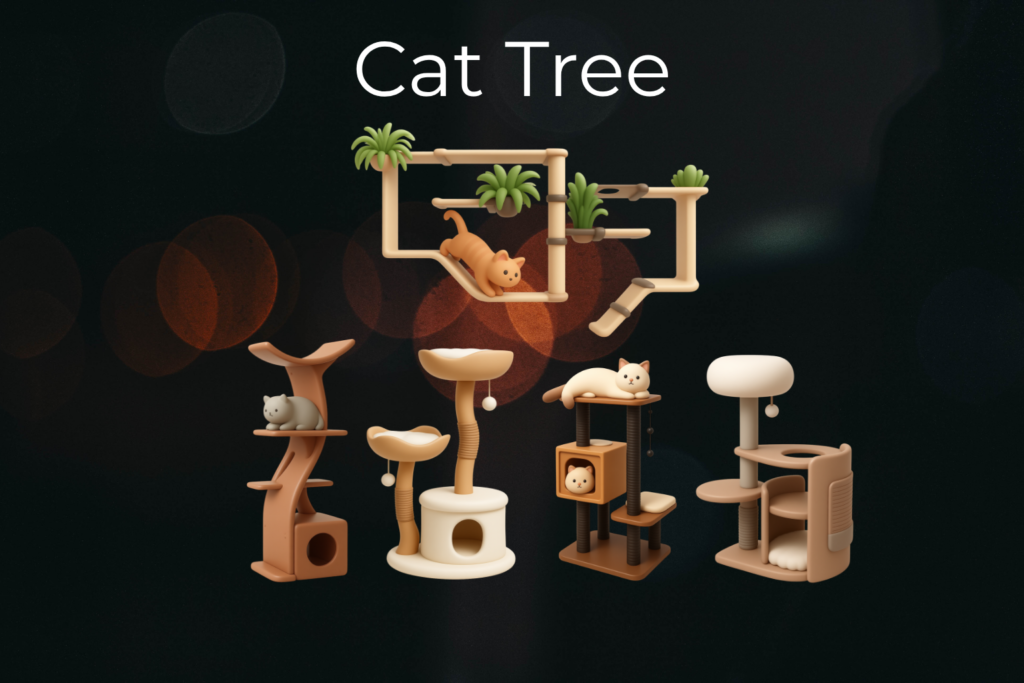
You can spend months refining a living room, then lose the entire visual effect to a bulky beige tower wrapped from floor to ceiling in synthetic carpet. The familiar cat-tree problem is not that cats need furniture. It is that much of that furniture was designed without the human room in mind.
Modern cat trees use curved plywood, real branches, bamboo, restrained colors, and replaceable wear parts to create vertical territory that can remain where the family spends time.
That placement matters to the cat, too. Elevated resting areas let cats observe their surroundings, while appropriate scratching surfaces and separated resting locations support normal feline behavior. In multi-cat homes, several safe places and resources can also reduce competition, although no single tower can resolve an established relationship problem by itself.[1]
The design premium does not automatically produce a better cat tree. A beautiful tower can still have narrow steps, weak traction, or an awkward descent route. Wall systems are only as safe as their installation.
We compared five visually distinctive options using the same practical questions: Is it stable? Can the cat stretch and scratch? Are the resting surfaces usable? Do the dimensions suit the intended cat? Can worn parts be replaced? What happens if the cat ignores it?
Our overall pick is The Refined Feline Lotus Cat Tower because it combines a genuinely sculptural silhouette, a 69-inch observation perch, a relatively compact 20-by-20-inch footprint, replaceable contact surfaces, and documented support hardware. It is not the right choice for every cat, however. Large cats that prioritize broad basket beds may prefer the Mau Cento, renters may need a freestanding model rather than a wall system, and older cats may require lower steps or a ramp.
How we reviewed: Modern Cat Society did not conduct hands-on testing for this article. We compared current manufacturer specifications, materials, dimensions, care instructions, replacement-part availability, installation requirements, return terms, and warranty information. We also checked feline environmental and scratching guidance from veterinary and animal-welfare organizations. Manufacturer load claims are reported as manufacturer claims, not independent laboratory findings.
Affiliate disclosure: This article contains affiliate links. As an Amazon Associate I earn from qualifying purchases. If you buy through one of these links, we may earn a commission at no additional cost to you. This does not affect our editorial recommendations.
Quick Verdict
- Editorial verdict: The Lotus Cat Tower is the strongest all-around choice when the goal is a tall, furniture-like centerpiece that still provides perches, a den, traction, and a useful scratching surface.
- Best for: Design-conscious homes, agile adult cats, window watchers, and single- or multi-cat households that can justify a premium freestanding tower.
- Skip it if: Your cat has limited mobility, strongly prefers wide enclosed beds, needs steps with minimal vertical gaps, or is unlikely to use a tall structure enough to justify the investment.
Lotus Cat Tower Key Specifications
| Feature | Verified details |
|---|---|
| Product type | Freestanding, four-level modern cat tower |
| Assembled size | 20 in W × 20 in D × 69 in H |
| Product weight | 72 lb |
| Platform support | Manufacturer states at least 30 lb per platform |
| Middle platforms | 8 × 23 in |
| Top platform | 20 × 24 in |
| Bottom cubby | 14 in W × 16 in D × 13 in H |
| Main materials | Premium plywood, real oak veneer, Berber carpet or faux fur, foam cushions, and sisal on applicable finishes |
| Stability features | Reinforced support bar and adjustable floor levelers |
| Wear parts | Replacement platform coverings, carpet, cushions, and sisal pad are sold by the manufacturer |
| Assembly | Required; manufacturer estimates approximately one hour and includes tools and hardware |
| Direct-purchase return policy | 60-day trial; direct-site terms include a 10% deduction and customer-paid return shipping, subject to stated conditions |
| Warranty | Six-month limited warranty for manufacturing defects; normal carpet and sisal wear is excluded |
| Best use | A tall observation and resting station in a visible living area, ideally near a secure window |
| Main limitation | Premium cost and relatively narrow intermediate platforms |
Modern Cat Tree Comparison at a Glance
| Model | Best for | Size | Published cat or load guidance | Primary materials | Main compromise |
|---|---|---|---|---|---|
| The Refined Feline Lotus | Best overall sculptural tower | 20 × 20 × 69 in | At least 30 lb per platform, per manufacturer | Plywood, oak veneer, textile coverings, sisal | Narrow middle platforms and premium cost |
| Mau Cento | Large cats and organic interiors | 23-in base; 45.5 in high | Cats up to 23 lb each, per manufacturer | Treated real branches, woven baskets, jute, plush cushions | Lower observation height than the Lotus |
| Catit Vesper High Base | Compact geometric design | 22.1 × 22.1 × 47.8 in | No maximum cat weight published on the current official page | Laminated MDF, memory foam, seagrass, sisal | MDF construction and retailer-dependent policies |
| Catastrophic Creations Gardens | Wall-spanning multi-cat territory | 113 × 11 × 63 in | 65 lb hammocks and 85 lb shelves, contingent on correct installation, per manufacturer | Bamboo, cotton canvas, steel, sisal | Requires seven correctly spaced wall studs and substantial installation |
| PetPals Cullen | Narrow mid-century footprint | 22.5 × 14.5 × 41 in | Cats up to 20 lb, per manufacturer | Laminated wood, recycled paper rope, sisal, faux fur | Shortest primary climbing structure in this group |
These models solve different problems: the Lotus prioritizes height, the Cento broad beds, the Vesper geometric compactness, the Gardens wall territory, and the Cullen a narrow footprint.
What Is a Modern Cat Tree?
A modern cat tree is an indoor structure that combines one or more feline resources, such as elevated perches, resting beds, hiding spaces, scratching surfaces, or climbing routes, in a design intended to resemble contemporary furniture rather than a carpet-covered utility tower.
The word modern describes the visual language, not a regulated construction standard. One company may use furniture-grade plywood and oak veneer; another may use laminated MDF, woven paper rope, or natural branches. “Wooden” can therefore mean anything from real branch supports to an engineered wood panel with a decorative finish. Buyers should read the materials list rather than relying on the category name.
Replaceable textiles and scratchers can extend useful life, although availability and cost may change.
A modern cat tree is also not a complete enrichment plan. Cats still need opportunities for interactive play, choice, hiding, horizontal or vertical scratching according to preference, and access to separated resources. FelineVMA guidance specifically recommends multiple safe places and key resources in multi-cat homes rather than assuming one shared station will suit every cat.[1]
How Do Modern Cat Trees Work?
Cat trees work by concentrating several useful behaviors into a vertical footprint. The lowest level may offer a den or a stable base. Intermediate surfaces create a route upward. The top becomes an observation or sleeping point, while textured columns or panels give the cat an approved location to scratch and stretch.
Height expands usable territory and lets a cat monitor the room from a position of choice. Cat Friendly Homes notes that elevated areas increase vertical space and support observation.[9] Height loses value when the route is slippery or difficult to descend.
Scratching surfaces serve a separate function. Cats scratch as part of normal claw maintenance, stretching, and communication. Cats Protection recommends a post with a heavy, stable base that is tall enough for a full stretch; it also notes that cats who prefer horizontal scratching may need a pad instead.[2] A tower with only a short wrapped section should not be expected to satisfy every scratcher.
Judge resting surfaces by usable area, not tower height. A shorter tree with wide baskets may fit a large sleeper better than a tall model with narrow transitions.
Does “Sculptural” Mean Better for Cats?
No. Sculptural design describes what the furniture contributes to the room. Feline usability comes from stability, traction, accessible routes, appropriate surface dimensions, multiple exits from enclosed spaces, and materials the individual cat is willing to use.
The strongest designs control visual clutter without deleting traction, scratching, resting, or escape routes.
A tower also cannot promise to stop furniture scratching, cure boredom, create harmony between incompatible cats, or replace play. It provides a better option. Whether the cat chooses that option depends on placement, texture, social access, mobility, and previous habits.
1. The Refined Feline Lotus Cat Tower: Best Overall
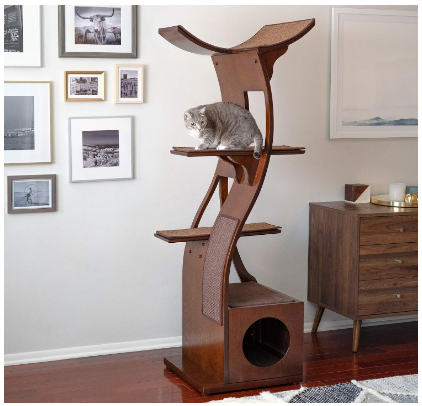
The Lotus is the clearest answer to the article’s design brief. Its bent profile rises like a single continuous stem, with staggered shelves branching toward a broad upper platform. The visible structure is premium plywood with real oak veneer rather than a stack of carpeted tubes. Current finishes include wood tones and a white version.[3]
Functionally, the 69-inch height is the headline. The 20-by-20-inch footprint is modest for such a tall freestanding tower, and the 20-by-24-inch top platform is the most desirable resting area. Two 8-by-23-inch middle platforms create the route upward, while the base contains a cushioned 14-by-16-by-13-inch den. The manufacturer states that each platform supports at least 30 pounds.[3]
Stability deserves a nuanced reading. A tall curved structure can visibly flex when a heavy cat launches from the top. The current design includes adjustable floor levelers and a reinforced support bar intended to reduce movement. That is meaningful hardware, but it does not remove the need to tighten every fastener, place the tower on a level surface, and check it periodically. “Supports multiple cats” should never be interpreted as permission for children to climb it.
Carpet, cushions, coverings, and the sisal pad are replaceable. Cushion covers can be washed, but removable carpet is spot-clean only. The white finish uses faux fur and lacks the sisal pad supplied with applicable wood finishes.[3]
The manufacturer estimates about an hour for assembly. Narrow intermediate platforms may challenge long-bodied or hesitant cats, but the overall design is compelling for agile adults that enjoy altitude.
2. Mau Cento: Best for Large Cats and Organic Interiors
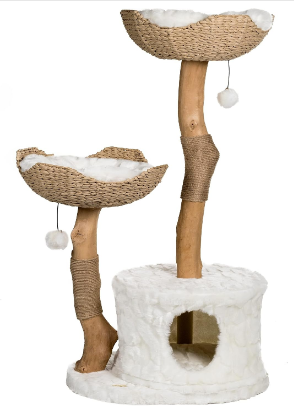
The Cento replaces a conventional geometric frame with professionally treated real branches, two handwoven basket beds, and a cave at the base. Because the branches retain natural variation, each tower differs slightly in color and shape. That individuality is part of the appeal, but buyers expecting perfectly symmetrical manufactured furniture should understand what “one of a kind” means before ordering.[5]
Mau publishes a suitability limit of up to 23 pounds per cat. The tower stands 45.5 inches high on a 23-inch base and has an approximate packaged weight of 38 pounds. The lower height sacrifices some lookout value compared with the Lotus, yet the basket-centered design may suit a large cat more naturally than narrow transition shelves.
Mau sells replacement baskets, cushions, rope, and toys. Its cushions require the coldest wash without detergent, while the frame should be wiped or vacuumed rather than treated with liquid detergent.[5]
The direct 45-day free-return trial applies in the contiguous United States and Canada. A one-year limited warranty covers functional defects but excludes normal wear.[5]
Choose the Cento when bed size, natural texture, and a softer organic silhouette matter more than maximum height. Skip it if your cat’s main pleasure is surveying the room from near ceiling level or if exact visual uniformity is essential to the design plan.
3. Catit Vesper High Base: Best Compact Geometric Option
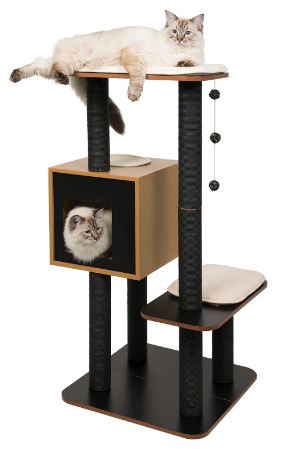
The Vesper High Base looks more like a small shelving system than a faux tree. Its square platforms, laminated surfaces, cube den, and restrained color options work well in apartments or rooms where a flowing statement piece would feel too decorative.
The High Base measures 47.8 inches high and 22.1 inches square. It has four levels, a two-entry cube, memory-foam cushions, seagrass-wrapped scratching posts, and a sisal mat. The frame is high-quality MDF with a decorative laminate, not solid hardwood or plywood. Catit lists replaceable parts, which improves the ownership case for a model built around several wear surfaces.[6]
The official product page does not publish a maximum cat weight for the High Base. That omission matters. A retailer description or customer photo is not a substitute for manufacturer load guidance, particularly for a very large cat or a household where two cats may land on one platform together. Ask Catit or the retailer for current guidance if load capacity will determine the purchase.
The Vesper is a value choice only when priced meaningfully below premium models. Its MDF frame requires prompt spill cleanup and separation from fountains or litter overspray.
4. Catastrophic Creations Gardens: Best Wall-Mounted Installation
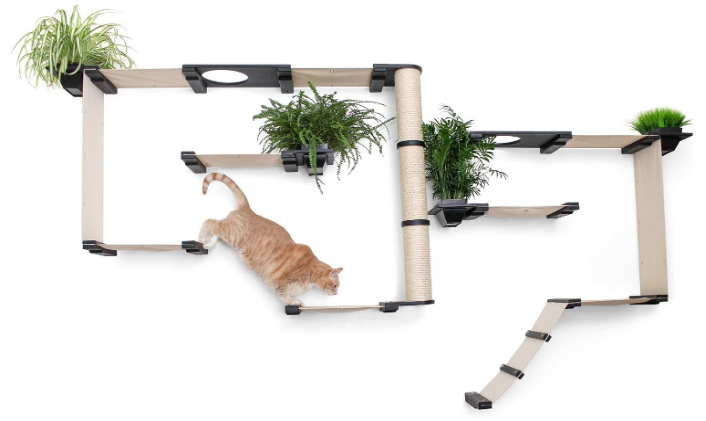
The Gardens is included as the architectural wildcard because it is not a freestanding tree at all. It is a wall-spanning system of bamboo mounting planks, heavyweight cotton canvas, steel hardware, a central sisal climbing pole, escape hatches, and planters. The full version measures 113 inches wide, 63 inches high, and 11 inches deep, and weighs 45 pounds before cats begin using it.[7]
This design preserves open floor space but demands a large, appropriate wall. The standard full Gardens layout is designed around seven studs spaced 16 inches on center; the Mini Garden uses four. Drywall anchors alone are not an acceptable substitute for the specified structural mounting route. If the stud pattern, wall condition, or installation skill is uncertain, consult a qualified installer before purchase.
The manufacturer states 65-pound hammock and 85-pound shelf limits, contingent on correct attachment to sound framing. These are not universal limits for every wall or custom layout.[7]
Escape hatches create alternative routes, but a shared wall cannot guarantee social peace. Watch for blocking or monopolization and add separate territory as FelineVMA recommends.[1]
The planters require special caution. Include only plants verified as nontoxic to cats, prevent access to fertilizers or treated soil, and remember that “pet friendly” marketing is not a botanical identification. The fabric sections can be cold-washed and hung to dry. This is the most visually ambitious option here, but it is also the hardest to relocate and the least renter-friendly.
5. PetPals Cullen: Best Narrow Mid-Century Footprint
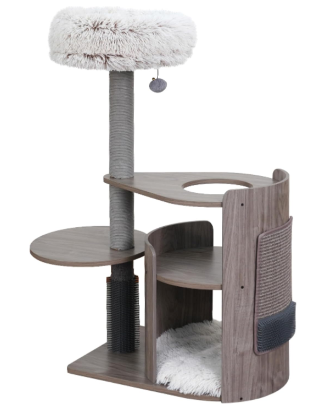
The Cullen is 22.5 inches long, only 14.5 inches wide, and 41 inches high. At 26 pounds assembled, it is much lighter and lower than the Lotus. Its four levels combine laminated wood, two recycled-paper-rope posts, a removable sisal mat, a faux-fur bed and cushion, and a flexible grooming element. PetPals states that it supports cats up to 20 pounds.[8]
The narrow depth is useful beside a desk, console, or apartment window, but a narrow base deserves deliberate placement. Put the longest side parallel to a wall, follow every assembly step, and reassess movement after the first week of jumping. The manufacturer includes tools and instructions but does not present the Cullen as a substitute for structural wall furniture.
The faux-fur pieces can be cold-washed and air-dried, with handwashing preferred. PetPals offers direct returns within 30 days, free replacement parts for three months, and later discounted-part terms.[8]
Choose the Cullen when visual lightness and a slim footprint matter more than maximum height. For an athletic cat that wants a commanding lookout or for several cats that need widely separated perches, it is the weakest primary territory solution in this group.
Safety, Stability, and Feline Fit
The safest cat tree is not necessarily the heaviest or the one with the largest published load number. Safety comes from the entire system: a sound frame, correct hardware, level placement, usable traction, an appropriate route, and a cat whose size and mobility match the geometry.
Measure the floor or wall area, nearby obstacles, and the landing path. Freestanding towers should not rock when pushed; wall units must follow the specified attachment method.
Inspect the finished structure before allowing unsupervised use. Look for protruding screws, loose rope, exposed staples, unstable baskets, split wood, or textile loops that could catch a claw. Retighten hardware after the initial settling period and whenever movement increases. Replace worn components before their attachment points fail.
Scratching surfaces should be tall and stable enough for the individual cat’s full extension. Cats Protection advises a heavy base and enough height for a full-body stretch, while also recognizing that some cats prefer horizontal pads.[2] Keep a separate horizontal scratcher if the tower’s vertical surface does not match the cat’s habits.
Keep tall towers away from unsecured windows, cooktops, stair edges, blind cords, and unstable furniture. Published cat load limits never apply to people.
Large Cats, Kittens, Seniors, and Multi-Cat Homes
For large cats, published weight guidance is only the first filter. Compare shoulder width, body length, turning space, and the size of the preferred sleeping position. The Mau Cento’s stated 23-pound suitability and broad baskets make it the clearest large-cat candidate. The Lotus publishes at least 30 pounds per platform, but its 8-inch-wide middle stages may feel restrictive to some long-bodied cats.[3][5]
Kittens are agile but inexperienced. Supervise early exploration, remove damaged dangling toys, and ensure a clear descent route.
Older cats and cats with osteoarthritis may still value elevated resting places, but access often needs modification. Cat Friendly Homes recommends horizontal scratching options when vertical scratching is painful and notes that some cats may need steps or a ramp to reach elevated safe spaces.[10] A low, stable window perch or shorter stepped system may therefore be more humane than the most dramatic tower.
In multi-cat households, count desirable destinations, not just levels. One premium top bed can become a contested resource. Provide additional resting, hiding, and scratching locations in separate areas, and make sure a cat can leave without passing directly beside another cat. No manufacturer’s “multi-cat” label overrides the behavior you observe at home.[1]
Return Policy and Warranty
Returns address unwanted purchases; warranties address defects. Direct-brand terms may not apply to Amazon or other retailer purchases.
| Product | Direct return terms reviewed | Warranty or replacement terms reviewed | Important qualification |
|---|---|---|---|
| Lotus Cat Tower | 60-day trial from delivery; direct-site refund is reduced by 10%, and customer generally pays return shipping | Six-month limited manufacturing-defect warranty; carpet and sisal wear excluded | The direct trial does not apply to third-party purchases; check the Amazon seller’s terms before assembly |
| Mau Cento | 45-day direct trial with free returns in the contiguous U.S. and Canada | One-year limited warranty for functional defects; normal wear excluded | International orders have different shipping, duty, and return obligations |
| Catit Vesper High Base | Retailer-specific | No duration stated on the current model page reviewed | Confirm both seller return rights and Catit support before ordering |
| Gardens | 60 days from delivery, but item must be new and unused; customer pays return shipping | No product-specific warranty duration stated on the page reviewed | Installation and visible use can make the return condition difficult to satisfy |
| PetPals Cullen | Free returns and refunds within 30 days for direct purchases | Free replacement parts during the first three months; later discounted-part terms are stated | Verify whether the same terms apply through the chosen retailer |
Inspect the Lotus before full assembly, photograph damage, and keep its packaging. The current FAQ asks customers to report shipping damage to the distributor within ten days for a free replacement.[4]
Mau has the most forgiving eligible direct trial here. The Gardens period is longer, but its “new and unused” condition makes real adoption testing difficult. Save receipts and assembly photographs.
Catit Vesper Base vs. High Base vs. High Base XL vs. Double
Catit offers the clearest same-brand size ladder among these selections.[6]
| Vesper model | Height | Footprint | Levels or layout | Best scenario |
|---|---|---|---|---|
| Base | 33.2 in | 22.1 × 22.1 in | Three levels and one cube | Small cats, low windows, or limited vertical reach |
| High Base | 47.8 in | 22.1 × 22.1 in | Four levels and one cube | Best balance for many apartments |
| High Base XL | 62.2 in | 22.8 × 30.5 in | Five levels and one hideaway | More altitude and a larger available footprint |
| Double | 40.75 in | 25.5 × 25.5 in | Four levels and two cube dens | Cats that prioritize enclosed resting spaces |
The High Base balances footprint and altitude. The XL is taller but deeper; the Double trades height for a second den. Choose from actual measurements, not the family name.
Premium Modern Cat Trees vs. Traditional Carpeted Towers
Traditional carpeted towers still make sense when budget, soft traction, and closely spaced steps matter most. Their common weaknesses are fixed fabric, visual bulk, and limited replacement parts.
Premium modern trees concentrate textile only where the cat contacts the structure and make the frame part of the room’s furniture language. They are easier to wipe down and may last longer when replacement parts remain available. The compromise is that exposed hard surfaces need adequate traction and every curve or cutout must still work for the cat’s body.
A modest tower beside a favorite window can outperform an expensive sculpture hidden in an unused room.
Pros and Cons
| Pros of the Lotus Cat Tower | Cons of the Lotus Cat Tower |
|---|---|
| Distinctive curved silhouette reads as furniture rather than pet equipment | Premium purchase relative to conventional towers |
| 69-inch height creates a valuable upper observation point | Narrow 8-inch middle platforms may not suit every large or hesitant cat |
| Compact 20-by-20-inch floor footprint for its height | Tall curved structure may show some movement during forceful jumps |
| Broad 20-by-24-inch top platform | Requires careful assembly and periodic hardware checks |
| Reinforced support bar and adjustable floor levelers | Direct returns can involve a 10% deduction and return-shipping expense |
| Plywood and real oak veneer construction | Six-month warranty is shorter than Mau’s stated one-year coverage |
| Replaceable carpet, cushions, coverings, and scratch pad | White finish does not include the sisal pad supplied with applicable wood finishes |
| Removable contact surfaces simplify routine care | Removable carpet is for spot cleaning, not machine washing |
| Base den adds a lower hiding and resting option | Bottom cubby may be small for cats that prefer roomy enclosed beds |
| Manufacturer publishes dimensions and platform guidance | No design can guarantee adoption or stop scratching elsewhere |
Who Should Buy the Lotus Cat Tower?
Buy the Lotus if you want one freestanding tower to function as the visual centerpiece of a living room, your cat confidently climbs and jumps, and a 20-inch-square footprint fits the intended space. It is particularly compelling near a secure window where the 69-inch top platform has a daily purpose.
Choose the Cento for roomy baskets, the Vesper for a lower geometric tower, the Gardens for a permanent wall installation, or the Cullen when its 14.5-inch depth is decisive.
Choose a different category altogether for a senior cat that avoids jumping, a cat that scratches only horizontally, or a household that needs multiple separated resting sites. A low perch, ramped shelf system, sturdy horizontal scratcher, or two simpler trees may fit better than one premium tower.
How to Get the Most From the Lotus Cat Tower
Measure the cat and the route before ordering
Mark the 20-inch-square base and 69-inch height in the room. Compare the cat’s current bed with the top platform and cubby measurements.
Assemble and inspect it methodically
Follow the current manual, install the support bar, level the base, and tighten hardware evenly. Recheck fasteners after several days and during cleaning.
Introduce it without forcing the cat
Use familiar scent, treats, or a wand toy to reward voluntary exploration. Never place the cat at the top or move their paws against the scratcher.[11]
Put it where the reward already exists
Place the tower near people, a safe window, or an existing feline route. Keep a separate horizontal scratcher if that is the cat’s preference.[2]
Maintain the surfaces and the structure
Follow the surface-specific care instructions and replace worn sisal or textile before attachments are exposed. Stop access if the frame cracks or becomes unstable.
Frequently Asked Questions
What is the best modern cat tree that looks like furniture?
The Lotus Cat Tower is our best overall choice because it combines a distinctive curved form with meaningful height, replaceable contact surfaces, a den, a scratcher, and documented stability hardware. The best model for an individual home may still be the Mau Cento, Vesper, Gardens, or Cullen depending on cat size, mobility, wall access, and available space.
Is the Lotus Cat Tower suitable for large cats?
The manufacturer states that each platform supports at least 30 pounds, but fit is not determined by weight alone. The 20-by-24-inch top is generous, while the 8-inch-wide middle platforms and 14-by-16-inch cubby may feel constrained to some long-bodied cats. Measure resting and turning space before buying.[3]
Which modern cat tree is best for a Maine Coon?
The Mau Cento is the clearest candidate in this comparison because Mau explicitly supports cats up to 23 pounds and centers the design on large woven baskets. A Maine Coon’s actual weight and dimensions vary, so confirm that the specific cat can turn, rest, climb, and descend comfortably.[5]
Are modern wooden cat trees more stable than carpeted towers?
Not automatically. Material quality helps, but base geometry, total height, hardware, floor level, and assembly quality determine stability together. A low carpeted tree with a broad base can be safer than a poorly assembled designer tower. Test movement and follow any anchoring or stud requirements.
Can a cat tree stop my cat from scratching the sofa?
It can provide an appropriate alternative, but it cannot guarantee that the cat will abandon a preferred sofa. Match the texture and orientation the cat already chooses, place the scratcher near the existing target, and reward voluntary use. Some cats need both vertical and horizontal scratching surfaces.[2]
Is the Catastrophic Creations Gardens safe for drywall?
It is designed to mount into structural studs, not drywall alone. The standard full system uses seven studs at 16-inch spacing, and the manufacturer also describes other specified variants. Confirm stud positions and wall condition before ordering, and use a qualified installer if you are uncertain.[7]
Which option is easiest to clean?
The Lotus has wipeable veneer and replaceable contact surfaces, although its removable carpet is spot-clean only. The Cento and Cullen have washable cushions with specific care instructions. Vesper’s laminated surfaces wipe clean but should be protected from prolonged moisture. Gardens canvas can be cold-washed and hung dry.
Do these cat trees require replacement parts or subscriptions?
They do not require an app or subscription. Scratchers, rope, cushions, baskets, and textiles are wear items, however. Lotus, Mau, Vesper, Gardens, and Cullen all document at least some replacement or modular parts. Availability and cost can change, so confirm parts before treating serviceability as a lifetime promise.
What is the best model for an older cat?
The best choice is usually a lower, stable structure with broad steps and short transitions. The Vesper Base is lower than the High Base, but even that may be inappropriate for a cat with pain or poor balance. Consider a ramp, pet steps, low perch, and horizontal scratcher, and discuss new mobility changes with a veterinarian.[10]
Can two cats share one modern cat tree?
They may, but one tower should not be the household’s only desirable elevated resource. Provide multiple safe resting and scratching locations in separate areas, especially if one cat blocks routes or monopolizes the top. Watch behavior rather than relying on a “multi-cat” product label.[1]
What should I check immediately after delivery?
Check the model, finish, parts list, hardware, wood or panel damage, textile condition, and packaging. Photograph damage before assembly and contact the seller promptly. Keep the box until you know the product is complete and the applicable return process is clear.
Are expensive designer cat trees worth it?
They can be worth it when the design keeps the tower in a high-value social location, the dimensions fit the cat, and replaceable components extend useful life. They are poor value when selected for appearance alone, placed where the cat has no reason to visit, or purchased despite inaccessible steps and unsuitable beds.
Final Verdict: Is the Lotus Cat Tower Worth It in 2026?
The Lotus Cat Tower is worth considering in 2026 for buyers who want a genuine living-room statement piece without stripping away the functions that make cat furniture useful. Its 69-inch height, broad top platform, base den, oak-veneer frame, replaceable surfaces, levelers, and support bar make it the most complete sculptural freestanding option in this comparison.[3]
The recommendation remains conditional. The narrow middle platforms are not ideal for every large or cautious cat, the return economics require attention, and the warranty is shorter than Mau’s stated coverage. A senior cat may benefit more from a lower route, while a large basket sleeper may prefer the Cento. Renters and homeowners should also distinguish between a floor tower and the permanent installation demanded by the Gardens.
Among modern cat trees, the right design should look good enough to stay in the heart of the home and work well enough that the cat chooses it. When the Lotus’s dimensions match both the room and the animal, it meets that standard better than the alternatives reviewed here.
Read more:
Minimalist Cat Furniture Review (2026): Which Pieces Are Worth It?
10 Modern Cat Room Ideas You’ll Love (2026)
Sources and References
- Feline Veterinary Medical Association and International Cat Care — Your Cat’s Environmental Needs. Guidance on elevated safe places, separated resources, multi-cat tension, play, and voluntary interaction. View source
- Cats Protection — Why Do Cats Scratch? Guidance on stable, full-height scratching posts, horizontal preferences, placement, and appropriate alternatives. View source
- The Refined Feline — Lotus Cat Tower. Official dimensions, materials, platform guidance, assembly, care, finishes, stability hardware, and replacement parts. View source
- The Refined Feline — Cat Furniture Frequently Asked Questions. Direct return, warranty, damage-reporting, cleaning, and third-party purchase qualifications. View source
- Mau — Cento. Official size guidance, dimensions, materials, care, replaceable parts, direct trial, and warranty terms. View source
- Catit — Vesper Base Collection. Official dimensions, model numbers, materials, features, variants, and replacement-part information. View source
- Catastrophic Creations — The Gardens Modern Cat Tree with Plants. Official dimensions, materials, stud requirements, components, load claims, cleaning, and direct return conditions. View source
- PetPals — Cullen Mid-Century Cat Tower. Official SKU, dimensions, supported cat weight, materials, cleaning, replacement parts, and direct policies. View source
- Cat Friendly Homes — What Your Cat Needs to Feel Secure. Guidance on familiar territory, appropriate scratching resources, and the value of elevated observation areas. View source
- Cat Friendly Homes — Home Modifications for Your Cat. Guidance for cats with pain or limited mobility, including ramps, steps, accessible safe spaces, and horizontal scratchers. View source
- Cat Friendly Homes — Cat Training Techniques for Caregivers. Guidance on positive reinforcement and rewarding appropriate scratching behavior. View source
Sources, specifications, prices, and policies reviewed August 30, 2026. Product features, retailer terms, warranty coverage, and manufacturer guidance may change. Verify critical details with the manufacturer or retailer before purchasing.