The Door Dasher: Why Your Indoor Cat Tries to Escape—and How to Keep Them Safe
By Demosthenes Staudinger | Updated August 24, 2026
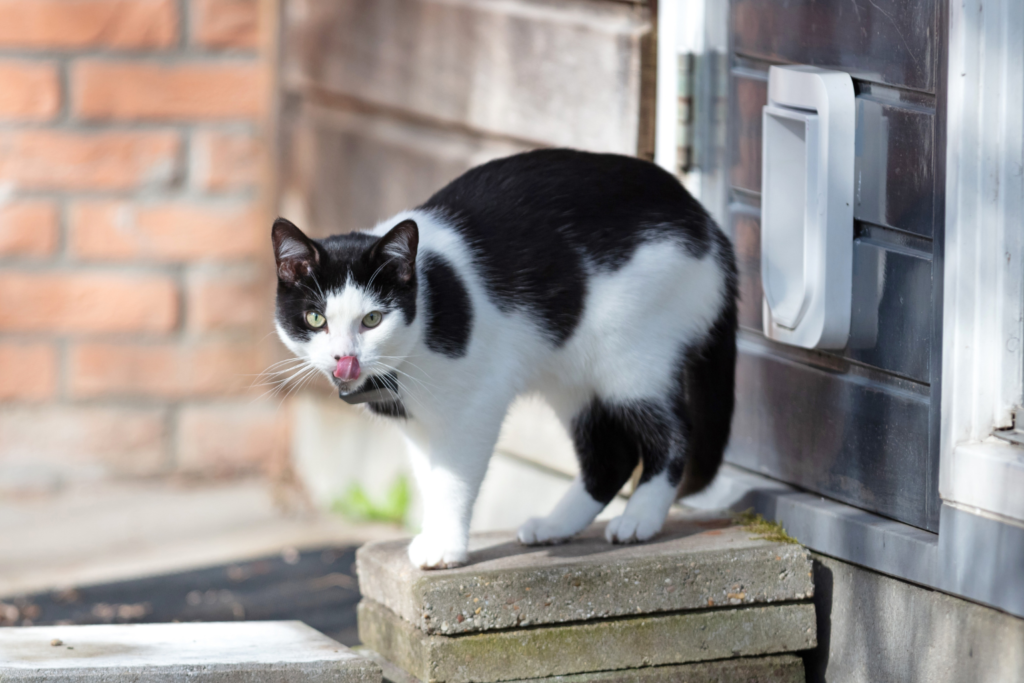
Deliveries and returns home can become high-stakes negotiations with a door-dashing cat. You open the front door a few inches, position one leg as a barricade, and try to stop a determined feline from slipping through the gap.
It is natural to take this behavior personally. You may wonder whether your cat is bored, unhappy, or trying to leave you. In most cases, however, a rush toward an open door is not a verdict on your relationship or proof that indoor life has failed. The doorway is simply a powerful concentration of novelty: unfamiliar scents, moving insects, outdoor cats, voices, airflow, and a route into unexplored space.
That does not mean every escape attempt has the same explanation. Door dashing is a behavior pattern, not a diagnosis. Curiosity, a learned routine, hunting motivation, mating behavior, household stress, and even a medical change can all contribute. The safest response is therefore not a single gadget or punishment. It is a layered system that prevents access, teaches an alternative behavior, improves the indoor environment, and prepares for recovery if prevention fails.
Quick answer: An indoor cat may try to escape because the doorway offers novelty, prey-like movement, social or territorial information, or a behavior that has been rewarded in the past. Intact cats may also seek a mate. Start with a physical barrier and a door-opening routine, then add positive-reinforcement training, daily enrichment, permanent identification, and an optional tracker as a backup.
Important: A sudden or dramatic change in escape behavior—especially when accompanied by appetite or weight changes, vocalization, disorientation, pain, aggression, or litter-box changes—deserves a veterinary examination. This article is educational and does not replace advice from your veterinarian or a qualified feline behavior professional.
How We Researched This Guide
Modern Cat Society reviewed current guidance from the Feline Veterinary Medical Association, Cat Friendly Homes, the American Animal Hospital Association, the ASPCA, Humane World for Animals, and current manufacturer documentation. Product details were checked against official specifications and the linked Amazon listings available in August 2026.
We did not hands-on test these products. Recommendations reflect documented functions, safety, suitability, and manufacturer-disclosed limitations. Features, subscriptions, inventory, and sellers can change, so confirm the current listing and terms before buying.
Why Does My Indoor Cat Try to Escape?
A cat standing near the door is not necessarily planning a permanent departure. Often, the cat is reacting to what the doorway predicts or reveals. Watch what happens immediately before the dash, where your cat looks, and what they do if they reach the other side. Context usually tells you more than the escape attempt alone.
1. The doorway is a gateway to novelty
Cats gather information through scent, sound, movement, and vision. Even a comfortable indoor home is predictable, while an entrance changes throughout the day. Shoes carry outdoor odors, hallways contain the scents of people and animals, and airflow delivers new information. Curiosity is especially likely when a cat pauses to sniff or remains close to the entrance rather than running away.
Novelty seeking can become stronger when the indoor environment offers few opportunities to climb, hide, forage, scratch, or observe outdoor activity. Current feline environmental guidance emphasizes safe resting places, separated resources, predictable positive interaction, opportunities for predatory play, and respect for the cat’s sensory world.[1][2] Meeting those needs will not make an open door irrelevant, but it can reduce the contrast between a static home and an exciting hallway or yard.
2. Door dashing has become a learned routine
Cats are excellent observers of patterns. Keys, shoes, a coat, an intercom, or the sound of a delivery truck can predict that the door is about to open. If rushing forward has ever produced access to the hallway, attention from a person, or an exciting chase, the behavior may have been reinforced.
Intermittent rewards are persistent. Even rare hallway access—or the excitement of shouting and chasing—can keep the behavior going.
This is why the whole household needs one consistent routine. If one person rewards the cat for waiting on a mat while another casually allows hallway exploration, the cat receives conflicting information. Training works best when the desired behavior is easier, safer, and more consistently rewarding than charging the threshold.[3][4]
3. Something outside activates hunting, social, or territorial interest
A moth, bird, or mouse can trigger an immediate chase. A neighborhood cat spraying near the door, resting outside a window, or vocalizing in the hallway may provoke investigation, frustration, or defensive arousal. Some cats rush outside to approach; others are trying to increase distance from a frightening event inside. Calling every dash a “territorial patrol” oversimplifies the behavior.
Look for a fixed stare, low posture, chattering, tail lashing, growling, or repeated checking of the same outdoor location. If another animal is the trigger, use privacy film, blinds, strategic furniture placement, or humane outdoor deterrents on your own property to reduce visual access. Do not touch or pick up a highly aroused cat; redirected aggression can occur when the original trigger is unreachable.
4. An intact cat may be looking for a mate
Sex hormones can create intense escape motivation. An unspayed female in heat may vocalize, roll, become unusually affectionate, raise her hindquarters, and try to reach intact males. An intact male may roam, spray, fight, or persistently seek outdoor scents.
No amount of puzzle feeding can reliably override a strong mating drive. If your cat is intact, discuss spaying or neutering with your veterinarian, including the timing and any individual medical considerations. Preventing accidental breeding is only one benefit; your veterinarian can explain the wider health and behavior implications for your cat.[5]
5. Fear, conflict, or a health change may be involved
A cat may bolt because the interior feels unsafe. Construction noise, a guest, a dog blocking a corridor, inter-cat conflict, or a frightening appliance can push them toward an available exit. Medical and age-related changes belong on the checklist too. Pain, hyperthyroidism, or cognitive dysfunction can alter normal routines. A new pattern—especially with physical or behavioral changes—should not be dismissed as stubbornness.
| What you observe | Possible explanation | What to check | First response |
|---|---|---|---|
| Cat sniffs and explores just outside | Novelty or sensory investigation | Indoor enrichment, hallway odors, recent household changes | Add enrichment and prevent access with a secondary barrier |
| Cat rushes when keys, shoes, or intercom appear | Learned departure routine | Whether attention or occasional access follows the dash | Change the routine and reward a station away from the door |
| Cat fixates on birds, insects, or another cat | Hunting or social/territorial arousal | Windows, porch lights, outdoor animal activity | Block the trigger, add structured play, and avoid handling during arousal |
| Cat yowls, sprays, or tries to roam while intact | Mating motivation | Reproductive status and signs of heat | Speak with your veterinarian about spaying or neutering |
| Behavior appears suddenly with physical or behavioral changes | Pain, illness, fear, or cognitive change | Appetite, weight, thirst, mobility, litter box, orientation | Arrange a veterinary examination |
Does Door Dashing Mean Your Cat Is Unhappy Indoors?
Not by itself. A well-cared-for cat can still find an open doorway irresistible. Curiosity does not equal rejection, and one successful trip into the hall can create a lasting habit.
At the same time, indoor safety should not be confused with complete welfare. Keeping cats indoors reduces exposure to traffic, fights, predators, infectious hazards, and parasites, but cats still need an environment that supports species-typical behavior.[2][6] If your cat has no elevated resting places, predictable play, scratching options, hiding spots, or opportunities to search for food, the outdoor world may become disproportionately appealing.
Use the behavior as useful information rather than a reason for guilt. Ask two separate questions:
- How can I make the doorway physically safe today?
- What need or learned pattern might be increasing my cat’s interest over time?
The first question prevents an emergency. The second helps change the behavior.
The Safest Strategy: Four Layers of Protection
The most dependable order is prevention, training and enrichment, identification, then tracking. A tracker may help after an escape, but it cannot stop a cat from crossing a road, entering a garage, becoming trapped, or losing the collar that carries it.
Layer 1: Create a physical “airlock” at the entrance
Management is the foundation because it works even when your cat is excited, frightened, or not yet trained. The ideal setup creates a second boundary between the cat and the exterior.
Depending on your home, that may be:
- A closed interior door between the living space and entryway.
- A tall, securely mounted pet gate with spacing your cat cannot squeeze through.
- A screen or mesh vestibule designed for the doorway and installed without climbable gaps.
- A separate room where the cat relaxes during deliveries, maintenance visits, parties, or moving day.
- A fully enclosed porch or catio that functions as a controlled transition space.
Many cats can jump ordinary gates or climb mesh. Select a barrier for your cat’s size and agility, and check that it cannot topple, trap a paw, or interfere with emergency egress.
Build a simple household protocol:
- Locate the cat before opening the exterior door.
- Close the secondary barrier.
- Bring packages fully inside before reopening the interior area.
- Ask guests to wait until you confirm the cat is secure.
- Place a clear “Indoor cat—please wait” note at eye level for contractors and delivery situations.
For high-traffic events, use a quiet safe room with water, litter, a hiding place, and a bed. Secure the cat before the first guest or worker arrives. AAHA highlights current identification and a safe-room plan because indoor pets can slip out during moves and door activity.[7]
Layer 2: Teach a station and an emergency recall
Training adds cooperation to the physical system. It should never be the only barrier, but it can make ordinary arrivals calmer and safer.
How to teach a door station
Choose a mat, small platform, or cat tree several feet from the entrance—far enough that a cat cannot reach the threshold in one leap. The station should offer a clear view without placing the cat in the traffic path.
- Make the station valuable. Toss a small treat onto the mat. When your cat steps on it, mark the moment with a clicker or a consistent word such as “yes,” then deliver another reward on the station.
- Reward remaining in place. Gradually increase from one second to several seconds. Deliver treats low and toward the back of the mat so the reward does not pull the cat toward the door.
- Add a cue. Once your cat is reliably approaching the mat, say “place” or another short cue immediately before they move toward it.
- Teach a release word. Use a separate cue such as “free” before tossing a treat away from the mat. This tells your cat exactly when the exercise ends.
- Introduce door movements slowly. Touch the handle, reward. Turn it, reward. Open the door one inch behind a secure secondary barrier, reward. Progress only while your cat can remain relaxed and successful.
- Add real-life distractions gradually. Practice with a family member walking outside, then with a soft knock, a bag, or the sound of keys. Do not begin with a delivery driver and a fully open door.
Keep sessions to a few minutes and end before frustration appears. Account for training treats in the daily diet. If your cat stops eating, hides, or fixates on the exit, increase distance and return to an easier step.
Positive-reinforcement training can teach a cat to target a place, respond to cues, enter a carrier, use a cat door, or accept a harness.[3] Punishment is not necessary and can make the entrance more emotionally charged.[4]
Build an emergency recall cue
Choose a sound you do not use casually: a particular whistle, word, or treat-container sound. Several times a week, make the sound indoors and immediately deliver an exceptional reward. At first, the cue should always predict something valuable.
Practice from different rooms. Do not use the emergency cue mainly to end enjoyable activities or summon your cat for medication. Recall can help in a hallway or yard, but it is not guaranteed under fear or predatory arousal. If the cat is close, crouch sideways, speak softly, and avoid chasing.
Layer 3: Make indoor life behaviorally complete
Enrichment is not a pile of toys left permanently on the floor. It is a daily plan that gives your cat safe ways to perform behaviors that matter to them.
Create vertical choices and safe retreats
Provide sturdy shelves, a cat tree, a window perch, and hiding places. Height can help a cat observe household activity without entering the doorway. In multi-cat homes, offer multiple routes so one animal cannot block another.
Use a hunt-catch-eat sequence
Schedule short interactive play around your cat’s activity peaks. Move a wand toy away from the cat, behind objects, and with pauses; allow repeated captures, then finish with a small meal or treat. Store string toys after supervised play.
Turn food into a search activity
Use puzzle feeders, treat trails, or small measured portions hidden in safe locations. Start with an easy puzzle so the cat experiences success. Food games should supplement an appropriate feeding plan, not add unlimited calories.
Offer controlled outdoor experiences
For cats strongly interested in outdoor activity, a fully enclosed catio can be an excellent compromise. Inspect every seam, roof edge, latch, and connection point. Harness walks are another option for suitable cats. Introduce the harness gradually indoors and start in a quiet enclosed space. No harness is escape-proof; never tether a cat unattended.
Layer 4: Prepare identification and recovery backups
Every indoor cat should have a permanent identification plan because doors, screens, carriers, and human routines can fail.
Microchip first
A veterinary microchip is permanent identification, not a GPS device.[7] It can help a shelter, clinic, or animal-control organization connect a found cat to the registered owner after scanning the chip. Ask your veterinarian to scan it during routine visits, register it with the appropriate database, and update your phone number and address whenever they change.
Add visible identification when appropriate
A current ID tag can help a neighbor return a cat without a shelter visit. Use a properly fitted feline safety or breakaway collar and check the neck regularly for hair loss, redness, tightness, or irritation. Ask your veterinarian about collar suitability for kittens, very small cats, cats with skin disease, or cats who repeatedly get collars caught.
A breakaway mechanism creates a tradeoff: it may reduce entanglement risk, but the collar and tracker can separate from the cat. No collar promises perfect release or retention in every circumstance.
Consider a tracker as a recovery tool
A cellular GPS tracker can provide location updates over a wider area than a short-range Bluetooth item tag when it has battery power, satellite visibility, cellular coverage, and a subscription. AirTag instead relies on nearby Apple devices in the Find My network.[9][10]
Neither option contains a cat or guarantees recovery. Choose according to size, collar tolerance, local coverage, and environment.
Smart Safety Tools: What Each Product Actually Does
Affiliate disclosure: This article contains affiliate links. As an Amazon Associate I earn from qualifying purchases. If you buy through one of these links, we may earn a commission at no additional cost to you. This does not affect our editorial recommendations.
| Product | Best use | Connection | Ongoing cost | Most important limitation |
| Tractive GPS Cat Tracker | Active recovery after an escape | GPS plus cellular network | Subscription required | Coverage, battery, environment, and collar retention affect updates |
| Apple AirTag (2nd generation) | Lower-cost backup in areas with Apple-device traffic | Bluetooth and Find My network | No Tractive-style cellular subscription | Not a pet GPS tracker and not continuous real-time tracking |
| Breakaway AirTag cat collar | Carrying an AirTag with a lower-profile holder | No connection of its own | Collar replacement as needed | Safety release can separate the AirTag from the cat |
| SureFlap Microchip Cat Flap | Selective entry between the home and a secure catio | Reads compatible implanted microchips | Batteries | Standard model identifies entry, not each cat’s permission to exit |
1. Best for Active Recovery: Tractive GPS Cat Tracker
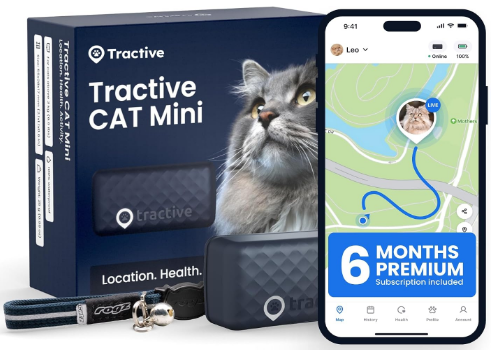
The linked Tractive CAT Mini bundle is the strongest option here for locating a cat beyond the property line. It uses GPS for positioning and cellular service to send data to the app. In LIVE mode, the listing advertises updates every two to three seconds under suitable conditions.
Tractive lists the CAT Mini tracker at approximately 25 grams and about 42 grams with the included safety-release collar. It is intended for cats above approximately 6.6 pounds. The company advertises up to five days of battery with Power Saving Zones and closer to two days without them.[11]
The app can alert you when the tracked location crosses a Virtual Fence. This is software, not containment, and alerts may be delayed by GPS acquisition, cellular transmission, battery state, buildings, or terrain.
Best for: Owners who want the most actionable location data in this comparison and live where Tractive cellular coverage is reliable.
Why it may be worth buying:
- LIVE tracking, location history, and escape-zone alerts can guide a physical search.
- The linked bundle currently advertises six free months of service, which may lower the initial cost.
Consider before ordering:
- Every Tractive tracker requires an active subscription. Confirm how the promotional period is redeemed, the renewal price, cancellation terms, and availability in your region.
- Check your cat’s weight and tolerance for the complete collar-and-tracker setup, not only the tracker’s weight.
- “Unlimited range” means it is not limited to Bluetooth distance; cellular service, battery power, and usable GPS conditions are still required. The linked CAT Mini is not the newer CAT 6 Mini model.
- The safety-release collar may detach if snagged—which can protect the cat but leave the tracker behind.
2. Best Lower-Cost Backup for iPhone Households: Apple AirTag (2nd Generation)
Apple introduced the second-generation AirTag in January 2026 as an item tracker for belongings—not a pet GPS device.[9] Nearby Apple devices can detect its Bluetooth signal and relay an approximate location through the Find My network. When a compatible iPhone is near the tag, Precision Finding can provide distance and direction guidance.
The new model offers longer Precision Finding range, upgraded Bluetooth, and a louder speaker.[9] Those improvements do not create cellular GPS: there is no independent mobile-data connection or guaranteed stream of location updates.
Best for: Owners already in the Apple ecosystem who want a compact, battery-efficient backup in a neighborhood with frequent Apple-device traffic.
Why it may be worth buying:
- No Tractive-style monthly cellular subscription and a replaceable battery.
- Precision Finding can be helpful during the final nearby search when the phone and tag are within supported range.
Consider before ordering:
- The location can be approximate or stale because updates depend on nearby Find My devices and the environment.
- Precision Finding is a nearby recovery feature, not neighborhood-wide live GPS.[10]
- Low-traffic areas may produce fewer updates than a dense neighborhood.
- The AirTag’s speaker sits close to the cat when collar-mounted. Use sound thoughtfully and observe the cat’s response.
- An AirTag is most useful as an additional recovery clue, not a replacement for a microchip, visible ID, physical prevention, or a systematic search.

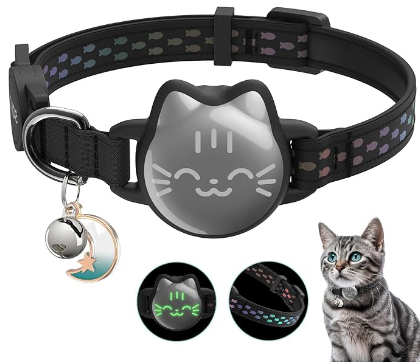
3. Best Companion Accessory: Breakaway AirTag Cat Collar
A purpose-built collar can reduce dangling compared with a key-ring attachment. The linked listing describes a reflective breakaway cat collar compatible with first- and second-generation AirTag models, with a holder that keeps the tag close to the collar.
The collar is not a tracker by itself. Its usefulness depends on correct sizing, holder security, AirTag coverage, and the cat’s comfort.
Best for: Cats who already tolerate a safety collar and whose owners want a streamlined AirTag holder.
Why it may be worth buying: Reflective material may improve visibility in direct light, while the integrated holder can reduce swinging and contact with bowls.
Consider before ordering:
- Verify the size range, buckle, holder closure, and current seller; marketplace variants can change.
- Follow fitting instructions and inspect it daily at first. It should not rub, press the tag against the throat, or leave a hazardous gap.
- Confirm that the AirTag cannot pop out during ordinary activity.
- A breakaway buckle is designed to release when loaded, so the collar and AirTag may be lost during an escape. That is a safety tradeoff, not a product defect.
- Do not substitute a non-breakaway fashion collar solely to keep the tracker attached. Discuss unusual collar needs with your veterinarian.
4. Best for a Secure Catio Connection: SureFlap Microchip Cat Flap
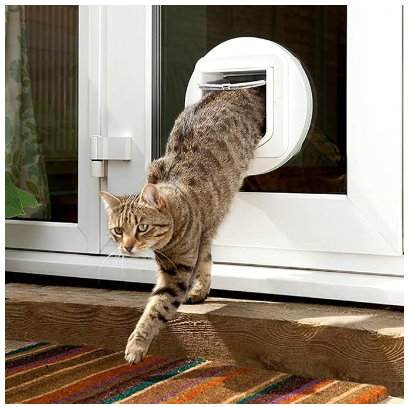
The SureFlap Microchip Cat Flap reads a compatible implanted microchip—or compatible collar tag—to unlock for a registered animal entering the home. It helps prevent unregistered animals from coming inside.[12]
For a door dasher, its best application is a controlled connection between the home and a fully enclosed catio or screened patio—not unrestricted neighborhood access.
The linked model advertises a flap opening of about 4 3/4 inches high by 5 5/8 inches wide. Measure your cat and review installation guidance before modifying a door, wall, or panel.
Best for: Households connecting an interior room to a secure, fully enclosed outdoor space while excluding unregistered animals from entering.
Why it may be worth buying: It can recognize a compatible existing microchip without an electronic collar, and selective entry can reduce intruder-cat access.
Consider before ordering:
- The standard model provides selective entry. Any animal can normally exit; it does not identify which individual cat has permission to leave. A manual in-only or locked setting applies to the flap as a whole.[12]
- It must not open into an unsecured yard if the goal is to keep an indoor cat safely contained.
- No flap can guarantee that another animal will never tailgate or exploit an installation gap.
- Confirm microchip compatibility, cat size, batteries, adapters, and installation needs.
- Test recognition and all lock modes before giving the cat access to the enclosure.
If Your Indoor Cat Gets Out: An Immediate Recovery Plan
Frantic chasing can push a frightened cat farther away. Move deliberately.
1. Secure the scene
Close gates, stop doorway traffic, and secure other pets. If safe, monitor a familiar route back inside; do not leave an exterior door unattended.
2. Search the home and immediate property again
Before assuming the cat crossed the neighborhood, recheck closets, furniture, utility spaces, and garages. Outside, inspect decks, porches, vehicles, shrubs, sheds, and neighboring enclosed spaces.
Indoor-only cats commonly hide close to the escape point and may remain silent even when they hear their owner. Humane World for Animals advises focusing carefully on the immediate area and asking neighbors to inspect enclosed spaces rather than only calling from the street.[8]
3. Search quietly at low-activity times
After dark, use a flashlight to look for eye reflection and pause to listen. Speak calmly and crouch rather than approaching head-on. If you see the cat, avoid lunging; create a path to safety and use the recall cue.
4. Use tracker data intelligently
If a Tractive location updates, look at the time stamp, accuracy information, battery, and movement pattern before traveling to the point. A signal can reflect delay or location uncertainty. If an AirTag reports a location, remember that it shows where the tag was detected—not proof that the cat is still there or still wearing the collar.
5. Activate identification networks
Report the cat missing to the microchip registry and confirm your contact details. Contact shelters, animal control, veterinary clinics, rescue groups, and building management. Visit shelters in person when possible.
Create a clear flyer with a recent photo, distinctive markings, location and date last seen, contact details, and instructions not to chase a fearful cat. Share it with immediate neighbors and relevant local groups. Be cautious of anyone demanding payment, codes, or sensitive information before providing verifiable evidence that they found the cat.
6. Escalate with qualified local help
A motion camera may reveal where the cat returns. A humane trap can help in some cases, but seek local professional guidance for placement and monitoring. Never leave a trap unchecked for long periods.
What Not to Do With a Door-Dashing Cat
Do not punish, spray, or frighten the cat at the entrance
Yelling, spray bottles, shock devices, and painful or startling mats may suppress behavior in the moment, but they do not teach the cat what to do instead. They can also associate the doorway, visitors, or you with fear and increase avoidance or frantic movement.[4]
Do not chase for entertainment
If rushing the door reliably starts an exciting game, the behavior can strengthen. Block access calmly, minimize drama, and reward the station behavior instead.
Do not rely on an electronic boundary alert
A Virtual Fence notification is not containment. By the time an alert arrives, the cat has already crossed the boundary. Physical management must come first.
Do not assume the tracker will stay attached
Inspect the collar and tracker holder routinely. A safety collar can release, a holder can fail, and a battery can expire. The microchip remains the most durable identification layer because it is implanted and does not depend on a collar.
Do not use unrestricted outdoor access to stop the behavior
Allowing unsupervised roaming can expose a cat to vehicles, fights, toxins, parasites, infectious disease, entrapment, theft, and wildlife conflict.[6] If you want to expand your cat’s world, choose a secure catio or carefully introduced harness walks.
When to Call Your Veterinarian or a Behavior Professional
Arrange a veterinary assessment when door dashing begins suddenly, becomes frantic, or appears alongside:
- Weight loss or a major appetite change.
- Increased thirst or urination.
- Persistent yowling, restlessness, or nighttime disorientation.
- Limping, sensitivity to touch, hiding, or reduced grooming.
- Urine marking or litter-box changes.
- Aggression toward people or other animals.
- Signs of heat or intense roaming behavior in an intact cat.
Take notes or video from a safe distance and record the time, trigger, body language, and duration. That information can help your veterinarian distinguish a medical concern from a learned or environmental pattern.
After medical causes are addressed, a qualified feline behavior professional can design a plan for complex fear, inter-cat conflict, redirected aggression, or persistent escape behavior. Avoid anyone who recommends dominance, flooding, or punishment. A good plan should be gradual, measurable, and based on reinforcement and environmental change.
Frequently Asked Questions
1. Does trying to escape mean my indoor cat is unhappy?
Not necessarily. An open door offers powerful sights, scents, sounds, and movement even for a content cat. Improve any weak areas in enrichment while treating the doorway as a separate safety problem.
2. Why has my cat suddenly started running out the door?
Look for a new outdoor cat, prey activity, a prior successful escape, household disruption, sexual maturity, or illness. Sudden behavior with physical changes warrants a veterinary examination.
3. How do I train my cat not to run out the front door?
Teach the cat to go to a mat or elevated station several feet from the entrance, reward remaining there, add a release cue, and introduce door movements in very small steps behind a physical barrier. Practice briefly and consistently. Training supports an airlock or secondary door; it should not replace one.
4. Will a spray bottle, alarm, or deterrent mat stop door dashing?
It may interrupt the cat temporarily, but it can add fear and does not teach a safe alternative. Use barriers, control the trigger, and reward stationing or recall instead. Avoid shock, pain, and intense startle devices.
5. Is a GPS tracker the best way to keep my cat safe?
It is one useful recovery layer, not the best prevention layer. A tracker cannot stop an escape or protect the cat from immediate outdoor hazards. Physical containment, a registered microchip, visible ID when appropriate, and a practiced recovery plan come first.
6. Does the Tractive GPS Cat Tracker work without a subscription?
No. Tractive states that all of its trackers require an active subscription for cellular data and app services.[11] The linked listing currently advertises a six-month promotional period, but confirm redemption, renewal price, region, and cancellation terms before buying.
7. Is an Apple AirTag a GPS tracker?
No. AirTag has no GPS or cellular data connection. Nearby Apple devices can relay its Bluetooth signal to Find My, while Precision Finding works when a compatible iPhone is within supported range.[9][10]
8. Is the second-generation AirTag good for a cat?
It can be a useful supplemental clue in an Apple-device-dense area, especially because the 2026 model improves nearby finding range. Apple markets AirTag for belongings, not pets, and its location may be delayed or absent. It should not replace a microchip, physical barriers, or a true GPS tracker when active location updates are the priority.
9. Should a cat tracker be attached to a breakaway collar?
A feline safety or breakaway collar is generally intended to reduce entanglement risk, but it can release and separate the tracker from the cat. Use a lightweight, properly fitted setup suitable for your cat, inspect the neck and holder regularly, and ask your veterinarian about individual concerns.
10. Can the SureFlap Microchip Cat Flap keep my cat indoors?
The linked standard model selectively unlocks for registered animals entering the home. It does not individually control which cat may exit; in normal operation, any animal can leave, although manual lock modes can restrict the whole flap.[12] Use it to connect to a fully enclosed catio—not an open yard—when containment is the goal.
11. Will a catio or harness walk stop door dashing?
Controlled outdoor access can meet some sensory and exploration needs, but it may not erase a learned doorway habit. Continue using an airlock and station training. Inspect catios for gaps and introduce a well-fitted harness gradually indoors before any outdoor session.
12. What should I do first if my indoor cat escapes?
Secure other exits and pets, then search the home, immediate property, and neighboring enclosed spaces carefully and quietly. Do not assume the cat traveled far or will respond when called. Check tracker data, notify the microchip registry and local shelters, and ask neighbors to inspect garages, sheds, porches, and decks.[7][8]
Final Thoughts
A door-dashing cat is not rejecting your home. They are responding to novelty, instinct, learning, or—in some cases—stress or a physical change. Begin with a closed secondary barrier and a household door routine. Add station training, enrichment, a registered microchip, and current identification. Then give technology a defined job: Tractive for active recovery data, AirTag as a network-dependent backup, or SureFlap to connect the home with a secure catio.
No device can guarantee prevention or recovery. A layered system can nevertheless make the doorway safer, give your cat better choices, and help you respond with a plan instead of panic.
Read more:
Your Indoor Cat Has Separation Anxiety?
Why Does My Cat Follow Me Everywhere?
Best GPS Trackers for Cats in 2026: 4 Top Picks
Apple AirTag for Cats Review: Is It a Good Cat Tracker?
Tractive GPS Cat Tracker Review: Is It the Best for Cats?
Sources and References
- Feline Veterinary Medical Association. Environmental Needs Guidelines. 2026.
- Feline Veterinary Medical Association. 2025 Indoor Cats Position Statement. 2025.
- Cat Friendly Homes, Feline Veterinary Medical Association. Cat Training Techniques for Caregivers. Accessed August 25, 2026.
- Feline Veterinary Medical Association. Training Techniques for Addressing Undesirable Behaviors. Accessed August 25, 2026.
- VCA Animal Hospitals. Recommendations for New Kitten Owners. Accessed August 25, 2026.
- ASPCA. General Cat Care. Accessed August 25, 2026.
- American Animal Hospital Association. How to Update Microchip Details: The First Step in Lost Pet Prevention. 2025.
- Humane World for Animals. How to Find a Lost Cat. Accessed August 25, 2026.
- Apple. Apple Introduces New AirTag With Expanded Range and Improved Findability. January 26, 2026.
- Apple Support. Find Your Lost Items With AirTag and Find My. Accessed August 25, 2026.
- Tractive. GPS Tracker for Cats: Product Details and CAT Mini Comparison and Tracker Subscription and Compatibility Guide. Accessed August 25, 2026.
- Sure Petcare. SureFlap Microchip Cat Flap. Accessed August 25, 2026.