Why Does My Cat Follow Me Everywhere? 7 Surprising Reasons (2026)
By Demosthenes Staudinger | Last updated August 24, 2026
Affiliate disclosure: This article contains affiliate links. As an Amazon Associate I earn from qualifying purchases. If you buy through one of these links, we may earn a commission at no additional cost to you. This does not affect our editorial recommendations.
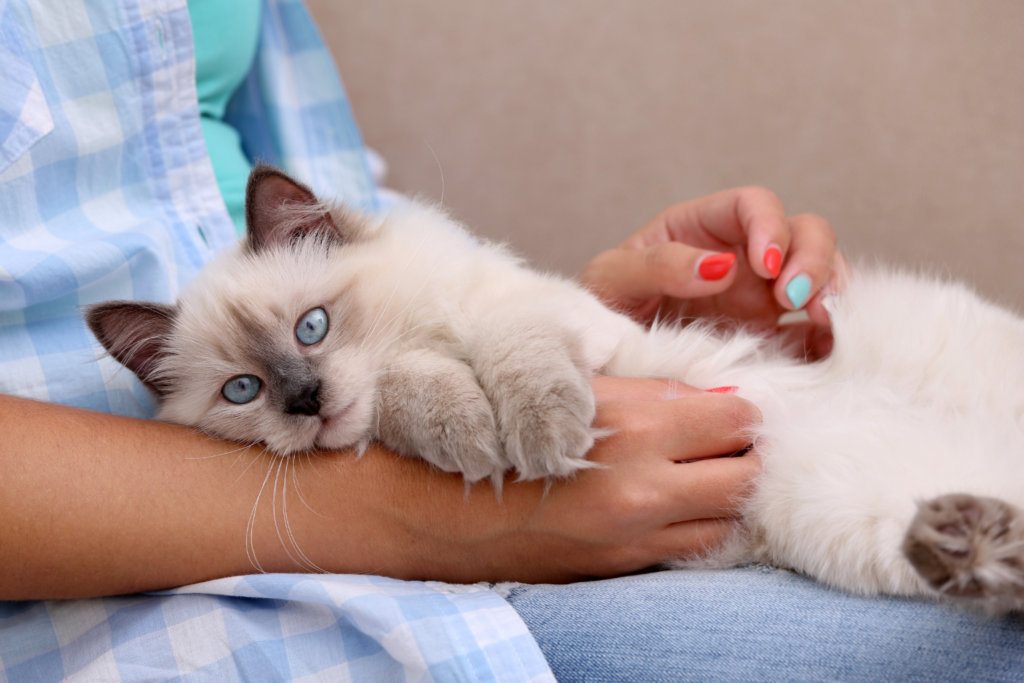
You walk into the kitchen, and your cat appears. You move to your home office, and a few seconds later, the same small shadow settles beside your chair. Even the bathroom door becomes a matter of urgent feline interest.
So, why does my cat follow me everywhere? In most cases, the answer is reassuring: your cat may enjoy your company, monitor changes in their territory, anticipate a familiar reward, or simply follow a routine that has worked before. Cats are not universally aloof. Research shows that they can form distinct attachment relationships with human caregivers, and many use a familiar person as a source of security in an unfamiliar situation.[1]
Following is not a diagnosis, however. The behavior does not automatically mean that your cat is bored, anxious, hungry, dominant, or unusually dependent. Its meaning changes with context. A relaxed cat who trails you with an upright tail and then naps nearby is communicating something very different from a senior cat who suddenly becomes restless, vocal, disoriented, and unable to settle.
The useful question is not only why is my cat following me? but also what happens before, during, and after it? This guide explains seven likely reasons, separates ordinary companionship from potential concern, and matches four enrichment products to specific indoor needs.
No product in this article treats anxiety, pain, cognitive decline, or any other medical condition. Enrichment can support a healthy routine, but a sudden or substantial behavior change deserves veterinary attention.
How we researched this guide: We reviewed peer-reviewed research on cat–human attachment and separation-related behavior; current guidance from the Feline Veterinary Medical Association (FelineVMA), the American Animal Hospital Association (AAHA), and Cornell University College of Veterinary Medicine; and current specifications published by the featured product manufacturers. Product availability, prices, colors, and Amazon sellers can change, so confirm the live listing before purchasing.
Quick Verdict
Editorial verdict: A cat who follows you from room to room is usually expressing normal social interest, learned expectation, curiosity, or a preference for predictable company. Following alone is not evidence of a behavioral disorder.
Best response: Observe body language and patterns first. Then provide predictable social time, short interactive play sessions, elevated resting places, scratching options, and opportunities to forage or watch the environment.
Skip shopping and contact your veterinarian if: The behavior is new or intense and appears with appetite or weight changes, increased thirst, litter-box changes, pain signs, weakness, nighttime vocalization, confusion, breathing difficulty, or inability to urinate.
| What you notice | Most likely possibilities | Helpful first step | When to escalate |
|---|---|---|---|
| Relaxed following, upright tail, slow blinks, resting nearby | Affection, social preference, routine | Offer calm attention and let your cat choose proximity | Usually not concerning by itself |
| Following mainly near the kitchen or at set times | Learned food association, hunger, schedule | Review portions and feeding routine; reward calm waiting | Call the vet for increased hunger with weight loss or thirst |
| Vocalizing, pawing, then leading you toward a toy or resource | Request for play, attention, food, water, or litter care | Check the resource and provide a brief appropriate response | Investigate repeated distress or unmet needs |
| Shadowing combined with destructive behavior or restless attention-seeking | Possible under-stimulation, stress, or learned reinforcement | Add structured play and independent enrichment | Seek professional help if the pattern persists or worsens |
| Sudden clinginess in a senior cat | Pain, sensory change, endocrine disease, cognitive change, or insecurity | Record the change and arrange a veterinary examination | Prompt assessment is appropriate |
Is It Normal for a Cat to Follow You Everywhere?
Yes—frequent following can be completely normal. Cats vary widely in sociability, and the same cat may want more or less contact depending on age, time of day, recent changes, temperature, household activity, and individual temperament.
Attachment research is useful here, but it should not be overinterpreted. In a controlled “secure base” test, researchers found evidence that cats can show secure and insecure attachment patterns toward caregivers.[1] That result challenges the old idea that cats are emotionally indifferent to people. It does not mean that every cat who follows closely has an insecure attachment, nor can an owner diagnose attachment style by watching ordinary household behavior.
The FelineVMA’s current indoor-cat framework emphasizes five broad needs: a safe place; multiple, separated resources; opportunities for play and predatory behavior; positive, consistent, predictable human interaction; and an environment that respects feline sensory needs.[2] Following may simply be one way your cat participates in that predictable social relationship.
What matters most is the complete pattern. Consider:
- Did your cat always behave this way, or did it begin suddenly?
- Is the following limited to predictable situations, such as mealtimes?
- Does your cat look loose and comfortable or tense and unable to settle?
- Can your cat rest, eat, play, and explore independently?
- Are appetite, thirst, weight, mobility, grooming, sleep, and litter-box habits unchanged?
If the answers point to a stable, relaxed pattern, you probably have a socially interested cat—not a problem to solve.
1. Your Cat Enjoys Your Company and Feels Secure With You
The simplest explanation is often the right one: your cat follows you because being near you is rewarding.
Cats can form meaningful bonds with caregivers, and familiar people may provide comfort and predictability.[1] Your scent, voice, movement, and daily rituals are part of the cat’s known social environment. A cat may therefore relocate when you relocate, then settle a few feet away without demanding anything else.
Look for relaxed social signals:
- A tail held upright, sometimes with a softly curved tip
- Slow blinking
- Cheek or body rubbing
- Purring in an otherwise relaxed context
- Kneading, resting, grooming, or sleeping nearby
- Approaching and leaving freely rather than appearing unable to disengage
This kind of following does not need to be discouraged. Let the cat control the distance. Offer a gentle greeting, a slow blink, or a brief petting session if your cat solicits touch. Avoid grabbing or holding a cat who merely chose to be in the same room; social proximity is not always an invitation to be handled.
One important nuance: purring is not an infallible sign of happiness, and proximity is not proof that all is well. Body language must be read as a whole. If your cat appears hunched, tense, unusually quiet, restless, or reluctant to move, investigate further.
2. Your Movements Are the Most Interesting Part of the Territory
Cats continually gather information about their environment. Opening a closet, carrying a package, moving a chair, or entering a room creates new sounds, scents, access points, and possibilities. Following allows your cat to inspect what changed.
This is especially obvious when the cat arrives as soon as you open a cabinet they rarely see, change the bedding, unpack groceries, or clean a room. You are not only a companion; you are also the household’s most active environmental event.
In one experiment, cats appeared surprised when their owner’s voice seemed to move unexpectedly between two locations, consistent with tracking the owner’s position.[4] That does not prove why an individual cat follows, but it shows that familiar people are part of the cat’s spatial awareness.
Curiosity-driven following is usually brief and purposeful. The cat investigates, sniffs, watches, and then moves on. You can accommodate it safely by allowing supervised exploration while keeping cleaning chemicals, appliances, hot surfaces, cords, small objects, and unsafe rooms out of reach.
The bathroom is a classic example. It contains running water, unusual acoustics, closed doors, cool surfaces, moving towels, and a captive human. Your cat’s attendance may be less mysterious than it appears.
3. Your Cat Has Learned That Following You Produces Food
Cats are excellent students of consequence. If walking behind you leads to breakfast, treats, a topped-up bowl, or even conversation in the kitchen, the behavior is likely to be repeated. AAHA behavior guidance summarizes the principle clearly: rewarded behaviors tend to increase in frequency.[5]
That reward does not need to be deliberate. Imagine that your cat follows you at 5:30 a.m. and meows. You feed them to restore peace. From the cat’s perspective, following plus vocalizing successfully started breakfast. If you occasionally respond and occasionally resist, the unpredictable payoff may make persistence even stronger.
Food-motivated following is usually tied to location, time, sounds, or preparatory actions. It may intensify when you approach the pantry, handle a can opener, finish a work call, or begin your own dinner.
To make the routine calmer:
- Measure the cat’s complete daily ration rather than adding untracked extras.
- Feed on a predictable schedule that fits your veterinarian’s nutritional guidance.
- Reward a calm alternative behavior, such as waiting on a mat or perch.
- Use part of the measured ration in a food puzzle instead of adding extra treats.
- Avoid feeding immediately after escalating meows, ankle-grabbing, or counter-jumping when it is safe to wait for a moment of calm.
Do not assume that every hungry-seeming cat is merely manipulative. Increased appetite accompanied by weight loss, increased thirst or urination, vomiting, diarrhea, hyperactivity, or a poor coat can occur with conditions such as hyperthyroidism, particularly in middle-aged and older cats.[7] That combination needs veterinary evaluation, not a larger bowl.
4. Your Cat Is Asking for Social Interaction
Following can be a practical request. Your cat may want a play session, access to a favorite room, fresh water, a clean litter box, grooming help, or simply a few minutes of attention.
The clue is what happens next. Does the cat look back and lead you somewhere? Sit beside an empty water dish? Paw at a wand-toy drawer? Stand near the litter box? Jump onto a grooming station? Cats often communicate by combining proximity, gaze, movement, and vocalization.
Before calling the behavior “clinginess,” check that food, water, clean litter boxes, preferred rooms, comfortable temperatures, and play opportunities are available—and that another pet is not guarding the route to them.
Positive, predictable human–cat interaction is one of the FelineVMA’s core environmental pillars.[2] That does not require constant entertainment. Two or three short, focused play or social sessions can be more satisfying than hours of distracted contact.
When you cannot engage, avoid punishment. A calm cue followed by a reinforced alternative—such as going to a nearby bed, perch, or puzzle—teaches your cat what to do. Yelling, spraying water, or frightening the cat can create fear and damage the relationship.[5]
5. Your Indoor Cat May Need More Stimulation
Sometimes you truly are the most interesting option available. An indoor cat with few climbing, scratching, hunting, foraging, hiding, and observation opportunities may follow household members because movement predicts activity.
But following alone is not enough to diagnose boredom. Look for a cluster of signs, such as:
- Repeatedly initiating play but receiving little response
- Short, restless cycles of pacing and vocalizing
- Ambushing feet or ankles during predictable high-energy periods
- Scratching inappropriate surfaces despite having no suitable alternative
- Rapidly losing interest in an unchanging toy collection
- Excessive food-seeking or disruptive nighttime activity despite appropriate care
Indoor welfare requires more than filling the floor with toys. The FelineVMA recommends access to safe resting places, separated key resources, vertical space, and opportunities for play, hunting, and foraging.[2][3] Quality and placement matter. A window perch beside an active outdoor view may provide more value than ten ignored toys in a basket.
Build enrichment gradually. Rotate a small set of toys, schedule short wand sessions, hide portions of dry food, add cardboard boxes or paper packing material without tape or staples, and create multiple elevated destinations. Finish interactive play with an attainable “capture,” followed when appropriate by a small portion of the daily ration. Cats need opportunities to complete at least part of the predatory sequence rather than endlessly chase something they can never catch.[3]
Read more: Best Interactive Cat Toys to Keep Your Cat Happy and Active
6. You Are a Familiar Anchor During Stress or Change
A new home, unfamiliar visitors, construction noise, a changed work schedule, another pet, the loss of a companion, or rearranged furniture can make a cat seek more proximity to a trusted person. Rescue cats and recently adopted cats may also follow while learning where resources are and which routines are safe.
The appropriate response is reassurance through predictability—not forced independence. Preserve meal and play schedules, keep familiar bedding available, provide quiet hiding places, and allow the cat to choose contact. Make sure important resources are not concentrated in one area where another pet can block access.
Following can coexist with stress without being a formal separation-related disorder. A questionnaire study of 223 cats identified possible separation-related problems in a minority of the sample, but the authors emphasized that feline separation problems remain difficult to identify and insufficiently studied.[6] Reported behaviors included destructive behavior, excessive vocalization, inappropriate elimination, agitation, and apathy during the caregiver’s absence—not simply walking behind someone while that person is home.
If your cat panics when you prepare to leave, vocalizes persistently when alone, eliminates outside the litter box only during absences, damages exit areas, overgrooms, stops eating, or cannot settle, record video if it can be done safely and discuss the pattern with your veterinarian. Medical causes should be excluded before a behavior plan is designed.
7. Following Has Become Part of the Daily Routine
Cats notice sequences. The alarm precedes breakfast. Closing a laptop precedes play. Walking toward the sofa predicts evening contact. Entering the bathroom may precede fresh water from a faucet or an uninterrupted audience.
Once embedded in a reliable chain, following may continue even when the original reward is absent. That is ordinary learning, not scheming; the journey itself can offer novelty, warmth, access, or social contact.
If the routine works for both of you, there is no need to change it. If it creates unsafe underfoot behavior or constant interruptions, reinforce a nearby alternative:
- Choose a stable bed, mat, shelf, or cat tree within view.
- Lure or target your cat to that location before the usual following begins.
- Reward the cat there with a tiny food portion, play, praise, or petting—whichever they value.
- Repeat during easy, low-distraction moments.
- Gradually extend the time between rewards while keeping the experience positive.
Do not abruptly withdraw all social contact. The goal is to expand your cat’s options, not make proximity feel unsafe.
What Your Cat’s Body Language Adds to the Story
The same act—walking behind you—can reflect different emotional states. Read the entire cat rather than one signal in isolation.
| Body-language pattern | What it may suggest | Sensible response |
| Upright tail, neutral ears, soft eyes, relaxed gait | Friendly greeting or social interest | Acknowledge the cat and allow voluntary contact |
| Looking back, walking a few steps, repeating | Attempt to lead you toward something | Follow once and inspect food, water, litter, doors, or a toy |
| Crouched posture, wide pupils, ears rotated outward, scanning | Fear, uncertainty, or high arousal | Reduce noise and pressure; provide an accessible retreat |
| Tail lashing, skin twitching, ears back, abrupt biting | Overstimulation, frustration, fear, or pain | Stop contact; give space; investigate recurrence |
| Restless following with repeated vocalization | A need, learned requesting, stress, pain, or medical change | Check context and associated symptoms rather than guessing |
| Increased proximity plus reluctance to jump or move | Possible pain or mobility difficulty | Arrange a veterinary assessment and improve access meanwhile |
| Nighttime following, confusion, staring, altered sleep in a senior | Sensory, medical, or cognitive change | Schedule a veterinary examination promptly |
Record short videos and keep a simple log of time, trigger, duration, body language, and what happened afterward. Patterns are more useful to a veterinarian or veterinary behaviorist than a label such as “needy.”
Affection, Boredom, or Anxiety? A Practical Comparison
| Pattern | Affection or social preference | Under-stimulation | Anxiety or distress |
| Ability to settle | Usually settles near you or elsewhere | May repeatedly seek activity | May struggle to settle even with proximity |
| Body language | Loose, soft, voluntary | Alert, restless, play-seeking | Tense, vigilant, avoidant, or excessively proximity-seeking |
| Response to enrichment | Enjoys it but may still prefer you | Often engages when the activity suits the cat | May be too distressed to engage |
| Behavior during absence | Usually rests or follows another routine | May seek other stimulation | May vocalize, eliminate, destroy, overgroom, or show marked agitation |
| Onset | Often longstanding | May follow reduced play or environmental change | May be sudden or linked to a stressful event |
| Best next step | Enjoy the bond and respect choice | Improve the daily enrichment plan | Veterinary assessment; behavior referral when indicated |
These categories can overlap. A bonded cat can also be bored, and an anxious cat can also enjoy affection. When signs are intense, new, or impairing daily life, professional assessment is more reliable than an online checklist.
Four Amazon Products That Support Independent Enrichment
Products work best when they solve a defined problem: missing vertical territory, observation, foraging, or motion between human-led play sessions. None is a cure for following.
| Product | Best for | What to verify before buying | Main limitation |
| Globlazer F70 Pro Cat Tree | Climbing, scratching, elevated rest | Floor space, assembled height, stability, access for your cat | Large item; particleboard and plush, not solid wood |
| Zakkart Window-Sill Perch with Bolster | Birdwatching, resting, passive visual enrichment | Exact window slot, sill, wall-gap, and cat-size requirements | Fits only compatible window architecture |
| KADTC Large Cat Puzzle Toy | Food-motivated cats and beginner foraging | Kibble size, difficulty setting, cleanability, calorie allocation | Some cats need gradual teaching |
| ORSDA 2-in-1 Interactive Cat Toy | Short independent chase-and-pounce sessions | Safe placement, detachable parts, charging, supervision | Does not replace interactive wand play |
1. Globlazer F70 Pro Cat Tree: Best for Vertical Territory
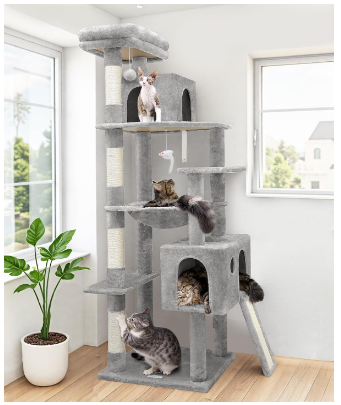
The Globlazer F70 Pro is the strongest match for a cat who follows because every desirable resting point is tied to the caregiver’s location. Place a stable tower near the room where you spend the most time and the cat can remain socially connected from their own elevated station.
According to Globlazer, the light-gray F70 Pro is approximately 70 inches tall (55 × 45 × 178 cm), weighs 16.5 kg, and combines particleboard, plush, and sisal. It includes a condo, hammock, scratching surfaces, multiple climbing routes, and a removable top perch.[9] This corrects an important error in the original draft: it should not be described as a solid-wood architectural tower.
Best for: Healthy adult cats who enjoy climbing, scratching, hiding, and observing from height.
Check first: Measure the full assembled footprint and height, inspect the current listing, assemble every fastener correctly, and use any supplied anti-tip hardware. Put the tower where a fall would not reach a sharp edge or unstable object. Cats with arthritis, weakness, poor vision, or limited jumping ability may need lower steps or a different configuration.
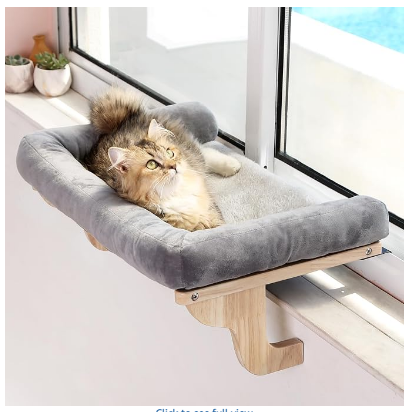
2. Zakkart Window-Sill Perch with Bolster: Best for Observation
A window perch can turn an otherwise unused view into a predictable place to watch birds, people, leaves, and changing light. It is a particularly elegant choice for cats who want to remain in the same room without being directly underfoot.
The manufacturer lists a 24.8 × 15.4-inch bed and a stated capacity of up to 40 pounds for this Zakkart model. It uses hardwood with a metal support frame and a three-sided bolstered bed.[10] The critical issue is compatibility: Zakkart specifies a window slot at least 0.5 inch deep, a sill no deeper than 6 inches, and a wall gap no greater than 3 inches for the model reviewed here.[10]
Best for: Cats who enjoy visual monitoring, sunlight, and elevated rest but do not need a full tower.
Check first: Measure the exact window—not a similar one—before ordering. Confirm that the frame sits securely, inspect it regularly, and keep the window screen and opening cat-safe. A manufacturer-listed load limit is not a substitute for correct installation.
3. KADTC Large Cat Puzzle Toy: Best for Food-Motivated Followers
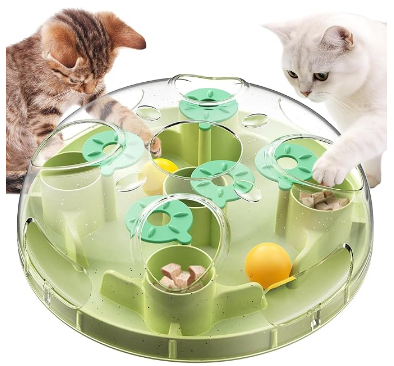
For a cat who follows primarily around meals, a food puzzle can move part of the reward away from the person and into a species-appropriate foraging task. The FelineVMA specifically identifies food puzzles and food balls as ways to mimic hunting and support more natural food-acquisition behavior.[3]
The featured KADTC design combines a treat or kibble puzzle with rolling foraging balls. The manufacturer describes adjustable food release and a weighted, non-slip base for the “Trove” version.[12] Because Amazon listings can change or group variants, confirm that the live page shows the same model and features before purchasing.
Best for: Healthy, food-motivated cats who eat compatible dry food or small dry treats and are new to puzzle feeding.
Check first: Use food from the measured daily ration, not unlimited bonus calories. Begin at the easiest setting with some food clearly visible. Demonstrate one or two successful movements, then allow the cat to solve it. Wash food-contact surfaces according to the current instructions and stop using any cracked or damaged component.
4. ORSDA 2-in-1 Interactive Cat Toy: Best for Short Independent Play
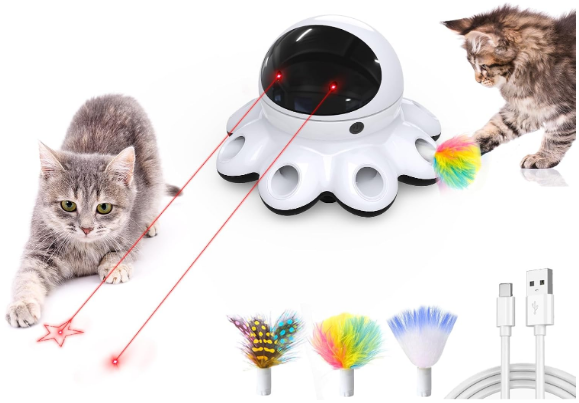
The ORSDA unit combines randomly moving laser patterns with feathers that appear through eight openings. The manufacturer describes voice and touch activation, timed sessions, USB-C charging, and an automatic night mode.[11] Those features may provide short bursts of activity when you are occupied, especially for cats attracted to motion.
This should supplement—not replace—human-led play. Laser chasing does not provide a physical object to catch, so follow a laser session with a tangible toy or a small food reward when appropriate. Never direct a laser toward eyes, reflective surfaces, stairs, breakable objects, or unsafe jumping areas. Inspect feathers and openings frequently, and supervise until you understand how your cat interacts with the device.
Best for: Active cats who enjoy chase-and-pounce games and can use the toy safely in a clear area.
Skip it if: Your cat becomes frustrated by light-based play, chews or swallows feathers, has mobility limitations, or reacts fearfully to automatic movement or sound.
How to Choose the Right Upgrade for Your Cat
Start with the missing need, not the most impressive product.
- Choose the cat tree if your cat wants to be near you but lacks a stable, elevated destination or appropriate scratching surface.
- Choose the window perch if your cat already climbs comfortably and has a compatible window with an interesting, safe view.
- Choose the puzzle feeder if following is concentrated around meals and your cat is motivated by dry food or treats.
- Choose the electronic toy if your cat enjoys moving prey-like stimuli and needs occasional short activity between interactive sessions.
The puzzle feeder is a compact starting point for many households, but a tower or perch may matter more when vertical territory is the missing resource.
Do not buy all four at once and place them in a single “cat corner.” New objects can be ignored or even feel disruptive. Introduce one item, pair it with positive experiences, and position it where the cat already chooses to spend time. Separate resting, feeding, scratching, water, and toileting resources rather than clustering everything together.[2][3]
A Seven-Day Plan for a Cat Who Follows Constantly
Use this only for a healthy cat with longstanding, relaxed following. Start with your veterinarian if the behavior is new or concerning.
| Day | Action |
| 1 | Log the time, trigger, body language, duration, and apparent reward for each episode. |
| 2 | Schedule two short, focused sessions of play, grooming, training, or quiet contact. |
| 3 | Add one safe station—a box, bed, shelf, tree, or compatible perch—in a room you use often. Reward voluntary use. |
| 4 | Put a small part of the measured daily ration in an easy puzzle or safe scatter-feeding activity. |
| 5 | Before cooking or carrying items, cue the cat to the station and reward there. Never use it as isolation. |
| 6 | Rotate one familiar toy or box into a new safe location instead of accumulating more objects. |
| 7 | Review whether the cat has more choice and settles more easily. Continued relaxed following can still be normal. |
Pros and Cons of Living With a “Velcro Cat”
| Potential benefits | Potential challenges |
| Frequent opportunities to notice subtle health or behavior changes | Underfoot movement can create fall or kitchen hazards |
| Strong, enjoyable social routine | Food- or attention-seeking may be accidentally reinforced |
| Easier to involve the cat in training and enrichment | Constant requests can interrupt sleep or work |
| Proximity may help a new cat feel secure | Sudden clinginess can be mistaken for affection when it signals illness |
The relationship is not improved by trying to make a social cat aloof. Manage safety and teach alternatives while preserving the voluntary bond.
When Should You Be Concerned?
Contact your veterinarian when following is a new change, particularly in a senior cat. AAHA’s feline life-stage guidance advises evaluating new or unusual behavior in senior cats for medical conditions. Altered interaction can occur alongside pain, sensory changes, hyperthyroidism, hypertension, or cognitive dysfunction.[8]
Watch for:
- Weight loss, increased appetite, increased thirst, or increased urination
- Reduced appetite, vomiting, diarrhea, or lethargy
- Difficulty jumping, stiffness, hiding, irritability, or sensitivity to touch
- Nighttime yowling, disorientation, staring, getting stuck, or changed sleep
- House soiling or a sudden litter-box change
- Overgrooming, hair loss, or skin injury
- Persistent agitation when you leave or inability to settle when you return
- Rapid, labored, or open-mouth breathing
- Repeated litter-box trips with little or no urine, straining, or crying
Cats often conceal pain, so behavior or activity changes may be more visible than limping or crying.[8] Breathing difficulty and suspected urinary obstruction are emergencies; seek immediate care rather than waiting for a routine appointment.
If medical causes are excluded and distress continues, ask your veterinarian about referral to a board-certified veterinary behaviorist or another appropriately qualified feline behavior professional. Do not use human anti-anxiety medication, calming supplements, essential oils, or punishment without veterinary guidance.
Frequently Asked Questions
Why does my cat follow me into the bathroom?
Bathrooms combine several attractive features: a closed door, running water, cool surfaces, interesting sounds, moving towels, and an owner who is briefly stationary. Your cat may also have learned that bathroom visits lead to attention or faucet access. It is usually normal unless the behavior is new, distressed, or accompanied by other changes.
Does my cat follow me because they love me?
Possibly. Relaxed following can be part of a positive social bond, and research supports cats’ capacity to form attachment relationships with caregivers.[1] Still, affection is only one explanation. Food expectation, curiosity, routine, environmental monitoring, and a request for a resource can produce the same visible behavior.
Why is my cat suddenly so clingy?
Sudden clinginess deserves attention because pain, illness, sensory loss, stress, and cognitive change can alter social behavior. Record when it began and note appetite, thirst, weight, urination, stool, mobility, vocalization, sleep, and grooming. Contact your veterinarian, especially for a senior cat or when another symptom is present.
Is following me everywhere a sign of separation anxiety?
Not by itself. Separation-related concerns are defined by what happens during or around absence and may include excessive vocalization, destructive behavior, inappropriate elimination, agitation, apathy, or overgrooming.[6] A cat who calmly follows while you are home and rests when alone may simply be social.
Is my cat bored if they follow me from room to room?
Maybe, but following alone does not prove boredom. Look for restless activity-seeking, inadequate play, few climbing or foraging options, ankle ambushing, or repeated attempts to initiate engagement. Try a structured enrichment plan and judge whether the cat becomes more settled—not only whether the following stops.
Should I ignore my cat when they follow me?
There is no need to ignore relaxed companionship. If demanding behavior has been reinforced, avoid rewarding escalation and instead reinforce a calm alternative such as waiting on a perch. Check genuine needs first, provide predictable social time, and never punish or frighten the cat.
Can an automatic toy replace playing with my cat?
No. Automatic toys can add variety and brief independent activity, but interactive play with a caregiver provides social engagement and allows you to adapt speed, distance, and difficulty to the cat. Rotate both types, supervise new devices, and allow successful capture of a physical toy.
Will a second cat stop my cat from following me?
Do not adopt another cat solely to change this behavior. Cats vary in social compatibility, and a new cat can create resource competition and stress. A second cat is a long-term welfare, financial, and household decision that requires careful matching, gradual introduction, and duplicated, separated resources.
Which enrichment product should I buy first?
Match the product to the unmet need. Choose a puzzle for food-focused following, a tower for missing vertical territory and scratching, a perch for visual observation in a compatible window, or an automatic toy for occasional motion-based activity. A daily wand session and a cardboard box may be more valuable than an expensive product that does not fit your cat.
How do I stop my cat from walking under my feet?
Teach a station behavior before predictable high-risk moments. Reward the cat on a stable mat, bed, or perch away from the stove and walkway. Practice when the environment is calm, then use the cue before cooking or carrying items. Never kick, shove, spray, or startle the cat.
Why does my senior cat follow me and meow at night?
Nighttime following and vocalization can occur with pain, sensory loss, hyperthyroidism, hypertension, or cognitive dysfunction, among other causes.[8] It should not be dismissed as normal aging. Arrange a veterinary examination and bring videos plus a written timeline of sleep, appetite, thirst, urination, mobility, and disorientation.
Final Thoughts: Why Does My Cat Follow Me Everywhere?
For most cats, following is not a flaw. It is a flexible behavior that may express companionship, curiosity, learned food expectation, a request for interaction, a need for stimulation, a search for security, or a well-established routine.
The best response is not to force independence or buy a random gadget. First read the context. Protect predictable social contact, provide several safe and separated resources, create vertical and observation options, and make some daily food and play opportunities more active. Then choose a product only when it fills a clear gap.
If you are still asking why does my cat follow me everywhere after a sudden change—especially when appetite, thirst, weight, mobility, sleep, vocalization, breathing, or litter-box habits have also changed—let your veterinarian answer before assuming it is affection or boredom. Careful observation protects both your cat’s health and the bond that made them want to stay close in the first place.
Sources and References
- Vitale KR, Behnke AC, Udell MAR. “Attachment bonds between domestic cats and humans.” Current Biology. 2019. https://doi.org/10.1016/j.cub.2019.08.036
- Feline Veterinary Medical Association. “New Feline Veterinary Medical Association Position Statement Reimagines Life for Indoor Cats.” August 28, 2025. https://catvets.com/news/2025-indoor-cats-position-statement/
- Feline Veterinary Medical Association. “Client Education: The Five Pillars of a Healthy Feline Environment.” Accessed August 24, 2026. https://catvets.com/resource/client-education-2/
- Takagi S, Chijiiwa H, Arahori M, et al. “Socio-spatial cognition in cats: Mentally mapping owner’s location from voice.” PLOS ONE. 2021. https://pubmed.ncbi.nlm.nih.gov/34758043/
- American Animal Hospital Association. “Changing Behaviors.” 2015 AAHA Canine and Feline Behavior Management Guidelines. https://www.aaha.org/resources/2015-aaha-canine-and-feline-behavior-management-guidelines/changing-behaviors/
- de Souza Machado D, Oliveira PMB, Machado JC, Ceballos MC, Sant’Anna AC. “Identification of separation-related problems in domestic cats: A questionnaire survey.” PLOS ONE. 2020. https://pmc.ncbi.nlm.nih.gov/articles/PMC7159185/
- Cornell Feline Health Center. “Hyperthyroidism in Cats.” Updated 2026. https://www.vet.cornell.edu/departments-centers-and-institutes/cornell-feline-health-center/health-information/feline-health-topics/hyperthyroidism-cats
- American Animal Hospital Association. “Behavior and Environmental Needs: Senior Cats.” 2021 AAHA/AAFP Feline Life Stage Guidelines. https://www.aaha.org/resources/2021-aaha-aafp-feline-life-stage-guidelines/behavior-and-environmental-needs-senior-cats/
- Globlazer. “F70 Pro Heavy Duty Cat Tree (Light Gray, 70-inch).” Accessed August 24, 2026. https://www.globlazer.com/products/f70-pro-lg.html
- Zakkart. “Cat Perch for Window Sill with Bolster.” Accessed August 24, 2026. https://www.zakkart.com/products/zakkart-cat-perch-for-window-sill-with-bolster
- ORSDA. “2-in-1 Cat Laser Toy.” Accessed August 24, 2026. https://www.orsda.com/products/cat-laser-toy
- KADTC. “Large Size Cat Puzzle Toy—2 Ways to Play.” Accessed August 24, 2026. https://kadtctoy.com/products/tackdg-cat-toy-indoor-for-cats-interactive-best-kitten-puzzle-toys-seller-kitty-treasure-chest-puzzles-smart-stimulating-mental-stimulation-brain-games-track-balls-teaser-catnip-ball-with-feather
Editorial update note: Veterinary guidance and manufacturer specifications were checked on August 24, 2026. Amazon prices, sellers, availability, colors, and bundled variants may change without notice. Confirm the current listing and consult your veterinarian for advice specific to your cat.