Resource Guarding: Why Your Cats Are Fighting Over Food (And How to Stop It)
By Demosthenes Staudinger | Updated August 25, 2026
Affiliate disclosure: This article contains affiliate links. As an Amazon Associate I earn from qualifying purchases. If you buy through one of these links, we may earn a commission at no additional cost to you. This does not affect our editorial recommendations.
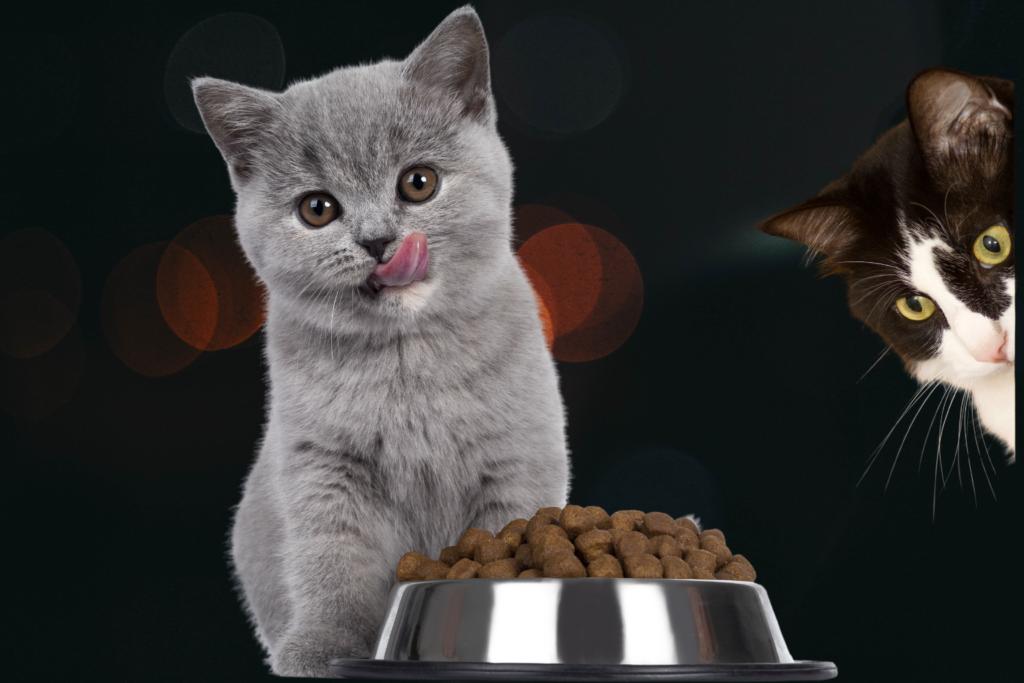
One cat finishes in seconds, moves toward the neighboring bowl, and stares until the other cat retreats. Perhaps there is a swat or hiss. More often, the quieter cat simply steps away, waits under the table, or eats only after the confident cat has left.
That pattern is frequently described as resource guarding, but “intercat tension around food” is often the more useful framing. The behavior is not proof that one cat is malicious, dominant in every situation, or destined to dislike the other. It means the current feeding arrangement lets one cat control access to something valuable.
The original version of this article offered a tempting but incomplete solution: buy a smart feeder and the conflict disappears. Access-controlled feeders can be extremely useful—especially when cats eat different diets—but they do not resolve every cause of tension. A cat can still block the approach, hover behind the authorized cat, or guard the entire room.
The durable solution combines separate feeding locations, an individualized nutrition plan, calmer meal routines, environmental changes, and, when appropriate, identity-controlled technology. This guide explains the complete process and compares two very different products: the SureFeed Microchip Pet Feeder Connect and the PETLIBRO One RFID Smart Feeder two-pack.
How We Researched This Guide
Modern Cat Society did not conduct hands-on testing for this article. We reviewed feline behavior and feeding guidelines, veterinary nutrition resources, current manufacturer specifications, official support instructions, and the Amazon listings available on August 25, 2026. Product functions attributed to a manufacturer are clearly identified as claims. Prices, bundles, app features, warranty terms, and availability can change; confirm the exact listing before purchase.
Quick Verdict
Editorial verdict: Do not begin with technology. First provide each cat with a measured meal in a separate, visually protected location. If that works, you have identified competition as a major factor. A smart feeder can then make the solution easier to maintain, but it should not be expected to repair the cats’ broader relationship.
Choose SureFeed Connect if: You need implanted-microchip access, serve wet or dry food, protect prescription food, or want integrated scales that track changes in how much an authorized cat eats. Remember that the linked Connect model requires a separate Sure Petcare Hub for app features.[8][10]
Choose the PETLIBRO One RFID two-pack if: Both cats eat dry kibble, can safely wear breakaway collars, and you want each feeder to dispense scheduled portions automatically. Each unit recognizes only its assigned PETLIBRO tag; it does not read an implanted microchip.[11]
Skip both for now if: The cats are having physical fights, one cat cannot safely approach the feeding area, a cat has unexplained weight or appetite changes, or you cannot supervise the introduction. Start with veterinary assessment and physically separated meals.
What Resource Guarding Looks Like in Cats
Resource guarding is any behavior used to retain access to food, water, resting places, litter boxes, people, doorways, or other valued resources. Around food, it may look dramatic—but feline tension is frequently silent. The 2024 AAFP Intercat Tension Guidelines emphasize that conflict between household cats often goes unrecognized because its signs can be subtle.[1]
Watch for:
- Staring at another cat while positioned beside the bowls
- Blocking a doorway or the route to the feeding station
- Eating rapidly and immediately moving to the second bowl
- Placing the body between another cat and the food
- Swatting, chasing, growling, hissing, or biting near meals
- One cat repeatedly abandoning food when the other approaches
- A hesitant cat scanning the room instead of eating
- One cat gaining weight while another loses weight
- Vomiting after rushed eating
- Tension that begins before food appears, such as crowding you in the kitchen
The cat who leaves is not necessarily “submissive” in a fixed social hierarchy. Cats can have different relationships around different resources. One may control the food station while the other controls a favored window, hallway, or human lap. Labels such as “alpha” and “bully” can obscure the specific environment that needs to change.[1]
The Science: Solitary Feeding Does Not Mean Cats Are Antisocial
Domestic cats are flexible social animals. They can form affectionate relationships, sleep in contact, groom one another, and live successfully in compatible groups. At the same time, their natural feeding pattern centers on catching and consuming multiple small prey items, often alone rather than around a communal bowl.
The AAFP feline feeding consensus recommends giving cats opportunities for frequent small meals, hunting or foraging behavior, and eating in a solitary fashion—even in multi-pet homes.[2] That does not mean every pair of bowls must be placed behind locked doors. It means each cat should be able to eat without being watched, displaced, or forced into close proximity.
Two bowls touching each other are not two independent resources. From the cats’ perspective, they form one feeding station controlled by whichever cat is willing to remain closest. Moving the bowls a few inches apart rarely solves the underlying problem. Visual separation and independent access routes matter more.
Why Cats Fight Over Food
1. The feeding stations are too close
This is the most common setup error. Even cats that get along elsewhere may find face-to-face or shoulder-to-shoulder eating uncomfortable. Feline environmental guidelines recommend multiple and separated key resources so cats can access what they need without being challenged.[3][4]
Place meals in different rooms, on opposite sides of a visual barrier, or at different heights only when both cats can comfortably reach those levels. Each station should have an exit route that does not require passing the other cat.
2. One cat finishes much faster
A fast eater can consume an appropriate portion and still find the other bowl available. The slower cat then learns that pausing means losing food. This can create a cycle of hurried eating, regurgitation, vigilance, and theft.
A slow feeder or puzzle feeder may help the fast cat, but only if it does not create frustration. The slower cat still needs protected access. Identity-controlled feeders are particularly useful when meal duration differs greatly.
3. Free-feeding creates one resource that can be guarded all day
A communal bowl that is continuously available seems generous, but it makes individual intake almost impossible to measure and allows one cat to monitor access. Scheduled, measured meals reveal who is eating, make weight management easier, and reduce the time during which food can become a contested resource.
Some healthy cats do well with grazing. If grazing is medically appropriate, a microchip-access bowl can preserve that pattern for one cat without offering unrestricted calories to another.
4. The cats eat different diets
Life-stage foods, calorie-restricted plans, food trials, and therapeutic diets cannot be managed reliably from open communal bowls. A single stolen mouthful is not automatically a medical emergency, but repeated cross-feeding can undermine the plan your veterinarian prescribed.
Ask the prescribing veterinarian how strict separation needs to be. An elimination diet for suspected food allergy, for example, may require more rigorous control than a modest difference between maintenance formulas.
5. Previous scarcity changed the cat’s expectations
A former stray, a cat from an overcrowded setting, or a kitten that competed within a large litter may eat as though the next meal is uncertain. This is not greed. Predictable timing, protected portions, and repeated experiences of uninterrupted eating can gradually reduce urgency.
Do not punish food stealing or remove a bowl mid-meal as a training tactic. Punishment adds uncertainty to an already valuable resource and may increase defensive behavior.
6. Broader intercat tension is appearing at mealtime
Food may be only the most visible point of conflict. Look for hallway blocking, staring, chasing after litter-box use, competition for elevated resting places, or one cat restricting where the other moves. The 2024 AAFP guidelines recommend a systematic approach to risk management, restriction of the problem, and resolution rather than expecting cats to “work it out.”[1]
Adding separate feeding stations without also duplicating water, litter boxes, resting sites, scratching areas, and vertical territory may provide only partial improvement.[3][4]
7. Increased hunger has a medical cause
A cat that suddenly raids every bowl needs more than a behavioral label. Hyperthyroidism commonly causes weight loss with increased appetite and may also cause increased thirst, urination, vomiting, diarrhea, or hyperactivity.[6] Diabetes can cause weight loss despite a good appetite, along with increased thirst and urination.[7]
Digestive disease, parasites, medications, an inadequate calorie allowance, or other conditions can also alter appetite. Schedule an examination when food-seeking is new, intense, or accompanied by weight, stool, thirst, urination, energy, or coat changes.
A Practical Plan to Stop Food Stealing and Mealtime Fights
Step 1: Protect both cats immediately
If there are swats, chases, or bites, feed behind closed doors while you redesign the routine. Separate rooms are not a failed or primitive solution. They are inexpensive, reliable, and often the safest option for strict diets.
Do not put your hands between fighting cats. Use distance and a physical barrier, then allow both cats to calm down. Repeated serious aggression requires guidance from your veterinarian or a qualified feline behavior professional.
Step 2: Establish each cat’s nutritional target
Record each cat’s weight, body condition, diet, daily calories, medications, and health conditions. A veterinarian should determine the plan for therapeutic diets and significant weight loss. WSAVA nutrition guidance supports an individually tailored nutrition plan rather than relying on a generic amount printed on a bag.[5]
Measure food by weight when precision matters. Automatic feeder “portions” are volumetric and can vary with kibble size and shape. Weigh several dispensed portions on a kitchen scale before assuming the app setting equals a fixed number of grams.
Step 3: Build independent feeding zones
Each cat should have:
- A station outside the other cat’s direct line of sight
- A predictable approach and escape route
- Enough space to eat without another cat standing behind them
- A nonslip surface and comfortable bowl height
- Water located separately from the contested food area
For two cats, start with two rooms and close the doors. If tension resolves, you can test a less restrictive setup later. Do not rush simply because the cats sometimes sleep together; affiliation does not guarantee comfort around food.
Step 4: Use more, smaller meals
The feline feeding consensus supports frequent small meals and, where appropriate, puzzle or forage feeding.[2] Divide the veterinarian-approved daily allowance rather than adding extra calories. For a fast eater, use a safe slow bowl or puzzle. For a timid cat, begin with an easy, open design; a difficult puzzle can increase frustration when another cat is nearby.
Step 5: Remove the reward for theft
Pick up unfinished open bowls after a defined meal window, unless a veterinarian has recommended another arrangement. If one cat needs to graze, protect that food with an access-controlled feeder. Consistency matters: occasional successful theft can keep the behavior highly persistent.
Step 6: Choose the correct technology
There are two distinct product categories:
- Access-controlled bowl: Opens for an implanted microchip or tag. Best for wet food, prescription diets, and grazers. It does not necessarily dispense meals.
- RFID automatic dispenser: Releases scheduled dry food, then restricts bowl access to the assigned collar tag. Best for portion schedules and cats that tolerate collars.
Do not buy one type expecting the functions of the other.
Step 7: Address the whole household
Distribute litter boxes, water stations, hiding places, scratching surfaces, and elevated resting areas throughout the home. Avoid arranging every resource in one utility room. Multiple separate resources reduce the ability of one cat to control the other’s daily life.[3][4]
SureFeed Connect vs. PETLIBRO One RFID: At a Glance
| Feature | SureFeed Microchip Pet Feeder Connect | PETLIBRO One RFID two-pack |
|---|---|---|
| Identification | Implanted microchip or compatible Sure Petcare tag | Dedicated PETLIBRO collar tag only |
| Food type | Wet or dry | Dry kibble only, 2–15 mm per manufacturer[11] |
| Scheduled dispensing | No; caregiver fills the bowl | Yes; up to 10 meals/snacks daily[11] |
| Food storage | 400 ml bowl | 3-liter hopper per feeder[11] |
| Intake information | Integrated scale monitors changes in food consumed, per manufacturer | Feeding/dispensing logs; no documented integrated intake scale |
| Extra hardware | Sure Petcare Hub required for app features | RFID reader mat and assigned tag required |
| Power | Four C batteries; manufacturer advertises up to six months[8][10] | Corded; three D batteries provide backup, with Wi-Fi disabled on battery[11] |
| Best fit | Wet food, prescription diets, grazing, cats without collars | Scheduled dry meals for cats comfortable in breakaway collars |
| Important limitation | Does not automate meal dispensing; side/rear theft can still occur | Does not read implanted chips; one tag per unit; dry food only |
Product 1: SureFeed Microchip Pet Feeder Connect
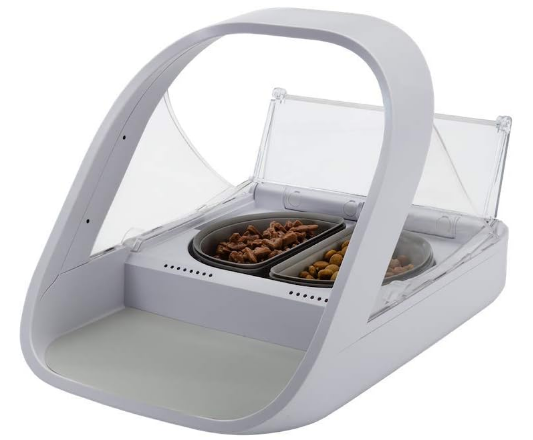
The SureFeed Microchip Pet Feeder Connect is the stronger choice when the primary requirement is controlling who can reach an already served meal. It reads the authorized cat’s implanted identification microchip or a compatible Sure Petcare collar tag, then opens the lid as that cat enters the arch.[8]
Unlike a hopper feeder, it does not dispense breakfast on a schedule. You place wet or dry food into its 400 ml bowl. The lid helps limit exposure to air and flies while closed, but it does not refrigerate wet food; ordinary food-safety time limits still apply.[8]
Why the Connect model stands out
Its integrated scale is the meaningful upgrade over the standard SureFeed Microchip Pet Feeder. Sure Petcare says the LEDs guide the user to the target serving weight within one gram, while the app shows how much, how often, and when the registered cat eats.[8] That can make trends easier to notice, but it is not a diagnostic device and should not be used to delay veterinary care.
The system works through a separate Sure Petcare Hub connected to the home router. The linked Amazon offer is explicitly the feeder-only version and says the Hub is sold separately.[10] Before buying, confirm that a compatible Hub is available, included nowhere else in your cart, and supported in your region.
Advantages
- Uses an implanted microchip, so a collar is optional
- Accepts wet and dry food
- Useful for prescription diets, food trials, and weight-management plans
- Integrated scales provide more meaningful intake trends than dispense-only logs
- Adjustable training mode introduces lid movement gradually[9]
- Optional rear cover can make access harder for persistent thieves[8]
Limitations
- The Connect model requires the Hub for app data and remote features
- It is an access-controlled bowl, not a scheduled automatic dispenser
- Four C batteries add an ongoing cost
- The 400 ml bowl must be filled manually
- A thief may approach from the side or rear while the authorized cat keeps the lid open; placement and the rear-cover accessory may be necessary
- A nervous cat may need days or weeks to accept the arch and moving lid
- App trends support observation but do not diagnose illness
Best for: A cat on wet, therapeutic, or calorie-controlled food; a slow grazer; or a cat that cannot safely wear a collar.
Skip it if: Your priority is unattended scheduled kibble dispensing, you cannot obtain the required Hub, or the cat is too fearful to enter the arch after patient training.
Product 2: PETLIBRO One RFID Smart Feeder Two-Pack
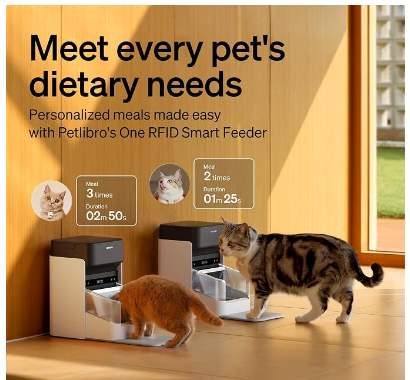
The linked PETLIBRO One RFID two-pack includes two independent feeders designed to give each cat scheduled dry-food access. Each unit pairs with one dedicated PETLIBRO collar tag. The reader does not recognize a veterinary microchip or another brand’s RFID tag.[11][12]
This distinction makes PETLIBRO a better automation tool but a less invisible identification system. The cat must wear the supplied tag on a properly fitted breakaway collar whenever food access is needed.
What the system does
PETLIBRO lists a 3-liter hopper, compatibility with 2–15 mm dry kibble, Wi-Fi app control, feeding logs, and scheduling for up to 10 meals or snacks per day.[11] The manufacturer states that each unit can sync with only one tag, which is why a two-cat household generally needs two feeders for two individualized schedules.[11]
The product page describes diet tracking, but the verified specifications do not document an integrated bowl scale equivalent to SureFeed’s. Treat “how much” in the log primarily as the amount programmed or dispensed, not a veterinary-grade measurement of what entered the cat’s stomach. Leftovers, crumbs, jams, and theft while the authorized bowl is open can create a difference.
Advantages
- Dispenses dry food on a schedule without the caregiver present
- Two-pack creates one feeder and one assigned tag per cat
- Up to 10 daily meal events can support smaller, more frequent feeding[11]
- Three-liter hoppers reduce daily refilling
- Stainless steel bowls are included in the current manufacturer specification[11]
- Supports 2.4 and 5 GHz Wi-Fi, according to PETLIBRO[11]
- Backup batteries preserve schedules during an outage, although Wi-Fi is disabled on battery power[11]
Limitations
- Dry food only; wet, semi-moist, or freeze-dried pieces outside the specified range may not dispense reliably
- Requires the proprietary tag and reader mat
- Each feeder pairs with only one tag
- The cat must tolerate a collar; use the breakaway design and check fit regularly
- Dispensed portions can vary with kibble dimensions, so verify grams with a scale
- Feeders should be positioned at least 10 inches apart to avoid interference, according to PETLIBRO[11]
- A determined cat may still hover, intimidate, or attempt to share access
- The two units require significantly more floor or counter space than two ordinary bowls
The current PETLIBRO page advertises a 24-month warranty and 30-day return policy for direct website purchases; Amazon purchases follow the terms shown for the retailer and seller at checkout.[11]
Best for: Two healthy cats eating dry kibble on different schedules or calorie allowances, provided both tolerate breakaway collars.
Skip it if: Either cat eats wet food, cannot wear a collar, needs exact weighed intake data, or guards the entire feeding zone rather than merely stealing exposed food.
Which Feeder Should You Choose?
Choose according to the feeding problem, not the longer feature list.
| Your situation | Better starting choice | Reason |
| One cat eats prescription wet food | SureFeed Connect | True microchip access and wet-food compatibility |
| One cat grazes while another overeats | SureFeed Connect | Protects an available bowl without requiring a collar |
| Two cats need scheduled dry meals | PETLIBRO two-pack | Each unit dispenses its assigned cat’s kibble schedule |
| You need actual leftover-based intake trends | SureFeed Connect | Integrated scale is designed to track food removed from the bowl |
| Your cats cannot wear collars | SureFeed Connect | Reads compatible implanted microchips |
| The cats have serious room-level conflict | Separate rooms first | Neither device prevents doorway blocking or intimidation |
| Your budget is limited | Closed-door measured meals | Reliable identity control without hardware |
A veterinarian may recommend a different approach depending on the diet, disease, body condition, and urgency of preventing cross-feeding.[5]
How to Introduce a Smart Feeder Without Creating More Anxiety
1. Start with physical separation
Teach each cat in a different room. Placing two unfamiliar machines beside each other recreates the same competitive setup with added noise and moving parts.
2. Leave the mechanism inactive
For SureFeed, use the manufacturer’s staged training mode, beginning with the lid open and adding movement only after the cat eats comfortably.[9] For PETLIBRO, let the cat investigate the inactive feeder, reader mat, bowl shields, collar, and tag before relying on a scheduled meal.
3. Build a positive association
Serve a familiar meal in the new bowl. Reward calm approaches. Never push the cat’s head through an arch, hold the cat on a reader mat, or withhold all alternative food until fear “wears off.”
4. Test identification and closing behavior
Confirm that the correct cat consistently opens the feeder and that the unauthorized cat cannot approach from the rear or side. Adjust lid-close timing where the product allows it. Add a rear cover, wall placement, or visual screen if needed—but do not create a corner where the eating cat can be trapped.
5. Verify real portions
For PETLIBRO, weigh multiple test dispenses with the exact kibble. Calculate the full day’s food rather than adding automated meals to the previous ration. For SureFeed Connect, confirm that the bowl rests correctly on the scale and compare app data with visible leftovers.
6. Keep a fallback plan
Maintain a reliable manual routine for dead batteries, power or internet outages, an app problem, a lost collar tag, travel, or device cleaning. Technology should reduce workload—not become the only way your cat can reach food.
7. Review the cats, not just the app
Weigh each cat regularly, assess body condition with your veterinary team, and watch actual posture at the station. A perfect feeding log does not show a second cat staring from outside the camera frame.
When to Call Your Veterinarian or a Behavior Professional
Arrange a veterinary examination when food conflict begins suddenly or is accompanied by:
- Weight loss despite eating well
- Markedly increased hunger, thirst, or urination
- Vomiting, diarrhea, or a change in stool
- Reduced appetite or missed meals
- Pain, dental difficulty, or dropping food
- Lethargy, hyperactivity, or a change in temperament
- Injuries from fights
- A therapeutic diet that another pet repeatedly accesses
Hyperthyroidism and diabetes are two important causes of weight loss with preserved or increased appetite.[6][7] A smart feeder can reveal a pattern, but only a veterinarian can determine why it changed.
Seek qualified behavioral help when one cat blocks rooms, stalking continues outside mealtime, injuries occur, or separation and environmental improvements do not reduce tension. The problem may require a structured reintroduction and treatment of broader fear or anxiety—not merely a better bowl.[1]
Frequently Asked Questions
1. Why does one cat steal the other cat’s food?
The opportunity is available, the second food may be more appealing, the cat may finish faster, or the current stations may function as one guardable resource. Increased hunger can also have a medical cause. Separate the cats for measured meals and arrange a veterinary check if the behavior is new or accompanied by weight, thirst, urination, stool, or energy changes.
2. Are my cats fighting because one is dominant?
“Dominant cat” is usually too broad to guide a solution. A cat may control food access but yield another resource elsewhere. Focus on the observable pattern: who stares, blocks, approaches, leaves, and eats. The 2024 AAFP guidelines emphasize recognizing subtle intercat tension rather than relying on simplistic hierarchy labels.[1]
3. Should I feed my cats in separate rooms?
Yes. Separate rooms are often the fastest, safest, and most affordable solution. They are especially appropriate during a diagnostic food trial, with prescription diets, or when physical aggression occurs. A smart feeder becomes valuable when closed-door feeding is impractical or one cat needs protected grazing access.
4. How far apart should cat food bowls be?
There is no universal distance. “Across the room” may still be too close if cats can stare at each other or one controls the exit. Start in separate rooms or behind solid visual barriers. PETLIBRO also specifies at least 10 inches between its RFID units for technical interference, but behavioral separation will usually need much more than 10 inches.[11]
5. Can cats share one microchip feeder?
Some access-controlled feeders can register more than one identity, but that does not provide individual portions if several cats open the same bowl. For food theft, different diets, or intake monitoring, each cat generally needs an independently protected feeding station. Follow the instructions for the exact model.
6. Does the SureFeed Connect dispense food automatically?
No. You fill its bowl manually. It controls access, weighs the served food, and tracks authorized feeding activity through the app when connected to the required Hub.[8] If you need scheduled dry-food dispensing, the PETLIBRO One RFID is the more relevant product.
7. Does the SureFeed Connect require a Hub?
Yes. Sure Petcare states that the Connect feeder links to the app through its Hub, and the linked Amazon feeder listing says the Hub is sold separately.[8][10] Verify Hub availability before purchasing. The non-Connect SureFeed Microchip Pet Feeder does not provide the same app and integrated-scale features.
8. Can PETLIBRO read my cat’s implanted microchip?
No. The One RFID feeder reads only its dedicated PETLIBRO collar tag, and each unit synchronizes with one tag.[11] The cat must wear the supplied tag on an appropriately fitted breakaway collar to receive access.
9. Can the PETLIBRO One RFID feeder hold wet food?
No. PETLIBRO specifies dry food only, with compatible kibble between 2 and 15 mm.[11] For wet food access control, SureFeed is the suitable option of these two. Neither product refrigerates an open wet meal.
10. Will a microchip feeder completely stop food stealing?
It can prevent an unauthorized identity from opening a closed bowl, but it cannot guarantee complete separation. A persistent cat may approach while the authorized cat is eating, enter from the side, or intimidate the cat away from the station. Positioning, accessories, supervision, and broader conflict management still matter.
11. Can feeder apps tell me exactly how much my cat ate?
SureFeed Connect uses an integrated scale to estimate food removed from the bowl and is the stronger option for intake trends.[8] PETLIBRO logs scheduled or dispensed feeding activity, but its verified specifications do not describe an equivalent integrated intake scale. Neither device proves ingestion or replaces weight checks and veterinary assessment.
12. What if my cat refuses to use the smart feeder?
Return to the last comfortable training stage. Keep the mechanism still, use familiar food, and provide a safe alternative. SureFeed offers a gradual lid-training function.[9] Do not force the cat or allow prolonged fasting. If the return window is important, begin acclimation early enough to learn whether the product is a realistic fit.
Final Verdict
Food conflict is not a character defect in either cat. It is evidence that the current arrangement allows competition, fear, or uncontrolled access. Restore safety first with separate measured meals and distributed household resources; then use technology to preserve the routine.
The SureFeed Microchip Pet Feeder Connect is the more versatile access-control option for wet food, prescription diets, grazing, and implanted-microchip recognition—provided you account for the required Hub. The PETLIBRO One RFID two-pack is the better automation choice for scheduled dry meals when both cats tolerate breakaway collars.
Neither feeder is a cure for intercat tension. The best system is the one in which every cat can approach, eat, and leave without being watched, rushed, blocked, or displaced.
Read more:
5 Hidden Signs Your Indoor Cat Has Separation Anxiety—and What to Do
Why Does My Cat Bite Me? 8 Common Reasons and What to Do
Why Does My Cat Meow So Much? Common Causes and Modern Solutions
PETLIBRO Review 2026: Are Their Smart Cat Products Worth It?
Sources and References
- Rodan I, Ramos D, Carney HC, et al. 2024 AAFP Intercat Tension Guidelines: Recognition, Prevention and Management. Journal of Feline Medicine and Surgery. 2024;26(7). doi:10.1177/1098612X241263465.
- Sadek T, Hamper B, Horwitz D, Rodan I, Rowe E, Sundahl E. Feline Feeding Programs: Addressing Behavioral Needs to Improve Feline Health and Wellbeing. Journal of Feline Medicine and Surgery. 2018;20(11):1049–1055. doi:10.1177/1098612X18791877.
- Ellis SLH, Rodan I, Carney HC, et al. AAFP and ISFM Feline Environmental Needs Guidelines. Journal of Feline Medicine and Surgery. 2013;15(3):219–230.
- Feline Veterinary Medical Association. Setting Up the Environment for Success. Accessed August 25, 2026.
- World Small Animal Veterinary Association. Global Nutrition Guidelines. Accessed August 25, 2026.
- Cornell Feline Health Center. Hyperthyroidism in Cats. Updated April 30, 2026.
- Cornell Feline Health Center. Feline Diabetes. Accessed August 25, 2026.
- Sure Petcare. SureFeed Microchip Pet Feeder Connect: Features and Specifications. Accessed August 25, 2026.
- Sure Petcare. Teaching Your Pet to Use the Microchip Pet Feeder Connect. Accessed August 25, 2026.
- Amazon product listing. SureFeed Microchip Pet Feeder Connect, ASIN B07RHZHHGN. Accessed August 25, 2026.
- PETLIBRO. One RFID Smart Feeder: Specifications and FAQ. Accessed August 25, 2026.
- Amazon product listing. PETLIBRO One RFID Automatic Cat Feeders Two-Pack, ASIN B0FP533MTZ. Accessed August 25, 2026.