5 Hidden Signs Your Indoor Cat Has Separation Anxiety—and What to Do
By Demosthenes Staudinger | Updated August 25, 2026
Affiliate disclosure: This article contains affiliate links. As an Amazon Associate I earn from qualifying purchases. If you buy through one of these links, we may earn a commission at no additional cost to you. This does not affect our editorial recommendations.
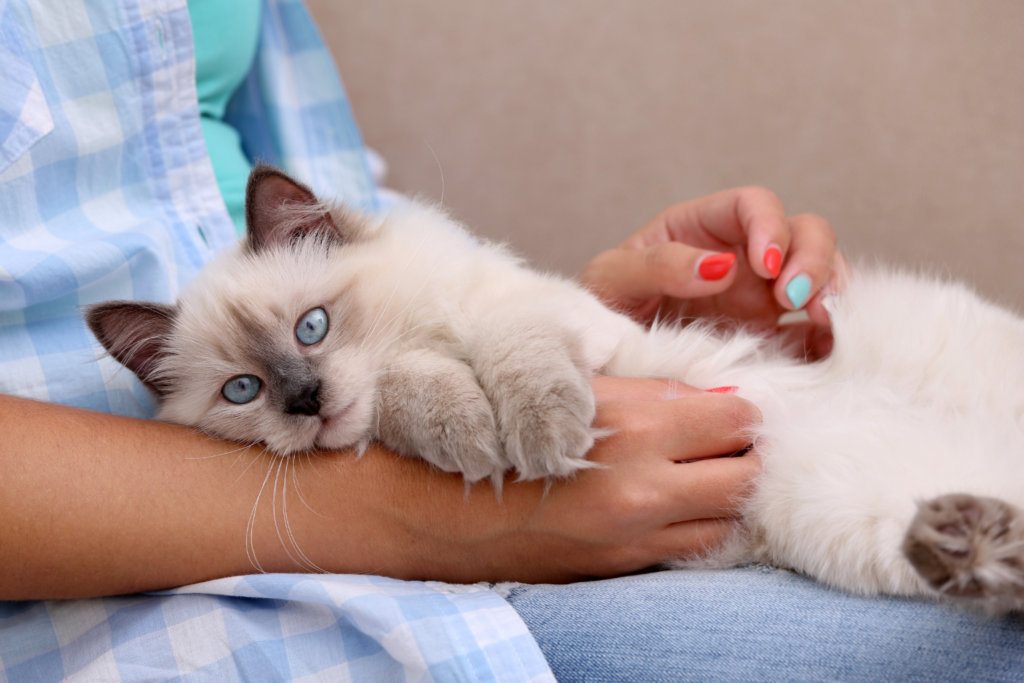
Cats are often described as low-maintenance companions who barely notice when their people leave. Research tells a more nuanced story: cats can form distinct attachment bonds with human caregivers, and some experience behavior changes associated with a preferred person’s absence.[1][2]
That does not mean every indoor cat who follows you or greets you enthusiastically has cat separation anxiety, nor that a long workday automatically causes a disorder. Temperament, health, age, household relationships, schedule changes, resources, and outside events all matter.
The central clue is the pattern around separation. A behavior becomes more suggestive when it begins as you prepare to leave, appears reliably during your absence, improves after you return, and cannot be better explained by a medical condition or another environmental trigger.[7][8]
Some signs are obvious, such as prolonged yowling near the door. Others are easy to miss: a cat may stop eating, remain tense and motionless, hide, pace, or groom one area repeatedly. What looks like a quiet day on the sofa may not always be relaxed sleep.
The language matters too. Researchers and behavior professionals often use separation-related problems or separation-related distress because feline diagnostic criteria are less established than they are in dogs. These broader terms describe concerning changes linked to separation without assuming one specific emotional diagnosis.[1][7][8]
This guide will help you recognize five possible signs, collect useful evidence, and build a practical support plan. Smart devices can make behavior visible and provide limited enrichment, but they do not diagnose or cure anxiety. Veterinary assessment, environmental changes, and carefully paced behavior work remain the foundation.
If your cat is straining to urinate, passing only drops or no urine, crying in the litter box, vomiting repeatedly, having difficulty breathing, collapsing, or injuring themselves, seek urgent veterinary care. Do not wait to test an anxiety strategy at home.[9]
How we researched this guide: This is a research-based editorial guide, not a veterinary diagnosis or a hands-on product test. We reviewed feline behavior research, veterinary guidance, professional behavior resources, and current manufacturer and Amazon listing information as of August 25, 2026. Product features are manufacturer- or listing-provided and may change. Recommendations include limitations, subscription requirements, and safety considerations.
Quick Verdict
- Editorial verdict: Separation-related distress is possible in cats, but one behavior is not enough to confirm it. Look for a repeatable absence-linked pattern on video and rule out medical and environmental causes with your veterinarian.
- Best first step: Record several ordinary departures, note when signs begin and end, and schedule a veterinary visit for new, severe, or persistent behavior changes.
- Most useful home changes: Predictable routines, safe resting places, separated resources, individual play, food puzzles introduced while you are home, and departures kept within the cat’s current tolerance whenever feasible.
- Role of pet cameras: Observation, progress tracking, and occasional remote interaction. They are not treatment by themselves and do not replace an in-person caregiver during extended absences.
What Does Separation Anxiety Look Like in Cats?
Separation-related distress is not defined by affection. A sociable cat can enjoy company and still relax alone; a less demonstrative cat can become withdrawn during an absence. Cats form meaningful bonds with people, but attachment style and clinical anxiety are not interchangeable.[2][7]
Instead, focus on three questions:
- Does the behavior occur in anticipation of or during separation? Picking up keys, putting on work shoes, closing a laptop, or packing a suitcase may become predictive cues.
- Is the pattern reasonably consistent? A single scratched chair or isolated litter-box accident does not establish a separation problem.
- Have competing explanations been investigated? Pain, urinary disease, skin disease, hyperthyroidism, cognitive decline, litter-box aversion, intercat conflict, outdoor animals, hunger, noise, and simple play can produce similar signs.[3][4][5][7][8]
The timing can be more informative than the mess left behind. A camera may show that vocalizing begins after the door closes and stops when another trusted person remains. Conversely, footage may reveal that the trigger is a delivery truck or neighborhood cat. The treatment direction would be very different.
Separation-related clue or something else?
| What you notice | More suggestive of separation-related distress | Important alternatives to investigate | Useful evidence |
|---|---|---|---|
| Following or blocking the door | Escalates around departure cues and is followed by distress when alone | Normal sociability, food anticipation, learned attention, pain, routine preference | Video before and after departure; behavior on non-work days |
| Scratching or damaged objects | Frantic activity near exits or a repeatable episode after departure | Normal scratching, insufficient scratchers, play, outdoor-cat trigger, intercat tension | Location, timing, body language, window view, which cat is involved |
| Urine or stool outside the box | Occurs mainly during absences after medical and litter-box causes are addressed | Urinary disease, constipation, pain, marking, box aversion, blocked access, mobility limits | Veterinary exam, urinalysis as advised, box audit, camera footage |
| Hair loss or repetitive licking | Grooming increases during separation and medical causes are excluded | Fleas, allergies, infection, pain, neurologic disease, other dermatologic conditions | Skin examination, parasite control history, video, lesion pattern |
| Yowling, pacing, hiding, or not eating | Begins with departure and resolves after return or with a trusted caregiver present | Hunger, noise, outdoor animals, cognitive decline, hyperthyroidism, pain, nausea | Audio/video, food intake, trigger log, veterinary workup |
This table is a screening tool, not a diagnosis. Several causes can occur at once, and treating only the visible behavior may miss a medical problem.
1. Departure-Cue Distress and the “Velcro” Pattern
A cat who shadows you from room to room is not automatically anxious. Following may reflect affection, curiosity, warmth, food anticipation, or a well-established social routine. Hyperattachment alone is a poor shortcut to diagnosis, and blaming a close bond can make caregivers feel they must become emotionally distant from their cat.[2][7]
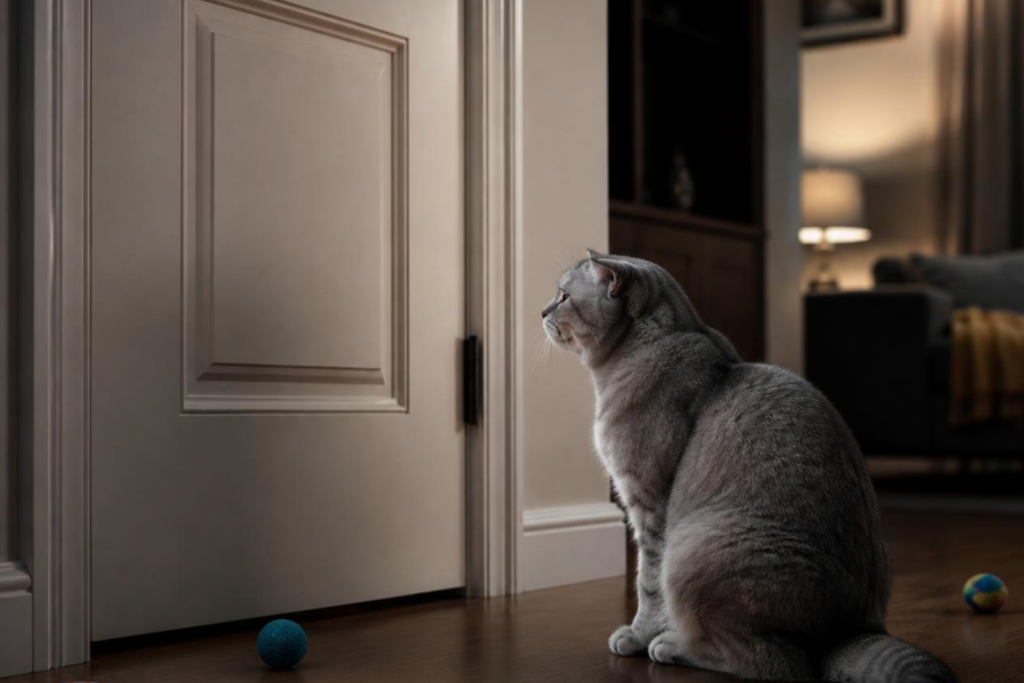
The pattern becomes more concerning when ordinary departure cues trigger an abrupt change. Your cat may stop eating when you put on work clothes, pace between you and the door, vocalize as you gather your bag, swat at your ankles, hide when a suitcase appears, or remain tense at the exit after you leave. Some cats show an unusually intense reunion; others withdraw rather than greet.
What to observe
- Which cue appears first: keys, shoes, coat, alarm, suitcase, or a particular time of day?
- Does the cat remain relaxed if you perform the cue but stay home?
- Does distress occur when anyone is present, or only when a particular person is absent?
- How quickly does the cat settle after the door closes?
- Does the response change with departure duration or time of day?
Do not repeatedly trigger departure cues until your cat panics just to test the theory. Capture normal routines first. If a cue predicts distress, a professional can help you design gradual practice below the cat’s threshold.
Keep departures and arrivals calm and predictable. This does not require ignoring your cat or sneaking out. A brief, consistent routine is less confusing than a dramatic farewell followed by an unexplained disappearance. If your cat is already distressed by the earliest cue, handing over a food puzzle at the door may be too late; highly anxious cats may not eat.[7]
2. Destruction, Frantic Scratching, or Restless Pacing While Alone
Returning to torn curtains or an overturned plant can feel personal, but cats do not damage objects to punish a late owner. Scratching is normal feline behavior used for claw maintenance, stretching, visual marking, and scent communication. Young or active cats may also chase, climb, and knock things over during ordinary play.[3]
Separation becomes a stronger possibility when video shows a repeatable burst of restless activity after departure: pacing between rooms, repeatedly jumping at the doorknob, clawing door frames or window sills, or moving without settling. Damage concentrated around an exit can be relevant, but location alone still does not prove anxiety.
Check environmental triggers. An outdoor cat can cause territorial arousal; household cats may compete for resources when people are absent; construction noise or a timed appliance may start the episode. A camera aimed only at the sofa can miss all of this.
Reduce risk without suppressing normal behavior
- Provide tall and horizontal scratchers near existing scratch locations, resting areas, and room transitions.
- Separate food, water, litter boxes, sleeping places, scratching areas, and elevated refuges so one cat cannot guard everything.[3]
- Move fragile objects and toxic plants out of reach while you investigate.
- Use window film or adjust perches if outdoor animals reliably trigger arousal.
- Schedule interactive wand play before a typical quiet period, allowing the cat to stalk and capture the toy.
- Introduce simple food puzzles while you are present; increase difficulty only when the cat uses them confidently.
Do not confine a distressed cat in a small carrier or unfamiliar room to protect furniture. If a safe room is part of the plan, introduce it positively and provide comfortable, separated resources—not punishment.[8]
3. Urinating or Defecating Outside the Litter Box During Absences
The phrase “protest pee” should be retired. House soiling is information, not revenge. Cats may urinate or defecate outside the litter box because of lower urinary tract disease, kidney disease, diabetes, constipation, pain, mobility limits, litter preference, box cleanliness, location, resource guarding, social stress, or urine marking. Separation-related distress is one possibility among many.[4][7][8]
Some clinical reports have found owner beds among the locations used by cats with separation-related house soiling, but the location does not reveal the cat’s intent. It is not scientifically responsible to state that the cat is deliberately combining scents to comfort themselves. Softness, absorbency, privacy, access, learned preference, urgency, and social odor may all matter.[7]
Start with veterinary and litter-box basics
Arrange a veterinary examination promptly for any new house-soiling pattern. Diagnostics depend on age, sex, symptoms, and history. A male cat repeatedly straining with little or no urine may have a life-threatening obstruction and needs emergency care.[9]
At home, audit the setup rather than simply adding fragrance:
- Provide one litter box per cat, plus one additional box, placed in multiple accessible locations rather than lined up as one station.[4]
- Choose boxes large enough for the cat to enter, turn, and dig comfortably.
- Scoop at least daily and wash with a mild, unscented product.
- Offer an unscented litter the cat accepts; avoid abrupt changes.
- Make sure another pet, appliance, child, or noisy doorway cannot block access.
- Give senior or mobility-impaired cats a low-entry option on every level they use.
- Clean accidents with a product intended for pet urine; avoid ammonia-based cleaners.
If footage shows that the cat freezes in one preferred area for long periods, your veterinary team may suggest a temporary additional box nearby while the broader problem is treated. Protecting bedding with a washable waterproof layer can reduce household damage, but deterrents alone do not resolve fear, pain, or inappropriate box placement.
Never punish, carry the cat to the mess, rub their nose in it, or spray them with water. Delayed punishment does not teach the desired toileting location and may add fear to an already stressful situation.[8]
4. Overgrooming, Hair Loss, or Other Quiet Physical Changes
Stress-related grooming is often described as a hallmark of anxiety, but hair loss is not a behavior diagnosis. Cats lick because of itch, parasites, allergies, infection, pain, neurologic problems, and other medical causes. Cornell advises veterinary evaluation when licking removes hair or damages skin, and psychogenic alopecia should be considered only after medical explanations have been investigated.[5]
That caution is not theoretical. In a small study of 21 cats referred with presumptive psychogenic alopecia, 16 had a medical cause identified and three had both medical and compulsive components.[6] The study does not tell us the rate in every cat population, but it shows why “she is just anxious” is an unsafe assumption.
Video can reveal licking that occurs after departure. Record the area targeted, timing, duration, and whether the cat can disengage. Photograph changes for your veterinarian, but do not apply human creams, essential oils, bitter products, or a recovery garment without guidance.
Other quiet changes can also accompany separation-related distress:
- Eating or drinking less while alone
- Refusing a favorite puzzle only after departure
- Hiding for most of the absence
- Remaining immobile with a tense posture rather than sleeping loosely
- Vomiting or having diarrhea around schedule changes
- Sleeping less, becoming hypervigilant, or startling easily
Each sign has medical and environmental alternatives. A camera alert labeled “vomiting” or “anxiety” is not a diagnosis; automated detection can miss events or classify them incorrectly. Save the clip, note the time and context, and let your veterinarian interpret it with the full history.
5. Vocalizing, Searching, or Becoming Unusually Inactive After You Leave
Yowling is the sign neighbors are most likely to notice, yet sound is only one part of the picture. A cat may walk from door to window calling, remain stationed at the entrance, pace, or repeatedly search rooms. Others respond in the opposite way by hiding, reducing exploration, and barely moving. Passive signs can be just as important as dramatic ones.[7]
Record audio and video before assuming the vocalization is about you. A cat may call at dawn because of hunger, react to birds or outdoor cats, vocalize because of pain, or become disoriented from sensory or cognitive changes. Hyperthyroidism and other illnesses can increase vocalization, particularly in older cats.
Relaxed sleep or a stress-related shutdown?
A loosely curled cat who changes position, grooms normally, drinks, visits the litter box, and wakes to ordinary sounds may simply be resting. A cat who remains rigidly crouched, breathes faster, keeps pupils enlarged in stable light, scans constantly, hides without changing position, or refuses food may be coping poorly. Do not diagnose from one still image; review movement and body language over time.
If calling starts only after the front door closes and stops when a trusted person returns, that correlation is useful evidence. If it starts at the same time even while you are home, investigate the clock-based event—food delivery, outside activity, medication timing, or household noise.
Avoid yelling through a speaker when vocalization begins. Your voice may reassure some cats, but others become more agitated when they hear you and cannot locate you. Test two-way audio while you are nearby but out of sight. If your cat relaxes, approaches with loose posture, and resumes normal activity, brief use may be reasonable. If they search, pace, flatten their ears, or call more intensely, turn it off and share that response with your behavior professional.
How to Confirm the Pattern with a Camera and Behavior Log
A pet camera is most valuable before it becomes an entertainment device. Its first job is to show what actually happens. You do not need artificial intelligence or a subscription to begin; a securely positioned phone, local-storage camera, or ordinary indoor camera can capture useful footage if privacy and data security are addressed.[7][8]
A practical five-day baseline
- Choose representative days. Record several ordinary departures rather than one unusual trip. Include at least one comparison period when you remain home if possible.
- Capture the transition. Begin recording before departure and include the first 30–60 minutes, when early changes may be most visible. Longer recording may be needed if signs appear later.
- Cover relevant zones. Aim at the exit and the cat’s usual resting area without placing cords where they can be chewed. In a multi-cat home, more than one view may be necessary.
- Log observable facts. Write “paced between door and window for 11 minutes,” not “felt abandoned.” Note vocalization, posture, food, water, litter use, grooming, triggers, and time to settle.
- Compare and share. Save short clips that show the clearest sequence and bring them to your veterinarian. Repeat the same measures to track improvement.
Do not deliberately extend an absence once your cat is in obvious distress just to discover the maximum duration. The goal is to identify a workable baseline, not prove how badly the cat can panic. If the cat cannot settle, injures themselves, refuses food repeatedly, or develops medical signs, seek professional guidance before practicing more departures.
What Actually Helps a Cat with Separation-Related Distress?
There is no universal gadget, supplement, or five-minute trick. A useful plan addresses health, physical and social resources, predictability, learned coping skills, and unavoidable absences at the same time.
1. Rule out medical causes first
Schedule an examination for a new or persistent behavior change. Bring your timeline, videos, photographs, feeding information, litter-box details, and a list of all medications and supplements. Diagnostics depend on the sign: urinary problems, skin disease, gastrointestinal signs, pain, endocrine disease, and cognitive changes require different workups.
Medication may be appropriate when anxiety is severe enough to prevent eating, movement, or learning, but only a veterinarian can choose the drug, dose, monitoring, and duration. Medication is usually one part of a broader plan, not a substitute for environmental and behavior work.[7][8]
2. Build a secure, resource-rich home
FelineVMA’s environmental guidance emphasizes safe places; multiple, separated resources; opportunities for predatory play; positive and predictable human interaction; and respect for scent.[3] Translate those principles into the individual cat’s routine:
- Offer elevated and enclosed resting options the cat can enter and leave freely.
- Separate food, water, litter, scratching, play, and sleep locations.
- Give each cat individual access to resources and one-on-one play.
- Place a sturdy perch where outdoor activity is interesting rather than threatening.
- Rotate a small selection of safe toys instead of leaving every toy out permanently.
- Use familiar bedding and avoid sudden waves of strongly scented cleaners.
Enrichment is successful only if it improves the cat’s behavior and welfare. A complex puzzle ignored during every absence is not enrichment for that cat at that moment. Begin with easy choices while you are home and measure engagement.
3. Make the daily schedule predictable without making one person the only event
Offer play, meals, quiet contact, and rest at reasonably consistent times. Then build pleasant activities that do not require continuous contact: scatter part of a measured meal, offer a familiar food puzzle, open access to a favorite perch, or cue the cat to settle on a mat.
Use food from the cat’s normal daily allowance so enrichment does not quietly cause weight gain. Cats on prescription diets, with food allergies, diabetes, obesity, urinary conditions, or multi-cat food competition need a veterinarian-approved feeding plan.
4. Teach calm independence while you are still home
Reward the cat for choosing a bed, perch, or mat a comfortable distance from you. Start with seconds, not minutes. Deliver reinforcement calmly, release the cat, and stop before they abandon the station. Gradually add ordinary movement—standing up, walking across the room, touching the doorknob—only while the cat remains relaxed.[7]
This is not about withholding affection. Continue positive social contact at times your cat enjoys. The new skill is simply that resting apart also predicts safety and good outcomes.
5. Practice absences below the cat’s threshold
When a veterinary or behavior professional recommends departure training, begin with a duration the cat can tolerate without escalating. Remote video helps determine whether the pace is appropriate. Progress may be measured in seconds at first. If the cat stops eating, searches, freezes, vocalizes, or becomes tense, the step was too difficult.
Severe cases are not ideal do-it-yourself projects. A board-certified veterinary behaviorist can evaluate medical and behavioral factors together; qualified feline behavior consultants can collaborate with the primary veterinarian. Avoid trainers who promise a guaranteed cure, use punishment, or frame the problem as dominance.
6. Arrange human support for absences the cat cannot yet handle
A camera cannot refill water after a spill, notice subtle illness throughout the home, clean a litter box, administer medication safely, or provide emergency care. For long workdays, schedule changes, overnight travel, and treatment periods, consider a trusted household member or professional cat sitter. Kittens, seniors, cats with medical conditions, and cats showing distress may need more frequent in-person care than a healthy, relaxed adult.
Adding another cat is not a treatment shortcut. Some cats enjoy compatible feline company; others merely tolerate it or experience resource competition. A second cat can create a new welfare problem if introduced to solve separation distress without an individual assessment.[3][8]
Two Smart-Camera Options for Monitoring and Remote Interaction
These products may help you document behavior or provide brief interaction, but neither is a treatment for separation anxiety. Verify the current Amazon listing, app compatibility, Wi-Fi requirements, subscription terms, return policy, and privacy settings before purchasing.
| Product | Best for | Useful current features | Main limitation |
| Furbo 360° Cat Camera | Wide-room monitoring plus remote treat delivery | Rotating view, live video, two-way audio, treat tossing, cat-oriented accessory; plan-dependent alerts and history | The linked version requires a paid Furbo Nanny plan for activation and a minimum commitment |
| Petcube Cam 360 + Play 2 Bundle | Two camera positions plus remotely controlled laser play | Pan-tilt Cam 360 paired with a Play 2 offering 1080p video, 160° view, night vision, audio, and built-in laser | Play 2 itself has a fixed wide-angle view; some cloud/history features may require Petcube Care |
Furbo 360° Cat Camera: Best for Treat-Based Check-Ins
The linked Amazon listing is the Furbo 360° Cat Camera, subscription-required version (ASIN B0CFGQBCDX). Its rotating room view, two-way audio, and treat-tossing mechanism can help caregivers observe movement across a larger area and remotely reinforce calm behavior. Furbo currently markets plan-based video history and smart alerts through Furbo Nanny.[11]
Best for: Caregivers who want one cat-focused device for room monitoring and occasional delivery of compatible dry treats.
How to use it responsibly: First watch without speaking or tossing anything. Establish the cat’s ordinary pattern and save clips for your veterinarian. If your care team recommends reinforcing calm behavior, deliver a treat while the cat is settled—not only after prolonged yowling. Test the speaker while you are nearby and stop using it if hearing your voice increases searching or agitation.
Important subscription warning: The exact Amazon version linked here states that a paid plan is required to activate the camera, with a three-month minimum commitment. Subscription prices, included alerts, video-history periods, trial terms, renewal conditions, and device ownership rules can change. Read the current listing and Furbo terms before checkout; do not assume the hardware price is the total cost.
Other limitations: Smart alerts are screening tools, not medical detectors, and may be missed or mislabeled. Use only treats that fit the manufacturer’s requirements and your cat’s diet. Count every tossed treat in the daily calorie allowance, and avoid unattended treat delivery where cats compete for food. Secure the power cord and place the camera on a stable surface that cannot fall onto the cat.
![Furbo 360° Cat Camera [No Monthly Fee] 360° Rotating Live View, Meowing Alerts, Treat Toss, 2-Way Audio, Night Vision, Smart Home Kitten Monitoring, No AI Alerts](https://moderncatsociety.com/wp-content/uploads/2026/07/Furbo-360°-Cat-Camera-Review.png "Furbo 360° Cat Camera Review")
Petcube Cam 360 + Play 2 Bundle: Best for Multi-Angle Viewing and Supervised Laser Play
The linked Amazon bundle (ASIN B0CNH9DMS5) combines Petcube Cam 360 with Petcube Play 2. The Cam 360 supplies pan-and-tilt coverage, while Petcube currently lists the Play 2 with 1080p video, a 160° fixed wide-angle view, night vision, two-way audio, and an app-controlled or scheduled laser.[12]
Best for: Homes that benefit from two viewpoints and cats that already enjoy short laser sessions without becoming frustrated.
How to use it responsibly: Use the cameras to identify timing and triggers first. If laser play is appropriate for your cat, keep sessions short, never aim at eyes or reflective surfaces, and finish with something the cat can physically catch—a wand toy, small toy, or measured food reward. Feline environmental guidance recommends intermittent prey capture, and an observational study found an association between frequent laser use and guardian-reported repetitive behaviors; it did not prove that lasers caused those behaviors.[3][10]
Important limitations: Play 2 does not physically pan; its 160° lens is fixed. Pan-tilt coverage comes from the separate Cam 360 in this bundle. Autoplay cannot read subtle fatigue, pain, fear, or frustration as well as a person can. Stop if the cat fixates after the light disappears, searches compulsively, vocalizes more, crashes into objects, or becomes agitated. Some recording, cloud history, and smart-alert functions may depend on a Petcube Care subscription, so compare current free and paid features before buying.
The laser and speaker are optional tools—not a reason to leave a distressed cat alone beyond their tolerance. Place both cameras securely, protect cords from chewing, use strong account security, and review household privacy before enabling cloud recording.

What Not to Do
- Do not punish the evidence. Yelling, spraying, physical correction, and rubbing a cat’s nose in urine can increase fear and do not address the cause.[8]
- Do not call the behavior spite. Destruction, house soiling, and vocalization have functional, emotional, environmental, or medical explanations.
- Do not force panic to “get the cat used to it.” Repeated exposure above the cat’s coping threshold can rehearse distress rather than build confidence.
- Do not sneak out unpredictably. Calm, consistent departures provide information; treatment should reduce the emotional response gradually.[7]
- Do not assume more toys equal treatment. A cat too anxious to eat or move may not use puzzles or robotic toys.
- Do not adopt a second cat as a cure. Compatibility is individual, and added competition may worsen stress.[3][8]
- Do not rely on remote voice or laser play without testing. Either feature can increase arousal in some cats.
- Do not let a camera replace veterinary care or a sitter. Technology can observe only the zones it covers and cannot respond physically to illness or danger.
When to Contact a Veterinarian or Behavior Specialist
Book a veterinary appointment when the behavior is new, persistent, worsening, or affecting appetite, elimination, skin, sleep, mobility, or safety. Seek help sooner if the cat cannot settle, injures themselves near exits, stops eating during absences, or shows intense panic.
Urgent signs include repeated straining with little or no urine, blood in urine with distress, breathing difficulty, collapse, seizures, repeated vomiting, severe lethargy, suspected toxin exposure, or an injury. Contact an emergency veterinary service rather than waiting for camera footage.
After medical evaluation, ask whether referral to a board-certified veterinary behaviorist is appropriate. The American College of Veterinary Behaviorists maintains a specialist directory. A collaborative plan may combine management, environmental modification, reward-based training, sitter support, and veterinarian-prescribed medication when indicated.
Frequently Asked Questions
1. Can cats really have separation anxiety?
Cats can show distress and behavior changes associated with separation from a preferred person. However, feline criteria and treatment research are less developed than in dogs, so separation-related problems is often the more careful term.[1][7][8] Diagnosis depends on timing, repeated observation, medical evaluation, and exclusion of other causes—not on one sign.
2. Is a cat following me everywhere a sign of separation anxiety?
Not by itself. Following can be normal social behavior, curiosity, food anticipation, or a learned routine. It becomes more relevant if departure cues trigger visible distress and footage shows the cat cannot settle after you leave. A strong bond does not mean you caused a disorder by giving too much affection.[2][7]
3. How can I tell what my cat does when I am away?
Record several ordinary departures with a securely positioned camera. Include the period before departure and at least the first 30–60 minutes afterward. Log observable behavior, time to settle, vocalization, food, grooming, litter use, and outside triggers. Share representative clips with your veterinarian instead of relying only on an app-generated label.[7][8]
4. Does my cat pee on my bed because they are angry that I left?
No evidence lets us conclude that a cat urinates on a bed as revenge. Urinary disease, pain, urgency, box aversion, litter preference, marking, resource conflict, mobility problems, and separation-related distress are all possibilities. New house soiling needs veterinary evaluation and a complete litter-box review.[4][7]
5. Can overgrooming be caused by anxiety?
It can have a behavioral component, but medical causes are common and must be investigated first. Fleas, allergies, infection, pain, and neurologic or dermatologic disease can all cause licking and hair loss. Psychogenic alopecia is a diagnosis of exclusion, not something to determine from a bald patch alone.[5][6]
6. How long can an indoor cat safely stay alone?
There is no single number that fits every cat. A healthy, relaxed adult with safe resources may cope with a normal workday, while kittens, seniors, cats with medical needs, multi-cat conflict, or separation distress need more frequent care. Overnight travel and extended absences require an in-person plan; food dispensers and cameras are not substitutes for a reliable sitter.
7. Should I talk to my cat through a pet camera?
Only if your cat responds calmly. Test the speaker while you are nearby but out of sight. Some cats relax when they hear a familiar voice; others search, pace, or vocalize more because they cannot locate the person. Body language—not the feature list—should determine whether you continue.
8. Can the Furbo 360° Cat Camera fix separation anxiety?
No. It can help you observe behavior, save useful clips, speak briefly, or deliver compatible treats, but it does not diagnose or treat an emotional disorder. The linked version also requires a paid plan for activation, so review the minimum commitment, renewal terms, and included features before purchasing.[11]
9. Is remote laser play safe for cats?
It should be brief, carefully controlled, directed away from eyes and reflective surfaces, and followed by a physical capture. Stop if the cat becomes agitated or continues searching after the light disappears. An observational study reported an association between frequent laser play and repetitive behaviors, but it did not establish causation.[3][10]
10. Will getting another cat solve the problem?
Not reliably. Separation distress may center on a particular person, and cats vary greatly in their tolerance for feline housemates. An incompatible introduction can create intercat tension and competition for resources. Consider another cat only because you want and can support one after evaluating compatibility—not as an anxiety treatment.[3][8]
11. Should I ignore my cat before leaving and after returning?
You do not need to become cold or withhold normal affection. Keep departures and reunions calm, brief, and predictable. Avoid dramatic farewells, punishment, and overstimulating greetings. A behavior professional may personalize the routine based on what video shows.[7][8]
12. When is medication appropriate for cat separation anxiety?
Medication may be considered when distress is severe, frequent, medically complicated, or prevents the cat from eating, exploring, or learning during behavior work. Only a veterinarian should prescribe and monitor it. The best plans generally combine medical care with environmental management, gradual training, and practical support for unavoidable absences.[7][8]
Final Thoughts
A distressed cat is not being manipulative, and a devoted caregiver has not failed simply because work requires leaving home. The most useful response is careful rather than dramatic: document the timing, rule out medical causes, meet the cat’s environmental needs, protect them from absences they cannot yet handle, and build coping skills at a pace their body language supports.
Smart cameras can bridge an information gap and make invisible behavior visible. Treat dispensers and remote play can add carefully chosen interaction. But the lasting goal is not a more connected gadget—it is a cat who can eat, rest, explore, groom normally, and feel safe whether you are in the next room or temporarily away.
Read more:
Why Does My Cat Follow Me Everywhere?
Why Your Cats Are Fighting Over Food?
Why Your Indoor Cat Tries to Escape?
Sources and References
- de Souza Machado D, et al. “Identification of separation-related problems in domestic cats: A questionnaire survey.” PLOS ONE. 2020. https://journals.plos.org/plosone/article?id=10.1371/journal.pone.0230999
- Vitale KR, Behnke AC, Udell MAR. “Attachment bonds between domestic cats and humans.” Current Biology. 2019. https://pubmed.ncbi.nlm.nih.gov/31550468/
- Feline Veterinary Medical Association and International Cat Care. “Your Cat’s Environmental Needs: Practical Tips for Cat Caregivers.” 2026. https://catvets.com/wp-content/uploads/2026/02/FelineVMA-Environmental-Needs_2026-BW.pdf
- American Association of Feline Practitioners and International Society of Feline Medicine. “Feline House-Soiling: Useful Information for Cat Owners.” 2014. https://catvets.com/wp-content/uploads/2024/01/HouseSoiling-B%26W.pdf
- Cornell Feline Health Center. “Cats That Lick Too Much.” https://www.vet.cornell.edu/departments-centers-and-institutes/cornell-feline-health-center/health-information/feline-health-topics/cats-lick-too-much
- Waisglass SE, Landsberg GM, Yager JA, Hall JA. “Underlying medical conditions in cats with presumptive psychogenic alopecia.” Journal of the American Veterinary Medical Association. 2006. https://pubmed.ncbi.nlm.nih.gov/16740071/
- Johnson D. “Separation-Related Problems in Cats.” IAABC Foundation Journal. 2020. https://journal.iaabcfoundation.org/separation-related-problems-in-cats/
- Radosta L, Fagen A. “Separation-Related Disorders and the Differences Between Dogs and Cats.” Today’s Veterinary Practice. 2017. https://todaysveterinarypractice.com/behavior/separation-related-disorders-differences-dogs-cats/
- Cornell Feline Health Center. “Feline Lower Urinary Tract Disease.” https://www.vet.cornell.edu/departments-centers-and-institutes/cornell-feline-health-center/health-information/feline-health-topics/feline-lower-urinary-tract-disease
- Kogan LR, et al. “Laser Light Pointers for Use in Companion Cat Play: Association With Guardian-Reported Abnormal Repetitive Behaviors.” Animals. 2021. https://pmc.ncbi.nlm.nih.gov/articles/PMC8388446/
- Furbo. “Furbo 360° Cat Camera” and Furbo Nanny product information. Accessed August 25, 2026. https://furbo.com/us/products/furbo-360-cat-camera
- Petcube. “Petcube Play 2 Smart Pet Camera with Laser Toy.” Accessed August 25, 2026. https://petcube.com/store/product/play-2/