How to Stop Your Cat From Scratching Luxury Furniture
By Demosthenes Staudinger | Updated August 25, 2026
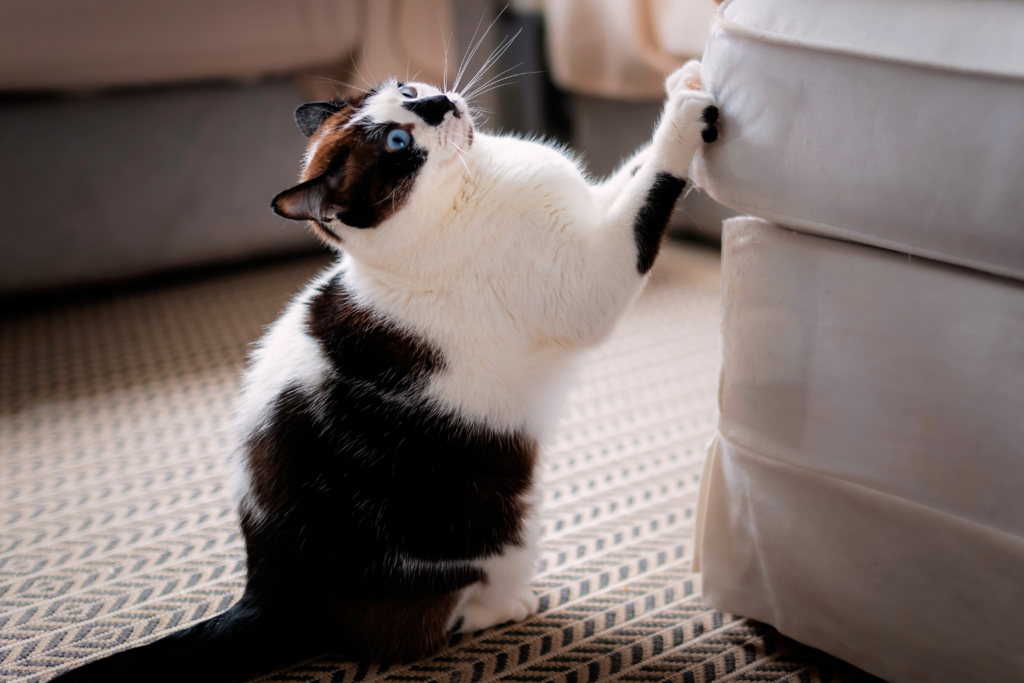
A few pulled threads can change a velvet chair permanently, while one scratching session can mark an aniline-leather sofa meant to last for decades. When the damaged piece is valuable or central to your living room, it is understandable to want the behavior stopped immediately.
Your cat, however, is not evaluating the upholstery invoice. The sofa offers several things many inexpensive scratching posts do not: a prominent location, a stable structure, a satisfying texture, and enough height for a full-body stretch. Scratching also leaves visible and scent signals, removes worn outer claw sheaths, and helps cats stretch after resting. It is normal feline behavior, not spite or revenge.[1][4]
The reliable strategy is not suppression. It is making an approved surface more useful than the furniture while temporarily protecting the target. A short, wobbly post hidden in another room cannot compete with a solid sofa arm in the center of the cat’s territory.
The right setup depends on what your cat already does. A cat that reaches upward on a sofa needs a tall, stable vertical surface beside that exact spot. A cat that claws a rug or the front edge of a seat may prefer horizontal cardboard. A cat that repeatedly returns to one couch corner may benefit from a fitted sisal panel that occupies the existing scratching location.
To stop your cat from scratching luxury furniture, the strongest starting combination is a full-height sisal post, a horizontal option, immediate rewards, and a material-safe temporary barrier. No product can guarantee that every cat will abandon every piece of furniture.
This guide explains how to identify your cat’s preferences, protect delicate finishes, retrain the behavior without fear or punishment, and select Amazon products that serve genuinely different purposes.
Affiliate disclosure: This article contains affiliate links. As an Amazon Associate I earn from qualifying purchases. If you buy through one of these links, we may earn a commission at no additional cost to you. This does not affect our editorial recommendations.
How we researched this guide: This is a research-based editorial guide, not a hands-on product test. We evaluated current feline veterinary guidance, peer-reviewed scratching research, positive-reinforcement recommendations, official manufacturer specifications, upholstery compatibility warnings, and practical differences among the featured products. Modern Cat Society has not purchased or field-tested these products. Manufacturer performance and material claims are identified as such.
Quick Verdict
- Editorial verdict: Protecting luxury furniture works best as a two-part plan: place a stable scratcher that matches the cat’s existing preference directly beside the damage, then use a temporary, upholstery-compatible barrier while rewarding the new behavior.
- Best for: Indoor cats scratching sofa arms, corners, chair backs, rugs, or other high-value surfaces, and caregivers willing to observe preferences and train consistently.
- Skip it if: You expect a deterrent, nail trim, or single scratching post to remove the biological need to scratch. Sudden or unusually intense scratching accompanied by other behavior changes should be discussed with a veterinarian first.
Recommended Products at a Glance
| Product | Best use | Manufacturer-listed size | Primary material | Important limitation |
|---|---|---|---|---|
| SmartCat Ultimate Scratching Post | Full-height vertical scratching | About 32 in high; 16 × 16 in base | Woven sisal | Requires floor space and assembly; individual adoption varies |
| PetFusion Ultimate Cat Scratcher Lounge | Horizontal scratching and lounging | About 34 × 10.5 × 10.5 in | Corrugated cardboard | Cardboard sheds and eventually needs replacement |
| Sofa-Scratcher Original | Wide or rounded sofa corners | 24-in-high contoured panel | Woven sisal with felt backing | Must be anchored under a compatible sofa leg; not designed for recliners |
| Sofa-Scratcher Squared | Straight 90-degree sofa corners | 24-in-high corner panel | Woven sisal with felt backing | Fits a narrower range of furniture shapes |
| FUKUMARU L-Shaped Scratcher | Lower-cost vertical/horizontal option | 26.8 × 16.6 × 11.5 in, large size | Corrugated cardboard | Less durable than woven sisal and can create debris |
| FixZilla Furniture Protector | Temporary shield on compatible upholstery | Listing varies by pack; panels up to about 17 × 12 in | Clear plastic with adhesive and optional pins | Not for leather, faux leather, velvet, or microfiber; patch testing is essential |
Dimensions and package configurations were reviewed August 25, 2026. Verify the selected color, model, seller, return eligibility, and current specifications before ordering.[7][8][9][10][11][12]
Why Cats Scratch Luxury Furniture
Scratching is a species-typical behavior with several functions. Cats use it to maintain their claws, stretch the muscles of the forelimbs and body, and leave both visual and scent information in significant parts of their environment.[1][4] The behavior commonly appears after waking and in prominent social or territorial locations, including near resting areas, windows, doorways, and frequently used rooms.[1]
That explains why a beautifully upholstered sofa often wins over a generic post. The sofa does not wobble. Its arm may be tall enough for a complete stretch. The fabric offers resistance, and its position in the living room makes the resulting marks conspicuous. If the cat has used that spot repeatedly, the familiar physical marks and scent make it even more relevant.
Increased scratching can also accompany environmental change or social tension. A new animal, outdoor cats at a window, construction, a changed schedule, or competition may increase marking. The home may need separated resources, resting areas, play, predictability, or veterinary assessment—not merely a larger protector.[1][2]
The practical objective is therefore not a “no scratching” home. It is a home in which the cat can perform the behavior on locations and materials that both the cat and caregiver can accept.
Diagnose the Scratching Pattern Before Buying Anything
The damaged furniture contains useful information. For two or three days, record the target, direction, height, time, and events immediately before scratching. Photos make patterns easier to compare.
Identify the orientation
Long marks running downward from a sofa arm, chair back, or door frame usually indicate a vertical preference. The replacement must be tall enough for the cat to reach upward and pull down without the post shifting.
Damage along a rug, seat edge, carpeted stair, or the top of a low ottoman suggests a horizontal or angled preference. A cardboard lounge or floor scratcher will often compete more effectively than another upright post.
Some cats use both orientations. Research based on owner observations found that offering different types and styles of scratching surfaces was associated with less inappropriate scratching, although individual preference remained important.[5] Providing one vertical and one horizontal option is not excess when each solves a different need.
Match the texture, not just the color
A cat attracted to a coarse woven sofa may prefer sisal or corrugated cardboard. A cat scratching wood trim may respond to a firm, resistant surface. Older cats can change preferences as mobility and comfort change; current FelineVMA guidance specifically notes that a senior cat may move from vertical to horizontal scratching.[2]
Choose a decor-friendly color only after confirming the orientation, height, material, and stability.
Map the important location
Note whether the target is beside a bed, window, entrance, travel route, or social area. Location is part of the behavior; a scratcher where the cat rarely goes cannot replace a meaningful sofa corner.
Look for a change rather than a longstanding habit
If a cat that rarely damaged furniture suddenly begins scratching several locations, investigate what changed. New vocalization, hiding, aggression, overgrooming, house-soiling, reduced jumping, appetite changes, or sensitivity to touch can justify a veterinary examination. Physical discomfort and chronic stress can interfere with learning, and unexpected behavior changes should not be dismissed as disobedience.[1][3]
How to Stop Your Cat From Scratching Luxury Furniture: Seven Steps
1. Protect the target without damaging its finish
Before training, prevent additional damage with the least invasive method compatible with the furniture. A securely fitted throw, removable furniture cover, or smooth commercial protector can make the surface temporarily unavailable. Current FelineVMA guidance recommends a furniture protector or throw while a suitable sturdy post is installed at the same location.[1]
Consult the furniture maker before applying adhesive, pins, repellents, or cleaners. “Clear” does not mean finish-safe: adhesive can change leather, lift velvet fibers, leave residue, or interact with stain treatments. Pins create holes by design.
Do not use double-sided sticky tape as an aversive surface. The current FelineVMA training guidance favors nonpunitive protection and explicitly advises against double-sided sticky tape as a deterrent.[1] A one-sided clear shield, where the adhesive faces only the compatible furniture and the outward surface is smooth, is a different type of product—but it still requires a hidden patch test and manufacturer approval.
2. Put the replacement at the exact point of damage
Place the new scratcher directly beside, in front of, or over the chosen sofa corner. Do not start across the room. Cornell and FelineVMA guidance both emphasize offering the acceptable surface where the cat is already scratching.[1][4]
If the cat scratches distant locations, provide more than one surface. In a multi-story home, offer options on the levels the cat uses.
3. Reproduce the preferred movement
For vertical scratching, the cat should be able to extend the front legs, lean into the surface, and pull down. For horizontal scratching, the pad should be long and stable enough for the cat to brace the body and draw the claws backward. An angled scratcher may be appropriate for cats that target sloped furniture sides or carpeted steps.
The SmartCat post addresses a vertical pattern; the PetFusion lounge addresses a horizontal one. The Sofa-Scratcher models are site-specific vertical panels, while the FUKUMARU can be configured as a vertical or horizontal cardboard surface. The choice should follow the observed behavior rather than a universal ranking.
4. Eliminate wobble and sliding
Stability is non-negotiable. A post that rocks when the cat commits body weight can be less satisfying than a sofa that remains completely still. Assemble freestanding products according to the manufacturer’s instructions, place them on a level surface, and check fasteners regularly.
Do not mount a tall scratcher with inadequate hardware. A fall can frighten the cat and create avoidance. Nonslip pads are useful only when they preserve stability and have no chewable loose pieces.
5. Invite exploration without forcing the paws
Allow the cat to inspect the product voluntarily. You can draw a wand toy across the surface, place a preferred treat nearby, or use catnip if that individual responds to it. Not all cats react to catnip, and a lure is an invitation rather than proof that the surface will suit the cat.
Avoid holding the cat against the post or dragging the front paws over it. Forced contact can make the new object predict restraint, which works against the calm association you are trying to build.
6. Reward the correct behavior immediately
Keep several small treats near the scratcher during the first training period. The moment the cat scratches the approved surface, mark it with quiet praise and deliver the reward. Food is not the only option; a brief play session or preferred social interaction may be more valuable to a particular cat.
Positive reinforcement increases the likelihood that the rewarded behavior will recur. FelineVMA guidance recommends immediate, individual rewards and warns that fear and punishment impair learning.[3] A survey of more than 4,000 cats also found that owners who rewarded approved scratching reported more frequent use of the preferred post than owners who never rewarded it.[5]
7. Keep the successful surface available
Once the cat reliably uses the scratcher, keep it in the meaningful location. If it must be moved for design reasons, shift it only a few inches at a time and confirm continued use. Moving it abruptly to a hidden utility room can return the sofa to its status as the best available marking point.
Do not replace a scratcher merely because it looks used; familiar marks and scent can increase its value. Replace it when instability, exposed fasteners, loose components, or severe breakdown creates a safety issue.[4]
Recommended Amazon Products for Protecting Luxury Furniture
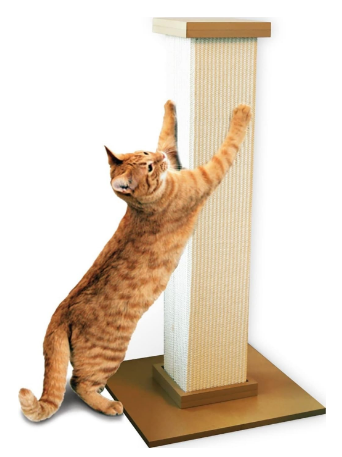
SmartCat Ultimate Scratching Post: Best general vertical option
The SmartCat Ultimate Scratching Post is the strongest first purchase for a cat that reaches upward on a sofa arm or chair back. Pioneer Pet lists a roughly 32-inch height, a 16 × 16-inch base, and woven sisal construction.[7] That height gives many adult cats room to extend, while the broad base is intended to reduce wobble.
Place it with one side almost touching the damaged furniture. If the cat attacks the outer corner of the sofa, orient a flat sisal face toward the cat’s usual approach. Reward every voluntary use. After the new habit is established, the post can remain there as part of the room rather than being treated as temporary training equipment.
Its limitations are the footprint, assembly, and the possibility that a cardboard- or carpet-preferring cat will ignore sisal. It is not a climbing tower or horizontal pad.
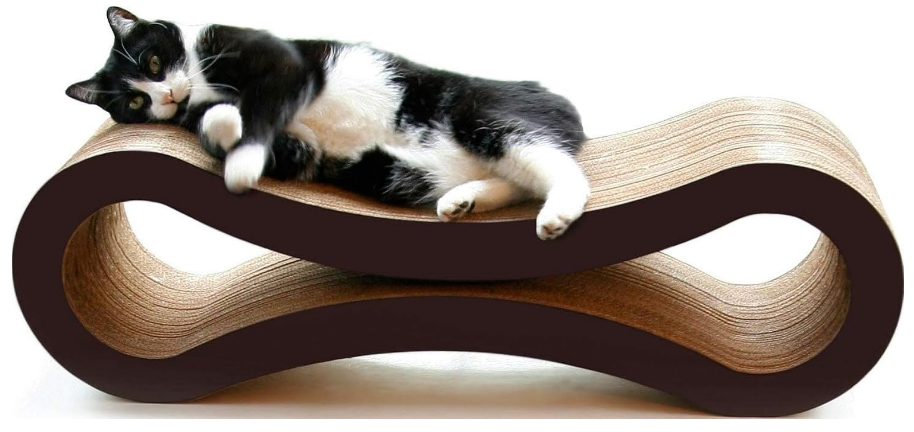
PetFusion Ultimate Cat Scratcher Lounge: Best horizontal design
The PetFusion Ultimate Cat Scratcher Lounge is better suited to cats that scratch rugs, seat edges, or low horizontal surfaces. Its manufacturer-listed dimensions are approximately 34 × 10.5 × 10.5 inches, and the curved cardboard form can function as both a scratcher and resting place.[8] The reversible shape provides another usable surface when one side becomes worn.
Its sculptural profile is easier to integrate into a modern room than a basic flat cardboard tray. Place it directly in front of the damaged area at first, even if that is not the final design position. If the cat scratches the front edge of a sofa seat, align the lounge with that approach rather than tucking it behind an end table.
Cardboard produces debris and eventually needs replacement. Confirm stability on smooth floors, and do not expect it to replace a tall post for a vertical scratcher.
Sofa-Scratcher Original vs. Squared: Best location-specific solution
The Sofa-Scratcher line addresses a central behavior principle: put the approved scratching material exactly where the cat already wants to scratch. Both versions use a low-profile base anchored beneath a sofa leg and a felt-backed sisal panel positioned against the corner. This avoids placing adhesive directly on the upholstery, although you must still confirm that the base, backing, and furniture weight are appropriate for your sofa and floor.[9][10]
The Original has a contoured panel designed for wide or rounded corners. The manufacturer lists a 24 × 10-inch sisal panel, an 8 × 10-inch transparent base, and assembled dimensions of about 24 inches high by 10 inches wide by 9 inches deep.[9]
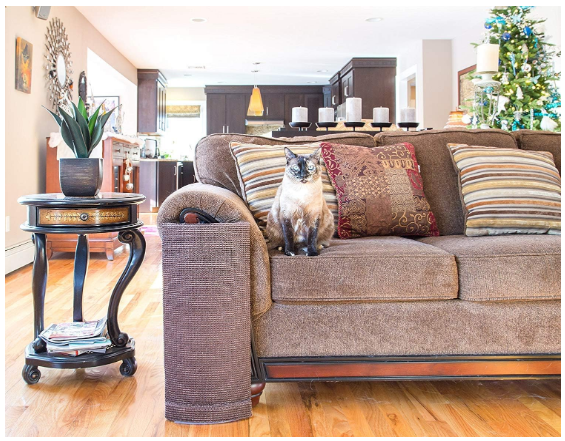
The Squared wraps a straighter 90-degree corner. Its manufacturer lists a 24-inch-high corner, a 7 × 9-inch base, and assembled dimensions of approximately 24 × 9 × 9 inches.[10]
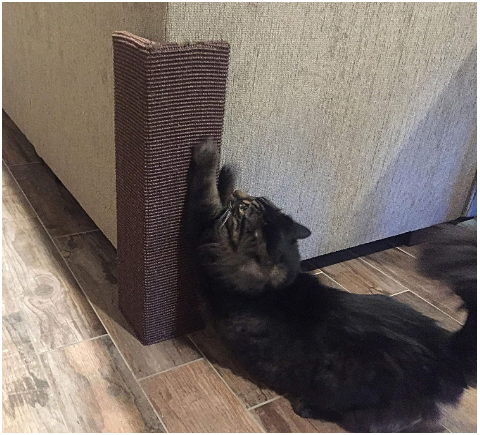
Measure before ordering. Neither version is universal, the base needs an appropriate leg, and the manufacturer says the designs are not for recliners. A mismatch can leave upholstery exposed or keep the panel from sitting flush.
FUKUMARU L-Shaped Scratcher: Best lower-cost flexible alternative
The large FUKUMARU L-shaped cardboard scratcher is manufacturer-listed at 26.8 × 16.6 × 11.5 inches.[11] Its shape can offer an upright face, a floor-level scratching surface, or a sheltered curve, making it useful when you have not yet determined whether the cat prefers vertical or horizontal movement.
It is a sensible budget alternative to buying both a premium post and a sculptural lounge immediately. Position the tall side beside the sofa arm for a vertical trial, then change the orientation only if observation suggests the cat wants a floor-level surface.
Cardboard can shed, deform, or wear faster than woven sisal. At 26.8 inches, it may also be short for a large vertical scratcher. Confirm that the unit does not slide or tip.
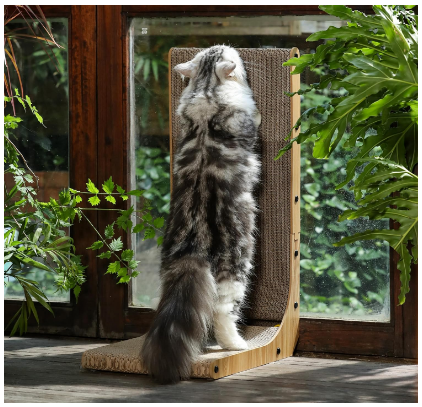
FixZilla Furniture Protector: A conditional temporary barrier
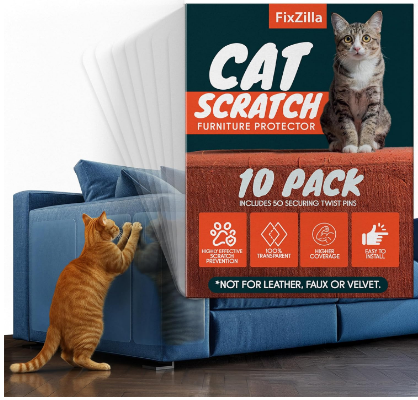
The FixZilla listing offers clear plastic panels with an adhesive side and optional twist pins. The current 10-pack listing describes a mix of larger panels and narrower corner pieces, but package configurations can change; verify the exact quantity and dimensions on the selected listing.[12]
This product should be treated as temporary physical protection, not the behavioral solution. Install an appropriate scratcher beside the protected area at the same time. The visible outer surface is smooth rather than double-sided sticky, so the strategy is to block claw access while rewarding an acceptable alternative.
The listing says it is not recommended for leather, faux leather, velvet, or microfiber.[12] Adhesive can affect finishes, pins puncture fabric, and some cats may pull at exposed pins. Use it only after checking the furniture instructions and testing a hidden area; otherwise choose a fitted throw or nonadhesive protection.
Which Product Should You Choose?
| Your cat’s pattern or furniture type | Best starting option | Add if needed | Avoid or reconsider |
| Reaches high on a sofa arm | SmartCat Ultimate | Material-safe temporary cover | Short or unstable posts |
| Scratches rugs or seat fronts | PetFusion Lounge | SmartCat if vertical marks also appear | Assuming one orientation suits every cat |
| Targets one rounded sofa corner | Sofa-Scratcher Original | Horizontal cardboard nearby | Ordering without measuring the sofa leg and corner |
| Targets one square 90-degree corner | Sofa-Scratcher Squared | SmartCat at another marked location | Using on recliners or incompatible bases |
| Needs a lower-cost trial | FUKUMARU L-Shaped | Upgrade after the preference becomes clear | Expecting cardboard to last indefinitely |
| Compatible woven upholstery needs temporary shielding | FixZilla plus a nearby scratcher | Positive reinforcement | Leather, faux leather, velvet, microfiber, or untested finishes |
| Senior cat has shifted to floor-level scratching | Low horizontal cardboard | Veterinary mobility assessment if the change is new | Forcing a formerly used vertical posture |
The right setup is the smallest combination that reproduces the cat’s preferred posture and texture in a meaningful location. Often that is one SmartCat beside the sofa and one PetFusion or FUKUMARU near a resting area.
Protecting Different Luxury Materials
Leather and faux leather
Do not apply FixZilla, tape, pins, or unverified spray to leather. Use a freestanding post or compatible Sofa-Scratcher plus a manufacturer-approved nonabrasive cover. Ask a leather professional about existing damage rather than trying household oils or cleaners.
Velvet
Velvet pile can crush, pull, or change direction. Avoid adhesive and pins. Use a secure removable cover during training and place the approved scratcher flush with the targeted corner.
Bouclé and textured weaves
Looped fabrics offer claw resistance. A tall woven-sisal post is a practical vertical substitute, paired with a removable cover. Do not pull loose threads; seek professional upholstery advice.
Linen, wool, and delicate natural textiles
Avoid liquids, adhesive, and untested barriers. Cover the entire target because the cat may shift slightly, then match the original orientation with a nearby scratcher.
Lacquered, painted, or antique wood
Tape can lift finish, and moving plastic can abrade polished edges. Use an independent scratcher and nonadhesive barrier. Consult a conservator before attaching anything to an antique.
Nail Trimming and Nail Caps: Helpful but Limited
Regular nail trimming can blunt the sharp hook at the end of the claw and reduce the severity of accidental damage. It does not remove the motivation to scratch, so it should support—not replace—the environmental plan. If you are unsure where the quick begins or your cat resists paw handling, ask a veterinarian or feline-friendly groomer for a demonstration.[4][6]
Temporary nail caps are another FelineVMA-listed alternative to declawing.[6] They require correct sizing, application, inspection, and replacement. They do not address stress, location, or an inadequate scratching setup; ask your veterinarian whether they suit your cat.
Declawing is not a furniture-protection shortcut. It is an amputation of the third phalanx, and the FelineVMA strongly opposes it as an elective procedure. The association identifies scratching posts, nail care, temporary caps, environmental enrichment, and behavior support as alternatives.[6]
Environmental Triggers That Can Keep the Behavior Going
A technically correct scratching post may not solve a broader environmental problem. If the damaged corner is beside a window where outdoor cats appear, scratching may be part of a territorial response. Adjust the view with a partial window film or blind while providing an elevated observation area elsewhere.
In multi-cat homes, watch for staring, blocking, chasing, or controlled access. Separate scratching surfaces, resting places, food, water, litter boxes, and safe areas instead of clustering every resource into one station.[2]
Add predictable interactive play, hunting-style food activities, climbing opportunities, and quiet resting locations. Enrichment does not replace the scratcher, but it can reduce frustration and give the cat more acceptable outlets. Keep routines as consistent as practical during moves, renovations, new-pet introductions, or major schedule changes.
Why Punishment Usually Makes the Problem Worse
Yelling, spraying water, chasing, or shaking cans may interrupt one episode, but interruption is not learning. The cat may fear you and scratch when unobserved; distress also interferes with positive associations.[1][3][4]
Do not use your hands to demonstrate scratching, force the paws onto the post, or confine the cat beside it. Calmly protect the furniture, make the correct option easy, and pay the cat promptly for choosing it. Consistency is slower than intimidation in the first few seconds, but it teaches a usable behavior rather than avoidance.
Avoid essential-oil repellents and homemade citrus mixtures. Exposure and finish compatibility are difficult to control, and odor does not teach an approved location.
A Practical 14-Day Transition Plan
Days 1–2: Observe and measure
Photograph the marks, identify vertical or horizontal movement, measure the cat’s reach and the available floor space, and inspect the furniture care label. Choose the product by function, not appearance alone.
Days 3–4: Protect and install
Cover the target with a material-safe barrier. Assemble the scratcher securely and put it directly at the damaged location. Add a second orientation only if the pattern is mixed or unclear.
Days 5–7: Build the reward history
Conduct several short sessions each day. Use a toy or treat to invite investigation without forcing contact. Reward any voluntary scratching immediately. Keep normal play and feeding routines predictable.
Days 8–10: Evaluate the evidence
If the cat uses the new surface, continue rewarding and leave it in place. If the cat ignores it, change one variable: texture, angle, stability, or precise placement. Do not move every item at once, because you will not know which change helped.
Days 11–14: Reduce management gradually
When approved scratching is consistent and the furniture has not received new damage, reduce the size of a removable cover gradually. Keep the scratcher at the successful location. If scratching returns, restore protection and reassess rather than punishing the cat.
Two weeks is an evaluation period, not a guaranteed deadline. Long-established behavior, stress, pain, or an unsuitable surface can require more time and professional guidance.
Pros and Cons of a Product-Based Redirection Plan
| Advantages | Limitations |
| Preserves normal feline behavior | No product guarantees adoption |
| Can protect furniture during training | Luxury materials limit adhesive-protector choices |
| Matches vertical, horizontal, or corner-specific patterns | Several preferences may require more than one surface |
| Uses positive reinforcement instead of fear | Rewards and observation require caregiver consistency |
| Freestanding options avoid attaching hardware to furniture | Stable posts require visible floor space |
| Sisal can provide durable resistance | Sisal may not appeal to a cardboard-preferring cat |
| Cardboard options are relatively affordable | Cardboard sheds and becomes a recurring purchase |
| Fitted corner products preserve the established location | Furniture geometry can prevent a correct fit |
| Nail care can reduce the severity of damage | Nail care does not stop the drive to scratch |
| The setup can improve environmental enrichment | Sudden behavior changes may require veterinary assessment |
Returns, Fit, and Buying Checks
Measure the sofa corner, leg position, clearance, scratch height, and available floor space before opening the product. Confirm that the selected Sofa-Scratcher shape matches the furniture and that a leg can anchor its base. For cardboard products, check whether the listed size is the large version; variant menus can change the dimensions.
Amazon sellers, package contents, and return eligibility change. Scratched, assembled, adhesive-backed, or opened products may not receive the same treatment as unused items. Read the current conditions before use.
For FixZilla, confirm the pack configuration and exclusions shown on the exact page reached by the affiliate link. Do not rely on the word “transparent” as evidence of upholstery compatibility. The furniture manufacturer’s care instructions take priority over a pet-product listing.
When to Consult a Veterinarian or Behavior Professional
Schedule a veterinary assessment when scratching increases suddenly, especially if it occurs alongside reduced mobility, sensitivity to touch, vocalization, hiding, appetite changes, house-soiling, aggression, excessive grooming, or sleep disruption. A senior cat that abandons a vertical post for the floor may simply prefer a new posture, but discomfort should be considered.[1][2][3]
If medical causes have been addressed and a carefully matched setup still fails, ask your veterinarian for referral to a board-certified veterinary behaviorist or another appropriately qualified feline behavior professional. Bring your observation notes, photos, room layout, and a list of strategies already attempted. That evidence is more useful than describing the cat as stubborn.
Frequently Asked Questions
Can I completely stop my cat from scratching?
You should not try to eliminate scratching because it is a normal feline behavior used for claw maintenance, stretching, and communication. The realistic goal is to redirect it toward approved surfaces and prevent access to valuable targets.[1][4]
Success means the cat scratches a post, pad, or fitted panel instead of the sofa. Keep an acceptable surface available even after the furniture damage stops.
Why does my cat scratch the sofa when a scratching post is available?
The post may be too short, unstable, the wrong texture, the wrong orientation, or in an insignificant location. The sofa may offer better resistance and stand in a prominent territorial area.
Place the alternative directly beside the damage and match what the cat already does. A horizontal cat will not necessarily switch to an upright post simply because it is marketed as a scratcher.
What is the best scratching material for protecting a sofa?
There is no universal material. Woven sisal is a strong starting choice for cats targeting coarse vertical upholstery, while corrugated cardboard often suits horizontal scratchers. Research found rope or sisal was frequently used when offered, but age and individual preference affected the result.[5]
Offer a second texture if the first is ignored rather than assuming the cat is untrainable.
How tall should a vertical scratching post be?
It should allow the cat to reach upward and pull down at full extension without wobbling. Cornell advises a post at least as tall as the cat standing on the hind legs with the front legs extended.[4]
The SmartCat’s roughly 32-inch height is a useful starting point for many adult cats, but measure your cat and consider a taller, stable structure for a particularly large individual.[7]
Where should I place the scratching post?
Begin directly beside the scratched furniture, not in another room. Other useful locations include near sleeping areas, because cats often scratch after waking, and near significant windows, entrances, or travel routes.[1]
If the cat has several established targets, provide several scratching surfaces rather than expecting one post to cover the entire home.
How can I get my cat interested in a new scratcher?
Use a wand toy, preferred treat, catnip when appropriate, or calm praise to invite voluntary contact. Reward the first scratching motions immediately. Keep sessions short and stop before the cat becomes frustrated.[2][3]
Do not place the paws on the surface or hold the cat against it. Forced interaction can create avoidance.
Can I use FixZilla on leather, velvet, or microfiber?
No. The current FixZilla listing specifically excludes leather, faux leather, velvet, and microfiber.[12] Adhesive and pins can permanently alter expensive upholstery.
Use a freestanding scratcher, a compatible Sofa-Scratcher, and a nonadhesive cover approved by the furniture manufacturer instead.
Should I buy the Sofa-Scratcher Original or Squared?
Choose the Original for a wide or rounded couch corner and the Squared for a straight 90-degree corner. Both require a compatible sofa leg to anchor the low-profile base.[9][10]
Measure the corner and leg position carefully. The manufacturer states that these models are not intended for recliners.
Is a cardboard scratcher enough to protect furniture?
It can be enough for a cat that prefers horizontal or angled cardboard, especially when positioned at the established target. It is unlikely to satisfy every vertical scratcher.
The PetFusion offers a larger reversible lounge, while the FUKUMARU provides a lower-cost L-shaped configuration. Both will wear and shed with use.[8][11]
Will trimming my cat’s nails stop furniture scratching?
No. Trimming can reduce the sharpness of the tips and limit damage, but the cat will still need to scratch. Maintain a suitable post or pad after every trim.[4][6]
Ask a veterinarian or feline-friendly groomer to demonstrate if you cannot clearly identify the quick or the cat resists handling.
Should I use a spray bottle or repellent spray?
Spraying the cat with water is punishment and can create fear without teaching an alternative. Unverified furniture sprays can also affect sensitive finishes or introduce odors the cat finds stressful.[1][3]
Use a physical, material-safe cover and reward approved scratching instead. Avoid essential-oil mixtures unless a veterinarian and the furniture manufacturer have specifically confirmed safety.
When is furniture scratching a reason to see a veterinarian?
Seek veterinary advice when the behavior appears suddenly, becomes much more frequent, or occurs with pain indicators, reduced jumping, aggression, hiding, overgrooming, house-soiling, vocalization, or other changes. Physical and emotional health affect behavior and learning.[1][3]
A veterinarian can rule out medical contributors and refer you for qualified behavior support when needed.
Final Verdict: Can You Protect Luxury Furniture Without Punishing Your Cat?
Yes. You can stop your cat from scratching luxury furniture when you treat scratching as a normal need to redirect rather than misconduct to suppress. The most reliable plan combines a surface that matches the cat’s preferred posture and texture, placement at the damaged area, temporary protection, immediate rewards, and enough patience to establish a new habit.
The SmartCat Ultimate is the strongest general choice for vertical sofa scratching. The PetFusion lounge is better for horizontal cats, while the Sofa-Scratcher Original and Squared make sense when one compatible couch corner is the repeated target. FUKUMARU offers a flexible lower-cost trial. FixZilla is only a conditional barrier for compatible woven upholstery—not leather, velvet, microfiber, or faux leather.
No single product is right for every cat or every interior. Measure the furniture, observe the behavior, protect delicate materials conservatively, and change one variable at a time. The result can be a home that respects both the craftsmanship of your furniture and the biological needs of the cat who shares it.
Read more:
Best Cat Nail Clippers for Stress-Free Grooming
Modern Cat Trees That Actually Look Like Sculptures
Why Your Cat Tips Over Their Water Bowl?
Sources and References
- Feline Veterinary Medical Association — Training Techniques for Addressing Undesirable Behaviors. Current guidance on normal scratching, placement of sturdy scratching surfaces, furniture protection, positive reinforcement, punishment, distress, and veterinary assessment. View source
- Feline Veterinary Medical Association — Setting Up the Environment for Success. Guidance on scratching preferences, life-stage changes, resource placement, short training sessions, environmental needs, and distress. View source
- Feline Veterinary Medical Association — Positive Reinforcement Training Educational Toolkit and How Cats Learn. Evidence-based principles for reward timing, feline learning, emotional state, and avoiding aversive training. View toolkit | View learning guide
- Cornell University College of Veterinary Medicine — Feline Behavior Problems: Destructive Behavior. Scratching functions, substrate and orientation matching, post height and stability, placement, nail care, punishment, and professional support. View source
- Wilson C, Bain M, DePorter T, et al. — Owner Observations Regarding Cat Scratching Behavior: An Internet-Based Survey. Peer-reviewed findings on scratching substrates, styles, height, multiple options, and owner-reported effects of rewards. Journal of Feline Medicine and Surgery. 2016;18(10):791–797. View study
- Feline Veterinary Medical Association — Declawing Position Statement. Position opposing elective declawing, explanation of third-phalanx amputation, risks, and recommended alternatives. View source
- Pioneer Pet — SmartCat Ultimate Scratching Post. Manufacturer specifications for dimensions, weight, and product model. View source
- Petmate/PetFusion — PetFusion Ultimate Cat Scratcher Lounge. Manufacturer description, dimensions, weight, construction, reversible use, and current variants. View source
- Sofa-Scratcher — Sofa-Scratcher Original. Manufacturer dimensions, materials, base design, assembly, compatibility, and intended corner shape. View source
- Sofa-Scratcher — Sofa-Scratcher Squared. Manufacturer dimensions, materials, base design, assembly, and 90-degree corner fit. View source
- FUKUMARU — Wall-Mounted/L-Shaped Cat Scratcher. Manufacturer-listed dimensions, configurations, cardboard construction, and cleaning guidance. View source
- FixZilla — Anti Cat Scratch Furniture Protector, ASIN B07Z2L8T27. Retailer-listed package details, installation method, optional pins, and exclusions for leather, faux leather, velvet, and microfiber. View current listing
Sources, specifications, prices, and policies reviewed August 25, 2026. Product features, retailer terms, warranty coverage, and manufacturer guidance may change. Verify critical details with the manufacturer or retailer before purchasing.