Norwegian Forest Cat vs. Maine Coon: Key Differences
By Demosthenes Staudinger | Updated August 29, 2026
Affiliate disclosure: This article contains affiliate links. As an Amazon Associate I earn from qualifying purchases. If you buy through one of these links, we may earn a commission at no additional cost to you. This does not affect our editorial recommendations.
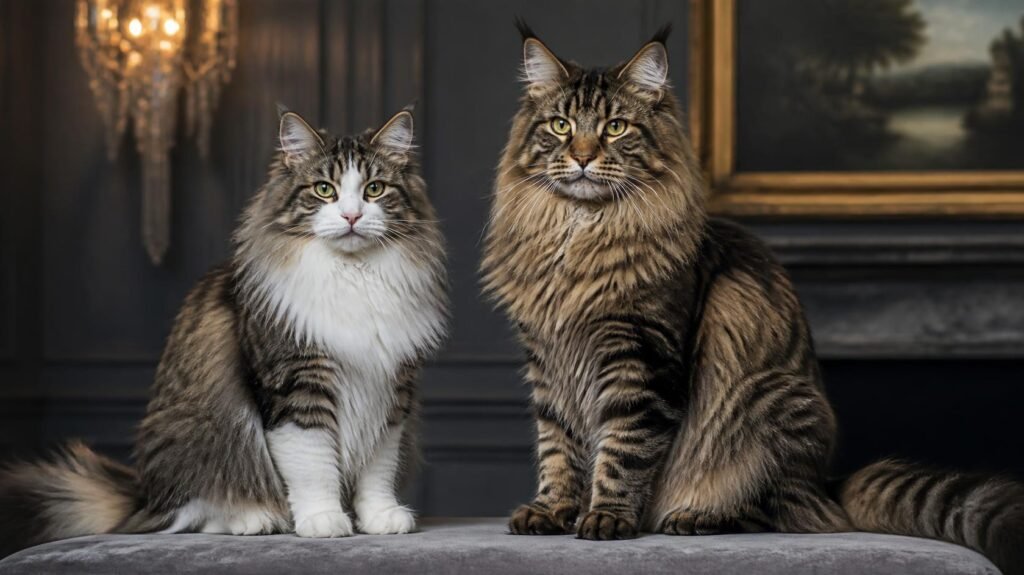
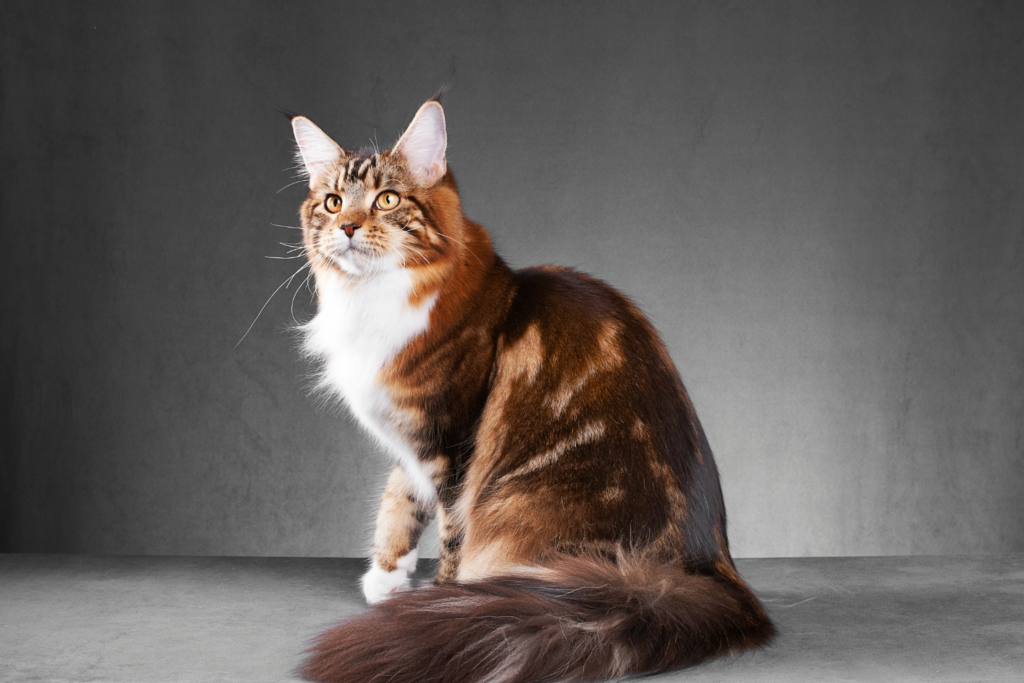
The Norwegian Forest Cat and Maine Coon can look like close relatives at first glance. Both are large, slow-maturing natural breeds with substantial bodies, furnished ears, long tails, and cold-weather coats. A brown tabby in full winter fur can make even an experienced cat lover pause.
Look beyond the fluff, however, and the breeds follow different designs. The Norwegian Forest Cat is built around a triangular head, straight profile, high hindquarters, and powerful climbing ability. The Maine Coon is longer and more rectangular, with a square muzzle, gently concave profile, and an often people-oriented social style.
Those differences matter when choosing a companion, planning grooming, evaluating a breeder, or buying adult-sized equipment. They do not make one breed universally better or guarantee an individual kitten’s personality, size, or health.
Official sources also disagree on some published weight and maturity figures. Rather than choosing the most dramatic range, this guide shows those discrepancies and explains what they mean for a real household.
The product recommendations are secondary: optional large-cat equipment examples whose manufacturer claims are qualified by fit, adoption, maintenance, and data limitations.
This evidence-based Norwegian Forest Cat vs. Maine Coon comparison explains what the official breed descriptions support, where published figures conflict, which health records deserve attention, and how to decide which cat fits your actual home.
How we reviewed this Norwegian Forest Cat vs. Maine Coon comparison: This is a research-based editorial guide, not a hands-on evaluation. We reviewed current TICA and CFA breed information, Cornell veterinary guidance, UC Davis genetic resources, feline environmental guidance, and manufacturer specifications for the three contextual products. Modern Cat Society has not purchased or field-tested those products. Manufacturer performance claims are identified as such.
Quick Verdict
Editorial verdict: Choose the Norwegian Forest Cat for affectionate independence and a stronger vertical drive; choose the Maine Coon for an often more visibly involved social style and rectangular size. Neither is a universal winner.
Best for: Prepared households that can provide large equipment, stable climbing and scratching territory, regular coat care, daily interaction, preventive veterinary care, and verifiable breeder health records.
Skip it if: You need guaranteed lap behavior, a precise adult weight, minimal shedding, or a low-maintenance pet. A temperament-assessed adult is more predictable when one behavior is non-negotiable.
Norwegian Forest Cat vs Maine Coon at a Glance
Factor
Norwegian Forest Cat
Maine Coon
Modern breed origin
Norway
Maine, United States
Fast visual shorthand
Triangle
Rectangle and square
Head
Equilateral-triangle impression
Slightly longer than wide; rectangular impression
Muzzle and profile
Muzzle follows the triangular lines; long, straight profile
TICA’s page gives two different sets: females 12–15 lb and males 18–22 lb in its summary, but females 9–13 lb and males 13–18 lb in detailed text
Maturity
Up to about 5 years
Roughly 3–5 years; TICA’s summary says about 4
Coat
Dense undercoat with long, water-repellent guard hairs
Smooth, shaggy, water-resistant coat with uneven length
Social tendency
Loving, interactive, often self-directed
Friendly, people-oriented, usually not overly dependent
Typical play bias
Climbing and high observation
Interactive chase, fetch, and household participation
Vocal style
Meows, chirps, and quiet conversation
Especially associated with soft chirps and trills
Grooming pattern
Regular combing; extra work during seasonal molt
Regular combing; frequency depends heavily on texture
Best fit
A home that respects independent affection and provides height
A home seeking an involved companion with room for a long, large cat
These are registry descriptions and useful tendencies—not personality contracts. Domestic longhairs and mixes can share many of the same features, and only reliable pedigree records can establish breed identity.
Origin and Breed Identity
The Norwegian Forest Cat, known in Norway as the skogkatt, developed as a Scandinavian natural breed. Its modern standard preserves features associated with a sturdy climbing cat adapted to a cold climate: strong hindquarters, a protective seasonal coat, and a substantial but athletic frame. TICA notes that the breed received organized protection in Norway during the twentieth century and later gained recognition in North America. [1]
The Maine Coon became established as North America’s native longhaired breed and is closely associated with the state of Maine. TICA describes it as a natural working cat shaped by the northeastern climate. Stories that Maine Coons descended from raccoons are biologically impossible; the famous tail and name do not change the fact that raccoons and domestic cats cannot interbreed. [2]
It is tempting to assume the two breeds must be directly related because both are large and weather-adapted. Their exact distant history contains uncertainty, but they are separate recognized breeds with different standards. Similar cold-climate features do not make every fluffy northern-looking cat a Norwegian, Maine Coon, or mix of the two.
Face and Head Shape: Triangle vs. Square
The face is the most useful visual starting point.
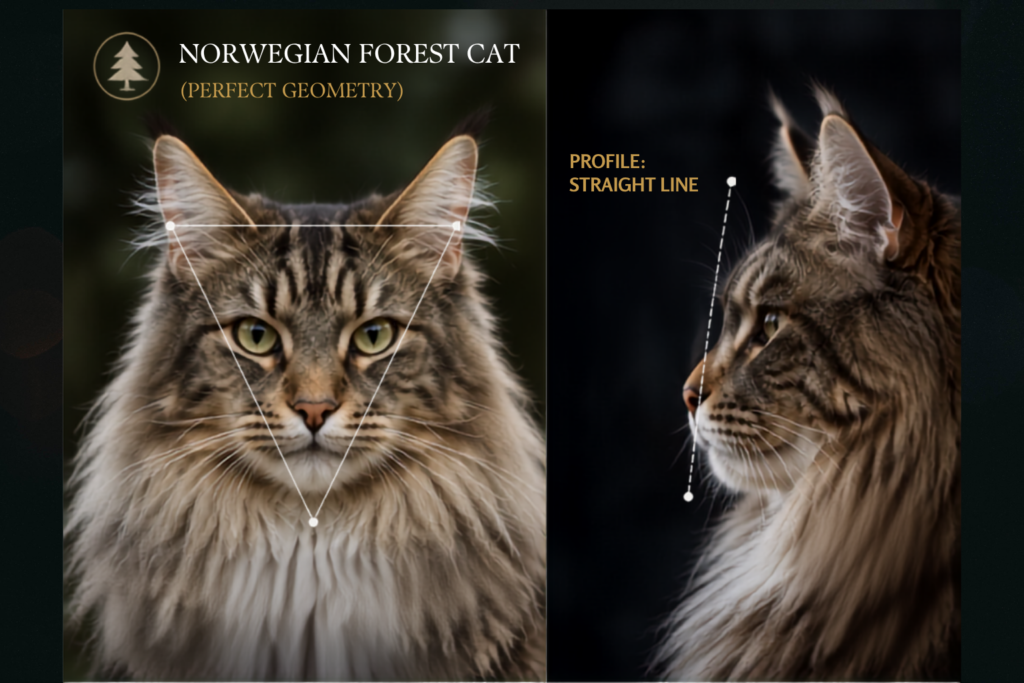
Norwegian Forest Cat: the triangle
Viewed from the front, the Norwegian Forest Cat’s head should form an equilateral-triangle impression. Imagine lines running from the outer base of each ear toward the chin. The forehead transitions into a long, straight nose profile without a stop, while the large almond-shaped eyes sit on a slight angle.
The muzzle should continue the lines of the head rather than forming the pronounced box seen on a Maine Coon. Heavily furnished ears and lynx-like tips may enhance the forest-cat look, but the CFA standard treats lynx tips as desirable rather than required. [3]
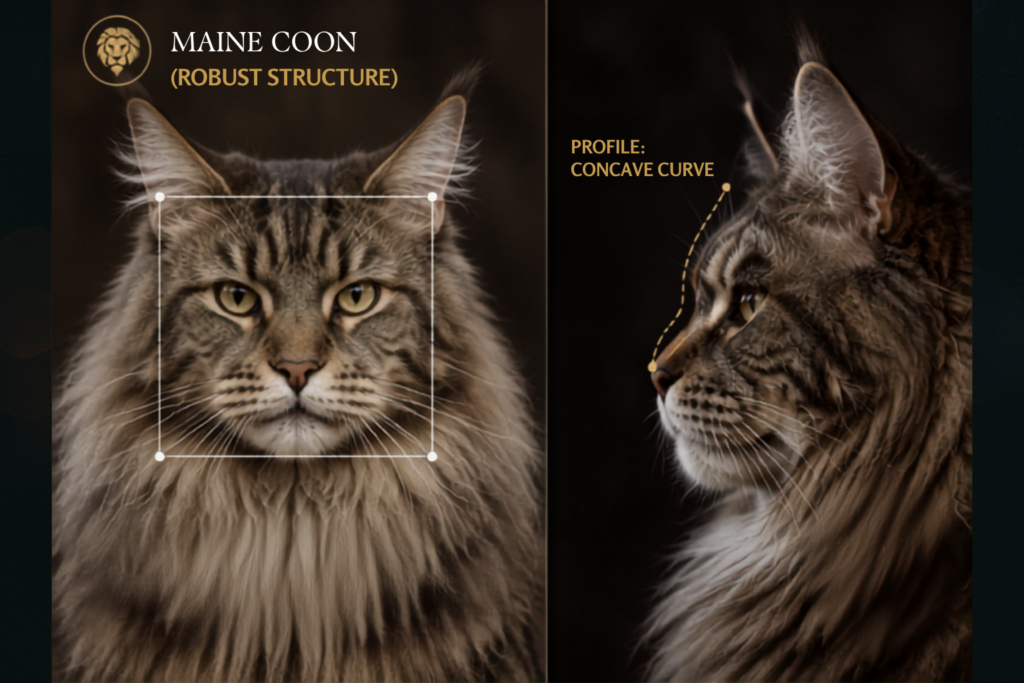
Maine Coon: the square muzzle
The Maine Coon’s head reads as longer and more rectangular. Its most recognizable feature is a strong, square muzzle. In profile, the nose has a gentle concavity rather than the Norwegian’s uninterrupted straight line. Large ears, expressive eyes, and a strong chin complete the rugged appearance described by CFA. [4]
The reliable visual shortcut
Norwegian Forest Cat: triangle plus straight profile.
Maine Coon: square muzzle plus gentle profile curve.
Do not rely on ear tufts, toe furnishings, tabby markings, or a bushy tail. Both breeds can display them, and so can cats without pedigree ancestry.
Size and Body Structure
Which breed is actually bigger?
The Maine Coon often produces the greater impression of length and can include exceptionally large males, but there is substantial overlap. An adult Norwegian Forest Cat can outweigh a smaller Maine Coon, and coat volume makes visual estimates unreliable.
Official numbers also demonstrate why one neat internet range is misleading:
TICA lists Norwegian females at 8–12 pounds and males at 12–18 pounds. CFA lists females at 9–12 pounds and males at 12–16 pounds. Both describe slow maturity that can take around five years. [1] [3]
TICA’s current Maine Coon page conflicts internally. Its “At a Glance” section lists females at 12–15 pounds and males at 18–22 pounds, while the detailed breed text gives 9–13 pounds and 13–18 pounds. The same page says four years in one section and three to five years in another. [2]
CFA avoids a full Maine Coon range but says a mature male may reach or exceed 20 pounds and females are usually smaller. [4]
Those differences are not a reason to select the most exciting number. Registries describe populations and ideals, not biological minimums. Adult weight depends on sex, lineage, age, frame, muscle, nutrition, neuter status, and body condition. A breeder who guarantees an enormous adult from a young kitten is selling certainty that responsible evidence cannot provide.
Norwegian Forest Cat body: the climbing build
The Norwegian is substantial and muscular, with heavy bone and powerful thighs. Its signature structural clue is that the hind legs are longer than the front legs, raising the rump above the shoulders. That architecture supports its strong jumping and climbing reputation. [1] [3]
Maine Coon body: the rectangle
The Maine Coon has a long, hard-muscled, rectangular torso, broad chest, substantial legs, large feet, and a flowing tail. Its size should remain balanced; CFA explicitly cautions that quality should not be sacrificed for exaggerated size. [2] [4]
When choosing carriers, beds, boxes, and perches, body length can matter as much as weight. A 16-pound Maine Coon may require more usable floor area than a compact cat of the same weight.
Coat, Colors, and Shedding
Both breeds developed protective semi-long coats, but their coat structures create different silhouettes.
Norwegian Forest Cat coat
The Norwegian has a dense woolly undercoat protected by long, glossy, water-repellent guard hairs. “Water-repellent” does not mean waterproof. In full winter coat, the cat can develop a prominent ruff, frontal bib, hind-leg britches, tufted paws, and a full tail. The summer coat may look dramatically shorter after the dense undercoat releases. [1] [3]
The effect is an insulated, somewhat rugged coat that follows the sides of the body. Some colors and textures are softer or more prone to tangles than others.
Maine Coon coat
The Maine Coon’s smooth, shaggy coat is shorter over the shoulders and longer along the sides, stomach, hind legs, and ruff. A long plumed tail amplifies the rectangular body. TICA describes the mature coat as two-layered and notes that texture can vary from relatively silky to cottony and higher-maintenance. [2]
Do they come in the same colors?
Both appear in many traditional colors and patterns, including tabbies, solids, tortoiseshells, and versions with white. Color is therefore a poor breed test. A brown tabby with a ruff and ear tufts may be either breed—or neither.
Which sheds more?
There is no defensible universal winner. Norwegian Forest Cats are known for a pronounced seasonal molt, especially when the winter undercoat releases. Maine Coons also shed and can mat, with workload influenced by texture, climate, indoor conditions, health, and grooming. Neither is a low-shedding choice.
Personality and Affection
Breed profiles describe averages and recurring tendencies. They cannot tell you whether one kitten will become a lap cat, greet visitors, tolerate handling, or enjoy another pet.
Norwegian Forest Cat personality
TICA and CFA portray the Norwegian as gentle, intelligent, playful, interactive, and affectionate, with a distinct independent streak. Many prefer to stay near their people, follow household activity, or watch from a high perch while retaining control over when close contact begins and ends. TICA specifically warns that someone seeking a guaranteed lap cat may find the breed unpredictable. [1] [3]
“Independent” should not be translated as unfriendly or content with neglect. Norwegian Forest Cats still need predictable interaction, play, environmental choice, and companionship suited to the individual.
Maine Coon personality
TICA describes the Maine Coon as highly people-oriented without being overly dependent. Many follow family members, supervise daily tasks, play fetch, and remain nearby rather than demanding constant physical contact. CFA similarly describes a moderate need for human interaction and a reputation for compatibility with respectful children and other animals. [2] [4]
The “dog-like” label can be useful shorthand for household involvement, but it can also create false expectations. A Maine Coon is still a cat with boundaries, species-specific needs, and individual preferences.
Which is more affectionate?
Neither breed wins affection as a measurable category. The practical distinction is often style:
A Norwegian may be loving while more clearly controlling access and retreating to height.
A Maine Coon may be more visibly involved in whatever the household is doing.
Individuals can reverse both patterns. If lap time, visitor confidence, or a specific handling tolerance is essential, consider a foster-assessed adult rather than predicting an unknown kitten from breed alone.
Vocalization
Maine Coons are famous for soft chirps and trills that can sound surprisingly small for their bodies. Norwegian Forest Cats may also chirp, meow, and converse, but neither should automatically be described as loud. Sudden, persistent, or distressed vocalization is a reason to consider health, environment, and veterinary advice—not simply breed character.
The Norwegian has the clearer climbing specialization. TICA highlights its strong hindquarters, high jumps, and preference for elevated seats, scratching structures, and observation points. A narrow decorative shelf is not enough; landings must be broad, stable, and arranged so the cat can descend safely. [1]
Maine Coon: interactive play with room to move
Maine Coons can climb, but TICA calls them less vertically oriented than some breeds and notes a tendency to chase objects on the ground and play fetch. Their length favors generous running paths, large platforms, and toys that can be pursued without forcing sharp turns in a cramped room. [2]
Can either breed live in an apartment?
Yes. Square footage alone does not determine feline welfare. A well-arranged apartment can offer more useful territory than a large but empty house.
Feline environmental guidance emphasizes a safe place, separated key resources, opportunities for play and predatory behavior, predictable positive social interaction, and respect for feline sensory needs. [9] For either breed, that means:
Stable elevated retreats and unobstructed escape routes.
Long scratching surfaces that permit a full-body stretch.
Daily interactive play with opportunities to stalk, chase, and catch.
Food, water, litter, sleep, and scratching resources that are not crowded together.
Secure screens and no access to unsafe balconies or unstable furniture.
The Norwegian generally benefits from a stronger vertical plan. The Maine Coon’s length makes wide resting surfaces and open floor routes especially valuable.
Children, Other Pets, and Time Alone
Both breeds have positive family reputations, but breed does not make introductions automatic.
With children, teach invitation rather than restraint. The cat needs a child-free retreat, the ability to leave, and protection from chasing, forced carrying, tail pulling, and disturbance during sleep or meals. A large gentle cat can still scratch or bite when frightened or trapped.
With dogs or other cats, use gradual introductions, scent exchange, controlled visual access, and short positive sessions. Distribute food, water, litter boxes, scratching areas, and resting places so one animal cannot block every valuable resource.
Neither “independent Norwegian” nor “social Maine Coon” means a cat should routinely be left without play, observation, care, or human contact. A second cat helps only when the pairing is compatible; acquiring two cats does not guarantee friendship.
Grooming: Which Breed Needs More Work?
Both require routine coat care. The honest answer is that the individual coat may matter more than the breed label.
Norwegian Forest Cat grooming
TICA describes weekly combing as usually sufficient, with additional work during one or two seasonal molts. CFA likewise recommends regular combing and more attention in spring. That is lighter than the schedule required by some longhaired breeds, but “low maintenance” is relative: a neglected undercoat can still form painful mats. [1] [3]
Maine Coon grooming
TICA says some silky coats are relatively easy while cottonier coats may need daily attention. CFA gives a practical baseline of combing two or three times per week to manage shedding and matting. Use coat condition, not a generic calendar, to adjust the routine. [2] [4]
A realistic routine for both
Begin with brief, rewarded sessions before the cat is fully grown.
Comb gently to the skin, especially behind the ears, under the front legs, across the belly, through the britches, and near the tail base.
Use your fingers to separate small tangles; never pull hard against the skin.
Do not cut close mats with scissors. Thin feline skin can be pulled into the blades.
Ask a veterinarian or qualified feline groomer for help with painful, widespread, or skin-tight matting.
Include nail care and veterinarian-guided dental care in the broader routine.
Sudden coat deterioration, greasy fur, new touch sensitivity, or an abrupt inability to self-groom may indicate pain or illness and deserves veterinary assessment.
Health Screening: What to Ask For
No responsible comparison can promise that either breed is healthier. The useful question is whether a breeder can show relevant, identifiable, dated records and explain how those results influence breeding decisions.
HCM matters in both breeds
Hypertrophic cardiomyopathy (HCM) thickens the heart’s ventricular walls and can lead to heart failure or blood clots. Cornell calls echocardiography the diagnostic gold standard for feline HCM. A cat may appear normal despite disease, so the absence of symptoms is not a screening result. [8]
For Norwegian Forest Cats, TICA says no breed-specific DNA test currently rules out HCM and recommends periodic echocardiographic screening of breeding cats. It also identifies pyruvate kinase deficiency and glycogen storage disease type IV (GSD IV) as relevant inherited conditions with available DNA tests. [1]
For Maine Coons, the UC Davis DNA test detects the breed-associated MYBPC3 A31P variant. That result informs risk, but it is not a complete HCM clearance: UC Davis reports HCM in Maine Coons that do not carry A31P, and the test detects only that specific variant. [5] TICA therefore recommends both the appropriate DNA result and periodic echocardiograms interpreted by a veterinary cardiologist. [2]
Breed-relevant screening table
Breed
Ask the breeder for
Why the limitation matters
Norwegian Forest Cat
Dated parental echocardiograms; GSD IV and PK-deficiency DNA results; any additional testing recommended for the lineage
A DNA panel cannot replace heart imaging. GSD IV is autosomal recessive and fatal in affected cats; genetic results allow breeders to avoid producing affected kittens. [7]
Maine Coon
Dated parental echocardiograms; A31P HCM DNA results; SMA DNA results; hip-dysplasia evaluation; line-specific records
A negative A31P result does not exclude every cause of HCM. Maine Coon SMA is autosomal recessive; affected kittens develop progressive instability and muscle atrophy, while carriers are clinically unaffected. [5] [6]
What useful documentation looks like
A meaningful record should identify the tested cat, date, method, result, laboratory or clinician, and enough information to connect the animal to the kitten’s sire or dam. An undated screenshot, a generic “DNA clear” badge, or proof that a distant ancestor was tested is not equivalent to current parent documentation.
Screening reduces avoidable risk; it does not guarantee lifelong health. Ask your veterinarian what evaluation is appropriate after acquisition and throughout adulthood.
Labored or open-mouth breathing, collapse, profound weakness, or sudden painful hind-limb weakness or paralysis can be emergencies associated with heart disease or blood clots. Seek emergency veterinary care rather than waiting for an ordinary appointment. [8]
How to Evaluate a Breeder or Rescue
Do not let giant-size marketing, rare colors, dramatic ear tips, or a polished website replace evidence.
Ask a breeder for:
Registered names and pedigrees for the sire and dam.
Verifiable health records relevant to the breed and lineage.
A written contract, health terms, and a return-to-breeder policy.
Veterinary, vaccine, parasite-control, and microchip records for the kitten.
An honest description of socialization, temperament, and home environment.
Permission to verify records with the issuing laboratory or clinic.
Avoid sellers who guarantee a huge adult, will not identify the parents, resist documentation, always have many breeds available, pressure immediate payment, or claim that one DNA panel proves a cat can never develop inherited disease.
Breed-specific rescue and adult rehoming are valid routes. A foster home may be able to describe mature size, affection style, child or dog comfort, litter habits, and grooming tolerance more reliably than anyone can predict those qualities in a kitten.
Home Setup for a Large Longhaired Cat
Large cats expose undersized equipment quickly. Marketing terms such as “XL,” “giant,” and “Maine Coon size” have no standardized meaning. Measure the actual cat and compare those measurements with usable interior space, entry height, platform width, and the manufacturer’s current load guidance.
Large-cat equipment checklist
Litter box: Enough usable room to enter, turn, dig, posture, and exit without squeezing.
Carrier: Interior length and door size that accommodate the cat comfortably; secure construction rated for the total load.
Cat tree: Wide base, stable joints, full-body resting surfaces, manageable level spacing, and wall anchoring when instructed.
Scratching surface: Tall or long enough for a complete stretch, with no rocking during vigorous use.
Food and water: Stable, easy-to-clean stations distributed so another pet cannot block access.
Backup plan: A manual litter box and ordinary water bowl remain useful when an automated device is being cleaned, charged, serviced, or rejected by the cat.
The Feline Veterinary Medical Association recommends multiple, separated key resources rather than clustering everything into one attractive “cat corner.” [9]
Three Contextual Products for Large Cats
Product
Best considered when
Verify before buying
Not a universal solution because
Neakasa M1 Plus
You want an open-top automatic litter box and your cat fits its current specifications
Some cats reject automation; it requires compatible clumping litter and ongoing maintenance
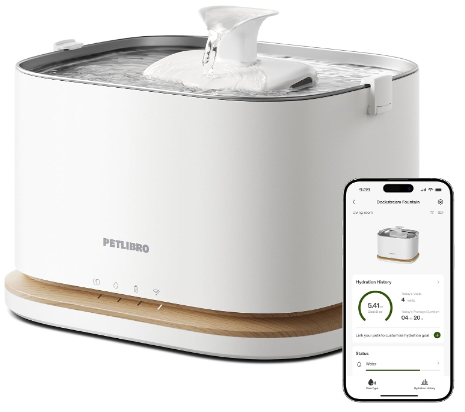
PETLIBRO Dockstream 2
You want a 3-liter fountain with app-based trend data
Cordless vs. plug-in model, Wi-Fi, one-pet tracking limitation, cleaning and filter costs
Standard tracking cannot identify multiple cats and is not diagnostic
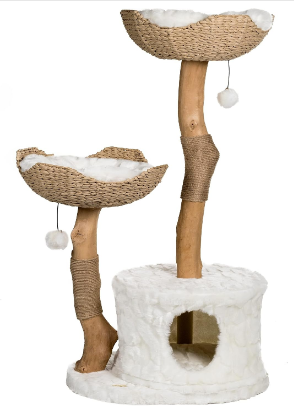
Mau Cento
You want furniture-style vertical territory for a cat within the current limit
Cat weight and body length, basket size, 23-inch base, 45.5-inch height, assembly and placement
Weight capacity does not prove that every long cat will fit comfortably
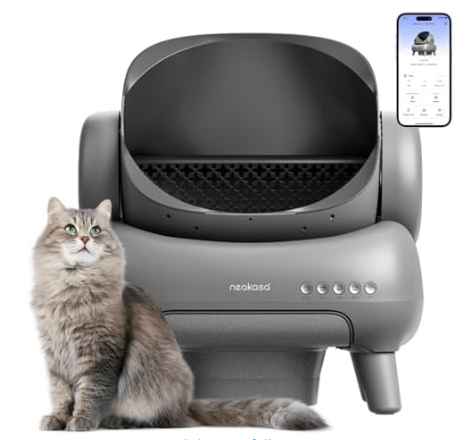
Neakasa M1 Plus: open-top automatic litter box
The Amazon listing retained from the original article calls this bundle the Neakasa M1 Plus. Neakasa’s current product page describes the M1 platform as an open-top automatic box for cats from 2.2 pounds to around 33 pounds, with a 13.86-inch entry, 7.17-liter litter capacity, and 11.23-liter waste bin. Those are manufacturer specifications, not our independent fit or endurance test. [10]
The open top may offer more headroom than an enclosed globe, but a published weight range does not establish that every long-bodied adult can turn and posture comfortably. Measure usable space. Neakasa says the sifting system works with fast-clumping scoopable litter within its particle guidelines and excludes several non-clumping or pellet-style substrates. Follow the current manual, introduce the box gradually, keep it clean, and retain a manual alternative.
PETLIBRO lists the Dockstream 2 Smart Fountain with a 3-liter reservoir, stainless-steel drinking tray, app connection, and 2.4 GHz and 5 GHz Wi-Fi support. The product line includes cordless and plug-in variants, so confirm which model the retailer is selling. [11]
For one cat, app data may help an owner notice a change worth investigating. It cannot confirm how much water a cat absorbed, diagnose disease, or replace cleaning and direct observation. PETLIBRO states that the standard Dockstream 2 tracks one pet at a time; in a multi-cat home, it cannot attribute visits to different cats. The company recommends routine refilling, cleaning, and filter replacement rather than treating the 3-liter capacity as permission to leave water unattended indefinitely.
Mau markets the Cento for cats up to 23 pounds and lists a 23-inch base and 45.5-inch height. It includes two woven baskets, removable cushions, a lower cave, jute-wrapped scratching areas, real-branch supports, and replaceable wear components. Because real branches and handmade elements can vary, verify the current product you are purchasing. [12]
The weight guidance is useful, but a very long Maine Coon or Norwegian Forest Cat can be within 23 pounds and still overhang a basket. Compare your cat’s resting length with current dimensions, assemble the unit exactly as instructed, place it on a level surface, check hardware periodically, and observe stability during dynamic jumps.
These are optional examples, not requirements or ranked winners. A well-sized manual litter pan, broad water bowl, and properly anchored conventional cat tree may fit your cat better and cost less.
Which Breed Fits Your Lifestyle?
Choose the Norwegian Forest Cat when…
You like affectionate companionship but respect a cat’s control over physical contact.
You can provide safe, stable vertical routes and high observation points.
You accept a substantial seasonal molt and will monitor the undercoat.
You will verify parental echocardiograms plus GSD IV and PK-deficiency records.
The triangular profile and athletic forest-cat build appeal to you more than promised size.
Choose the Maine Coon when…
You want an often involved cat that may follow household activity and enjoy interactive games.
You have room for an especially long body, broad platforms, and oversized equipment.
You can adapt grooming frequency to a coat that may be silky or cottony.
You will verify HCM DNA and cardiac imaging, plus discuss SMA and orthopedic screening.
The square muzzle and rectangular silhouette appeal to you without requiring a giant-weight guarantee.
Choose a known adult instead when…
Select a temperament-assessed adult if you require proven lap behavior, a known mature size, established comfort with children or dogs, or a predictable energy level. Breed can narrow expectations; observed adult behavior answers the question directly.
Neither list is a scorecard. A healthy, responsibly sourced individual whose needs fit your household is a better decision than the breed that appears to “win” the most rows.
Frequently Asked Questions
Is a Norwegian Forest Cat bigger than a Maine Coon?
Not consistently. Maine Coons often have greater length and some very large males, but official weight descriptions overlap and TICA publishes conflicting Maine Coon ranges on the same page. Compare the individual cat’s healthy body condition and measurements, not a promised number.
What is the easiest way to tell a Maine Coon from a Norwegian Forest Cat?
Look at the head. A Norwegian Forest Cat has a triangular head and long straight profile. A Maine Coon has a strong square muzzle, rectangular head impression, and gently concave profile.
Are Norwegian Forest Cats and Maine Coons related?
They are separate recognized breeds with different modern histories and standards. Similar coats, tails, and cold-climate adaptations do not prove close recent ancestry, and a domestic longhair with those traits is not automatically a mix.
Which breed is more affectionate?
Both can be deeply affectionate. Maine Coons are often described as visibly people-oriented, while Norwegians commonly combine affection with greater control over contact. Individual temperament and socialization matter more than the label.
Are Maine Coons or Norwegian Forest Cats better lap cats?
Neither offers a lap-cat guarantee. Official profiles note that many Maine Coons prefer staying nearby and many Norwegians choose when contact starts and ends. A known adult is the safer choice when lap behavior is essential.
Which breed is more vocal?
Maine Coons are particularly known for soft chirps and trills, but they are not necessarily loud. Norwegian Forest Cats may also chirp and meow. Sudden excessive vocalization should be evaluated in context rather than dismissed as a breed trait.
Which breed climbs more?
The Norwegian Forest Cat has the clearer vertical tendency, supported by longer hind legs and registry descriptions of strong climbing. Maine Coons can climb but are often associated with ground chase, fetch, and participation in household activity.
Which breed is easier to groom?
Norwegian Forest Cats often have the lighter baseline schedule, with weekly combing and more work during the molt. Maine Coon coat texture varies more visibly; some need modest care and cottonier coats may need frequent attention. The individual coat decides.
Which breed sheds more?
There is no universal answer. Norwegians can release a large seasonal undercoat, while Maine Coons also shed and may mat throughout the year. Climate, indoor heating, health, and grooming change the pattern.
Are both breeds good with children and dogs?
Both have positive family reputations, but safe outcomes depend on the individual animals, respectful children, gradual introductions, supervision, escape routes, and separated resources. Breed alone cannot guarantee compatibility.
Can a Norwegian Forest Cat or Maine Coon live in an apartment?
Yes, if the apartment offers usable territory: a large litter area, stable perches, full-length scratching, daily play, quiet retreats, and secure windows. Norwegians particularly benefit from vertical routes; Maine Coons need broad surfaces and room for their length.
What health tests should a breeder provide?
For a Norwegian, ask for dated parental echocardiograms plus GSD IV and PK-deficiency DNA results. For a Maine Coon, ask for dated echocardiograms, A31P HCM and SMA DNA results, and the breeder’s orthopedic screening plan. Verify the identity and date on every record.
Final Verdict
The Norwegian Forest Cat is the triangle: a straight profile, high hindquarters, strong climbing drive, seasonal protective coat, and affection commonly expressed with independence.
The Maine Coon is the rectangle: a square muzzle, long substantial body, uneven shaggy coat, people-oriented curiosity, interactive play, and characteristic chirps and trills.
Choose the Norwegian if self-directed affection and vertical athleticism fit your home. Choose the Maine Coon if you prefer an often involved household companion and can accommodate its length. Choose a known adult if personality predictability matters more than pedigree.
Do not buy either breed for a guaranteed giant, guaranteed lap cat, or effortless coat. Confirm health records, meet the actual cat, measure your equipment, and budget for appropriate veterinary care throughout a slow-growing cat’s life.
The best breed is not the one with the most dramatic silhouette. It is the healthy, responsibly sourced individual whose everyday needs match the life you can consistently provide.
Sources and References
The International Cat Association — Norwegian Forest. Structure, temperament, size, maturity, coat, climbing, grooming, and breed-relevant health guidance. View source
The International Cat Association — Maine Coon. Structure, temperament, internally differing size and maturity statements, coat, activity, grooming, and screening guidance. View source
Cat Fanciers’ Association — Norwegian Forest Cat. Breed standard, published size, maturity, coat, grooming, personality, and health information. View source
Cat Fanciers’ Association — Maine Coon Cat. Breed standard, size context, coat, grooming, temperament, and breeder-screening information. View source
UC Davis Veterinary Genetics Laboratory — Hypertrophic Cardiomyopathy in Maine Coons. A31P variant, associated risk, incomplete penetrance, and test limitations. View source
UC Davis Veterinary Genetics Laboratory — Spinal Muscular Atrophy in Maine Coon Cats. Clinical description, recessive inheritance, and interpretation of genetic results. View source
UC Davis Veterinary Genetics Laboratory — Glycogen Storage Disease Type IV in Norwegian Forest Cats. Clinical outcomes, recessive inheritance, and genetic-test interpretation. View source
Cornell Feline Health Center — Hypertrophic Cardiomyopathy. Disease overview, complications, and echocardiography guidance. Updated May 2025. View source
Feline Veterinary Medical Association — 2013 AAFP/ISFM Environmental Needs Guidelines. Five-pillar framework for a healthy feline environment. View source
PETLIBRO — Dockstream 2 Smart Fountain. Manufacturer specifications, model variants, app features, connectivity, capacity, care, and one-pet tracking limitation. View source
Mau Pets — Cento Cat Tree. Manufacturer weight guidance, dimensions, materials, care, and replacement-component information. View source
Method note: This article synthesizes current registry descriptions, veterinary resources, genetics information, environmental guidance, and manufacturer specifications. No individual cat, breeder, or product was physically tested for this comparison. Editorial recommendations are conditional and do not replace veterinary care.
Corrections policy: Modern Cat Society corrects factual errors when reliable evidence becomes available. Readers may contact the site with the source and passage that need review.
Sources, breed standards, veterinary guidance, genetic-testing information, and product specifications reviewed August 29, 2026. Registry pages, medical guidance, retailer terms, and manufacturer specifications may change. Verify critical details with the relevant registry, veterinarian, manufacturer, or retailer before making a decision.
10 Most Popular Cat Breeds in the U.S. in 2026 By Demosthenes Staudinger | Updated August 23, 2026 Affiliate disclosure: […]
Manage Consent
To provide the best experiences, we use technologies like cookies to store and/or access device information. Consenting to these technologies will allow us to process data such as browsing behavior or unique IDs on this site. Not consenting or withdrawing consent, may adversely affect certain features and functions.
Functional
Always active
The technical storage or access is strictly necessary for the legitimate purpose of enabling the use of a specific service explicitly requested by the subscriber or user, or for the sole purpose of carrying out the transmission of a communication over an electronic communications network.
Preferences
The technical storage or access is necessary for the legitimate purpose of storing preferences that are not requested by the subscriber or user.
Statistics
The technical storage or access that is used exclusively for statistical purposes.The technical storage or access that is used exclusively for anonymous statistical purposes. Without a subpoena, voluntary compliance on the part of your Internet Service Provider, or additional records from a third party, information stored or retrieved for this purpose alone cannot usually be used to identify you.
Marketing
The technical storage or access is required to create user profiles to send advertising, or to track the user on a website or across several websites for similar marketing purposes.