Minimalist Cat Furniture Review (2026): Which Pieces Are Worth It?
By Demosthenes Staudinger | Updated August 29, 2026
Cat furniture can solve real behavioral and environmental needs, yet much of it is designed as though color, scale, and materials do not matter. A bulky carpeted tower may give a cat somewhere to climb while making a carefully edited living room feel permanently improvised.
That tension has created a growing category of minimalist cat furniture: cat trees, wall systems, scratchers, perches, and litter boxes made with cleaner silhouettes, quieter colors, and materials that resemble human furniture. The best pieces do more than photograph well. They give a cat a stable place to climb, scratch, hide, rest, or eliminate.
The difficult part is separating useful design from decorative design. A narrow shelf can look elegant and still be too small for a cat to turn around. A sculptural scratching post can match the sofa and still be too short or unstable to attract the cat. A covered litter box can reduce visual clutter while providing less usable room than its exterior suggests.
This comparison examines five representative options from Mau, FUKUMARU, and Modkat. They serve different purposes, so there is no honest universal winner. The Mau Cento is our best documented all-in-one pick; the FUKUMARU floor and wall products target lower budgets or smaller rooms; and the Modkat XL addresses the visually difficult litter area.
The main limitation is adoption. Cats choose furniture according to stability, location, texture, accessibility, and individual preference, not because a finish is labeled modern. Measurements and return terms therefore matter as much as style.
Our preliminary verdict is that minimalist cat furniture is worth considering when it supplies a resource your cat already needs and fits the cat physically. It is poor value when appearance replaces stability, usable dimensions, or an appropriate setup.
How we reviewed minimalist cat furniture: This is a research-based editorial review, not a hands-on test. We evaluated current manufacturer specifications, official manuals and support resources, return and warranty policies, authoritative veterinary guidance, relevant independent research, and competing alternatives. Modern Cat Society has not yet purchased or field-tested these products. Manufacturer performance claims are identified as such.
Affiliate disclosure: This article contains affiliate links. As an Amazon Associate I earn from qualifying purchases. If you buy through one of these links, we may earn a commission at no additional cost to you. This does not affect our editorial recommendations.
Quick Verdict
Editorial verdict: Choose minimalist cat furniture by function first. The Mau Cento is the strongest premium all-in-one option in this group because its size guidance, care instructions, replacement parts, return window, and warranty are clearly documented. FUKUMARU offers more affordable and space-efficient formats, but its current documentation is inconsistent across some models. The Modkat XL is a design-forward litter solution only if its actual interior and entry dimensions suit your cat.
Best for: Design-conscious homes that need a stable vertical zone, a compact wall route, a visible scratching station, or a cleaner-looking litter area without hiding those resources in unsuitable locations.
Skip it if: Your cat has reduced mobility, dislikes covered litter boxes, needs platforms larger than the published dimensions, or would be better served by a simpler open tray, horizontal scratcher, ramped perch, or conventional tower.
| Review fact | Verified detail |
|---|---|
| Primary recommendation | Mau Cento modern cat tree |
| Product type | Floor-standing cat tree with two elevated baskets, a lower cave, scratching rope, cushions, and hanging toys |
| Published dimensions | 23-inch base and 45.5-inch height; approximately 38 lb packaged |
| Manufacturer cat-size guidance | Up to 23 lb per cat; this is not a guarantee that every basket will fit every large cat |
| Main materials | Real treated branches, hand-woven baskets, fabric cushions, and jute scratching rope |
| Cleaning | Removable cushions are machine washable under Mau’s specific care instructions; the structure is wiped or vacuumed |
| Assembly | Required; Mau provides an assembly video |
| Subscription | None |
| Optional recurring costs | Replacement cushions, baskets, rope, toys, and beds are sold separately |
| Direct-purchase return policy | Mau advertises a 45-day trial with free returns in the contiguous United States and Canada, subject to its terms |
| Warranty | One-year limited warranty against functional defects; normal wear is excluded |
| Price | Premium tier; price reviewed August 29, 2026. Verify current pricing and retailer terms |
| Main limitation | A 23 lb weight guideline does not confirm basket length, preferred sleeping posture, or easy access for every large or mobility-limited cat |
What Is Minimalist Cat Furniture?
Minimalist cat furniture is not a clinical or regulated product category. It is a design description applied to feline resources with restrained colors, simple forms, compact footprints, visible wood, washable textiles, or wall-mounted construction. The label says little about safety or behavioral value on its own.
Functional modern cat furniture usually falls into four groups:
- Vertical territory: floor trees, shelves, bridges, steps, and window-height perches.
- Scratching resources: vertical posts, horizontal boards, angled scratchers, or combinations with a bed.
- Resting and hiding areas: baskets, caves, hammocks, and partially enclosed platforms.
- Toileting solutions: visually restrained litter boxes or cabinets that contain an appropriately sized box.
Feline environmental guidance treats elevated areas, safe resting places, scratching surfaces, play opportunities, food, water, and toileting areas as distinct resources. Those resources should be accessible and, in multi-cat homes, distributed so one cat cannot control all of them.[11] A beautiful cat tree may combine several functions, but it does not replace every other resource.
The practical definition is therefore simple: minimalist cat furniture should solve a feline need with less visual noise. If a product merely resembles modern decor but is unstable, cramped, difficult to clean, or unacceptable to the cat, it is sculpture rather than useful cat furniture.
How Does Minimalist Cat Furniture Work?
The category works by integrating feline activity into the architecture of a room. A floor tree concentrates climbing, resting, hiding, and scratching into one footprint. Wall furniture converts unused vertical surface into a route. A scratcher places an acceptable texture where a cat is already motivated to mark and stretch. A modern litter box uses high sides, an entry design, and cleanable components to contain waste and litter more discreetly.
These mechanisms are straightforward; the challenge is matching them to behavior. A cat that scratches a rug may not transfer to an upright sisal post. A cat that wants a high observation point may ignore a low cave. A senior cat may value a soft bed but be unable to reach it without intermediate steps.
Location changes performance too. A scratching post hidden in a guest room may be irrelevant if the cat scratches after waking beside the living-room sofa. A perch beside a calm window can be valuable, while the same perch facing an outdoor cat that causes territorial distress may increase vigilance. Furniture needs to fit the cat’s actual routine, not an idealized floor plan.
Minimalism Does Not Mean One of Everything
In a multi-cat home, reducing the visible number of resources can create competition. FelineVMA guidance recommends multiple, separated key resources, including toileting, scratching, play, and resting areas.[11] Two pieces in different rooms may be more useful than one expensive statement tree everyone must share.
Coordinate finishes rather than removing needed options. Repeating light wood, walnut, cream, charcoal, or natural fibers can make several cat resources feel intentional without forcing cats into a single shared station.
Best Minimalist Cat Furniture at a Glance
| Product | Category | Published fit information | Best use | Important caveat |
|---|---|---|---|---|
| Mau Cento | Floor cat tree | 23-inch base, 45.5 inches tall; manufacturer guidance up to 23 lb per cat | Best documented premium all-in-one tree | Expensive, substantial, and not automatically spacious enough for every 23 lb cat |
| FUKUMARU Retro-Modern Cat Tree | Multi-level floor tree | Retailer title identifies a 53.5-inch model; current official page does not publish a complete measurement block | Value-oriented vertical territory with a wood-look finish | Confirm the exact SKU, dimensions, weight limits, and anchoring before purchase |
| FUKUMARU 4-in-1 Cat Wall Shelves | Wall system | Published component dimensions 16.9 by 6.3 by 11.6 inches; described for medium breeds and 16-inch stud spacing | Apartments and rooms with limited floor space | Installed route size and safe support depend on wall construction and correct mounting |
| FUKUMARU Retro-Style Scratching Post With Perch | Scratcher and bed | Reliable dimensions cannot be confirmed from the current official page | Compact scratching plus one elevated resting spot | The official specification block conflicts with the named product; verify before ordering |
| Modkat XL | Covered litter box | 21 by 16.5 by 17 inches; 10.25-inch top opening; 8.3 by 9.8-inch front opening | Design-conscious litter areas and cats that accept front or top entry | External size may still be below veterinary length guidance for a very large cat |
The table is not a ranking of interchangeable products. Choose the Cento or FUKUMARU tree when the unmet need is vertical territory; choose wall shelves when floor area is the constraint; choose a scratcher for clawing behavior; and consider the Modkat XL only for the litter zone.
Mau Cento: Best Overall Minimalist Cat Tree
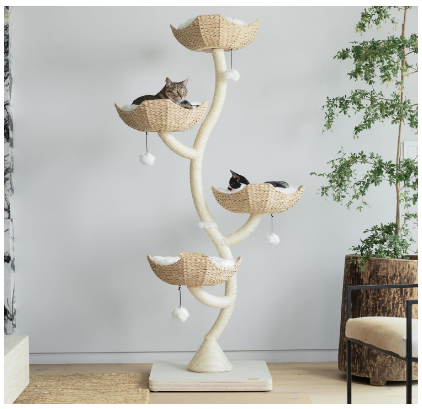
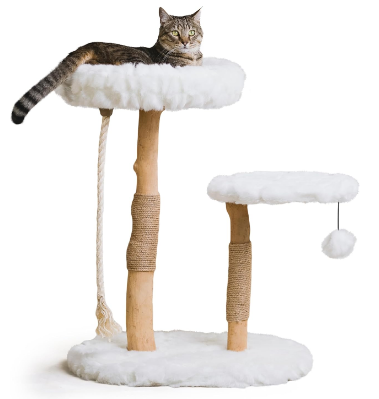
The Cento is the most convincing combination of design, function, and documentation in this comparison. It places two woven resting baskets above a lower cave, wraps two natural branch trunks in jute for scratching, and uses removable cushions. Mau lists a 23-inch base, 45.5-inch height, and suitability for cats up to 23 lb each.[1]
That specification makes it more plausible for substantial cats than many small decorative towers, but the number should be read correctly. It is manufacturer weight guidance for the structure, not proof that a long Maine Coon can fully stretch in every basket. Measure your cat’s relaxed sleeping length and compare it with the current basket drawings before buying.
The Cento also has a meaningful ownership advantage: wear components can be replaced. Mau currently offers baskets, cushions, repair rope, toys, and alternative beds, while the included basket cushions are machine washable under specific instructions.[1] Replacement access can extend useful life, although availability and color matching may change.
Its weaknesses are price, floor presence, and access. Forty-five and a half inches is useful vertical territory, but the route may still be demanding for a kitten, a cat with pain, or a senior with reduced jumping confidence. The cave is low, while the most desirable beds require climbing. Add a stable intermediate step if your veterinarian agrees that jumping should be reduced.
The Cento makes the most sense where it can remain in a socially important room. Hiding a premium tree in an unused corner removes much of its environmental value and much of the reason to pay for its appearance.
FUKUMARU Retro-Modern Cat Tree: Best Value Floor Tree
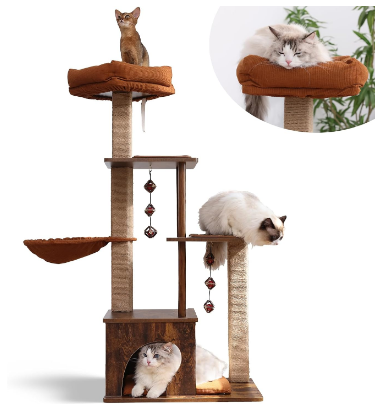
The FUKUMARU Retro-Modern Cat Tree follows a more conventional tower layout than the Cento but replaces the familiar carpeted look with wood-tone panels, neutral cushions, a hammock, a condo, and jute-covered scratching areas. It is the better stylistic fit for owners who want several levels without paying for a sculptural real-branch design.
The retailer title supplied for this guide identifies a 53.5-inch model. However, FUKUMARU’s current official product page does not expose a complete dimension, weight, platform-size, or load-limit block for that exact tower.[3] That missing documentation matters because height alone does not tell you whether an adult cat can turn, lie down, or land safely.
Treat it as a conditional value pick. Before ordering, confirm the exact listing title, overall footprint, largest platform dimensions, base weight, wall-strap requirements, and per-platform load guidance. Product images are not reliable measurement tools, especially when they show kittens.
The multi-level route may appeal to active adult cats and can provide more stepping options than a two-basket structure. It can also create more cleaning surfaces and more hardware to inspect. Detachable cushions are useful only if the current SKU actually includes them and the care label supports washing.
Choose this FUKUMARU when price and vertical levels matter more than replacement-part support or premium materials. Choose the Cento when you want clearer specifications, a longer direct return trial, and a more established replacement ecosystem.
FUKUMARU 4-in-1 Cat Wall Shelves: Best for Small Spaces
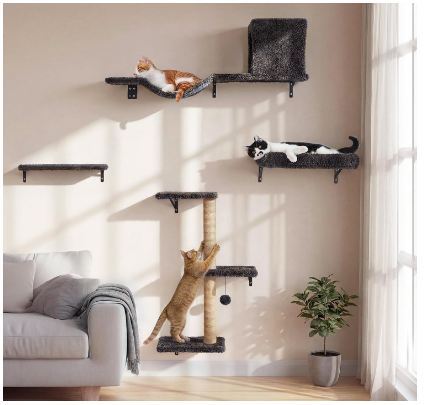
Wall furniture can add usable territory without taking another square foot of floor. FUKUMARU’s 4-in-1 set combines a bridge, bed, scratching post, and shelf. The current official page lists multi-layer board, polyester, and jute, describes the set for medium breeds, and publishes product dimensions of 16.9 by 6.3 by 11.6 inches.[4]
Those measurements appear to describe a component or packaged product rather than the span of a completed route. The amount of wall required depends on how widely the pieces are placed. Draw the full route with painter’s tape before drilling, including landing space and a safe way down.
FUKUMARU states that this version is designed around standard 16-inch U.S. stud spacing.[4] That does not mean every drywall installation is automatically safe. Cats jump onto shelves, creating dynamic force. Identify studs, confirm the wall material, use only compatible hardware, follow the supplied instructions, and stop using the system if any bracket, fastener, panel, or fabric loosens.
The best installation creates choices rather than a dead end. A cat should not be trapped on a high bed by another cat blocking the only descent. In a shared home, provide more than one route where feasible and keep food, water, litter, and resting resources distributed rather than clustering everything on one feature wall.[11]
This set is most attractive for confident, mobile cats in apartments. It is a poor default for cats with impaired balance, significant arthritis, or uncertain jumping ability unless a veterinarian-informed layout includes broad, nonslip, closely spaced steps.
FUKUMARU Retro-Style Scratching Post With Perch: A Conditional Compact Pick
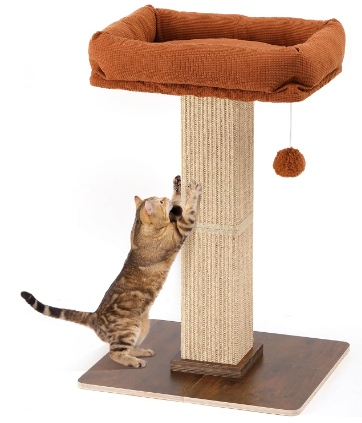
A combined scratching post and perch can be efficient in a small room: one base offers a vertical marking surface and an elevated resting spot. The FUKUMARU model uses a wood-look base, natural-sisal positioning, and a padded top in the retailer material supplied for this comparison.
We cannot give its dimensions the same confidence as the Mau or Modkat specifications. The current official FUKUMARU page names the retro-style post with perch, yet its specification block describes a 57-inch, 88 lb structure with four scratching posts and a 100 lb capacity.[5] Those details do not correspond to the compact product identity shown in the page title or the supplied retailer description.
That conflict is more than a typographical nuisance. Post height, base width, and perch diameter determine whether the product can support a full stretch and whether the cat can rest comfortably. Until the exact SKU is confirmed, do not rely on either the official block or the draft’s smaller measurements.
If the retailer’s current product is the compact post pictured, it may suit an average-size cat that already scratches vertically. A cat that scratches carpets or lies flat against cardboard may prefer a wide horizontal scratcher instead. Offering both orientations is often more effective than expecting a single attractive post to change an established preference.
Buy only after checking the current listing’s assembled dimensions, weight limit, anti-tip instructions, return terms, and replacement-sisal availability. The product idea is sound; the documentation is presently the weakness.
Modkat XL: Best Minimalist Litter Box
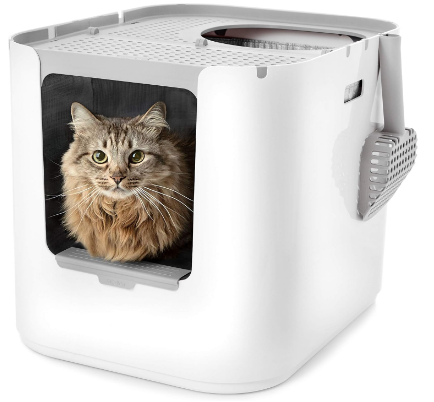
The Modkat XL is included because the litter area is often the hardest part of a modern room to integrate. It can be configured for top entry, front entry, or both, and uses a tall seamless base, swiveling lid, walk-off surface, scoop, odor-filter holder, and reusable liners.
Modkat publishes an exterior size of 21 by 16.5 by 17 inches and a product weight of 9 lb. The top opening is 10.25 inches, the front opening is 8.3 by 9.8 inches, and the front sill sits 6.25 inches above the floor. The lid is listed to support 30 lb.[7]
Those figures are more useful than the word XL. Feline house-soiling guidance says a litter box should generally be about 1.5 times the cat’s nose-to-tail-base length, and older cats may need a low entrance.[12] Because 21 inches is an external measurement, the Modkat XL may still be too short inside for a very long cat. Measure the cat and the usable base, not just the product’s marketing category.
The configurable entrance is valuable. A healthy, agile cat may use the top and shed some litter on the textured lid. A senior cat, kitten, or top-entry skeptic can use the front. However, a 6.25-inch sill is not truly low for every mobility-limited cat, and a covered box can be unacceptable to an individual that prefers an open field of view.
Modkat says its Type C and Type D tarpaulin liners are reusable and can last up to three months.[7] That is a manufacturer estimate, not a fixed replacement interval. Scratches, odor, washing, and the cat’s elimination pattern affect service life. Proprietary liners and filters create optional recurring costs that an open plastic tray does not.
Choose the XL for configurable entry, tall sides, and a finished appearance. Choose a large uncovered storage-style tray when maximum usable length, low entry, low cost, or unobstructed escape matters more than concealment.
Feline Function Comes Before Interior Design
Vertical Territory Must Be Usable
Elevated space expands a cat’s usable territory and offers observation and rest away from floor-level activity.[11] More height is not automatically better. Platforms need sufficient width, nonslip footing, manageable gaps, and a route that matches the cat’s age and mobility.
Watch how your cat moves before buying. A confident adult that already sleeps on a bookcase may readily adopt shelves. A cautious cat that climbs only by using chairs may prefer a floor tree with closely spaced levels. Sudden reluctance to jump can indicate pain or illness and deserves veterinary attention rather than a more elaborate climbing wall.
Scratching Requires the Right Orientation and Location
Scratching is normal behavior used for claw maintenance, stretching, and visual and scent communication. A useful scratcher is stable and placed where the cat wants to scratch. It may need to sit beside a damaged sofa, near a sleeping area, or along a familiar route rather than in the least visible corner.
Match orientation to evidence. Sofa-arm scratching suggests a vertical or angled option; rug scratching suggests horizontal material. Texture matters too. Sisal, cardboard, wood, and fabric do not feel interchangeable to a cat. Minimalism should coordinate several accepted surfaces, not reduce choice to one beautiful but ignored post.
A Stylish Litter Box Still Has to Be a Good Toilet
The litter box must be large enough, clean, accessible, and located where a cat cannot be cornered. FelineVMA guidance recommends one box per cat plus one extra in multiple locations and warns that boxes beside each other function like one resource.[12]
A cabinet can make an inadequate box even more confined. If you use an enclosure, measure its interior after accounting for hinges, doors, and ventilation, and make sure the cat can enter, turn, dig, and exit without another cat blocking the path. An attractive open tray is better than a cramped hidden one.
Size, Stability, Installation, and Adoption
Measure three things before shopping: the cat, the product, and the route around it. Record the cat’s standing nose-to-tail-base length, relaxed sleeping footprint, full scratching reach, body weight, and comfortable jump height. Then compare those numbers with platforms, baskets, openings, and entry sills rather than overall product dimensions.
For floor trees, place painter’s tape around the stated base and include clearance for tails, cleaning, doors, and walking paths. Use any wall restraint specified by the manufacturer. Recheck bolts after assembly and periodically thereafter. A wobbling tree teaches a cat to distrust it.
For wall furniture, plan takeoff, landing, turning, and descent. Mounting hardware must match the wall and structural support. Do not improvise around electrical wiring, plumbing, damaged drywall, or uncertain studs. Professional installation is reasonable when the wall construction or load path is unclear.
Introduce new furniture without forcing the cat. Assemble it away from the cat if noise causes stress, then place familiar bedding or a small amount of catnip only if the cat responds positively to it. Reward voluntary investigation. Do not lift a frightened cat onto a high platform or close a reluctant cat inside a covered box.
Keep the old resource during the transition. A new scratching post should overlap with the old scratcher; a new litter box should be offered beside the existing routine before any accepted box is removed. Adoption may take days or weeks, and some cats will reject a product despite careful introduction.
Return Policy and Warranty
Return policies matter because adoption cannot be guaranteed. They also differ according to seller, so direct-purchase terms should not be assumed for an Amazon order.
Mau currently advertises a 45-day return period from delivery with free returns and a full refund for direct orders within the contiguous United States and Canada. The item must be repackaged, damage may reduce the refund, expedited shipping is not refundable, and international conditions differ. Mau’s one-year limited warranty covers functional defects but excludes normal wear.[8]
For a Cento bought through Amazon, review the exact seller, return window, condition requirements, and warranty route on the retailer page before ordering. A manufacturer trial and a retailer return policy are not automatically interchangeable.
FUKUMARU’s official U.S. homepage displays a 30-day return and three-month warranty headline.[6] The accessible product pages do not consistently show detailed coverage, exclusions, return-freight responsibility, or how opened furniture is handled. Confirm those terms in writing for the exact seller and SKU, especially for mounted products that cannot be returned to an unused condition after installation.
Modkat accepts direct returns within 30 days of receipt. Its U.S. policy deducts a return-shipping fee for litter boxes, original shipping is nonrefundable, and the policy applies to items purchased from Modkat’s site.[9] The company also advertises a one-year warranty against manufacturing defects.[10] Amazon purchases follow the applicable retailer and seller terms.
None of these products requires a subscription. Optional costs include Mau replacement parts and Modkat liners or filters. FUKUMARU replacement availability is model-specific and should be confirmed before purchase.
Mau Cento vs. Mau Rizzo vs. FUKUMARU Retro-Modern Cat Tree
| Feature | Mau Cento | Mau Rizzo | FUKUMARU Retro-Modern |
|---|---|---|---|
| Format | Two baskets, lower cave, two scratching trunks | Two open resting levels, two scratching posts, hanging rope | Conventional multi-level tower with hammock and condo |
| Published height | 45.5 inches | 32 inches | Retailer title says 53.5 inches; official measurement block unavailable |
| Published base | 23 inches | 23 inches | Verify exact current SKU |
| Manufacturer cat guidance | Up to 23 lb each | Up to 16 lb each | Verify exact current SKU |
| Replaceable wear parts | Yes | Yes | Not clearly documented for this exact tower |
| Direct return and warranty | 45-day trial; one-year limited warranty | 45-day trial; one-year limited warranty | Homepage headline: 30-day return; three-month warranty |
| Best scenario | Larger cats and a premium living-room focal point | Smaller cats needing a lower, simpler Mau tree | More levels and lower purchase cost |
The Cento is the better Mau choice for higher published cat-size guidance, a cave, and two basket beds. The Rizzo is lower, less expensive, and easier to integrate when a cat does not need as much height; Mau lists it at 32 inches with guidance for cats up to 16 lb.[2] The FUKUMARU is the value route, but the missing official measurements make pre-purchase verification essential.
Minimalist Furniture vs. a Traditional Cat Setup
| Decision factor | Designed minimalist furniture | Traditional or modular solution |
|---|---|---|
| Appearance | Coordinated wood, neutral textiles, or enclosed forms | More utilitarian materials and visible pet equipment |
| Upfront cost | Often higher | Usually lower and easier to replace |
| Customization | Limited to the product’s geometry | Individual steps, boxes, scratchers, and beds can be mixed |
| Large-cat fit | Depends on published platform and opening dimensions | Oversized utility trays and broad shelves may offer more usable room |
| Senior accessibility | Some models are demanding | Low trays, ramps, and closely spaced stools can be easier |
| Maintenance | Washable or proprietary parts vary | Simple surfaces and generic replacements are often easier |
| Adoption risk | A costly integrated piece may go unused | Separate low-cost resources can be tested one at a time |
Choose minimalist furniture when a well-documented product solves a specific need and will remain where the cat uses it. Choose a modular setup when you need unusual dimensions, several resource locations, low entries, or the ability to test different scratching orientations cheaply.
Pros and Cons
| Pros | Cons |
|---|---|
| Makes essential cat resources easier to keep in central rooms | Design-led products often cost more than utilitarian equivalents |
| Can combine climbing, resting, hiding, and scratching in one footprint | One integrated piece does not replace separated resources in a multi-cat home |
| Neutral materials can coordinate with existing furniture | Cats may reject a product regardless of its appearance or price |
| Wall systems preserve floor space | Installation quality and wall construction determine safety |
| Washable textiles can simplify routine care | Care instructions vary and some fabrics cannot tolerate ordinary detergent |
| Replaceable Mau components may extend product life | Replacement parts remain dependent on future manufacturer availability |
| Published dimensions allow more informed fit decisions on Mau and Modkat | Several FUKUMARU pages lack or conflict on critical specifications |
| Modkat XL offers front and top entry rather than one fixed format | Covered litter boxes and a 6.25-inch sill do not suit every cat |
| A visible scratcher can protect furniture when placed correctly | Compact posts may be too short or narrow for a full stretch |
| A coordinated palette can reduce visual clutter without removing resources | Minimalism can become harmful if it is used to justify too few resources |
Who Should Buy Minimalist Cat Furniture?
Buy it if you are willing to measure carefully, place resources where your cat uses them, and pay for materials or forms that can remain visible in your living space. The Mau Cento particularly suits owners seeking one documented premium tree for an adult cat that climbs confidently. FUKUMARU wall furniture suits smaller homes with appropriate studs and a mobile cat. Modkat XL suits cats that accept an enclosed toilet and fit its actual openings and base.
Choose another solution if your priority is the lowest cost, maximum litter-box length, easy senior access, or flexible resource distribution. A heavy conventional tree, large open storage-style litter tray, horizontal cardboard scratcher, or series of low stools may serve the cat better.
Multi-cat homes should budget for duplication and separation. Do not buy one statement tree and assume it resolves access for cats that avoid one another. The most compatible alternative may be several simpler pieces in different rooms.
How to Get the Most From Minimalist Cat Furniture
Measure the Cat, Not the Breed Label
Breed names and weight limits are shortcuts. Measure body length, sleeping posture, shoulder width, scratch reach, and comfortable jump height. A dense 18 lb cat and a long 18 lb cat may need different basket dimensions.
Map the Footprint Before Ordering
Use painter’s tape for bases, litter-box clearance, doors, and traffic paths. For wall systems, tape every component and draw the likely route. Confirm there is a safe first step and a safe way down.
Install Exactly as Directed
Use the manufacturer-specified hardware and structural support. Tighten all fasteners, apply required restraints, and inspect the product after the first week of use. Stop access immediately if a shelf shifts, a base rocks, a basket loosens, or scratching rope exposes a hazardous fastener.
Introduce It Gradually
Keep accepted furniture available while the cat investigates the new option. Use familiar scent, play, or treats to encourage voluntary contact. Never place a cat on a high shelf or lock it into an unfamiliar litter enclosure.
Put Each Resource Where the Behavior Happens
Place scratchers near current scratching sites or sleeping areas, trees in rooms where the household spends time, and litter boxes in quiet locations with unobstructed access. The aesthetically easiest location is not always the behaviorally useful one.
Maintain the Function, Not Just the Look
Vacuum beds, wash removable textiles according to the label, scoop litter at least daily, and inspect sisal, liners, brackets, and bolts. Replace worn components before they become uncomfortable or unsafe. Do not use strong scents merely to make cat furniture smell new.
Frequently Asked Questions
What is the best minimalist cat furniture overall?
For an all-in-one floor tree, the Mau Cento is our strongest research-based pick because Mau publishes its dimensions, cat-size guidance, care instructions, replacement options, return policy, and warranty. It is still conditional on your cat fitting the baskets and reaching the levels comfortably.
Is the Mau Cento suitable for a Maine Coon?
Mau lists the Cento for cats up to 23 lb each.[1] That can include some Maine Coons, but weight alone is not enough. Compare your cat’s body and sleeping length with the current basket measurements and consider how easily the cat can move between levels.
Do indoor cats really need vertical space?
Elevated areas can expand usable territory and let cats rest or observe from a position away from floor-level activity. Feline environmental guidance includes elevated space among important household resources.[11] The height and route should match the individual cat’s mobility.
Are wall-mounted cat shelves safe?
They can be safe when the wall construction, fasteners, layout, and product instructions are compatible. The FUKUMARU set is designed around 16-inch stud spacing, but that claim does not remove the need to locate structural support and inspect the installation.[4] Hire a qualified installer if the wall is uncertain.
How far apart should cat wall shelves be?
There is no universal spacing because reach, confidence, age, and direction of travel vary. Recreate distances your cat already navigates comfortably, provide broad landing surfaces, and make the first arrangement conservative. Avoid a high dead end or a route another cat can block.
Is a minimalist scratching post enough?
Only if its orientation, material, height, stability, and location match the cat’s preference. Many homes need both vertical and horizontal options. A post with a perch does not help if the cat wants corrugated cardboard on the floor.
Is the Modkat XL large enough for a large cat?
It measures 21 by 16.5 by 17 inches externally.[7] Veterinary guidance generally favors a box about 1.5 times the cat’s nose-to-tail-base length.[12] Measure the interior usable floor and your cat; some long cats will need a larger open tray despite the XL name.
Can a senior cat use a top-entry litter box?
Some can, but top entry requires climbing and controlled descent. The Modkat XL has a front-entry option, although its sill is 6.25 inches high.[7] Cats with pain, weakness, or reduced mobility may need a lower open box, and a change in litter-box use warrants veterinary discussion.
How many litter boxes does a multi-cat home need?
A common veterinary guideline is one box per cat plus one extra, placed in multiple locations rather than grouped together.[12] Social relationships and the floor plan also matter because one cat should not be able to block another from toileting.
How long should I give a cat to adopt new furniture?
Allow days or weeks and preserve the old resource during the transition. Encourage exploration without force. If a cat avoids a new litter box, restore an accepted option immediately rather than waiting for an accident.
Do these products require subscriptions or proprietary supplies?
No product in this guide requires a subscription. Mau sells optional replacement parts. Modkat uses fitted liners and offers filters, although the box still requires ordinary litter and manual scooping. FUKUMARU part availability varies by model.
What return policy applies if I buy through Amazon?
Check the exact seller and product page before ordering. Mau, FUKUMARU, and Modkat publish terms for direct purchases, but those terms do not automatically replace Amazon’s applicable return conditions. Save the listing, order confirmation, and packaging until the cat has accepted the product.
Final Verdict: Is Minimalist Cat Furniture Worth It in 2026?
Yes, minimalist cat furniture can be worth it when design helps you keep a useful resource in the room where your cat needs it. The strongest purchase is not the piece that looks least like cat furniture. It is the one that combines appropriate dimensions, stability, access, cleanability, and a realistic return path with a form you are happy to live beside.
The Mau Cento is our best overall choice in this group for a premium floor tree because its specifications and ownership terms are comparatively transparent. The FUKUMARU options can deliver more vertical function for less money or preserve floor space, but incomplete and conflicting documentation requires extra verification. The Modkat XL is a thoughtful litter-box design, not a universal large-cat solution.
Choose traditional equipment when it fits better. A wide open litter tray, tall basic sisal post, or heavy conventional tree may be less photogenic and more appropriate for a particular cat. Good feline design is measured by use, not by how successfully it disappears.
Read more:
Beyond the Ugly Carpet: 5 Modern Cat Trees That Actually Look Like Sculptures
The Complete Guide to Keeping Your Indoor Cat Healthy and Happy
Sources and References
- Mau — Cento. Product configuration, 23-inch base, 45.5-inch height, manufacturer guidance for cats up to 23 lb, materials, care, replacement parts, return period, and limited warranty. View source
- Mau — Rizzo. Published 32-inch height, 23-inch base, manufacturer guidance for cats up to 16 lb, replaceable components, direct return period, and limited warranty. View source
- FUKUMARU — Cat Tree, 4 in 1 Large Modern Cats Tower. Current official product identity and the absence of a complete accessible dimension and load specification block for the compared tower. View source
- FUKUMARU — Cat Wall Shelves Stable & Safe 4 in 1 Furniture Set. Published component dimensions, materials, intended use, medium-breed description, included elements, and 16-inch stud guidance. View source
- FUKUMARU — Retro-Style Tall Scratching Post With Perch. Product identity and the conflicting dimension, weight, and feature block that prevents confident specification reporting. View source
- FUKUMARU — Official U.S. Store. Published headline terms for a 30-day return and three-month warranty; detailed conditions should be confirmed for the exact seller and SKU. View source
- Modkat — Modkat XL. Exterior dimensions, product weight, entry measurements, lid capacity, configurations, included components, liner types, and manufacturer liner-life claim. View source
- Mau — Shipping, Returns, & Warranty. Direct-order shipping area, 45-day return process, packaging and refund conditions, regional limitations, and warranty terms. View source
- Modkat — Return & Donate. Direct-purchase 30-day return window, U.S. litter-box return fee, nonrefundable original shipping, and seller limitations. View source
- Modkat — Official Store and Ownership Policies. One-year warranty against manufacturing defects and the company’s current high-level shipping and return statements. View source
- Feline Veterinary Medical Association — Your Cat’s Environmental Needs. Guidance on elevated space, safe places, scratching, play, and multiple separated resources in cat-friendly homes. View source
- Feline Veterinary Medical Association — Feline House-Soiling. Litter-box number, location, size, maintenance, multi-cat access, and low-entry considerations for older cats. View source
Sources, specifications, prices, and policies reviewed August 29, 2026. Product features, retailer terms, warranty coverage, and manufacturer guidance may change. Verify critical details with the manufacturer or retailer before purchasing.