Norwegian Forest Cat: Complete Guide to Personality, Size, Care, Health, and Ownership
By Demosthenes Staudinger | Updated August 29, 2026
Affiliate disclosure: This article contains affiliate links. As an Amazon Associate I earn from qualifying purchases. If you buy through one of these links, we may earn a commission at no additional cost to you. This does not affect our editorial recommendations.
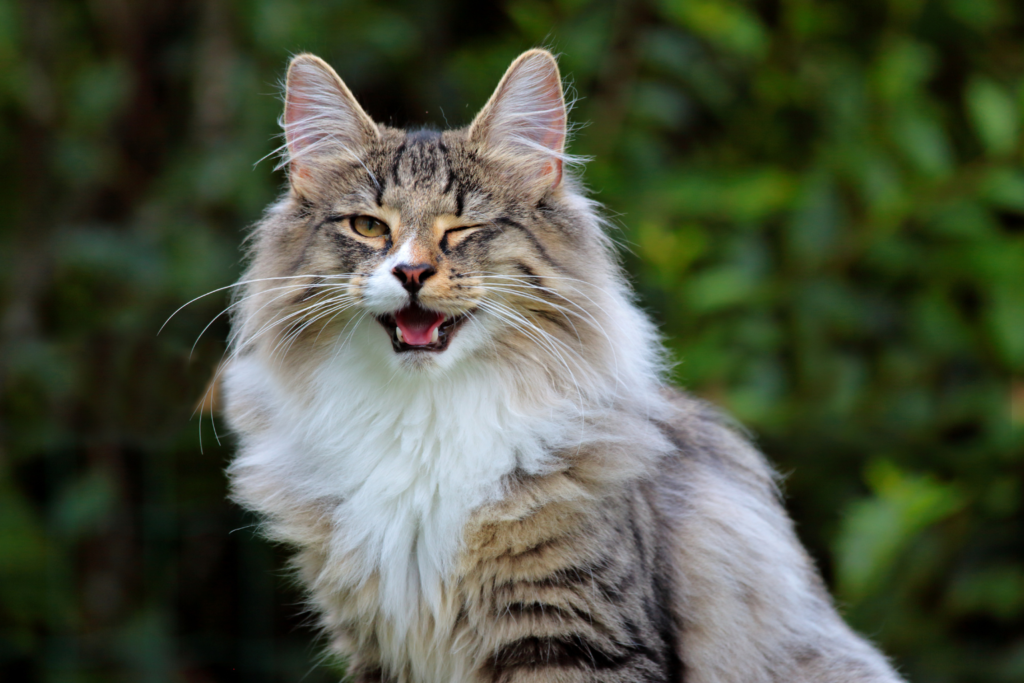
The Norwegian Forest Cat looks built for a legend: a muscular body, sweeping tail, tufted ears, substantial paws, and a dramatic seasonal coat. In Norway, the breed is called the skogkatt, or “forest cat.” Among admirers, the affectionate nickname is “Wegie.”
Its appearance may be rugged, but its typical personality is more nuanced. Norwegian Forest Cats are often affectionate, observant, playful, and involved in family life without demanding continuous physical attention. Many prefer sitting beside their people, following them through the home, or watching from a high perch to remaining in a lap for hours.
That independence does not make the breed effortless. A Wegie is a powerful climber, a slow-maturing cat, and the owner of a dense double coat that changes with the seasons. It needs stable vertical territory, appropriately sized everyday equipment, routine grooming, interactive play, preventive veterinary care, and companionship.
Those needs can fit beautifully into a modern home. A few correctly sized resources can support normal feline behavior while preserving an intentional interior.
This guide explains the breed’s needs, corrects exaggerated claims, identifies meaningful health tests, and helps you decide whether a Norwegian Forest Cat fits your household.
How we researched this Norwegian Forest Cat guide: This is a research-based editorial guide, not a hands-on product test or veterinary diagnosis. We compared current breed information from TICA, CFA, and FIFe; reviewed feline health and genetics resources from Cornell University and the UC Davis Veterinary Genetics Laboratory; and checked current product specifications on the manufacturers’ websites. Product fit still depends on your cat’s measurements, behavior, health, and tolerance. Consult your veterinarian about individual medical, nutritional, or grooming concerns.
Quick Verdict
Editorial verdict: The Norwegian Forest Cat can be an excellent companion for someone who wants a gentle, intelligent, athletic cat and is prepared to provide climbing space, coat care, enrichment, and responsible health screening.
Best for: Households that appreciate an affectionate but self-directed cat, can accommodate substantial vertical territory, and are comfortable with seasonal shedding and a long maturation period.
Skip it if: You want a reliably sedentary lap cat, dislike loose fur, cannot provide safe climbing opportunities, or are choosing the breed primarily for an exaggerated “giant cat” appearance.
Norwegian Forest Cat at a Glance
Characteristic
Typical Norwegian Forest Cat
Origin
Norway / Scandinavia
Norwegian name
Skogkatt (“forest cat”)
Common nickname
Wegie
Adult female weight
TICA: about 8–12 lb; CFA: about 9–12 lb
Adult male weight
TICA: about 12–18 lb; CFA: about 12–16 lb
Maturity
May take up to five years
Life expectancy
TICA lists 13+ years
Coat
Semi-long double coat with a dense undercoat and water-repellent guard hairs
Personality
Intelligent, affectionate, playful, independent, generally mild-mannered
Activity
Moderate to active; notably capable climber
Grooming
Weekly is a common baseline; more during seasonal molt
Best home feature
Stable, generously sized vertical territory
Weight ranges describe populations, not a target for every cat. Frame, sex, age, genetics, muscle, and body fat all affect the number on the scale. Healthy body condition matters more than making a Wegie as heavy as possible.
Norwegian Forest Cat Origins, History, and Viking Legends
The Norwegian Forest Cat is considered a natural breed associated with Norway’s harsh climate. Its substantial body and protective double coat are often described as adaptations shaped over generations rather than as features created quickly through modern selective breeding.
Norwegian stories include large, longhaired cats, and the breed has become closely linked with Norse folklore. TICA says it is believed that similar cats traveled on Viking ships as rodent control and notes that cats resembling the modern breed appeared in old Norwegian tales. That is meaningful breed tradition, but it should not be presented as a fully documented genealogy connecting a contemporary cat directly to a particular Viking voyage.[1]
The modern breed’s preservation history is better documented. Organized efforts began in Norway when the native cat population was becoming scarce, were disrupted during World War II, and resumed later. TICA records that the first breeding pair was imported into the United States in 1979 and that the association granted championship status in 1984.[1]
TICA, CFA, and FIFe all recognize the breed, though their wording and some numerical guidance differ. FIFe identifies its breed code as NFO and publishes a formal standard.[3] Standards explain breed type, but a fluffy cat with a triangular-looking face is not automatically a pedigreed Wegie.
For companion owners, the practical lesson is simple. Appreciate the folklore, but make decisions using documented pedigree records, health information, and the individual cat in front of you.
What Does a Norwegian Forest Cat Look Like?
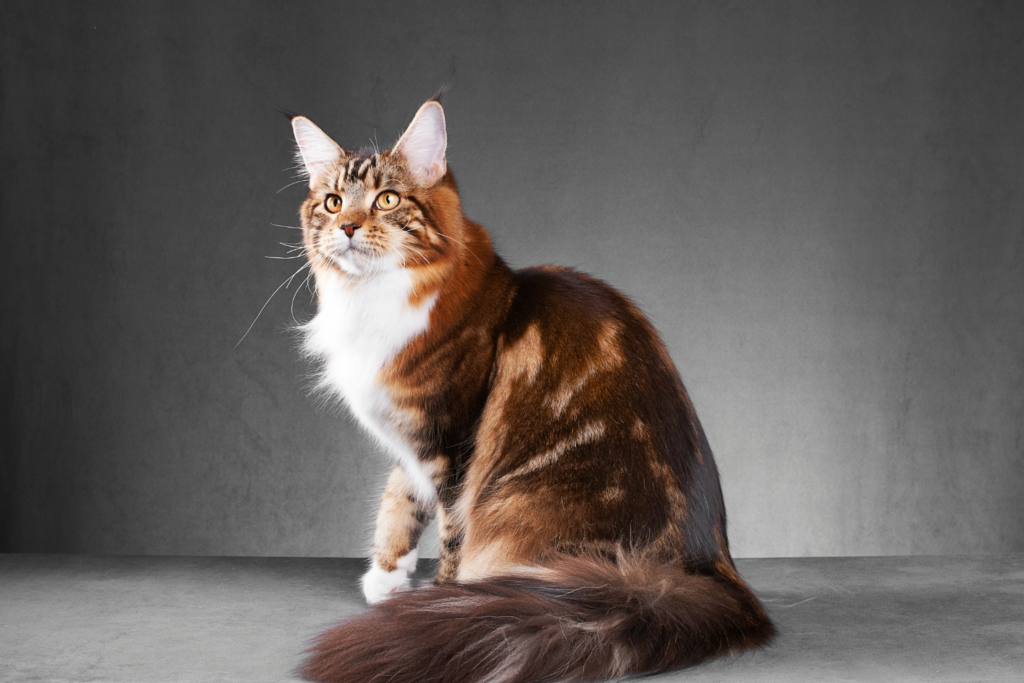
The Norwegian Forest Cat is medium-large to large, muscular, heavily boned, and longer than it is tall. One especially characteristic feature is its leg structure: the hind legs are higher than the forelegs. That conformation contributes to the breed’s powerful uphill movement and helps explain why many Wegies make vertical territory look effortless.[1]
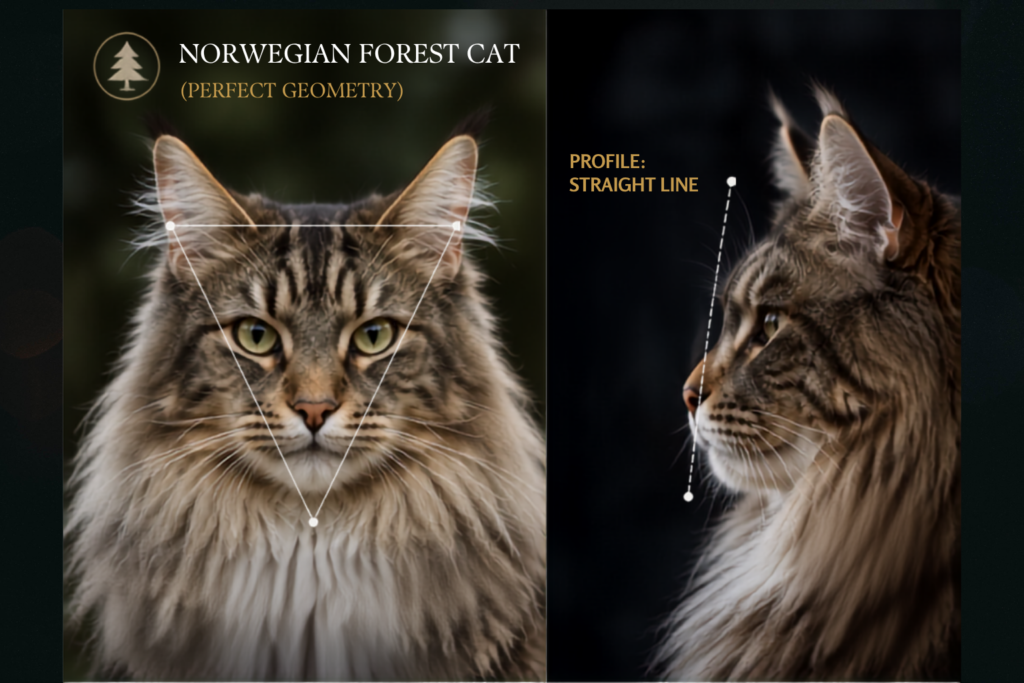
The head is the clearest visual clue. Breed standards call for a triangular outline, with the lines from the outer base of each ear meeting at the chin. In profile, the nose line should be long and straight rather than deeply curved or sharply stopped. Large ears continue the triangle, while almond-shaped eyes are set at a slight angle.[1][2]
The tail is long, full, and flowing. In a mature cat wearing a winter coat, the tail, neck ruff, chest furnishings, and hindquarter “britches” can make the animal appear much larger than its actual weight.
The coat is functional, not merely decorative
A true Norwegian Forest Cat coat is more complex than “long fur.” It combines a dense, woolly undercoat with longer, coarser guard hairs. TICA and CFA describe the outer coat as water-repellent or water-resistant.[1][2] That does not mean the cat is waterproof, should be left outdoors in severe weather, or enjoys being wet. It describes the texture and protective function valued in the breed standard.
Season makes a major difference. A fully coated winter Wegie may have a pronounced ruff and a dense undercoat; the summer coat can be substantially shorter. Color and texture also influence how full or soft an individual coat looks. Therefore, comparing one photograph taken in January with another taken in July can be misleading.
Colors and patterns
The breed appears in many traditional colors and patterns, including solids, tabbies, silver, red, blue, cream, amber, and combinations with white. Eye color varies as well.[1] Claims that every authentic Norwegian Forest Cat must be a brown tabby or have green eyes are incorrect.
Color is not a measure of health or companion quality. Documented ancestry, temperament, rearing conditions, and responsible screening matter far more.
Norwegian Forest Cat Size and Growth
Internet descriptions frequently turn every Norwegian Forest Cat into a 20-pound giant. Official organizations provide a more useful picture.
TICA lists adult females at approximately 8–12 pounds and adult males at 12–18 pounds.[1] CFA gives a slightly narrower range—about 9–12 pounds for females and 12–16 pounds for males.[2] The difference is a reminder that breed ranges are estimates, not precise guarantees.
A cat can look larger than the scale suggests because of its rectangular body, bone, tail, and seasonal coat. Conversely, an overweight cat can hide excess body fat beneath dense fur. Use hands as well as eyes when monitoring body condition, and ask your veterinarian to show you how to feel the ribs and assess the waist safely.
A slow-maturing breed
Norwegian Forest Cats may take up to five years to reach full maturity.[1][2] That does not mean continuous rapid growth for five years. Height and length develop earlier, while the frame, muscle, head, and coat may continue to mature gradually.
Avoid using this slow development as an excuse to overfeed. A young Wegie needs food appropriate for its life stage, but excess calories do not create better bone or breed type. They create excess body fat.
When buying furniture or carriers for a kitten, estimate the eventual adult size from the parents and breeder’s records. A bed, litter box, or tree that fits at four months may become cramped long before physical maturity.
Norwegian Forest Cat Personality
Breed descriptions are tendencies, not promises. Early handling, socialization, health, life experience, home environment, and individual genetics all influence behavior. Still, the major registries describe a recognizable pattern.
TICA characterizes the Norwegian Forest Cat as intelligent, resourceful, mild-mannered, playful, interactive, loving, and adaptable.[1] CFA similarly emphasizes affection paired with independence.[2] In daily life, that often produces a cat that wants to participate without being micromanaged.
A Wegie may follow you to another room, rest on the sofa back while you work, appear when a toy comes out, and then retire to a high shelf. Some enjoy laps; others prefer contact on their own terms. If your primary requirement is a cat that remains in your arms whenever requested, breed reputation cannot guarantee that experience.
Are Norwegian Forest Cats vocal?
They are not generally described as relentlessly loud. TICA notes chirps and meows, and many owners value the breed’s conversational but moderate communication style.[1] Individual variation is substantial: a quiet kitten can become more expressive, and a normally quiet adult may vocalize more when hungry, stressed, in pain, or seeking interaction.
A sudden change in vocal behavior deserves attention. “Talkative breed” should never be used to dismiss a new cry, nighttime yowling, or distress sound.
Children, dogs, and other cats
The Norwegian Forest Cat’s generally gentle temperament can suit family homes. TICA describes the breed as a good choice for families with children and other pets.[1] Success still depends on the household.
Children should learn to let the cat leave, avoid pulling the tail or coat, and never disturb eating, sleeping, or litter-box use. Dog introductions should be controlled and gradual. Cats need separate feeding stations, litter boxes, scratching options, and resting places so that access to essentials does not depend on confronting another animal.
The breed’s independence can be an advantage in a busy home, but it is not permission to ignore the cat. Daily play, predictable care, gentle social contact, and observation remain essential.
Climbing, Play, and Environmental Needs
If one behavior should shape your home setup, it is climbing. Norwegian Forest Cats have powerful hindquarters and a strong preference for elevated positions. TICA recommends climbing structures and warns owners not to be surprised when a Wegie reaches cabinets and other high places.[1]
Trying to ban every elevated surface usually creates frustration. A better strategy is to provide legal routes that are more stable and rewarding than the forbidden ones.
Useful options include:
A heavy cat tree with broad platforms
Wall shelves anchored into suitable studs or masonry
A window perch installed according to its load rating
A tall, stable scratching post
Clear landing zones rather than crowded shelves
A safe high bed away from children or other pets
The Feline Veterinary Medical Association states that an indoor lifestyle must meet cats’ needs for safe resting places, play, foraging or hunting behavior, clean toileting areas, and vertical territory.[7] A large floor plan does not automatically provide those things. A thoughtfully arranged apartment can be more enriching than an empty house.
Play should imitate a sequence
Use wand toys, soft prey toys, food puzzles, and short chase sessions to create opportunities to stalk, pursue, capture, and receive a small reward. Rotate toys instead of leaving every object on the floor indefinitely. Put string, ribbon, and small ingestible parts away after supervised use.
Focused play can be more valuable than a room full of inactive gadgets. Adjust jumping for kittens, seniors, cats with pain, or cats recovering from surgery.
Can a Norwegian Forest Cat live in an apartment?
Yes, if the apartment provides usable territory and the household can meet daily needs. Build upward, protect screens, secure unstable decor, and give the cat more than one resting choice. A window view can add interest, but it does not replace interactive play.
Balconies require secure cat-proofing rather than supervision alone. Standard insect screens are not designed to contain a determined cat. Outdoor access is a separate risk decision to discuss with your veterinarian; a secure catio or harness training may offer controlled alternatives for suitable cats.
Norwegian Forest Cat Grooming and Shedding
The dramatic coat is often less labor-intensive than a Persian coat, but “low maintenance” should not be confused with “no maintenance.” TICA says weekly combing is usually sufficient and recommends extra work during major molts.[1] CFA notes that some coat textures can mat more readily than others.[2]
Start with a metal comb that reaches through the coat without scraping the skin. Work in small sections and check friction-prone areas:
Behind and below the ears
Armpits
Chest and neck ruff
Belly and groin
Inner hind legs
Base of the tail
During seasonal shedding, shorten the interval between sessions. The goal is to remove loose undercoat before it compacts, not to strip healthy guard hairs. If a comb cannot move through a mat without pulling the skin, stop. A veterinarian or cat-experienced groomer can remove difficult mats more safely; scissors near thin feline skin can cause serious injury.
A practical grooming routine
Let the cat inspect the comb and reward calm contact.
Begin with a short session on an easy area such as the shoulders.
Hold the coat near the skin when working through a small tangle so pulling is minimized.
Stop before the cat becomes agitated.
Check nails, skin, ears, and teeth during routine handling without forcing a prolonged examination.
Bathing is not routinely required for every healthy Wegie. Use only cat-appropriate products when a bath is necessary, rinse thoroughly, and ask a veterinarian for help if the coat becomes greasy, develops dandruff, smells unusual, or changes suddenly. Coat changes can reflect more than grooming technique.
Powered grooming tools are optional. Some cats accept their sound and suction after gradual conditioning; others find them frightening. A traditional comb remains the baseline and requires no motor, filter, or acclimation to noise.
Daily Care: Food, Water, and Litter
Food and body condition
Norwegian Forest Cats do not need a special diet designed to make them “giant.” Choose a food that is complete and balanced for the cat’s life stage. The FDA explains that this wording generally indicates that a product meets an established AAFCO nutrient profile or has passed an appropriate feeding trial, and it distinguishes growth, adult maintenance, and other life-stage claims.[8]
Portion needs depend on age, activity, reproductive status, health, and body condition. Feeding directions are a starting point, not a personalized prescription. Weigh your cat periodically, measure food consistently, include treats in the total intake, and ask your veterinary team to reassess portions as the cat matures.
For multi-cat homes, feed in ways that let each cat access its own food without pressure. Side-by-side bowls can hide theft or inhibition. Separate stations also make it easier to notice reduced appetite—an important change that should not be dismissed.
Water and hydration
Provide fresh water in more than one accessible location, separated from litter boxes. Some cats prefer a wide bowl; others readily use a fountain. Material, placement, freshness, and cleaning may matter more than whether the water moves.
A fountain is not a medical treatment and will not make every cat drink more. It also needs regular cleaning, pump maintenance, and filter replacement. If you are comparing designs, see our verified guide to the best cat water fountains for indoor cats.
Contact a veterinarian if drinking or urination changes noticeably. Increased thirst can be a medical sign, while reduced intake accompanied by lethargy, vomiting, or refusal to eat can also require prompt care.
Litter boxes for a large, long-bodied cat
The most important feature is usable interior space. The cat should be able to enter, turn, dig, eliminate, and exit without squeezing. A large open manual pan is often the simplest and most accommodating choice.
In multi-cat homes, distribute boxes so one cat cannot guard every route. Scoop at least daily, use a litter the cats accept, and retain a manual box whenever introducing an automatic system. “Self-cleaning” does not eliminate inspection, refilling, waste-bin emptying, or periodic washing.
Measure the cat from nose to base of tail and compare that body length—not merely weight—with the usable area and entrance of any enclosed or automated box. A stated weight range is not a fit guarantee.
Norwegian Forest Cat Health and Lifespan
The breed is often described as robust, but no pedigree protects an individual cat from illness. The most useful approach is not fear; it is informed screening, routine preventive care, healthy body condition, and prompt attention to change.
TICA lists life expectancy at 13 years or more.[1] That is a population guideline, not a promise. Genetics, nutrition, dental health, accidents, access to veterinary care, body condition, and individual disease all influence lifespan.
Hypertrophic cardiomyopathy
Hypertrophic cardiomyopathy, or HCM, is characterized by thickening of the heart’s muscular walls. Some cats have no obvious early signs; others may develop heart failure or blood clots. Cornell describes echocardiography as the gold-standard diagnostic test.[6]
TICA notes that no breed-specific DNA test currently rules out HCM in Norwegian Forest Cats and discusses periodic echocardiographic screening in breeding animals.[1] Therefore, “DNA clear for HCM” is not an adequate answer for this breed. Ask what cardiac examinations were performed, by whom, at what ages, and whether results from both parents are available.
Open-mouth breathing, collapse, pronounced breathing difficulty, or sudden pain and weakness in the hind limbs can be emergencies. Seek immediate veterinary care rather than waiting for a routine appointment.
Glycogen storage disease type IV
GSD IV is an inherited disorder associated with an enzyme defect that affects glycogen metabolism. UC Davis explains that it is autosomal recessive: an affected kitten inherits the relevant variant from both parents. Affected kittens may die before or soon after birth; some survive longer before developing progressive neuromuscular disease.[4]
A DNA test is available. Responsible breeding decisions can prevent affected kittens while preserving genetic diversity through informed pairing. “Carrier” does not mean the cat is sick, but carrier status must be considered when choosing a mate.
Pyruvate kinase deficiency
Pyruvate kinase deficiency can cause intermittent hemolytic anemia. UC Davis also describes this condition as autosomal recessive and lists the Norwegian Forest Cat among breeds for which testing is appropriate.[5]
Because severity and age of onset can vary, appearance alone cannot establish genetic status. Ask for the laboratory report rather than accepting a verbal claim that a line is “healthy.”
Routine care still matters
Genetic screening addresses only specific inherited risks. It does not replace veterinary examinations, vaccinations tailored to lifestyle, parasite prevention, dental care, weight management, or observation at home.
Book an appointment when you notice persistent appetite change, weight loss, reduced jumping, altered grooming, breathing changes, repeated vomiting, diarrhea, urinary difficulty, or a major change in behavior. Cats often show illness through small deviations from routine.
How to Find a Responsible Breeder or Rescue
A registration listing does not replace due diligence. TICA recommends verifying the seller, reviewing the parents’ health and genetic records, assessing how kittens are raised, and obtaining a written contract.[9]
Ask a breeder for:
Registered names and pedigrees of both parents
GSD IV and PK-deficiency laboratory reports
The cardiac screening history of breeding cats
Veterinary records appropriate to the kitten’s age
Information about socialization and the home environment
A written sales contract and health terms
The age at which the kitten may leave
A clear return or rehoming policy if circumstances change
Be cautious when a seller pressures you to pay immediately, avoids live conversation, refuses verifiable records, always has many breeds available, or asks for difficult-to-recover payment methods. Search the breeder’s name, image-search listing photographs when something seems wrong, and independently verify registry claims.
Do not interpret “champion lines” as health evidence. Show results evaluate breed presentation under registry rules; they do not replace genetic or cardiac screening.
Breed-specific rescues and general shelters may occasionally have Norwegian Forest Cats or similar longhaired cats. A shelter cat without pedigree documentation may be a wonderful companion, but appearance alone should be described honestly as “Norwegian Forest Cat mix” or “Norwegian Forest Cat–type” only when the organization has a reasonable basis for that label.
Three Useful Products for a Norwegian Forest Cat Home
These products address three different owner problems: vertical territory, loose-fur containment, and automatic litter maintenance. None is mandatory, and none is automatically the best choice for every Wegie. We reviewed manufacturer specifications and intended use; we did not conduct hands-on testing.
Product
Best use
Main limitation
Simpler alternative
Mau Cento Cat Tree
Furniture-style vertical territory for a larger cat
Premium footprint and price; basket fit depends on body length
A stable, weight-rated tree or correctly anchored wall shelves
oneisall LM5C Grooming Vacuum
Capturing loose fur while brushing a cat that accepts powered tools
Noise and suction can distress some cats
Stainless-steel comb plus a household vacuum afterward
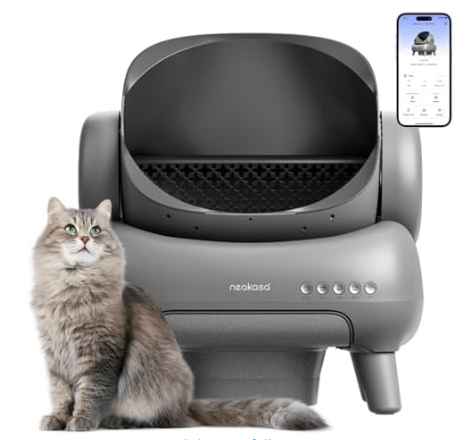
Neakasa M1 Plus
Open-top automated scooping for a compatible cat and litter
Expensive; still requires monitoring, cleaning, and a transition plan
Extra-large open manual litter pan
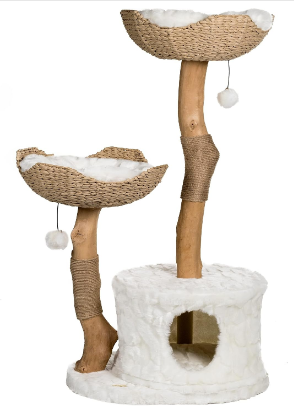
Mau Cento Cat Tree: a design-conscious climbing option
The Mau Cento combines real branch elements, jute-wrapped scratching areas, two woven baskets, removable cushions, and a cave. Mau currently lists a 23-inch base, a height of 45.5 inches, and suitability for cats up to 23 pounds each. It also sells replacement wear parts, which is useful for a structure expected to be scratched.[10]
Those numbers do not guarantee comfort. Compare basket diameter and platform geometry with your cat’s body length, watch how the structure behaves during energetic launches, and place it on a level surface. Natural branches vary, so the finished piece may not look identical to a studio photograph.
Best for: Owners who want vertical territory to look like intentional furniture and whose cat fits the manufacturer’s current dimensions.
Skip it if: You need ceiling-height climbing, have very limited floor space, or your cat prefers broad flat shelves to curved baskets.
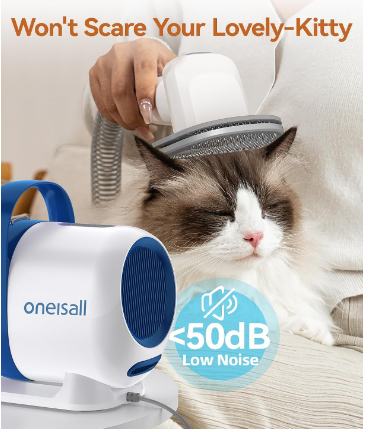
oneisall LM5C: optional help during seasonal shedding
The current oneisall LM5C 6-in-1 Cat Grooming Vacuum Kit combines grooming attachments with suction that collects loose coat. The manufacturer advertises up to 8,000 Pa of suction and operating noise below 48 dB.[11] These are manufacturer specifications, not evidence that every cat will find it quiet or comfortable.
Introduce the inactive tool first, then sound at a distance, and only then brief contact at the lowest practical setting if the cat remains relaxed. Do not restrain a frightened cat to complete a session. The vacuum does not replace careful combing at the skin level, and clippers require additional handling skill.
Best for: A tolerant cat whose owner wants to contain some loose coat during seasonal grooming.
Skip it if: Your cat hides from ordinary appliances, becomes tense around suction, or already does well with a simple comb.
Neakasa M1 Plus: an open-top automatic litter option
The Neakasa M1 uses an open-top design rather than a small enclosed globe. Neakasa currently lists an entrance of 13.86 inches, a supported cat-weight range of roughly 2.2–33 pounds, app connectivity, and compatibility requirements for fast-clumping scoopable litter. The M1 Plus bundle includes a mat and waste bags; current M1-family bundles can differ even when the core machine is similar.[12]
Weight capacity is not the same as interior fit or behavioral acceptance. Keep the original manual box available during transition, leave the automatic unit off initially if needed, and never force the cat inside. Confirm current litter specifications before buying; oversize pellets and non-clumping substrates may not sift correctly.
Automatic equipment must be checked every day. Sensors, apps, and cycle records do not prove how much a cat eliminated or diagnose disease. Watch the litter itself and your cat’s behavior, and maintain a manual backup for outages, mechanical problems, travel, or illness.
Best for: Owners who want automated scooping, have a cat that accepts an open-top machine, and are willing to follow litter and maintenance requirements.
Skip it if: Your cat avoids moving equipment, needs an unusually large manual pan, uses incompatible litter, or cannot meet the machine’s current weight guidance.
A consistent routine is more useful than occasional bursts of intensive care.
Every day
Provide measured meals and fresh water.
Scoop manual boxes or inspect an automatic box, waste bin, litter level, and surrounding area.
Observe appetite, urination, stool, movement, breathing, and social behavior.
Offer interactive play and friendly contact on the cat’s terms.
Check that trees, shelves, and window perches remain stable.
Once or more each week
Comb through the coat, adjusting frequency for the season and individual texture.
Wash food and water dishes thoroughly; clean fountain components on schedule if used.
Rotate toys and food puzzles.
Inspect scratching surfaces and furniture hardware.
Weigh food portions consistently and note any unusual leftovers.
Periodically
Trim nails as appropriate for the individual cat.
Weigh the cat and review body condition.
Deep-clean litter equipment according to material and manufacturer instructions.
Schedule veterinary preventive care and dental assessment.
Reassess the home as the cat grows, ages, or develops mobility changes.
This routine also creates an early-warning system. Owners who know what “normal Tuesday” looks like are more likely to notice a subtle change on Wednesday.
Norwegian Forest Cat vs. Maine Coon
Both breeds are large, longhaired, slow-maturing cats with impressive tails and ear furnishings, so confusion is understandable. The face provides the easiest shorthand.
The Norwegian Forest Cat standard emphasizes a triangular head and a long, straight profile. The Maine Coon is associated with a more square muzzle and different head and body proportions. Wegies also characteristically stand higher in the hindquarters.[1][2]
That shortcut cannot establish pedigree, and personality stereotypes should not decide a match on their own. If you are comparing the breeds, read our detailed Norwegian Forest Cat vs. Maine Coon guideand then evaluate the actual breeder, health records, home environment, and individual cat.
Frequently Asked Questions
1. How big does a Norwegian Forest Cat get?
TICA lists adult females at about 8–12 pounds and adult males at about 12–18 pounds.[1] CFA lists about 9–12 pounds for females and 12–16 pounds for males.[2] Individuals can fall outside these ranges, and a thick coat can exaggerate apparent size. Healthy body condition is more important than a target weight.
2. How long does a Norwegian Forest Cat take to mature?
The breed may take up to five years to reach full maturity.[1][2] Growth is gradual, and an adolescent cat may continue developing frame, muscle, coat, and overall substance after reaching adult height. Slow maturation should not be used to justify overfeeding.
3. Are Norwegian Forest Cats lap cats?
Some are, but it is not guaranteed. Many show affection by staying close, following family members, or sharing a nearby perch while deciding when and how long physical contact lasts.[1] Choose the individual, not a promise based solely on breed.
4. Are Norwegian Forest Cats vocal?
They are generally not described as excessively loud, though TICA notes that they communicate with chirps and meows.[1] Vocal style varies. A sudden increase or change in sound can signal stress, discomfort, or illness and should not automatically be attributed to personality.
5. Are Norwegian Forest Cats good with children and dogs?
They are commonly described as gentle family cats and may live successfully with respectful children and compatible pets.[1] Supervision, gradual introductions, escape routes, and separate access to essential resources remain necessary.
6. Why do Norwegian Forest Cats climb so much?
The breed has strong hindquarters, higher hind legs, and a history of being selected for an athletic, capable body. Elevated territory also serves normal feline needs for observation, rest, and security. Provide stable alternatives instead of expecting the cat to remain at floor level.
7. Do Norwegian Forest Cats shed a lot?
They undergo substantial seasonal coat changes, especially when losing the winter undercoat. Shedding between major molts may be more moderate, but household climate and the individual coat affect the pattern.[1] Regular combing helps capture loose fur and detect tangles early.
8. How often should I groom a Norwegian Forest Cat?
Weekly combing is a reasonable starting point, with more frequent sessions during seasonal molt or for a coat that tangles easily.[1][2] Check high-friction areas even when the visible topcoat looks smooth.
9. Can a Norwegian Forest Cat live happily in an apartment?
Yes. Apartment success depends more on environmental quality than square footage. Provide stable vertical territory, scratching, hiding and resting choices, interactive play, clean litter boxes, and protected windows or balconies.[7]
10. What is the typical Norwegian Forest Cat lifespan?
TICA lists 13 years or more.[1] It is a general estimate, not a guarantee. Genetics, preventive care, nutrition, dental health, body condition, safety, and individual disease all influence longevity.
11. What health tests should a Norwegian Forest Cat breeder perform?
Ask for DNA results for GSD IV and PK deficiency and for the parents’ cardiac screening history.[1][4][5] Because a breed-specific DNA result cannot currently rule out HCM in Norwegian Forest Cats, ask specifically about echocardiography rather than accepting a generic “health tested” statement.[6]
12. How can I tell a Norwegian Forest Cat from a Maine Coon?
A Norwegian Forest Cat typically has a triangular head, long straight profile, and hind legs higher than the forelegs. A Maine Coon generally has a squarer muzzle. These are breed-standard tendencies, not proof of ancestry; pedigree documentation is the reliable way to identify a pedigreed cat.
Final Verdict: Is a Norwegian Forest Cat Right for You?
The Norwegian Forest Cat offers an appealing balance: dramatic without being ornamental, affectionate without necessarily being clingy, playful without usually being frantic, and independent without being detached.
The best owner is not simply someone who loves the breed’s appearance. It is someone who can build safe vertical territory, maintain the changing coat, monitor weight beneath dense fur, provide daily play and companionship, and evaluate health documentation carefully.
You do not need the three featured products to care for a Wegie well. A stable conventional tree, stainless-steel comb, and extra-large manual litter pan may be smarter choices. Premium equipment earns its place only when its dimensions, function, maintenance, and your cat’s behavior match.
With thoughtful care, forest heritage and a modern interior do not have to compete. The goal is a home in which height, rest, scratching, food, water, toileting, play, and safety are designed around the cat using them.
Sources & References
The International Cat Association (TICA) — Norwegian Forest Cat. Breed profile covering size, temperament, structure, coat, history, maturity, grooming, activity, lifespan, and reported health concerns. View source
Cat Fanciers’ Association (CFA) — Norwegian Forest Cat. Official breed information covering physical characteristics, weight guidance, personality, maturity, and coat care. View source
Fédération Internationale Féline (FIFe) — Norwegian Forest Cat. Registry page and current breed-standard access for the NFO. View source
UC Davis Veterinary Genetics Laboratory — Glycogen Storage Disease Type IV in Norwegian Forest Cats. Inheritance, clinical outcomes, and available DNA testing. View source
UC Davis Veterinary Genetics Laboratory — Erythrocyte Pyruvate Kinase Deficiency. Inheritance, variable presentation, and breed-appropriate genetic testing. View source
Cornell Feline Health Center — Hypertrophic Cardiomyopathy. Veterinary overview of HCM, possible complications, and echocardiographic diagnosis. View source
Feline Veterinary Medical Association — 2024 Indoor/Outdoor Lifestyle Position Statement. Guidance on meeting indoor cats’ needs for vertical territory, play, rest, foraging, and clean toileting resources. View source
U.S. Food and Drug Administration — “Complete and Balanced” Pet Food. Explanation of nutritional adequacy and life-stage labeling. View source
The International Cat Association — Pet Buyer’s Guide. Guidance on breeder verification, records, contracts, and scam avoidance. View source
Mau — Cento Cat Tree for Large Cats. Current manufacturer dimensions, weight guidance, materials, components, and replacement-part information. View source
oneisall — LM5C 6-in-1 Cat Grooming Vacuum Kit. Current manufacturer features and operating specifications. View source
Sources and manufacturer specifications reviewed August 29, 2026. Breed guidance, genetic-testing recommendations, product bundles, dimensions, and availability can change; verify current details before making health or purchase decisions.
10 Most Popular Cat Breeds in the U.S. in 2026 By Demosthenes Staudinger | Updated August 23, 2026 Affiliate disclosure: […]
Manage Consent
To provide the best experiences, we use technologies like cookies to store and/or access device information. Consenting to these technologies will allow us to process data such as browsing behavior or unique IDs on this site. Not consenting or withdrawing consent, may adversely affect certain features and functions.
Functional
Always active
The technical storage or access is strictly necessary for the legitimate purpose of enabling the use of a specific service explicitly requested by the subscriber or user, or for the sole purpose of carrying out the transmission of a communication over an electronic communications network.
Preferences
The technical storage or access is necessary for the legitimate purpose of storing preferences that are not requested by the subscriber or user.
Statistics
The technical storage or access that is used exclusively for statistical purposes.The technical storage or access that is used exclusively for anonymous statistical purposes. Without a subpoena, voluntary compliance on the part of your Internet Service Provider, or additional records from a third party, information stored or retrieved for this purpose alone cannot usually be used to identify you.
Marketing
The technical storage or access is required to create user profiles to send advertising, or to track the user on a website or across several websites for similar marketing purposes.