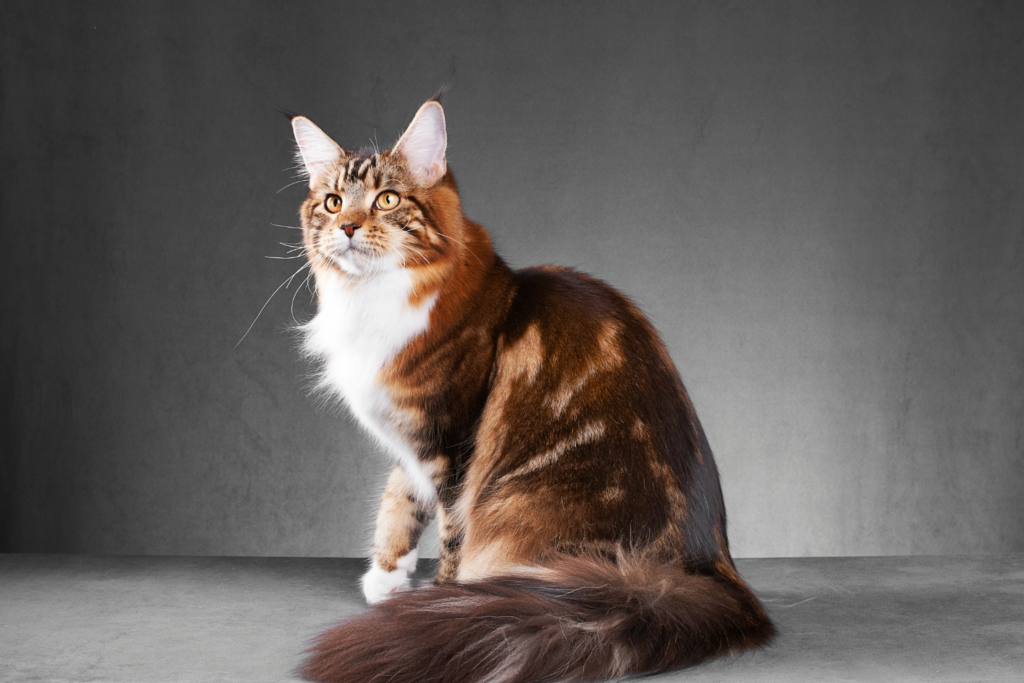
Siberian vs. Maine Coon vs. Norwegian Forest Cat: Which Breed Is Right for You?
By Demosthenes Staudinger
Last updated: August 23, 2026
Affiliate disclosure: Modern Cat Society may earn a commission from qualifying purchases made through links in this article, at no additional cost to you. Our editorial conclusions are based on independent research, and affiliate relationships do not determine which products or breeds we recommend.
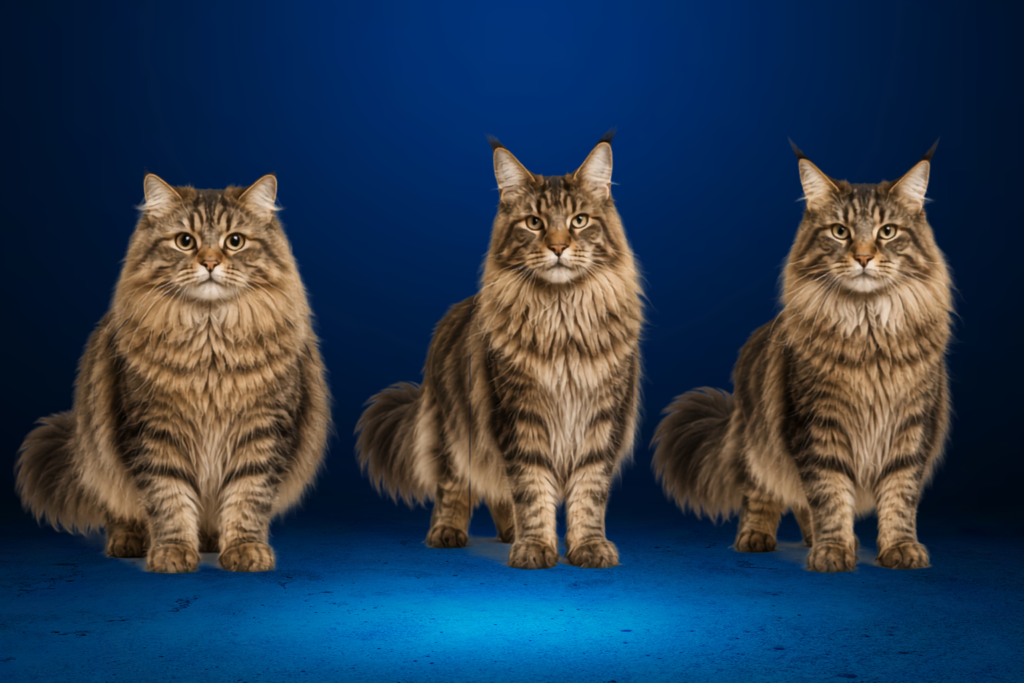
The Siberian, Maine Coon, and Norwegian Forest Cat share the look that makes large natural breeds so compelling: substantial bodies, furnished ears, full tails, and cold-weather coats. From a distance, they can seem like variations of the same cat. In structure, behavior, grooming workload, and breed-specific health screening, however, they are meaningfully different.
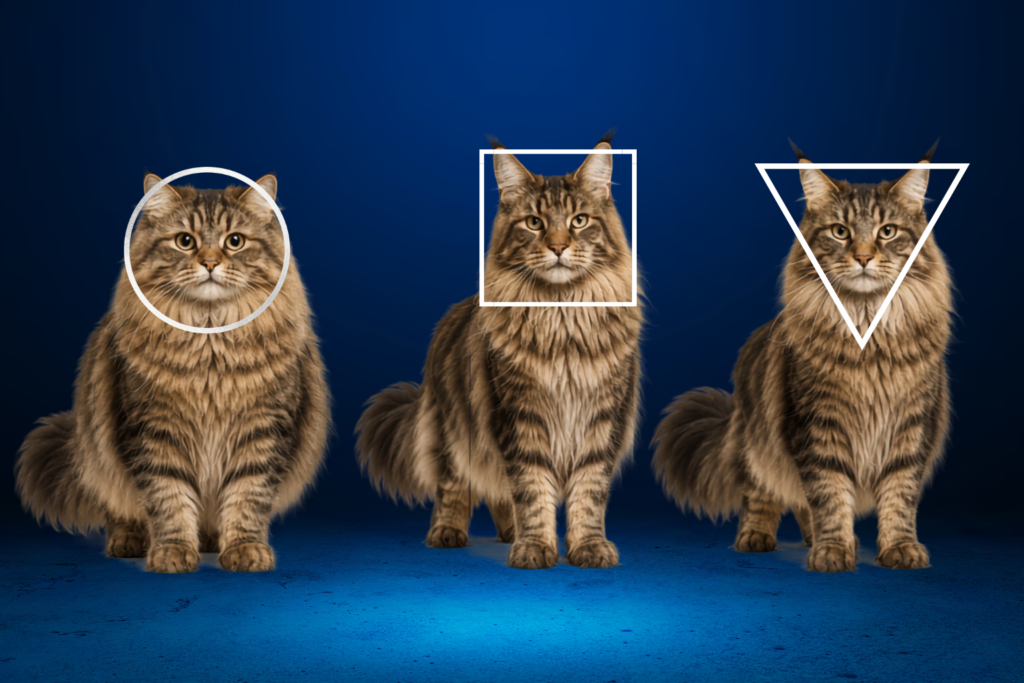
The quickest visual shorthand is rectangle, triangle, and circle. A Maine Coon is long and rectangular with a square muzzle. A Norwegian Forest Cat has a triangular head, straight profile, and powerful climbing build. A Siberian is defined by rounded contours, a barrel-like torso, and an especially dense seasonal triple coat. The Cat Fanciers’ Association uses essentially this geometric framework in its comparison of the three breeds. [1]
Geometry is only the beginning. The best match depends less on which cat looks largest in a photograph and more on the relationship, grooming routine, activity level, home setup, and breeder evidence you can realistically support. This guide compares those factors without treating breed tendencies as guarantees.
Quick Verdict
Editorial verdict: There is no universal winner. Choose the Maine Coon if your priority is an often people-oriented cat that likes participating in household life. Choose the Norwegian Forest Cat if you prefer affectionate companionship with a more independent streak and can provide serious vertical territory. Choose the Siberian if you want rounded, powerful athleticism and a social-playful balance. If lap behavior or an exact energy level is non-negotiable, a temperament-assessed adult is more predictable than any kitten selected by breed.
Best for: Prepared homes that can accommodate a large litter area, stable climbing and scratching furniture, regular coat care, daily interaction, preventive veterinary care, and responsible breeder due diligence.
Skip all three if: You want a low-shedding cat, cannot maintain a semi-long coat during seasonal molts, expect a guaranteed giant or lap cat, or plan to buy from a seller who will not provide verifiable parent health records.
Allergy verdict: Do not choose any of the three as an allergy-safe cat. The Siberian is worth investigating at the individual-cat level, but the evidence does not justify a breed-wide “hypoallergenic” promise.
How We Researched This Comparison
This is a research-based editorial comparison, not a hands-on test of individual cats. We reviewed current breed information from TICA and CFA, veterinary genetics resources from UC Davis, feline cardiology guidance from Cornell University, TICA’s buyer-safety checklist, and a peer-reviewed Siberian Fel d 1 study. Sources were checked in August 2026 and are numbered throughout the article.
We compared seven practical criteria: physical structure, published size and maturity, coat and grooming, social style, activity and home fit, relevant health screening, and buyer transparency. Registry descriptions represent breed ideals and reported tendencies; they cannot predict the body, personality, health, or allergy impact of a particular cat.
The two product examples retained from the original article are contextual options only. We did not test them. Specifications, model names, prices, availability, warranties, and return terms can change, so verify every detail with the manufacturer and retailer before purchasing.
Table of Contents
- Comparison at a Glance
- The Fastest Way to Tell Them Apart
- Size and Maturity
- Coat and Grooming
- Personality and Affection
- Activity and Home Fit
- Children, Pets, and Time Alone
- Home Setup and Products
- Allergies and the Siberian Claim
- Health Screening
- Breeder Due Diligence
- Ownership Costs
- Pairwise Comparisons
- Pros and Cons
- FAQ
- Final Verdict
Siberian vs Maine Coon vs Norwegian Forest Cat at a Glance
| Factor | Siberian | Maine Coon | Norwegian Forest Cat |
|---|---|---|---|
| Origin associated with the modern breed | Russia | Maine, United States | Norway |
| Visual shorthand | Circles and rounded contours | Squares and rectangles | Triangle and straight profile |
| Body | Powerful, barrel-like, medium-to-large | Long, substantial, rectangular | Substantial, moderately long, strong hindquarters |
| Published adult weight | CFA: females 8–12 lb; males 12–18 lb [5] | TICA’s page conflicts internally: detailed text says females 9–13 lb and males 13–18 lb, while its “At a Glance” section says 12–15 and 18–22 lb [2] | TICA: females 8–12 lb; males 12–18 lb [3] |
| Maturity | Slow; TICA says up to about 5 years [4] | Slow; TICA mentions roughly 3–5 years in detailed text and 4 years in its summary [2] | Slow; TICA says up to about 5 years [3] |
| Coat | Seasonal semi-long triple coat | Shaggy, uneven, water-resistant semi-long coat | Dense woolly undercoat with water-repellent guard hairs |
| Typical grooming pattern | A couple of sessions weekly; more during seasonal shedding | Regular combing; workload varies with coat texture | Often weekly; more during the heavy molt |
| Social tendency | Affectionate, lively, playful, involved without necessarily being needy | People-oriented, friendly, often follows household activity | Loving and interactive but commonly more self-directed |
| Vertical drive | Strong jumper | Capable climber but often enjoys ground-level games | Particularly height-oriented and agile |
| Lap-cat guarantee | None | None; many prefer staying close | None; often chooses when contact begins and ends |
| Main screening conversation | HCM plan and line-specific veterinary testing | HCM DNA plus echocardiography; ask about hips, SMA, and PK deficiency | HCM echocardiography plus DNA records for GSD-IV and PK deficiency |
| Allergy-safe? | No; individual investigation may be worthwhile | No | No |
The weight row is deliberately more cautious than many breed comparisons. A published range is not a promise, and coat volume can make all three look heavier than they are. Healthy body condition matters more than reaching an internet-famous number.
The Fastest Way to Tell Them Apart
Color is a poor identification method. Each breed appears in many colors and patterns, and a fluffy brown tabby is not automatically one of these breeds. For certainty, pedigree documentation matters.
Maine Coon: the rectangle
The classic Maine Coon has a square muzzle, strong chin, large ears, long hard-muscled torso, and flowing tail. Its shaggy coat is shorter over the shoulders and longer around the ruff, belly, and britches. Focus on the squared muzzle and rectangular silhouette—not ear tufts alone. [1] [2]
Norwegian Forest Cat: the triangle
The Norwegian Forest Cat has an equilateral-triangle head: the outer ear lines continue toward the chin, the profile is long and straight, and the eyes are almond-shaped. Its substantial body has higher hind legs suited to climbing. In full coat, trace the ear-to-chin triangle and inspect the profile. [3]
Siberian: the circle
The Siberian is built around power and roundness: a softly contoured modified wedge, almost-round eyes, heavy bone, strong musculature, and a barrel-like torso. Slightly longer hind legs provide powerful lift. Beside a long Maine Coon, a Siberian may look compact but feel surprisingly dense. [4]
Why appearance cannot prove breed
Domestic longhairs can share ruffs, plumed tails, big paws, ear tufts, tabby coats, and impressive size. Without a pedigree or verified history, a “mix” label is usually speculation and should not determine health assumptions.
Size and Maturity
Which breed is largest?
The Maine Coon generally has the strongest claim to length and overall presence; CFA describes it as the largest and longest pedigreed cat. [1] That does not mean every Maine Coon outweighs every Siberian or Norwegian. Sex, lineage, age, frame, muscle, and body fat all matter.
Official figures require context. TICA’s current Maine Coon page conflicts with itself: its summary lists females at 12–15 pounds and males at 18–22, while the detailed text lists 9–13 and 13–18 pounds. It also gives both four years and three-to-five years for maturity. [2] No one range is a biological boundary.
TICA lists Norwegian females at 8–12 pounds and males at 12–18, with maturity potentially taking five years. [3] TICA calls the Siberian medium-to-large and says maturity may take five years but leaves its weight fields blank; CFA lists females at 8–12 pounds and males at 12–18. [4] [5]
How the three carry their size
- Maine Coon: Rectangular length can demand more carrier and litter-box space than weight suggests.
- Norwegian Forest Cat: Strong thighs, high hindquarters, and winter coat create an athletic silhouette.
- Siberian: Heavy bone and a barrel torso concentrate power into a rounder outline.
What size means for care
Measure the individual cat when choosing a carrier, box, bed, perch, or appliance; usable interior dimensions matter more than exterior size. Monitor body condition with your veterinarian instead of chasing a target weight. Rapid gain is not proof of desirable development.
Coat Structure, Shedding, and Grooming
All three are semi-longhaired natural breeds, but each can shed heavily, mat, and require extra work during seasonal coat changes.
Maine Coon coat
The Maine Coon has a heavy, water-resistant, uneven coat, shorter at the shoulders and longer around the stomach, britches, and ruff. TICA says silky coats may be relatively easy, while cottonier coats can require much more frequent combing. [2] Start young; let coat condition—not the calendar—set frequency.
Norwegian Forest Cat coat
The Norwegian has a woolly undercoat beneath water-repellent guard hairs. Its winter coat is dramatic and its summer coat shorter. TICA says weekly combing is usually sufficient, with extra work during the spring molt. [3] “Low maintenance” is relative; neglected undercoat can still mat.
Siberian coat
The Siberian’s triple coat becomes dense in winter and shorter in warm weather. TICA recommends grooming a couple of times weekly and more during spring and fall shedding. [4] Inspect to the skin, especially the belly, armpits, britches, and behind the ears.
A realistic grooming routine
For any of the three:
- Use short, rewarded sessions and comb gently to the skin.
- Separate small tangles with fingers before using a tool.
- Never cut close mats with scissors; feline skin can be pulled into the blades.
- Get veterinary or feline-groomer help with painful or widespread matting.
- Maintain nails and veterinarian-approved dental care too.
Skin pain, sudden coat deterioration, or new touch sensitivity merits veterinary guidance, not a stronger brush.
Personality, Affection, and Social Style
Breed profiles describe tendencies, not personality contracts. Handling, genetics, age, health, learning, and the home all matter.
Maine Coon: involved and people-oriented
TICA portrays the Maine Coon as gentle, friendly, and interested in household activity without being excessively dependent. Many follow people, investigate projects, fetch, and chirp or trill—but prefer sitting beside you to living on your lap. [2] It often fits someone seeking a household participant, provided daily interaction is available.
For a deeper look at this breed alone, see our complete Maine Coon guide.
Norwegian Forest Cat: affectionate with agency
TICA describes the Norwegian as playful, loving, loyal, and independent. It may follow the family or rest nearby while deciding when and how long close contact lasts; the registry calls it an uncertain choice for someone demanding a lap cat. [3] This is agency, not necessarily aloofness.
Our Norwegian Forest Cat guide explores the breed’s care and history in more detail.
Siberian: lively, affectionate balance
TICA characterizes the Siberian as lively and affectionate: willing to chase toys, follow family, wait for attention, and settle nearby. [4] This play-and-downtime balance is appealing, but it does not guarantee a calm kitten or adolescent.
Which is the best lap cat?
None. Individual variation is larger than these stereotypes. If lap time is essential, meet a temperament-assessed adult in foster care, rescue, or a breeder-retirement program and ask what the cat initiates when relaxed.
Activity, Climbing, and Home Fit
Norwegian Forest Cat: strongest vertical tendency
The Norwegian’s powerful build makes height especially important. TICA describes strong hindquarters, agility, and climbing ability; tall, stable observation and scratching structures are practical needs. [3]
Siberian: explosive jumping power
Siberians also seek height. Powerful jumps make stable routes, wide landings, secured screens, and safe placement of plants and breakables important.
Maine Coon: play is not only vertical
Maine Coons can climb, but TICA notes a frequent preference for ground-level chase, retrieving, and interactive games. [2] Their length still requires broad, sturdy platforms.
Can these breeds live in apartments?
Yes. Usable territory matters more than square footage.
Provide:
- A quiet retreat and stable elevated territory.
- Long scratching surfaces and daily interactive play.
- Secure window observation and clear running paths.
- Litter boxes that fit the cat’s actual body.
For space-efficient ideas, see minimalist cat furniture that works in modern homes.
Children, Other Pets, and Time Alone
Official descriptions give all three strong family potential, but success depends on the individuals, introductions, resources, and supervision. [2] [3] [4]
With children
Teach children to invite rather than restrain contact. Provide escape routes and a child-free resting place; prohibit chasing, forced holding, tail pulling, and disturbing a sleeping or eating cat.
With dogs or cats
Use separate safe zones, scent exchange, controlled visual access, and short positive sessions. Duplicate food, water, resting, scratching, and litter resources so one animal cannot guard everything.
Time alone
Independence is not permission to ignore play, observation, companionship, and routine. If you are often away, arrange reliable interaction. A second cat can help only when the pairing is compatible; two cats do not automatically solve boredom.
Home Setup for a Large Longhaired Cat
Large cats expose weak design quickly. Weight capacity alone does not prove that a platform, carrier, or litter box has enough usable space.
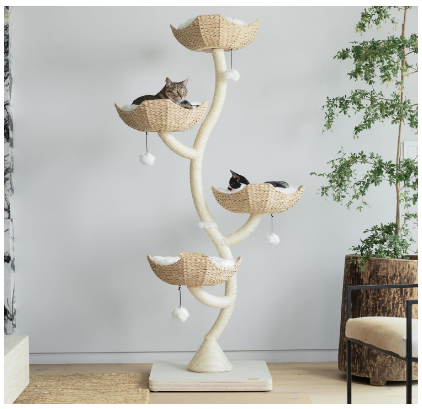
Cat tree checklist
- Wide base with no rocking under a dynamic jump.
- Full-body platforms, strong connections, and long scratching areas.
- Safe level spacing, an easy route down, and wall anchoring when instructed.
- Current manufacturer limits for each platform.
The Mau Cento is a furniture-style example from the original article. Mau markets it for cats up to 23 pounds on each applicable resting area, but that is a manufacturer claim—not our load test. Confirm dimensions, per-platform limits, anchoring guidance, parts, and returns. [11]
Litter box checklist
A cat should enter, turn, posture, dig, and exit without squeezing. An extra-large open pan is often the simplest answer; placement and cleanliness matter as much as automation.
For an automatic box, evaluate usable area, entry height, moving mechanism, cleaning access, litter compatibility, noise, app dependence, emergency behavior, and a manual backup.
The Neakasa M1 Plus is an open-top automatic example retained from the draft. Neakasa states a cat-weight range of about 2.2–33 pounds, but that does not prove comfortable fit or acceptance. Verify the manual, dimensions, litter, safety instructions, firmware, warranty, and returns. [12]
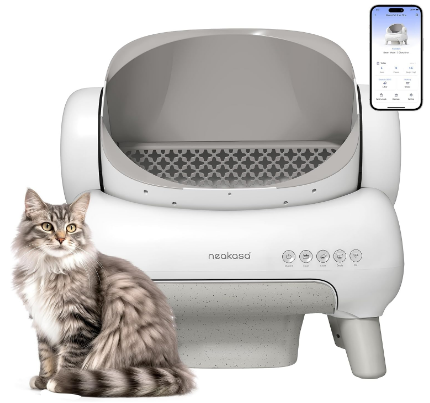
These are contextual options, not ranked winners. A large manual box and stable non-designer tree can work extremely well.
Are Siberian Cats Hypoallergenic?
No cat breed can be promised to be hypoallergenic; the Siberian is not an allergy-safe exception.
Fel d 1 is produced primarily in salivary and skin-associated glands, then grooming spreads it onto the coat. Hair length and shedding do not reliably predict a person’s reaction.
A 2017 peer-reviewed study examined 39 cats—only four Siberians and 35 non-Siberians. Researchers found potentially relevant Fel d 1 gene differences but called for further study. Three measured Siberians still had detectable Fel d 1; this tiny sample cannot establish a breed-wide outcome. [10]
A plausible biological variation is not proof that a particular person will tolerate a randomly selected Siberian.
If allergies or asthma affect the household:
- Consult a qualified allergist when reactions are significant.
- Spend repeated time with the specific cat in its normal environment.
- Reject generic breed guarantees and make a contingency plan.
- Never risk a severe respiratory reaction to conduct an exposure test.
The correct comparison is not “Siberian wins allergies.” It is “the Siberian may justify careful individual investigation, but none of these breeds is reliably allergy-safe.”
Health Screening: What to Ask For
Hypertrophic cardiomyopathy, or HCM, deserves attention across all three breeds. Cornell describes HCM as the most common feline heart disease and lists Maine Coons, Norwegian Forest Cats, and Siberians among breeds in which it is seen more frequently. Many affected cats initially appear normal. Echocardiography is the diagnostic gold standard; genetic tests can inform risk in specific contexts but do not replace cardiac imaging or veterinary interpretation. [8]
| Breed | Screening conversation | Important limitation |
| Maine Coon | Ask for the parents’ HCM DNA results and dated echocardiograms interpreted by an appropriately qualified veterinary cardiologist. Also ask what the program does about hip dysplasia, SMA, patellar problems, and PK deficiency. | The UC Davis test detects the Maine Coon-associated MYBPC3 A31P variant only. HCM also occurs in cats without that variant, so a negative DNA result is not an all-clear. [6] |
| Norwegian Forest Cat | Ask for dated HCM echocardiograms and DNA documentation for GSD-IV and PK deficiency in the breeding cats. | TICA states that no Norwegian-specific HCM DNA test currently rules out the disease; regular echocardiographic screening remains important. GSD-IV is separate, recessive, and potentially fatal in affected cats. [3] [7] |
| Siberian | Ask for the breeder’s HCM screening protocol, actual cardiology records, and a veterinarian-informed explanation of any additional tests used in that lineage. | A generic panel or a seller’s claim of “clear lines” does not establish current heart status. TICA advises that Siberians be checked for HCM. [4] |
What documentation should look like
A useful record names the cat, date, test or imaging method, result, laboratory or clinician, and enough identifying information to connect that animal to the kitten’s sire or dam. A screenshot with no identity, an undated “negative,” or a statement that grandparents were tested is not equivalent to current parent documentation.
Ask the breeder to explain how results affect mating decisions. Responsible screening is not a promise that no kitten will ever become ill; it is evidence that preventable risk is being managed transparently.
HCM warning signs
Many cats with HCM show no obvious illness, but labored or rapid breathing, open-mouth breathing, profound lethargy, sudden hind-limb pain, weakness, or paralysis can signal a life-threatening emergency. Cornell explains that heart failure and blood clots can cause these signs. Seek emergency veterinary care immediately rather than waiting for a routine appointment. [8]
This section is educational and cannot diagnose an individual cat. Your veterinarian should determine screening and care based on the cat’s history and examination.
How to Evaluate a Breeder
A polished website, rare color, giant parents, or waiting list does not establish ethical breeding. TICA recommends checking credibility, requesting sire and dam health records, seeing parents in person or by video, reading a written contract, and avoiding pressure or untraceable payments. [9]
Ask for:
- Registered names, pedigrees, and verifiable parent health records.
- A written contract, health terms, and lifelong return policy.
- The kitten’s veterinary, vaccine, parasite-control, and microchip records.
- Departure age, socialization plan, and honest temperament description.
- Permission to verify records with the issuing clinic or laboratory.
Red flags include guaranteed weight or allergy safety, numerous breeds always available, missing parent records, inconsistent identities, pressure for full payment before a kitten is identified, wire transfers, or gift cards. TICA explicitly warns against wire transfers, gift cards, and high-pressure sales. [9]
Breed-specific rescue and adult rehoming are valid paths; foster homes may provide better evidence of mature behavior than anyone can provide for a kitten.
Ownership Costs to Plan For
There is no responsible single “cost of the breed.” Purchase prices vary by location, demand, contract, and breeder, while lifetime care depends on health, diet, insurance, equipment, and local veterinary fees. High price does not prove ethical breeding; a bargain can be costly when early care was skipped.
| Cost category | Why these breeds can cost more | What to verify or budget for |
| Purchase or adoption | Screening, travel, and demand vary | Contract, included care, registration, transport, and return terms |
| Preventive veterinary care | Large slow-maturing cats still need routine exams, vaccines, parasite plans, dental care, and weight monitoring | Local exam and dental estimates; emergency clinic access |
| Cardiac and genetic evaluation | Screening may involve DNA and echocardiography | Breeder records versus later veterinary recommendations |
| Food | A large cat may eat more than an average cat, but calories should follow body condition—not marketing | Complete and balanced diet, measured portions, and veterinarian guidance |
| Grooming | Home tools may be sufficient; matting or difficult handling can require a professional | Comb, brush, nail care, and local feline-grooming rates |
| Equipment | Larger carriers, boxes, beds, and perches may be necessary | Usable dimensions, stability, parts, and returns |
| Insurance or emergency fund | HCM, injury, urinary problems, dental disease, and other emergencies can be costly | Waiting periods, hereditary-condition exclusions, limits, and deductibles |
| Ongoing litter and cleaning | A large box uses more litter; automated boxes add consumables and maintenance | Compatible litter, bags, replacement liners, electricity, and backup box |
Use current local quotes. Ask not only whether you can buy the kitten, but whether you can fund appropriate housing, preventive care, and emergencies for life.
The Three Pairwise Decisions
Siberian vs. Maine Coon
Choose the Maine Coon for rectangular length, a square muzzle, and an often participatory social style. Choose the Siberian for rounded density, powerful jumping, a triple coat, and playful affection. Do not choose the Siberian only for allergies or the Maine Coon for promised giant size.
Siberian vs. Norwegian Forest Cat
Choose the Norwegian Forest Cat for a triangular head, straight profile, climbing drive, and affectionate independence. Choose the Siberian for rounded contours, a barrel body, triple coat, and a more openly involved reputation. Both need height and coat care.
Maine Coon vs. Norwegian Forest Cat
The face separates them: square muzzle and rectangle for the Maine Coon; triangle and straight profile for the Norwegian. Maine Coons are usually described as more openly involved and interested in ground play; Norwegians as more self-directed and height-oriented. Individuals can reverse either pattern.
Pros and Cons by Breed
| Breed | Potential advantages | Potential tradeoffs |
| Siberian | Rounded, powerful build; affectionate and playful reputation; strong jumping ability; dramatic triple coat | Heavy seasonal shedding; no allergy guarantee; HCM screening conversation; needs robust vertical space |
| Maine Coon | Often people-oriented and interactive; distinctive square muzzle and long rectangular body; playful communication; strong family reputation | Size claims are frequently exaggerated; coat workload varies; large equipment needs; HCM, hip, and other screening require careful documentation |
| Norwegian Forest Cat | Striking triangular head; affectionate independence; exceptional climbing tendency; coat often manageable between molts | Not a predictable lap cat; needs safe height; heavy seasonal molt; HCM, GSD-IV, and PK-deficiency records matter |
These are decision prompts, not scores. A well-socialized, healthy individual whose needs match your home is a better choice than the breed that “wins” the most categories online.
Which Breed Is Right for You?
| Choose | When this sounds like your home |
| Maine Coon | You want an often involved companion, prefer rectangular size, can provide oversized equipment, will groom to the coat, and will verify HCM DNA and cardiac imaging. |
| Norwegian Forest Cat | You respect self-directed affection, can build safe vertical territory, accept seasonal molting, and will verify HCM, GSD-IV, and PK-deficiency records. |
| Siberian | You want rounded athleticism and playful affection, can maintain a triple coat, reject allergy guarantees, and will verify the breeder’s HCM protocol. |
| A known adult | You need predictable lap behavior, child or dog compatibility, mature size, or activity level. Observed adult behavior answers questions a kitten cannot. |
Frequently Asked Questions
Which is bigger: a Siberian, Maine Coon, or Norwegian Forest Cat?
The Maine Coon generally has the greatest length, but published ranges overlap and TICA’s own page gives conflicting figures. Siberians and Norwegians are also substantial. Judge body condition and measurements, not promised weight.
How can I tell a Maine Coon from a Norwegian Forest Cat?
A Maine Coon has a square muzzle and rectangular theme. A Norwegian has a triangular head, almond eyes, and long straight profile. Ear tufts, long fur, and tabby color do not distinguish them.
How can I tell a Siberian from a Maine Coon?
A Siberian has rounded contours, almost-round eyes, a barrel torso, and dense triple coat. A Maine Coon is longer and rectangular with a square muzzle and shaggy, uneven coat.
How can I tell a Siberian from a Norwegian Forest Cat?
The Siberian has a rounded modified wedge, almost-round eyes, and barrel body. The Norwegian has a triangular head, straight profile, almond eyes, and more angular climbing build.
Which breed needs the least grooming?
The Norwegian often has the lightest routine on paper—usually weekly—but its molt needs extra work. Maine Coon texture varies; Siberians commonly need a couple of weekly sessions. Follow the individual coat.
Which breed is most affectionate?
Maine Coons are often people-oriented, Siberians affectionate and playful, and Norwegians loving but independent. None guarantees lap behavior. Choose a known adult when affection style is essential.
Which breed is best with children and dogs?
All three have positive family reputations, but outcomes depend on the individuals, respectful handling, gradual introductions, escape routes, and adequate resources.
Which is the best climber?
The Norwegian has the clearest climbing tendency. Siberians are powerful jumpers; Maine Coons may favor ground chase and fetch. Provide safe height to all three.
Is a Siberian cat truly hypoallergenic?
No. A study found potentially relevant Fel d 1 variants but included only four Siberians and did not prove breed-wide safety. Consult an allergist and assess the specific cat without risking a severe reaction.
Can these breeds live in apartments?
Yes, with a large litter area, stable perches, scratching, play, retreats, and daily interaction. Norwegians and Siberians need vertical routes; Maine Coon length requires generous platforms and boxes.
What health records should a breeder provide?
Ask for identifiable, dated sire and dam records. Maine Coons need an HCM DNA and echocardiography discussion; Norwegians, echocardiograms plus GSD-IV and PK-deficiency records; Siberians, the HCM imaging protocol and line-specific testing. Verify “health tested.”
Final Verdict
- Maine Coon: rectangle, square muzzle, shaggy length, and often the most visibly involved social style.
- Norwegian Forest Cat: triangle, straight profile, weatherproof double coat, and affectionate independence with a strong vertical drive.
- Siberian: circles, barrel-like power, seasonal triple coat, and a playful-affectionate balance.
Do not buy a Maine Coon for a guaranteed 22-pound adult, a Norwegian for a guaranteed lap companion, or a Siberian for a guaranteed allergy solution. Evidence cannot support those promises.
Choose the Maine Coon for social participation and rectangular grandeur; the Norwegian for feline agency, height, and triangular elegance; or the Siberian for rounded athleticism and family involvement. Then evaluate the actual cat, source, records, and home fit.
The best choice is the healthy, responsibly sourced individual whose needs fit the life you will genuinely offer.
Sources, Method, and Corrections
- Cat Fanciers’ Association. Fine-Tuning the Three “Forest” Cats. Comparative breed structure and geometric identification. Accessed August 23, 2026.
- The International Cat Association. Maine Coon. Breed structure, temperament, size statements, maturity, coat, grooming, and health screening. Accessed August 23, 2026.
- The International Cat Association. Norwegian Forest. Size, maturity, temperament, coat, climbing, grooming, and health screening. Accessed August 23, 2026.
- <a id=”source-4″></a>The International Cat Association. Siberian. Structure, maturity, temperament, coat, grooming, activity, and HCM guidance. Accessed August 23, 2026.
- Cat Fanciers’ Association. Siberian. Published weight ranges and breed characteristics. Accessed August 23, 2026.
- UC Davis Veterinary Genetics Laboratory. Hypertrophic Cardiomyopathy in Maine Coons. A31P variant, incomplete penetrance, and test limitations. Accessed August 23, 2026.
- UC Davis Veterinary Genetics Laboratory. Glycogen Storage Disease Type IV in Norwegian Forest Cats. Inheritance, outcomes, and genetic testing. Accessed August 23, 2026.
- Cornell Feline Health Center. Hypertrophic Cardiomyopathy. Clinical signs, diagnosis, breed predisposition, and emergency implications. Updated May 2025; accessed August 23, 2026.
- The International Cat Association. Pet Buyer’s Guide. Breeder verification, documentation, contracts, payment safety, and scam warnings. Accessed August 23, 2026.
- Sartore S, et al. Polymorphism Analysis of Ch1 and Ch2 Genes in the Siberian Cat. Veterinary Sciences. 2017;4(4):63. Small genetic study concerning Fel d 1; PMID 29194349.
- Mau Pets. Cento Cat Tree. Manufacturer specifications and positioning. Accessed August 23, 2026.
- Neakasa. M1 Plus Open-Top Self-Cleaning Litter Box. Manufacturer specifications, compatibility, and product information. Accessed August 23, 2026.
Method note: This article synthesizes official breed descriptions, veterinary guidance, genetics resources, and the cited peer-reviewed paper. No individual cat, breeder, or product was physically tested for this comparison. Editorial conclusions are conditional recommendations based on household fit, not ratings.
Corrections policy: Modern Cat Society corrects factual errors when reliable evidence becomes available. Product specifications, registry pages, genetic-testing guidance, and veterinary knowledge can change; readers may contact the site with a source and the passage that needs review.