Cat Hygiene 101: The Complete Guide to Keeping Your Cat Clean and Healthy
By Demosthenes Staudinger | Updated August 24, 2026
Affiliate disclosure: This article contains affiliate links. As an Amazon Associate I earn from qualifying purchases. If you buy through one of these links, we may earn a commission at no additional cost to you. This does not affect our editorial recommendations.
Cats are capable self-groomers, but “self-grooming” does not mean “maintenance-free.” A cat cannot brush plaque from the gumline, trim an overgrown dewclaw, sanitize a food bowl, remove every painful mat, or explain that an ear, eye, tooth, or patch of skin hurts.
A thoughtful cat hygiene routine supports the behaviors cats already perform, keeps essential resources genuinely clean, and helps you notice small changes early. Most healthy indoor cats rarely need full baths, yet they still benefit from coat checks, claw and dental care, clean bowls, fresh water, hygienic litter boxes, and washable bedding. Seniors, longhaired cats, hairless cats, overweight cats, and cats with mobility or chronic health problems may need more assistance.
Modern equipment can reduce repetitive work, but no grooming vacuum, automatic litter box, fountain, or water additive replaces observation, low-stress handling, cleaning, or veterinary care. This guide shows where technology helps—and where marketing promises need perspective.
How we researched this guide: We reviewed current guidance from the American Animal Hospital Association (AAHA), Feline Veterinary Medical Association/AAFP resources, Cornell Feline Health Center, ASPCA, MSD Veterinary Manual, International Cat Care, and the Veterinary Oral Health Council (VOHC). Product specifications were checked against current manufacturer or Amazon listings on August 24, 2026. We did not perform hands-on testing, and seller claims are identified as such. This article is educational and is not a substitute for advice from your veterinarian.
Quick Answer: What Does Good Cat Hygiene Include?
A complete routine covers the cat and the resources used every day. Adjust this starting point for coat type, age, mobility, health, and veterinary advice.
| Hygiene task | Practical starting point | What deserves veterinary attention |
|---|---|---|
| Coat and skin check | Brief hands-on check several times a week; brush according to coat and shedding | Bald areas, wounds, parasites, dandruff with itching, odor, pain, excessive grooming, or sudden failure to groom |
| Bathing | Only when genuinely needed or medically directed | Contamination by a potentially toxic substance, inflamed skin, recurrent greasy coat, or inability to remain clean |
| Claw and paw check | Inspect weekly; trim sharp tips as needed, often every 2–4 weeks | Ingrown or split claws, swelling, bleeding, limping, pus, or a paw the cat will not bear weight on |
| Eyes and ears | Look during routine handling; clean only visible debris when appropriate | Redness, pain, cloudiness, odor, swelling, repeated head shaking, balance changes, or colored discharge |
| Teeth and gums | Aim for daily brushing with cat-safe supplies; inspect regularly | Persistent bad breath, red or bleeding gums, drooling, facial swelling, dropped food, or difficulty eating |
| Food and water vessels | Wash food bowls after meals and water vessels daily; refresh water every day | Reduced drinking, markedly increased thirst, vomiting, appetite change, or chin lesions |
| Litter boxes | Remove waste at least daily—twice daily is even better—and wash the box regularly | Straining, frequent trips, blood, crying, no urine produced, constipation, diarrhea, or elimination outside the box |
| Bedding and carrier | Spot-clean as needed; launder on a rotation that preserves some familiar scent | Fleas, ringworm-like lesions, urine leakage, persistent odor, or repeated vomiting/diarrhea |
A longhaired senior with arthritis may need daily combing, while a healthy young shorthair may need much less help. Sudden overgrooming or an unexpectedly unkempt coat can signal pain, parasites, skin disease, stress, obesity, or another medical problem.[1][2]
Why Cats Still Need Human Help With Hygiene
A cat’s tongue removes loose debris, but it is not a complete healthcare system. Human support matters because:
- Self-grooming does not prevent dental disease. Plaque forms on teeth regardless of how immaculate the coat looks.
- Some body areas are difficult to reach. An older, obese, injured, or arthritic cat may struggle to groom the lower back, hindquarters, or under the tail.
- Long coats can mat close to the skin. The surface may look acceptable while knots tighten underneath.
- Claws can overgrow. Senior cats may scratch less, allowing a curved claw to approach or penetrate the paw pad.[2]
- Grooming is an inspection opportunity. Your hands may detect a lump, scab, tender area, flea dirt, broken claw, or mat early.
Think “assist and observe,” not “scrub and deodorize.” Overbathing, strong fragrance, rough restraint, and unnecessary ear cleaning can irritate tissue and make future care harder.
1. Coat Care: Brushing, Shedding, and Mat Prevention
Brushing removes loose hair, helps prevent tangles, and exposes the skin for inspection. Cornell notes that it can reduce swallowed fur and shedding onto furnishings.[2] Tool and frequency depend on the coat.
For shorthaired cats
Use a soft rubber brush, grooming glove, or fine metal comb in the direction the hair grows. One or two short weekly sessions may suit many shorthairs; heavy seasonal shedding may require more.
For medium- and longhaired cats
Use a wide-tooth comb, then a finer comb if tolerated. Check behind the ears, under the front legs, around the collar, belly, and hindquarters, where mats can hide close to the skin.
What not to do with mats
Do not pull tight mats or slide scissors beneath them; thin, mobile cat skin is easily cut. Tease apart only small, loose tangles. Tight, extensive, damp, painful, or skin-adhered mats belong with a veterinarian or cat-experienced groomer.
Never treat a suddenly greasy, flaky, bald, foul-smelling, or painful coat as a cosmetic problem alone. The ASPCA lists parasites, allergies, infection, stress, and other medical problems among the possible causes of abnormal skin and coat changes.[1]
Product spotlight: oneisall LM2 Pet Grooming Vacuum Kit
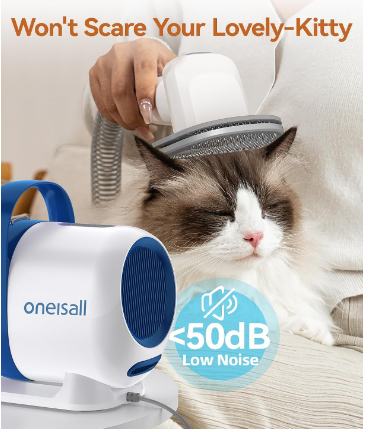
For a cat that enjoys brushing and remains relaxed around appliances, the oneisall LM2 Pet Grooming Vacuum Kit captures loose hair in a 1.5-liter canister. The listing includes three suction levels, a 5.2-foot hose, and multiple accessories. Its advertised 59 dB operation and “up to 99%” hair collection are seller claims, not Modern Cat Society test results.[8]
Best for: Heavy shedders that tolerate low appliance noise, and homes where airborne fur is the main grooming frustration.
Why it can be worth buying:
- Captures loosened coat at the source.
- Adjustable suction supports a gradual introduction.
- The long hose keeps the motor farther from the cat.
Important limitations: This is primarily a dog/pet kit, not a feline medical device. Do not use its clipper or grinder indiscriminately. Never vacuum wounds, inflamed skin, tight mats, the face, nipples, or genital area. Noise-sensitive cats are better served by a conventional brush.
Low-stress introduction: Reward investigation of the switched-off device, brush without suction first, and introduce the lowest setting at a distance. Stop at crouching, flattened ears, tail lashing, escape attempts, growling, or rapid breathing.
2. Bathing: When Does a Cat Actually Need a Bath?
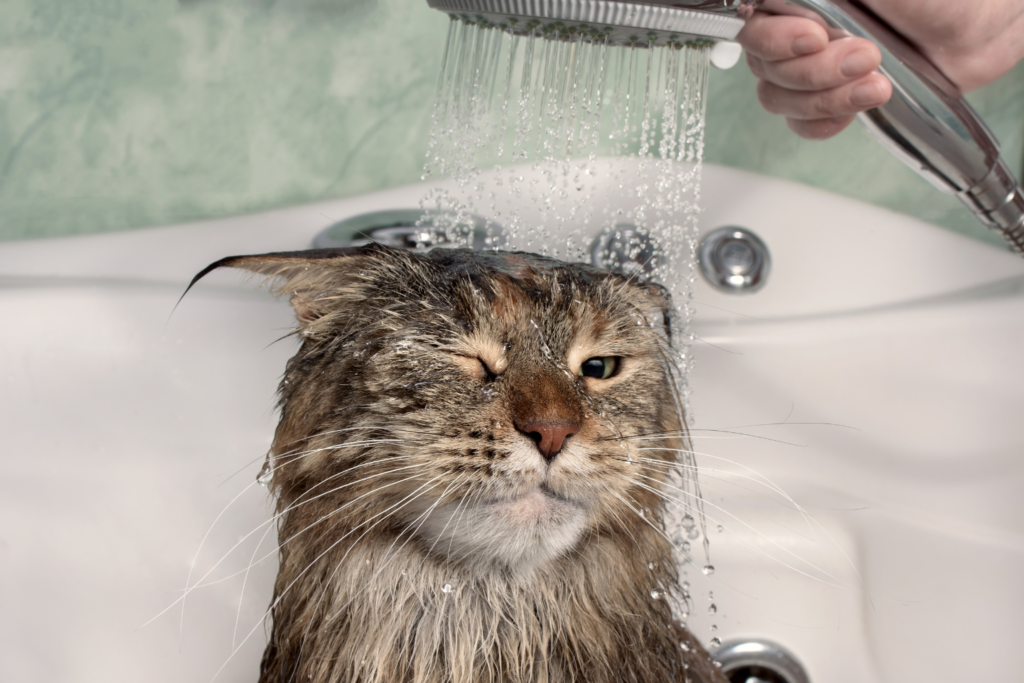
Most healthy indoor cats do not need baths on a fixed schedule. Routine bathing can dry the skin and make future handling harder; brushing and targeted cleaning are usually better first choices.
A bath may be appropriate when:
- A cat has feces, urine, grease, or another difficult substance in the coat.
- A hairless breed needs skin care recommended for that individual.
- A longhaired cat cannot keep the hindquarters clean.
- Obesity, arthritis, disability, or illness limits normal grooming.
- A veterinarian prescribes a medicated shampoo or bathing protocol.
- The cat is accustomed to bathing and genuinely benefits from occasional washing.
If a chemical, concentrated essential oil, medication, paint, adhesive, or unknown substance contaminates the coat, prevent licking and call a veterinarian or animal poison service. Do not improvise with solvents or home remedies.
How to bathe a cat safely
- Prepare first. Set out a non-slip mat, towels, cup or low-pressure sprayer, and cat-specific or prescribed shampoo.
- Brush before water. Water can tighten tangles; obtain professional help for difficult mats.
- Use lukewarm water. Keep it shallow and away from the eyes, nose, and ears.
- Support—do not overpower. Move slowly and avoid scruffing or forceful restraint.
- Rinse and towel-dry thoroughly. Residue can irritate skin and will be swallowed during grooming.
Never use human shampoo, human medicated wash, dog flea shampoo, undiluted essential oils, or a product containing ingredients your veterinarian has not approved for cats. “Natural” does not automatically mean feline-safe.
For a small dirty patch, a soft cloth dampened with warm water may suffice. Use cat-labeled wipes only as directed and stop if irritation develops.
3. Claw and Paw Hygiene
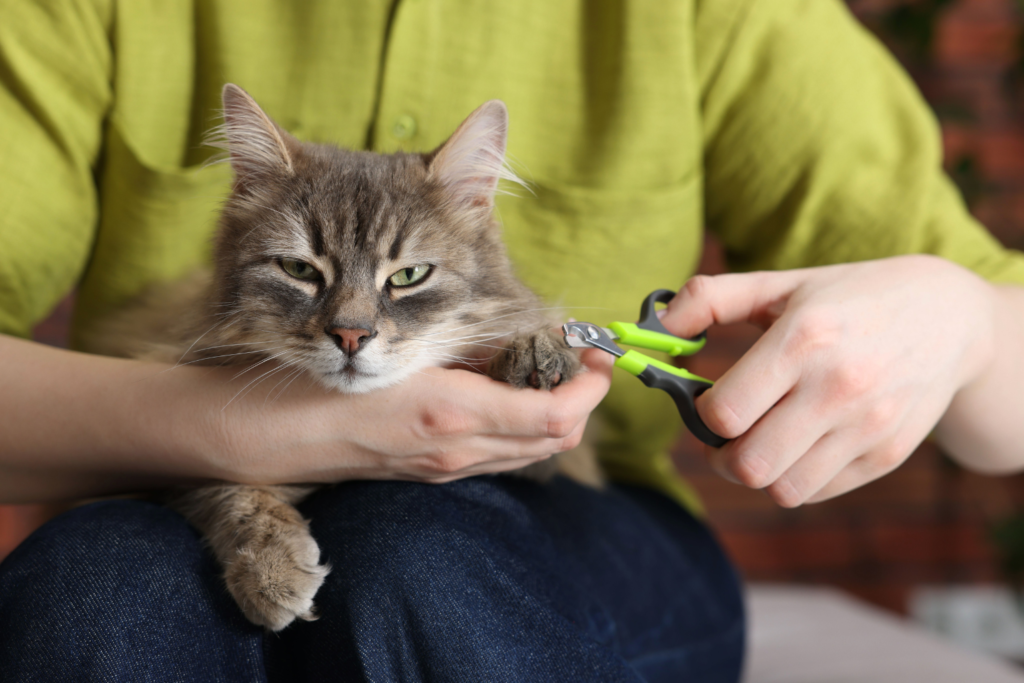
Claw care protects comfort as much as furniture. Scratching removes worn outer sheaths but does not keep every claw short; dewclaws receive little wear, and seniors may scratch less.
Inspect paws weekly for trapped litter, swelling, cuts, broken claws, excessive licking, or a claw curving toward the pad. Wipe ordinary dust with a damp cloth; seek guidance after chemical exposure.
How to trim claws without turning it into a struggle
- Begin when the cat is calm, not during play or immediately after a frightening event.
- Touch one paw briefly, reward, and end the session. Build tolerance before introducing clippers.
- Press the toe pad gently to extend the claw.
- In a light-colored claw, identify the pink quick containing nerves and blood vessels.
- Trim only the translucent hooked tip. If the quick is difficult to see, remove less.
- Do one or two claws and stop if that is what the cat can comfortably handle.
- Keep styptic powder available, and ask a veterinarian or groomer to demonstrate if you are unsure.
Many cats need a trim approximately every two to four weeks, but the correct interval varies. Check seniors more frequently because an ingrown claw can hide beneath fur and become painful or infected.[2]
Provide stable vertical and horizontal scratching surfaces even when you trim. Claw trimming is maintenance; scratching is a normal physical and communication behavior. Declawing is not a hygiene procedure—it amputates the end of each affected toe and is opposed by major feline welfare organizations.[3]
4. Ear and Eye Care: Inspect More, Clean Less
Healthy ears are pale pink, comfortable, and free from strong odor or heavy debris; they may need no routine cleaning. Inspect the visible ear flap, but never probe the canal with cotton swabs or other objects.
If cleaning is advised, use the veterinarian-recommended feline solution and technique. Lift visible debris gently with gauze; never pour peroxide, alcohol, vinegar, oil, or homemade mixtures into the ear.
Schedule an examination for:
- Repeated head shaking or scratching
- Redness, heat, swelling, or pain
- Black, yellow, bloody, or pus-like discharge
- A strong or unusual odor
- A tilted head, loss of balance, or disorientation
- Sudden sensitivity when the head is touched
For ordinary surface debris, wipe outward with a separate damp pad for each eye. Never use human eye drops or cosmetic cleansers. Squinting, redness, cloudiness, swelling, a visible third eyelid, or persistent colored discharge needs prompt assessment.[1]
Flat-faced cats may need more frequent cleaning of facial folds and tear overflow, but recurring staining or discharge is still worth discussing with a veterinarian rather than simply covering it with a grooming product.
5. Litter Box Hygiene: Clean Enough for the Cat, Observable Enough for You
The litter box is both a bathroom and a health-monitoring tool. Urine volume, stool consistency, frequency, straining, and blood can reveal early trouble. Keep it appealing without hiding those clues.
AAHA recommends scooping boxes twice daily when possible, washing them regularly with mild soap and water, and avoiding strongly scented disinfectants. It also reiterates the common starting rule of one box per cat plus one extra, distributed in quiet, accessible locations rather than grouped together.[4]
A reliable manual-box routine
- Remove urine clumps and feces at least once daily; twice daily is better in multi-cat homes.
- Wash the empty box periodically with mild, unscented soap and rinse thoroughly.
- Replace a deeply scratched plastic pan when odor persists after cleaning.
- Keep boxes away from food, water, loud appliances, dead-end spaces, and places where another pet can block access.
- Choose a box large enough to turn and posture comfortably, with a low entry for cats that need it.
- Avoid masking odors with perfumes. If the box smells, remove the source and clean it.
Never punish elimination outside the box. Urinary or gastrointestinal disease, arthritis, metabolic illness, stress, conflict, and box setup can contribute. Repeated straining with little or no urine—especially in a male cat—is an emergency.[4]
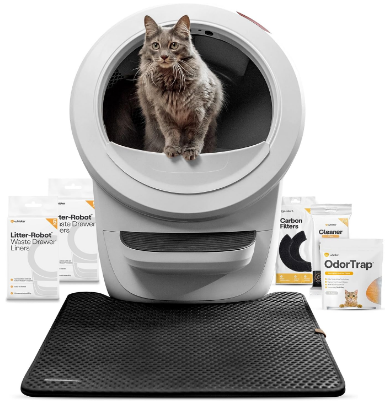
Product spotlight: Whisker Litter-Robot 4 Supply Bundle
The Whisker Litter-Robot 4 sifts clumping litter after a cat leaves and deposits waste in a lined drawer. For a compatible cat, waste spends less time exposed and daily scooping is greatly reduced.
The Amazon link is for a Supply Bundle, so confirm contents and color before ordering. The Whisker app provides drawer and litter-level alerts, recent visits, and qualifying weight data. Its sealed drawer and carbon filter reduce odor; they cannot guarantee an odorless room.[9]
Best for: One- or multi-cat households that use compatible clumping litter, have sufficient floor space, and want less manual scooping without giving up usage monitoring.
Why it can be worth buying:
- Sifts after use and contains waste in a drawer.
- Reduces repetitive scooping.
- App trends can make visit or weight changes easier to notice.
Important limitations: You must still inspect and empty the drawer, add litter, clean sensors and components, and observe waste. It works best with standard-weight clumping clay; non-clumping, loose-clumping, newspaper, and wood-pellet litters are incompatible. Light crystal litter may affect level readings.[9]
Automatic mode requires a cat weighing at least 3 pounds. Below that threshold, Whisker directs users to keep it off and cycle manually. The cat must also fit and posture comfortably.[9]
Transition tip: Place it near the familiar box, leave it off initially, add a little used litter, and retain the old box until adoption is reliable. Skittish cats may still prefer a large open pan; AAHA notes that automatic movement can startle some cats.[4]
6. Food Bowl, Water Bowl, and Fountain Hygiene
A bowl can look clean while holding saliva and food residue. Do not indefinitely top up yesterday’s food or water.
For a practical routine:
- Wash wet-food dishes after every meal.
- Wash dry-food and water bowls daily; rinse well and refresh the water.
- Use multiple water stations in multi-level or multi-cat homes.
- Keep water away from litter and, when possible, separate from food.
- Choose stable, easy-to-clean vessels. Stainless steel, glass, and intact glazed ceramic are practical options.
- Replace chipped ceramic and deeply scratched vessels.
Some cats enjoy running water; others prefer a still, wide bowl. International Cat Care recommends offering choices, placing water where the cat feels secure, refreshing it daily, and considering a fountain for cats attracted to moving water.[5] A fountain is an additional water option, not proof that a cat is drinking enough.
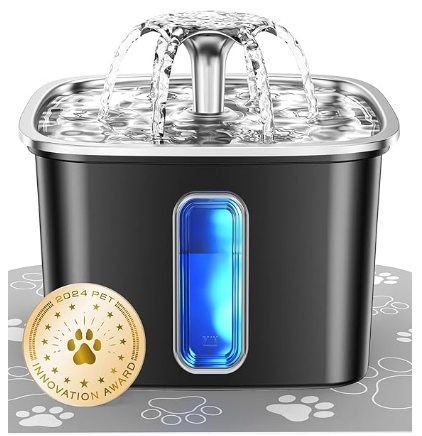
Product spotlight: Veken 108-Ounce Stainless Steel Cat Water Fountain
The Veken 108-Ounce Stainless Steel Cat Water Fountain suits owners wanting large capacity without a plastic drinking surface. It is listed at 108 ounces (3.2 liters), with 304 stainless-steel water-contact parts, water window, optional LED, filtration, and a pump the seller rates at 25 dB.[10]
One correction to the original article is important: this model is corded, not wireless. It requires a suitable outlet and thoughtful cord placement. A cord cover or routing the cable behind furniture can keep it away from teeth and walking paths.
Best for: Multi-cat homes, owners who prefer stainless-steel contact surfaces, and cats that favor circulating water.
Why it can be worth buying:
- Large reservoir for busy households.
- Durable, inspectable stainless-steel contact parts.
- Broad top instead of a deep, narrow bowl.
- Filtration to capture visible debris between cleanings.
Important limitations: Stainless steel still collects saliva, hair, minerals, and biofilm. Filtration does not sanitize water. The seller recommends weekly fountain/pump cleaning and filter/prefilter replacement about every two weeks; local water and use may change that schedule.[10]
Keep a separate fresh-water bowl available while your cat decides whether the fountain is appealing. Watch actual drinking behavior rather than assuming moving water increases intake. If a cat suddenly drinks much more or much less than usual, contact a veterinarian.
7. Feline Chin Acne: Hygiene Helps, but Plastic Is Not the Whole Story
Feline chin acne often appears as blackheads or dark debris on the chin and lower lip. More inflamed cases can develop redness, swelling, pustules, pain, bleeding, or secondary infection.
It is inaccurate to say that plastic bowls “almost always” cause the condition. MSD Veterinary Manual describes feline chin acne as a keratinization disorder with suspected infectious, environmental, and stress-related triggers; secondary infection is common.[6] Scratched plastic can be harder to clean, so switching to stainless steel, glass, or intact glazed ceramic and washing vessels daily is a sensible, low-risk step—but it is not a guaranteed cure.
Do not squeeze blackheads, scrub aggressively, apply human acne medication, or use essential oils. Veterinary treatment may be needed to distinguish acne from mites, ringworm, allergy, other skin disease, or a deeper infection. Seek care if the chin is swollen, painful, draining, bleeding, foul-smelling, or not improving.
Also inspect how the cat eats. A shallow plate may keep the chin cleaner than a deep bowl for some individuals. Wipe food residue gently with a damp cloth when necessary and dry the area without rubbing.
8. Dental Hygiene: The Most Important Cleaning Job Cats Cannot Do
Dental disease is more than bad breath. Plaque accumulates at the gumline, disease progresses beneath it, and cats hide oral pain. AAHA calls daily brushing the best at-home plaque-control method and recommends pet-specific supplies—never human toothpaste.[7]
How to build a cat-friendly tooth-brushing routine
- Begin only when the mouth is comfortable; red, bleeding, or painful gums need an exam first.
- Let the cat taste veterinarian-approved feline toothpaste, then reward brief lip lifting on later sessions.
- Progress to a soft cat toothbrush on the outer tooth surfaces near the gumline—never force the mouth open.
- Build toward daily care while preserving cooperation; a short success beats a wrestling match.
Brushing removes soft plaque; it does not remove established calculus or treat disease beneath the gumline. Professional evaluation, dental radiographs, and anesthetized cleaning may still be needed. Persistent bad breath, red gums, drooling, dropping food, chewing on one side, pawing at the mouth, facial swelling, or appetite change warrants a veterinary dental examination.[7]
If brushing is not yet possible, ask your veterinarian about a dental diet, treats, wipes, gels, sprays, or water additives with evidence for cats. The VOHC publishes a current cat-specific list of products that have earned its Seal of Acceptance for plaque or tartar control.[11]
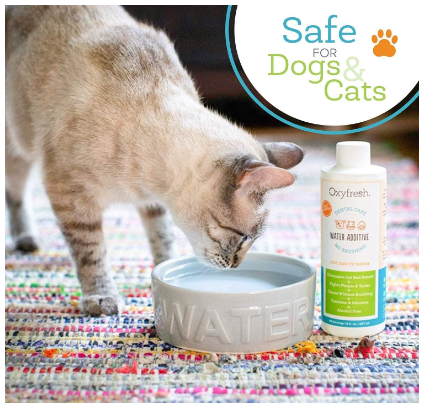
Product spotlight: Oxyfresh Premium Pet Dental Water Additive
Oxyfresh Premium Pet Dental Water Additive is an odorless, unflavored liquid measured into drinking water. Its listed ingredients include water, sodium benzoate, sodium citrate, stabilized chlorine dioxide, zinc acetate, sodium hydroxide, and chlorophyllin-copper complex.[12]
Best for: Owners seeking an easy, optional breath-care adjunct after discussing oral care with their veterinarian, particularly while they are gradually training a cat to accept brushing.
Why some owners may prefer it:
- No intended mint flavor or strong fragrance.
- Dosing based on measured water volume.
- No additional handling inside the mouth.
The evidence-related limitation: Oxyfresh advertises plaque and tartar benefits and suggests skipping brushing; we do not endorse that claim. It did not appear on the VOHC cat-accepted list reviewed August 24, 2026. That does not prove it unsafe, but it has not earned that independent efficacy seal for cats. An additive cannot remove calculus, clean below the gumline, or replace dentistry.[7][11]
Protect hydration: Obtain veterinary approval, measure exactly, and monitor drinking. Oxyfresh says carbon filters may remove active ingredients and suggests removing the filter; we do not recommend altering a fountain for this purpose. If approved, use a separate measured bowl and retain untreated water if intake changes.[12]
9. Bedding, Carriers, Litter Mats, and Household Surfaces
Do not strip every familiar scent at once. Rotate cleaning so the environment remains predictable.
Bedding and blankets
Vacuum loose hair, follow the care label, use mild fragrance-free detergent, rinse, and dry completely. After parasites or suspected infectious disease, ask your veterinarian for a specific cleaning protocol.
Carriers
Wash the liner and wipe hard surfaces with a cat-safe product. Rinse, dry, and return a familiar blanket. Leaving the carrier open at home helps it remain a safe resting place.
Litter mats and floors
Clean litter mats frequently. For urine, blot and use a surface-compatible enzymatic pet cleaner. Avoid ammonia-based products and exclude the cat until the surface is dry and residue-free.
Food-preparation surfaces
Wash food scoops and utensils, store food according to its label, refrigerate opened wet food promptly, and discard spoiled or long-abandoned portions. Wash hands after handling food, litter, medication, or waste.
Avoid diffusing essential oils or using strongly scented cleaners as a substitute for source removal. A clean cat home should smell neutral, not heavily perfumed.
10. Parasite Checks Are Part of Hygiene—But Cleaning Is Not Prevention
Indoor cats can still encounter fleas, ticks, mites, intestinal parasites, and ringworm through other pets, people, screened patios, travel, or newly introduced animals. Brushing and vacuuming may reveal a problem, but they do not replace a veterinarian-recommended prevention plan.
During coat checks, look for:
- Flea dirt—small black specks that turn reddish-brown when moistened
- Live fleas or ticks
- Crusting, scaling, circular areas of hair loss, or broken hair
- Persistent scratching or licking
- Rice-like tapeworm segments around the rear or bedding
- Dark, coffee-ground-like ear debris accompanied by itching
Do not use a dog flea product on a cat. Some canine ingredients and concentrations can be dangerously toxic to cats. Ask your veterinarian which parasite control is appropriate for the cat’s age, weight, health, region, and exposure risk.
A Practical Cat Hygiene Schedule
Use this as a flexible checklist rather than a universal prescription.
| Frequency | Cat-care tasks | Home and equipment tasks |
| Daily | Notice appetite, drinking, grooming, mobility, urine, and stool; brush teeth if tolerated; wipe visible food from chin or facial folds when needed | Wash food dishes; wash/refill water bowls; remove litter waste once or twice; wipe food-preparation surfaces |
| Several times a week | Brush or comb as coat requires; feel for mats, lumps, wounds, parasites, and tender areas | Vacuum favorite resting areas; inspect fountain water level and visible debris |
| Weekly | Inspect claws, paws, ears, eyes, mouth, and skin; provide extra grooming for seniors or longhaired cats | Wash the fountain and pump at least as directed; clean litter mats; launder one set of bedding; inspect automatic-box sensors and surfaces |
| Every 2–4 weeks | Trim claw tips as needed; reassess coat and skin | Replace fountain filters and automatic-box odor components according to actual use and manufacturer guidance; deep-clean litter equipment as needed |
| As needed | Bathe only for a specific reason; arrange professional mat removal; clean eyes/ears only appropriately | Clean carrier and accident sites; replace scratched bowls or boxes; sanitize as directed during infectious illness |
| Veterinary schedule | Wellness examinations, dental assessment, parasite plan, vaccines, and condition-specific care | Bring notes or app trends showing changes in weight, litter visits, drinking, appetite, or grooming |
The calendar matters less than the pattern. A sudden change should prompt attention even if the next “scheduled” check is days away.
How to Make Grooming and Hygiene Less Stressful
Cooperation grows from predictability and choice. Cats can learn brushing, claw trims, mouth handling, and carrier entry through small, rewarded steps.[3]
Use the consent test
Pause after a few strokes or touching a paw. Continue only while the cat remains loose and voluntarily stays; stop at tension, turning away, tail lashing, flattened ears, or escape.
Separate training from the full procedure
Reward looking at the brush before making one stroke; touch a paw before trimming; lift a lip before brushing; run the grooming vacuum at a distance before approaching. Tiny rehearsals build safe associations.
Set up the environment
- Choose a quiet room with a non-slip surface.
- Gather supplies before bringing the cat over.
- Work when the cat is relaxed and awake, not frightened or overstimulated.
- Use high-value treats if medically appropriate.
- Keep sessions short enough that the cat can succeed.
- Avoid punishment, shouting, spraying water, or forceful restraint.
Know when professional help is kinder
A veterinarian or cat-experienced groomer is the better choice for severe mats, painful skin, an aggressive fear response, embedded claws, medical baths, or any task that cannot be completed safely. A veterinarian can also discuss pre-visit medication or a cooperative-care plan when fear is intense. Forcing care until someone is bitten or the cat panics is not a successful hygiene session.
When to Call the Veterinarian
Contact your veterinarian promptly if you notice:
- A sudden decrease or increase in self-grooming
- Bald patches, relentless licking, intense itching, wounds, swelling, pus, or skin odor
- Tight mats pulling on the skin or hiding sores
- A claw growing into a pad, a split claw, limping, or a swollen paw
- Ear odor, discharge, pain, repeated head shaking, or balance changes
- Squinting, cloudy eyes, persistent discharge, redness, or a visible injury
- Persistent bad breath, drooling, bleeding gums, facial swelling, dropped food, or reluctance to eat
- Repeated vomiting, diarrhea, constipation, urine leakage, or fecal soiling
- New elimination outside the litter box
- Markedly increased thirst, reduced drinking, or a major change in urine output
- Weight loss, weakness, or an unkempt coat in a senior cat
Seek emergency care for repeated straining with little or no urine, breathing difficulty, collapse, significant bleeding, suspected poisoning, or a chemical/toxin on the coat that the cat may lick.
Frequently Asked Questions
Do indoor cats need baths?
Most healthy indoor cats do not need routine baths. Bathe for contamination, impaired self-grooming, a breed-specific need, or veterinary direction. Use a cat-safe product and rinse thoroughly.
How often should I brush my cat?
Many shorthairs do well with one or two weekly sessions; longhaired cats and heavy shedders may need near-daily combing. Increase support for seniors and cats with obesity or impaired mobility.
Can I use human shampoo or baby wipes on my cat?
No. Human shampoo can irritate feline skin, and wipes may leave ingredients that are swallowed during grooming. Use cat-labeled or veterinarian-recommended products.
How often should I clean the litter box?
Remove waste at least daily—ideally twice. Wash with mild soap, rinse well, and avoid heavy fragrance. Start with one box per cat plus one extra in separate locations.[4]
Does stainless steel prevent feline acne?
No material guarantees prevention. Stainless steel makes inspection and washing easy, but acne has multiple suspected triggers. Daily washing and replacing damaged vessels matter more than treating one material as a cure.[6]
Is a self-cleaning litter box more hygienic?
It can remove waste more consistently, but still needs emptying, litter replenishment, washing, sensor care, and waste monitoring. The cat must accept it. Retain a conventional box during transition and observe kitten weight restrictions.
Should I clean my cat’s ears every week?
Inspect weekly, but clean only when needed. Use veterinarian-approved supplies on visible material and never probe the canal. Odor, discharge, redness, pain, or head shaking requires an examination.
How often should I trim my cat’s claws?
Check weekly and trim the hook as needed, often every two to four weeks. Seniors may need closer monitoring. Avoid the quick and request a demonstration if unsure.
Is bad breath normal in cats?
Persistent strong breath is not normal. Dental disease is common, but oral injury or systemic illness is possible. Red gums, drooling, eating changes, facial swelling, or weight loss needs veterinary assessment.[7]
Are dental water additives enough to clean a cat’s teeth?
No. Some may support plaque or breath care, but daily brushing remains the best home method. Prefer cat-specific VOHC-accepted options and protect water intake; additives cannot remove calculus or treat disease below the gumline.[7][11]
Final Thoughts: Hygiene Is Preventive Care, Not Perfection
A clean cat does not need to smell like shampoo or lose every familiar scent. Good hygiene means a mat-free coat, comfortable claws, eyes and ears, real dental prevention, clean vessels, and appealing litter boxes.
Technology can help: oneisall captures shed fur, Litter-Robot 4 reduces scooping, Veken adds a circulating water option, and Oxyfresh may serve as a veterinarian-approved adjunct. Choose only products that solve a real problem, introduce them gradually, and keep the fundamentals. Your most valuable tool remains attention—knowing your cat’s normal pattern and acting when it changes.
Read more:
Best Cat Nail Clippers for Stress-Free Grooming
How to Brush Your Cat’s Teeth: A Stress-Free Guide for Healthier Smiles
Cat Vaccination Schedule: The Complete Guide Every Cat Owner Needs
Sources and References
- ASPCA — Cat Grooming Tips
- Cornell Feline Health Center — Choosing and Caring for Your New Cat and The Special Needs of the Senior Cat
- International Cat Care — Position Statement on the Declawing of Cats and FelineVMA — Feline Behavior Guidelines
- AAHA — Why Won’t My Cat Use the Litter Box? and AAHA/AAFP — General Litter Box Considerations
- International Cat Care — How to Encourage Your Cat to Drink
- MSD Veterinary Manual — Pyoderma in Dogs and Cats
- American Animal Hospital Association — Dog & Cat Dental Disease: Signs, Professional Cleanings, Anesthesia, and Home Care
- Amazon — oneisall LM2 Pet Grooming Vacuum Kit, ASIN B0BHYZV3HY
- Whisker — Litter-Robot 4 Product Details and FAQ
- Amazon — Veken 108-Ounce Stainless Steel Cat Water Fountain, ASIN B0FPFZ7XFJ
- Veterinary Oral Health Council — Accepted Products for Cats
- Oxyfresh — Premium Pet Dental Water Additive: Ingredients, Directions, and Fountain Guidance