5 Best Cat Water Fountains for Indoor Cats in 2026
By Demosthenes Staudinger | Updated August 24, 2026
Affiliate disclosure: This article contains affiliate links. As an Amazon Associate I earn from qualifying purchases. If you buy through one of these links, we may earn a commission at no additional cost to you. This does not affect our editorial recommendations.
A cat water fountain can solve a very ordinary problem: some cats prefer moving water, while their people want a water station that is easy to live with. The right model may make water more appealing, provide a larger reservoir than a bowl, and catch hair and debris.
It is not, however, a medical device or a shortcut to urinary health. Research has not shown that fountains reliably make every cat drink substantially more. In a small controlled study of 13 healthy cats, 12 drank slightly more from a fountain, but urine concentration did not change significantly; one cat rejected the fountain. A 2026 review of feline hydration research likewise concluded that water intake varies widely and that delivery by still or flowing water has not consistently changed intake.
A fountain can be a useful option, but it cannot prevent chronic kidney disease, cure urinary problems, or add years to a cat’s life by itself. Food moisture, bowl location, health status, and access to several clean water sources may be just as important. Cats eating wet food may drink less because much of their water already comes from food.
We compared five fountains using current manufacturer and retail documentation, capacity, power, materials, app functions, filtration, maintenance, recurring filter needs, and purchase support.
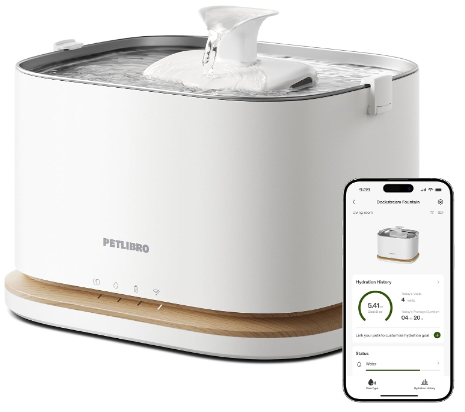
The PETLIBRO Dockstream 2 Smart Cordless Fountain is our best overall pick for a single-cat home because it combines flexible placement, a 3-liter reservoir, app-based intake estimates, dual-band Wi-Fi, and a removable stainless steel drinking tray. If you do not need electronics, the WOPET W03L offers a large glazed-ceramic bowl, while the Veken 2.8L is the more straightforward stainless steel choice.
How we reviewed these cat water fountains: This is a research-based editorial comparison, not a hands-on test. Modern Cat Society has not purchased or field-tested all five products. Rankings are based on current manufacturer specifications, manuals, retailer information, published feline-hydration research, expected cleaning and filter requirements, and fit for specific buyers. Product variants, package contents, prices, and availability can change, so confirm the live Amazon listing before ordering.
Quick Verdict: The Best Cat Water Fountains in 2026
Rank
Cat water fountain
Best for
Capacity
Power
Main drinking surface
Smart functions
Biggest limitation
1
PETLIBRO Dockstream 2 Smart Cordless
Best overall; one-cat homes and flexible placement
Tracks only one unidentified pet; frequent filter replacement
2
WOPET W03L Ceramic
Best ceramic fountain and large-breed stability
3 L / 101 oz
Corded
Glazed ceramic bowl
None
Heavy to move; current W03L specifications say it has no battery
3
Veken 2.8L Stainless Steel
Best value stainless steel fountain
2.8 L / 95 oz
Corded
Stainless steel
None
Less detailed official documentation than our top picks
4
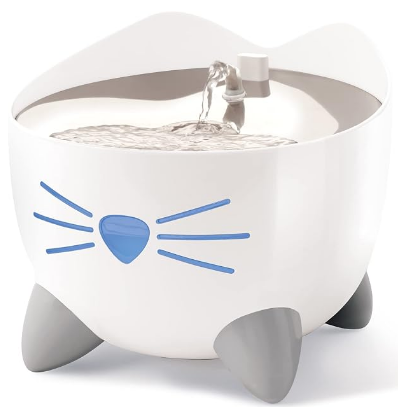
Catit PIXI Smart
Best app controls and maintenance alerts
2 L / 67.5 fl oz
Corded USB adapter
Stainless steel top over a plastic body
Remote control, timer, alerts, UV-C cycle
2.4 GHz Wi-Fi only; does not measure an individual cat’s intake
5
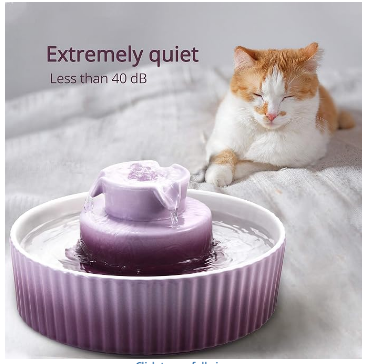
Lawfery Cupcake Ceramic
Best 360-degree heavy ceramic alternative
Listed as 2–2.1 L / 70–71 oz
Corded
Ceramic
None
Inconsistent capacity wording and limited manufacturer support information
How We Chose the Winners
The best fountain is not the one with the longest feature list. It must solve a practical problem without creating a disproportionate cleaning, filter, noise, or connectivity burden.
We weighted the following criteria:
Cat acceptance: An accessible drinking area and manageable stream matter more than decorative effects. No shape guarantees use.
Cleaning access: Reservoirs, trays, spouts, filter housings, and rotors all develop residue. We favored models that separate into accessible parts and disclose which components are dishwasher-safe.
Material accuracy: “Stainless steel fountain” may mean only the top tray is metal, so we distinguished the drinking surface from the reservoir.
Power and placement: A true rechargeable cordless fountain offers more placement freedom. A corded model can run continuously without charging but needs a safe outlet and cable route.
Recurring cost: Filters are consumables. A lower purchase price can lose its advantage when proprietary filters need frequent replacement.
Smart-feature usefulness: App controls and maintenance reminders are different from individual-cat measurement.
Documentation and support: Clear specifications, manuals, warranty information, and replacement parts improve long-term value. Weak or contradictory documentation reduced a product’s rank.
Evidence and honest claims: We did not award points for unverified promises that a fountain prevents disease, “sterilizes” water, eliminates every contaminant, or makes every cat drink more.
Do Cats Really Drink More From a Fountain?
Some do; some do not. International Cat Care recommends offering choices because individual preferences differ. A cat may favor a fountain, a wide bowl, a glass, or water placed in a quiet location away from food and litter. Running water is one option among several, not a universal feline requirement.
The best direct study remains limited. In the 2010 trial noted above, fountain access did not substantially increase intake or dilute urine across the group. More recent evidence reviews also emphasize that feline water intake is highly variable and that the minimum intake needed to reduce urinary or renal disease risk is not firmly established.
Dietary moisture has stronger support. In a small crossover study, cats fed food containing 73.3% moisture had greater total daily fluid intake and produced more dilute urine than when fed lower-moisture versions of the same diet. That does not mean every cat should be switched abruptly to wet food, especially if they have a prescribed diet, but it does show why a fountain should not carry the entire hydration strategy.
Cornell’s Feline Health Center gives a general reference of about 4 ounces of total water per 5 pounds of lean body weight per day. “Total” includes moisture in food, so the amount seen disappearing from a reservoir is not a complete hydration measurement. Needs also change with diet, temperature, activity, pregnancy, lactation, medications, and illness.
A sudden increase in thirst or urine volume deserves veterinary attention. Kidney disease, diabetes, hyperthyroidism, vomiting, diarrhea, and several other conditions can change water balance. Smart-fountain data may help you notice a pattern, but it cannot diagnose the cause.
1. PETLIBRO Dockstream 2 Smart Cordless Fountain — Best Overall
Best for: A single-cat household that wants cordless placement and useful drinking trends.
Skip it if: Several pets share one fountain, you dislike app-connected products, or you want the lowest possible filter cost.
Key specifications
Capacity: 3 L / 101 fl oz
Power: 5,200 mAh rechargeable battery; approximately 7–8 hours to charge while not operating
Materials: ABS reservoir with a removable stainless steel drinking tray
Dimensions: 9.6 × 7.8 × 7.7 inches
Connectivity: 2.4 GHz and 5 GHz Wi-Fi; iOS 13 or later and Android 7 or later
Flow: Continuous or pet-activated sensor mode
Filtration: Four-layer replaceable filter
Manufacturer support for direct purchases: 24-month warranty and 30-day money-back period listed at publication
PETLIBRO wins because it addresses two problems better than the others: outlet-dependent placement and visibility into drinking behavior. The cordless version can sit where your cat already feels comfortable instead of where the nearest socket dictates. Its detachable 3-liter tank and stainless steel tray also make it less visually intrusive than many exposed-pump fountains.
The app estimates intake, sessions, average drinking time, daily totals, and progress toward a goal, while providing low-water and maintenance reminders. Unlike the Catit PIXI Smart, this model attempts to quantify drinking rather than merely report device status.
There are important limits. The Dockstream 2 Smart Cordless does not use RFID, so it tracks one pet at a time and cannot identify which animal drank in a multi-pet home. PETLIBRO also says drinks under 2 mL may not register, playing with water can disrupt detection, and approaching from behind may prevent sensor activation. Put it against a wall if you rely on sensor mode, and treat the numbers as estimates rather than a veterinary measurement.
The advertised “up to 30 days” of battery life is based on one pet, sensor mode, 30 daily sessions, and 45 seconds per session. Continuous flow or heavier use can shorten it. Keep a separate bowl available during charging.
Maintenance is the main ownership cost. PETLIBRO recommends replacing the filter every two weeks for one pet and more often for multiple pets. The base must never be immersed, although the stainless tray is dishwasher-safe and the magnetic rotor can be rinsed. Optional PETLIBRO Care plans add advanced wellness features and multi-device data syncing; confirm which app functions are included without a subscription before buying.
What we like
True rechargeable cordless placement
Useful single-pet drinking trends and alerts
Large reservoir in a relatively compact footprint
Dual 2.4/5 GHz Wi-Fi support
Stainless steel drinking tray and pump-free magnetic rotor design
What to know before buying
Not an RFID or multi-pet identification system
Manufacturer’s battery estimate depends on restricted test conditions
Two-week filter guidance can create a meaningful recurring cost
Electronics make cleaning more deliberate than with a simple ceramic bowl
2. WOPET W03L Ceramic Fountain — Best Ceramic Fountain
Best for: Buyers who prioritize a substantial glazed-ceramic bowl, a large reservoir, and simple operation.
Skip it if: You need cordless placement, a lightweight fountain, or app-based monitoring.
Key specifications
Capacity: 3 L / 101 oz
Power: Corded, 110–240 V input according to the current W03L specification table
Material: Glazed ceramic bowl
Dimensions: 28.5 × 28.5 × 19.2 cm, approximately 11.2 × 11.2 × 7.6 inches
Filtration: Replaceable multi-stage filter
Cleaning: Ceramic bowl is listed as dishwasher-safe
Manufacturer support for direct purchases: 24-month extended warranty and 30-day money-back period listed at publication
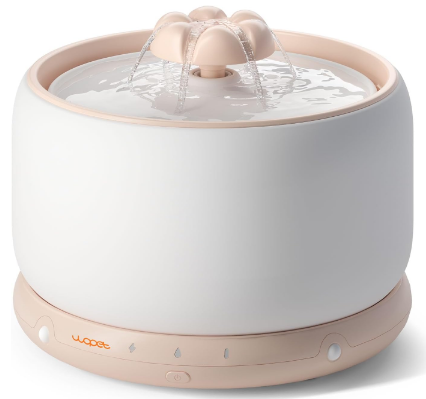
The WOPET W03L is the strongest non-smart choice for people who prefer ceramic. Its 3-liter reservoir matches the PETLIBRO’s nominal capacity, and the wide, heavy format should be harder for an enthusiastic cat to move than a light plastic unit. The glossy ceramic surface is also easy to inspect for residue and does not depend on an app, account, or Wi-Fi connection.
Ceramic is not automatically sterile or immune to damage. It still requires water changes, cleaning around the spout and filter housing, and inspection for chips or cracks. Its real advantage is a smooth, substantial bowl that is straightforward to wash.
The most important correction concerns power. WOPET’s page title and some customer-facing copy use the word “wireless,” yet the same official page identifies the current W03L as with power cable, lists without battery, and says a power cable is included. We therefore treat this model as corded. Amazon variants can change, so confirm the exact model number, package contents, and power source in the live listing rather than assuming that “W03 Lite” or a product photo indicates battery operation.
WOPET calls the pump quiet but publishes no test method for direct comparison. Check filter composition and replacement intervals in the included manual before calculating annual cost.
This suits buyers who value ceramic over data, but its full 3-liter bowl and 11.2-inch footprint require space and careful lifting.
What we like
Large 3-liter capacity
Smooth glazed-ceramic bowl
Dishwasher-safe ceramic component
Stable, decor-friendly design
No account, app, or network dependency
What to know before buying
Current W03L specifications indicate corded power and no battery
Heavy and comparatively wide
Ceramic must be inspected for chips and cracks
Published filtration and noise details are less specific than PETLIBRO’s
3. Veken 2.8L Stainless Steel Fountain — Best Value Stainless Steel Pick
Best for: Buyers who want a practical metal drinking surface without paying for app features.
Skip it if: You need cordless operation, individual intake tracking, or unusually detailed manufacturer documentation.
Key specifications
Capacity: 2.8 L / 95 oz
Power: Corded electric
Material: Current listing identifies stainless steel; confirm whether every water-contact part is steel
Approximate size: 8.4 × 8.4 × 5.3 inches in the current listing
Filtration: Activated carbon, ion-exchange resin, and non-woven media described by Veken
Recognition: Veken identifies this 2.8-liter stainless model as a 2023 Pet Innovation Awards winner
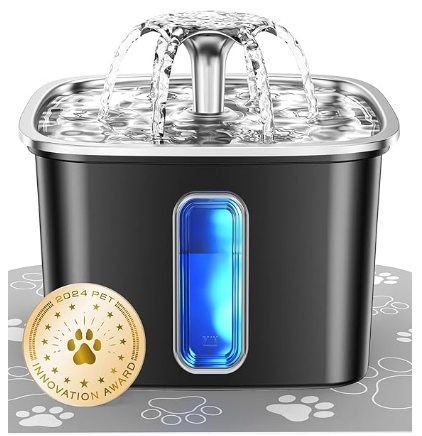
Veken takes third place because it offers the most direct route to a stainless steel fountain in this group. It has no app to configure and no battery to charge. A 2.8-liter reservoir is large enough to reduce constant top-ups in many single-cat homes, yet the listed footprint is smaller than the WOPET ceramic model.
The broad top may suit cats that dislike narrow vessels. Evidence for a distinct “whisker fatigue” syndrome is limited, so consider this a preference-friendly design rather than treatment.
Veken’s official site describes a filtration stack using activated carbon, ion-exchange resin, and non-woven fabric. Those layers can catch debris and may reduce some odors or dissolved compounds under the manufacturer’s intended conditions. They do not sterilize water, make contaminated tap water safe, or replace cleaning the reservoir and pump. Use water that is already safe for human consumption unless your veterinarian or local authority advises otherwise.
The tradeoff is documentation. Veken’s site confirms the 2.8-liter stainless model and filtration concept but provides fewer model-specific cleaning, warranty, and component details than PETLIBRO or Catit. Current retail information identifies model PFC3V301, corded power, included filters and pre-filter sponges, and a two-year warranty, but package contents and seller-backed coverage can change. Verify them on the exact Amazon offer you select.
This suits someone who wants circulating water and a washable metal surface without connectivity. It is not “set and forget”: hair collects around pre-filters, minerals can build up on the pump, and low water increases sound.
What we like
Straightforward corded operation
2.8-liter capacity in a compact format
Stainless steel drinking area
Replacement filters and pre-filter sponges are widely listed
No app or subscription
What to know before buying
Cord limits placement
No hydration measurement or low-water phone alert
Verify which parts are stainless steel, not only the top surface
Model-specific support information is less transparent than our top two picks
4. Catit PIXI Smart Drinking Fountain — Best for App Controls and Maintenance Alerts
Best for: A connected home that values remote controls, low-water alerts, and scheduled maintenance reminders.
Skip it if: You need cordless operation, 5 GHz-only connectivity, a fully stainless body, or per-cat intake measurements.
Key specifications
Capacity: 2 L / 67.5 fl oz
Power: Corded USB output with 5 V/1 A adapter; average use listed below 1 W
Materials: Stainless steel top with a plastic reservoir/body
Dimensions: 8 × 8 × 6.7 inches
Connectivity: 2.4 GHz Wi-Fi only
App: Free Catit PIXI app with no in-app purchases listed
Maintenance alerts: Filter every 30 days and pump cleaning every 60 days, according to Catit’s schedule
Other functions: Timer, remote on/off, app sharing, low-water alerts, energy-saving mode, and manual UV-C cycle
The Catit PIXI Smart earns a place because its app functions are specific and clearly documented. You can turn the fountain on or off, set a timer, activate a five-minutes-on/fifteen-minutes-off energy-saving cycle, start the UV-C clarification cycle, and share control with a family member or cat sitter. The app can also notify you every four hours when the water is low or empty.
This is device management, not hydration tracking. Catit does not state that the PIXI measures milliliters, counts sessions, or identifies an animal. Choose PETLIBRO for estimated intake trends; choose Catit when reminders and remote control are enough.
Catit combines a stainless steel top with a plastic lower body, so it should not be described as an all-stainless fountain. The stainless top is dishwasher-safe according to Catit, while the electrical components need the manual’s cleaning method. Its 2-liter capacity is also the smallest clearly documented reservoir in our top four, making water-level checks more important in a multi-cat home.
The built-in UV-C feature runs automatically for 60 minutes three times per day and can be started manually. Catit describes it as a way to clarify water and reduce cloudiness. We would not treat that as proof that the fountain sterilizes water or eliminates every pathogen. Filters and UV-C do not compensate for old water, slime, inaccessible residue, or a dirty pump.
The PIXI supports only 2.4 GHz Wi-Fi; a 5 GHz-only network will not connect. Confirm that 2.4 GHz is enabled, and never let water access depend entirely on a phone notification.
What we like
Clearly documented app controls and alerts
Free app without listed in-app purchases
Stainless steel top and shallow backup drinking pool
Low-water auto-shutoff
Useful filter and pump-maintenance schedule
What to know before buying
Does not quantify an individual cat’s intake
Corded and limited to 2.4 GHz Wi-Fi
2-liter capacity is modest for several pets
UV-C clarification does not eliminate the need for complete cleaning
5. Lawfery Cupcake Ceramic Fountain — Best 360-Degree Ceramic Alternative
Best for: A buyer who wants a heavy ceramic fountain with access around the full perimeter and is comfortable verifying the live listing carefully.
Skip it if: You want the strongest manufacturer documentation, dependable direct support, app functions, or confirmed current stock.
Key specifications
Capacity: Product title lists 2.1 L / 71 oz; current bullet copy also refers to 2 L
Power: Corded electric
Material: Ceramic body listed at approximately 6 pounds
Drinking area: 360-degree access
Filtration: Replaceable charcoal filter plus pre-filter sponge
Listed package: Three carbon filters and two pumps in the current product title
Pump claim: Seller-listed below 30 dB and 1.5 W; not independently verified
The Lawfery Cupcake is visually distinctive and substantially heavier than most plastic fountains. Its circular design allows cats to approach from several directions, which can help in a shared space where one animal might otherwise block a single drinking edge. The ceramic body also resists casual sliding and is easy to inspect while washing.
It ranks fifth because the supporting information is less consistent. The Amazon title says 2.1 liters/71 ounces, while current feature copy says 2 liters. The listing advertises three filters and two pumps, but buyers should confirm whether the second pump is included as a spare in the exact offer. We also could not verify a detailed official Lawfery support page comparable to PETLIBRO, WOPET, or Catit.
The seller describes the pump as below 30 dB, but noise claims are difficult to compare without a common test method. Any fountain may become louder as the water drops or the pump accumulates debris.
Its 360-degree access is more relevant than calling it a “nature simulator.” A free-falling stream may appeal to a faucet-loving cat, but it does not reproduce a spring or guarantee greater intake.
Because current availability has fluctuated, compare the seller, delivery estimate, return terms, included parts, and replacement-filter supply before paying. If support and predictable consumables matter more than the cupcake design, the WOPET W03L is the safer ceramic choice in this group.
What we like
Heavy ceramic body
Full-perimeter drinking access
Replaceable carbon filter and debris sponge
Seller lists spare consumables in the package
Decorative design for buyers who dislike rectangular appliances
What to know before buying
Capacity is described inconsistently as 2 and 2.1 liters
Seller noise claim is not an independent laboratory result
Manufacturer support and warranty information are difficult to verify
A rechargeable fountain helps when the best location has no outlet or a cat chews cords. Battery life depends on use, and a backup water source is essential while charging.
A corded fountain is simpler for continuous circulation. Route the cable where it cannot be chewed or become a trip hazard, keep plugs and adapters away from splashes, and use the power supply specified by the manufacturer. “Wireless pump” can describe how power is transferred inside a fountain without meaning that the appliance itself runs without a cord, so check for an actual battery specification.
Compare the water-contact surfaces, not the headline material
Material
Practical advantages
Practical limitations
Best fit
Stainless steel
Light, durable, easy to inspect, and often dishwasher-safe
Can show water spots; lower reservoir may still be plastic
Buyers who want low weight and a simple washable top
Glazed ceramic
Heavy, stable, visually furniture-like, and smooth when intact
Breakable, heavier to carry, and unsafe if glaze chips or cracks
Cats that push bowls and homes prioritizing appearance
Plastic
Light, inexpensive, and easy to mold into smart designs
Can scratch, retain odors, and require closer inspection
Smart features, travel, or budget-first purchases
Feline chin acne has multiple possible causes, and no material guarantees prevention. If a cat develops blackheads, swelling, redness, or discomfort around the chin, clean food and water vessels routinely and ask a veterinarian for guidance rather than assuming the bowl is the only cause.
Capacity is not a license to leave water untouched
A 3-liter tank reduces refills, but water quality still depends on cleanliness. Check the level daily, replace contaminated water immediately, and follow the manual’s full-cleaning schedule. Multiple pets and dusty or hot rooms increase maintenance.
Keep at least one separate bowl available. It gives a cat a preference, provides water during charging or cleaning, and protects against a failed pump or empty reservoir. In a multi-cat home, distribute water sources so one cat cannot guard all of them.
Filters have a recurring cost
Before buying, find the exact replacement-filter model and calculate how many the manufacturer’s schedule requires per year. PETLIBRO’s two-week recommendation implies roughly 26 filters annually for one cat if followed continuously. Catit’s 30-day reminder implies about 12. Veken, WOPET, and Lawfery schedules should be confirmed for the exact model and local water conditions.
A dark or slimy filter should be replaced early, but a new filter does not sanitize a dirty reservoir. Wash the tank, tray, spout, filter holder, impeller or rotor, and any gasket or crevice specified in the manual. Rinse new carbon filters as directed so loose carbon dust does not enter the water.
Noise depends on more than the pump
Decibel numbers from different brands are rarely directly comparable. Reservoir level, stream height, placement on a hollow cabinet, mineral buildup, trapped air, and a misaligned cover all change what you hear. A silicone mat can reduce vibration and catch splashes. If a previously quiet fountain becomes loud, unplug it, check the water level, and clean and reseat the pump or rotor before assuming it has failed.
Warranty, Returns, and Long-Term Ownership
Fountain
Manufacturer support visible at publication
Likely recurring purchases
Ownership note
PETLIBRO Dockstream 2 Smart Cordless
Direct product page lists 24-month warranty and 30-day money back
Filters; optional Care subscription; eventual battery aging
Best feature set, but potentially highest ongoing cost
WOPET W03L
Direct product page lists 24-month extended warranty and 30-day money back
Filters and possible replacement pump
Heavy bowl is durable in place but costly to ship or move
Veken 2.8L Stainless
Current retail documentation lists two-year coverage; confirm seller terms
Filters, pre-filter sponges, replacement pump
Simple design reduces software dependency
Catit PIXI Smart
Coverage and returns depend on region and retailer; register and retain receipt
Filters and replacement pump
Free app, but long-term smart value depends on app/service availability
Lawfery Cupcake
Confirm Amazon seller and return terms; detailed direct policy not verified
Filters and replacement pump
Verify stock and consumables before the return window closes
Amazon’s return eligibility is not a manufacturer’s warranty. Confirm the seller, shipper, condition, return deadline, and return-shipping terms. Keep the order page, model number, manual, and packaging through the return period.
How to Introduce a New Fountain
Keep the old bowl. Place the clean fountain nearby without removing the cat’s established water source.
Let the cat inspect it while off. Some cats need time to accept a new shape, smell, or reflective surface.
Start with the gentlest flow. A dramatic stream can attract one cat and alarm another.
Move water away from food and litter. Offer a quiet location with a clear approach and escape route.
Do not force interaction. Never push a cat’s face toward the water or splash them to demonstrate it.
Observe actual use. Reservoir loss also includes evaporation and play, so watch the cat or use trends only as supporting information.
Clean early. Factory residue and packaging smells can reduce acceptance. Wash all approved parts before first use.
If the cat continues using the bowl and ignores the fountain, that is a valid preference. Return the product within the eligible window rather than removing every alternative in an attempt to force adoption.
Which Cat Water Fountain Should You Buy?
Choose the PETLIBRO Dockstream 2 Smart Cordless if placement flexibility and single-cat drinking trends justify a higher price and frequent filters. It offers the strongest overall blend of capacity, app usefulness, and thoughtful maintenance features.
Choose the WOPET W03L if your priority is a large, stable ceramic bowl and you have a safe outlet. It is our preferred ceramic model, but treat it as corded unless the exact variant explicitly includes a battery.
Choose the Veken 2.8L Stainless Steel if you want a simpler, likely more affordable fountain with a metal drinking surface and no software. It is the easiest recommendation for buyers who regard smart features as unnecessary.
Choose the Catit PIXI Smart if you want remote controls, low-water notifications, and scheduled filter and pump reminders—not intake measurement. It is particularly appealing for a household already comfortable maintaining 2.4 GHz smart devices.
Choose the Lawfery Cupcake if the heavy round ceramic design and 360-degree access are decisive and the exact offer has suitable stock, returns, and replacement parts. Otherwise, WOPET is the more confidently documented ceramic purchase.
Frequently Asked Questions
Are cat water fountains better than bowls?
They are better for cats that prefer moving water and for people who value circulation, a larger reservoir, or device alerts. They are not inherently better for every cat. A clean, wide bowl in a preferred location may be accepted more readily and is much easier to maintain. The strongest setup usually offers both rather than forcing one format.
Will a fountain make my cat drink more water?
Possibly, but not reliably. Individual cats have different preferences, and controlled research has not shown a substantial group-wide increase or meaningful urine dilution from a fountain alone. Monitor your cat’s behavior, litter-box output, diet, and veterinary guidance instead of assuming moving water automatically equals adequate hydration.
Can a cat water fountain prevent kidney disease or urinary problems?
No fountain can make that promise. Adequate hydration supports normal body function, but chronic kidney disease and lower urinary tract disorders have multiple causes. A fountain can be one part of access to water. Sudden changes in drinking, urination, appetite, weight, or energy should be discussed with a veterinarian.
Is stainless steel or ceramic better for a cat fountain?
Both can be good when intact and cleaned properly. Stainless steel is lighter and durable; ceramic is heavier and often more stable. Check what the reservoir, tray, spout, and filter housing are actually made from. “Stainless steel” in a product title sometimes refers only to the top plate.
Is whisker fatigue a proven medical condition?
Not in the same way as a well-defined veterinary disease. Some cats appear to prefer wide, shallow bowls that minimize contact with their whiskers, but evidence for a distinct whisker-fatigue syndrome is limited. Choose a broad drinking surface as a comfort and preference feature, not as a medical treatment.
How often should I clean a cat water fountain?
Follow the model’s manual and clean sooner when you see hair, food, film, mineral buildup, or reduced flow. Check and refresh the water daily. A complete clean generally includes the reservoir, drinking tray, spout, filter housing, pump or magnetic rotor, and small crevices—not just wiping the visible top.
How often should fountain filters be replaced?
Schedules vary by model, number of pets, water quality, and debris. PETLIBRO recommends every two weeks for one pet, while Catit’s PIXI reminder is every 30 days. Confirm the exact filter model and instructions for WOPET, Veken, and Lawfery. Replace early if the filter is damaged, slimy, unusually discolored, or restricting flow.
Should a cat fountain run all day?
A corded fountain can usually operate continuously when filled, assembled, and maintained according to its manual. Sensor or timed modes may save battery and reduce sound. Regardless of mode, use auto-shutoff as a backup—not permission to ignore the water level—and keep another bowl available during power loss, cleaning, or charging.
Is a cordless fountain safer than a corded fountain?
Cordless placement removes a trailing cable near the bowl, which can reduce chewing and trip concerns. It introduces a rechargeable battery and charging routine, however. Both formats require correct use. Never immerse an electronic base, use a damaged cable or adapter, or place a plug where splashes can reach it.
Can one smart fountain track several cats?
Not unless it has a reliable identification method designed for that purpose. The PETLIBRO model reviewed here estimates use by one pet but has no RFID, so shared-home data cannot be assigned to a particular cat. The Catit PIXI Smart controls the device and reports status; it does not measure individual intake.
What if my cat refuses to use the fountain?
Keep a familiar bowl available, wash the fountain, try it switched off, use the lowest flow, and move it to a quiet location away from food and litter. Give the cat time, but do not force use. If the cat still prefers a bowl, return the fountain while eligible and respect that preference.
Can fountain data replace a veterinary examination?
No. Intake trends may help you notice that behavior changed and give a veterinarian useful context. They cannot determine whether the cause is kidney disease, diabetes, hyperthyroidism, diet, temperature, medication, stress, or measurement error. Seek veterinary advice for a marked or persistent change, especially with weight loss, vomiting, lethargy, appetite changes, or altered urination.
Final Verdict
The PETLIBRO Dockstream 2 Smart Cordless Fountain is the best cat water fountain for most technology-friendly, single-cat homes in 2026. It earns the top position through cordless placement, a 3-liter reservoir, clearly documented specifications, dual-band Wi-Fi, and intake-trend features that are more useful than simple app control. Its weaknesses—two-week filter guidance, one-pet tracking, long charging time, and optional subscription features—should be part of the purchase decision, not hidden after checkout.
The WOPET W03L is the better choice for a heavy ceramic bowl, the Veken 2.8L Stainless Steel offers the strongest no-app value, and the Catit PIXI Smart is best for remote operation and maintenance alerts. The Lawfery Cupcake can work for a buyer who wants a 360-degree ceramic design, but weaker documentation and fluctuating availability keep it in fifth place.
Most importantly, buy for your cat’s demonstrated preference and your willingness to clean the product. A simple bowl that is refreshed consistently is more valuable than an expensive fountain with an old filter and a neglected pump. The best hydration station is the one your cat willingly uses and you can maintain correctly.
7 Best Interactive Cat Toys to Keep Your Cat Active in 2026 By Demosthenes Staudinger | Updated August 25, 2026 […]
Manage Consent
To provide the best experiences, we use technologies like cookies to store and/or access device information. Consenting to these technologies will allow us to process data such as browsing behavior or unique IDs on this site. Not consenting or withdrawing consent, may adversely affect certain features and functions.
Functional
Always active
The technical storage or access is strictly necessary for the legitimate purpose of enabling the use of a specific service explicitly requested by the subscriber or user, or for the sole purpose of carrying out the transmission of a communication over an electronic communications network.
Preferences
The technical storage or access is necessary for the legitimate purpose of storing preferences that are not requested by the subscriber or user.
Statistics
The technical storage or access that is used exclusively for statistical purposes.The technical storage or access that is used exclusively for anonymous statistical purposes. Without a subpoena, voluntary compliance on the part of your Internet Service Provider, or additional records from a third party, information stored or retrieved for this purpose alone cannot usually be used to identify you.
Marketing
The technical storage or access is required to create user profiles to send advertising, or to track the user on a website or across several websites for similar marketing purposes.