Tabcat Tracker V2 Review (2026): Is It Better Than GPS for Cats?
Affiliate disclosure: This article contains affiliate links. As an Amazon Associate I earn from qualifying purchases. If you buy through one of these links, we may earn a commission at no additional cost to you. This does not affect our editorial recommendations.
A missing cat is not always far away. Sometimes the cat you cannot find is under a neighbor’s deck, inside a garage, behind a shed, or tucked into a hiding place in your own home.
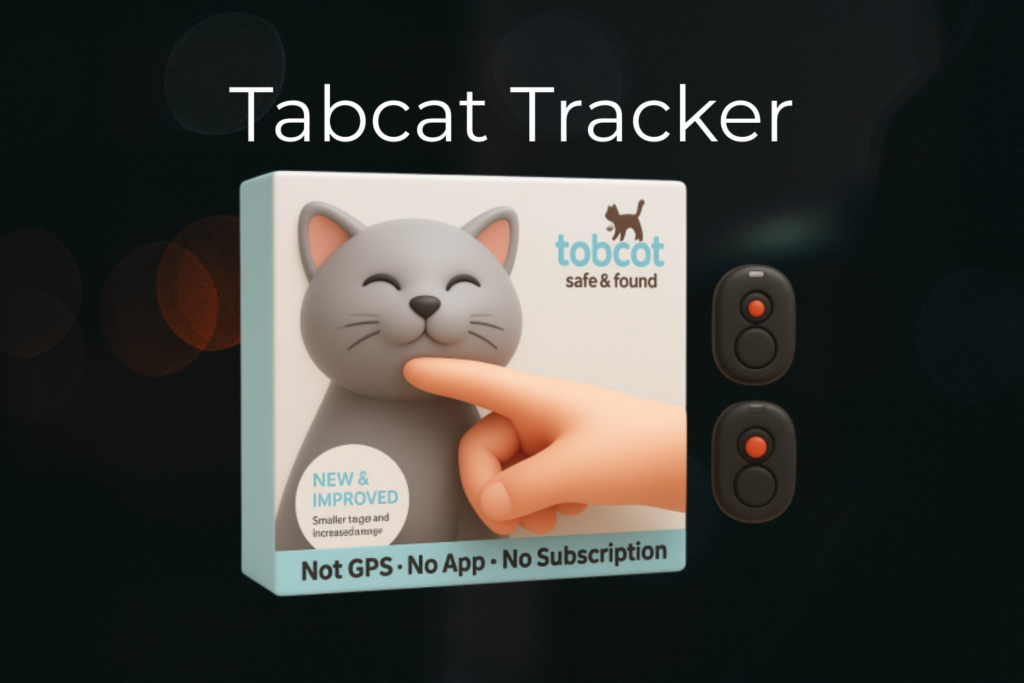
That is the situation the Tabcat Tracker V2 is designed to solve.
Tabcat is not a GPS tracker and does not place your cat on a smartphone map. It uses radio-frequency direction finding: your cat wears a small tag, and you carry a dedicated handset that gives stronger audio and visual cues as you move toward the tag.
This approach gives Tabcat several advantages over GPS: a 6 g tag, months of replaceable-battery life, no app, no cellular requirement, and no monthly subscription. The tradeoff is equally important: you must get within radio range and physically conduct the search.
So, is Tabcat better than GPS? For finding a cat hiding nearby, it can be the more practical tool. For locating a cat that may have traveled across town, it is not a substitute for cellular GPS.
How we reviewed the Tabcat Tracker: This is a research-based editorial review, not a hands-on test. We evaluated the current U.S. product specifications, manufacturer instructions and FAQs, cat-collar safety guidance, relevant research, and the official features of competing trackers. Modern Cat Society has not yet purchased or field-tested this product. Manufacturer performance claims are identified as such.
Quick Verdict
Editorial verdict: Recommended for primarily indoor cats, nearby escape scenarios, multi-cat households, and owners who want a lightweight locator without a subscription.
Best for: Finding a cat in or around the home, yard, garage, shed, or nearby properties.
Skip it if: Your main concern is a cat that roams long distances or if you want a live map, escape alerts, and location history.
| Feature | Tabcat Tracker V2 |
|---|---|
| Tracking technology | Direct 2.45 GHz radio frequency (RF) |
| GPS or cellular | No |
| Smartphone app | No |
| Monthly subscription | No |
| Directional locating | Yes, through a dedicated handset |
| Remote map location | No |
| Manufacturer range guideline | Up to 500 ft / 152 m in favorable conditions; reduced by walls and other obstacles |
| Claimed close-range guidance | Down to approximately 1 inch under suitable conditions; manufacturer claim, not independently verified here |
| Tag weight | 6 g / 0.21 oz, excluding the protective case and collar |
| Tag dimensions | 1.18 × 0.79 × 0.35 in / 3 × 2 × 0.9 cm |
| Tag battery | Two SR1130 or GP389 replaceable batteries |
| Battery guidance | About 2–4 months with daily use; up to roughly one year with light use |
| Cats per handset | Up to four |
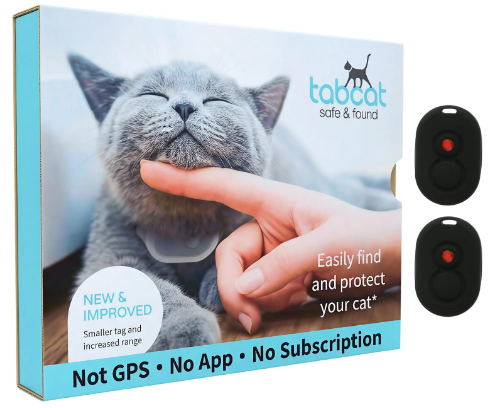
| Standard kit | One handset, two tags, two splash-resistant silicone cases, and batteries |
| Best use | Close-range searches indoors and around the property |
What Is the Tabcat Tracker?
Tabcat is more accurately described as a directional cat locator than a conventional cat tracker.
The cat wears a battery-powered homing tag. The owner keeps a handheld receiver. When the cat needs to be found, the owner selects the button assigned to that tag and slowly searches the area. Lights and beeps on the handset change as the signal becomes stronger or weaker.
The easiest way to understand the difference is this:
- GPS asks: Where on the map is my cat?
- Tabcat asks: Which direction should I walk?
That second question becomes useful when you already suspect the cat is close but cannot identify the hiding place.
There is no SIM card, cloud account, map, or internet connection. The handset communicates directly with the tag.
What Comes in the Box?
The current U.S. starter kit includes:
- One handheld locator
- Two V2 homing tags
- Two splash-resistant silicone cases
- Batteries for the handset and both tags
The standard kit can therefore cover two cats immediately. One handset can register as many as four individual V2 tags, and extra tags are sold separately.[1][2]
Owners replacing an older Tabcat should check the generation before ordering. V2 tags and handsets are not compatible with earlier versions.[1][2]
How Does Tabcat Work?
Each tag is paired with one of the four numbered buttons on the handset. During a search, you activate the handset, press the correct button, and allow it to detect the tag. The manufacturer then instructs the user to turn and compare the strength of the lights and beeps in different directions.[3]
As you walk toward the tag, the cues intensify. If they weaken, you change direction. Once you are close, you repeat the process more carefully to narrow the search to a specific bush, room, vehicle, shed, or hiding space.
Tabcat says its system can guide a user to within approximately one inch of the tag. That should be treated as a manufacturer claim under suitable conditions, not a guarantee of one-inch performance in every home, yard, or neighborhood.[1]
The system does not generate coordinates or report the cat’s location remotely. A person must be physically present and searching.
Where Tabcat Works Best
Indoor Hiding Places
Tabcat’s strongest use case may be the familiar indoor-cat mystery: the cat is probably inside, but nobody can find them.
The tag can be detected through doors and walls, although those barriers reduce the usable range. That makes the system useful for checking closets, basements, garages, spare rooms, spaces behind furniture, and other places where a GPS signal may be unreliable or irrelevant.[1]
A map cannot tell you which side of a wall a cat is hiding behind. Directional RF may help narrow that final distance.
Escapes Close to Home
An indoor cat that slips outside may freeze or hide nearby rather than continue traveling. In that scenario, a lightweight local locator can be valuable around porches, bushes, parked vehicles, crawl spaces, sheds, and neighboring yards.
Tabcat is therefore a tool for a systematic local search, not proof that every missing cat will remain near home.
Properties With Weak Cell Service
Because the handset communicates directly with the tag, Tabcat does not need mobile coverage or Wi-Fi. That can be helpful around rural homes, barns, outbuildings, or other locations where a cellular tracker may have difficulty transmitting a new position.
However, no cellular requirement does not mean unlimited range. Tabcat still works only when the handset is close enough to detect the tag.
Range and Real-World Limitations
Tabcat gives 500 feet / 152 meters as a range guideline, not as a guaranteed radius. The company states that walls and doors reduce range, while clear outdoor line of sight may increase it.[1]
Real searches can be affected by:
- Houses and outbuildings
- Walls, doors, and metal structures
- Terrain and vegetation
- The cat’s position relative to the handset
- Local radio conditions
This creates an important interpretation rule: no signal does not prove the cat is more than 500 feet away. A nearby obstruction may be reducing detection.
If the cat is two miles away, Tabcat cannot tell you that from home. You need to move through likely areas and periodically check for a signal. That is the system’s biggest disadvantage compared with true GPS.
Tabcat also does not provide:
- A live smartphone map
- Remote access from another city
- Escape or geofence alerts
- Route and territory history
- A last-known GPS location
- Automatic sharing with family members through an app
If any of those features are central to your safety plan, a cellular GPS tracker is the better category.
Tag Size, Battery Life, and Daily Ownership
A Very Light Cat-Worn Tag
The V2 tag itself weighs 6 g / 0.21 oz and measures approximately 1.18 × 0.79 × 0.35 inches. Those figures exclude the silicone case and collar.[1][2]
That distinction matters. The complete worn setup will weigh more than the electronic tag alone. Even so, Tabcat’s electronics are substantially lighter than current cellular GPS hardware. For example, Tractive lists the CAT 6 Mini device at 25 g before its integrated collar and 32 g including the collar.[4]
The smaller tag may suit cats that reject bulky devices, but fit, attachment, skin contact, and behavior still need to be observed.
Replaceable Batteries Instead of Recharging
The tag uses two SR1130 or GP389 batteries, while the handset uses one CR2032 battery.[1]
Tabcat’s broad product description gives a 3–12 month range. Its FAQ provides the more useful explanation: replacement may be needed every 2–4 months with daily use, while light use may extend toward one year.[2]
This avoids the regular charging routine required by GPS trackers.
Owners should still treat battery maintenance seriously. Tabcat recommends checking the tag, removing accumulated hair from the case, inspecting for damage, and using the recommended batteries. Low-battery behavior may include unexpected beeps or high-pitched sounds.[2]
The Protective Case Is Required
The included silicone case is described as splash resistant, not fully waterproof. For U.S. customers, the manufacturer says the V2 homing tag must be used with the supplied case to comply with applicable button-cell battery requirements.[1]
Keep the case installed, inspect it regularly, and do not assume that splash resistance makes the tracker suitable for immersion.
One Handset for Multiple Cats
One handset can support up to four tags. That is especially attractive in a multi-cat home because there is no separate cellular plan for each cat.
The standard kit includes two tags. Owners can add two more compatible V2 tags later, provided every tag and handset belongs to the same generation.[2]
Collar Safety and Permanent Identification
A tracker should not make the collar itself less safe.
Cats Protection recommends a cat-specific quick-release or snap-opening collar rather than an elasticated collar. The collar should fit closely enough that two fingers fit comfortably underneath, and damaged collars should be replaced.[9]
A breakaway collar may release and leave the tracker behind, but choosing a collar that cannot release simply to retain the electronics can create an entanglement risk. Safety should take priority over the device.
Tracker weight also deserves attention. In a controlled study of collar-mounted devices, the heaviest tested setup—about 3% of body mass—reduced cats’ measured home range and distance traveled. The researchers recommended keeping instrument-carrying collars at or below 2% of body mass.[11] That study did not test Tabcat specifically, but it supports evaluating the complete collar, case, and tag, not only the advertised tag weight.
Finally, Tabcat does not replace a registered microchip. The American Veterinary Medical Association explains that a pet microchip is an identification device, not GPS, and cannot track an animal’s location.[10] The two tools solve different problems:
- A tracker helps you search.
- A microchip helps identify the cat after someone finds and scans them.
A layered approach—current microchip registration, safe collar use when appropriate, and a tracker suited to the cat’s roaming risk—is more resilient than relying on any single device.
Tabcat vs. Tractive CAT 6 Mini
Tabcat and Tractive are not interchangeable products. They solve different stages of a missing-cat search.
| Feature | Tabcat Tracker V2 | Tractive CAT 6 Mini |
| Core technology | Direct RF direction finding | GPS + cellular, with Bluetooth nearby features |
| Remote map | No | Yes |
| LIVE location updates | No | Approximately every 2–3 seconds in LIVE mode |
| Close-range help | Handset points the search by signal strength and direction | Radar Mode shows whether the phone is getting closer or farther within Bluetooth range |
| Escape alerts | No | Yes, through Virtual Fences |
| Location history | No | Yes; duration depends on the subscription plan |
| Subscription | No | Required for each tracker |
| Device weight | 6 g tag, excluding case and collar | 25 g device; 32 g with integrated collar |
| Battery | Replaceable; months | Rechargeable; up to 7 days with a Power Saving Zone and up to 4 days without one |
| Cellular coverage | Not required | Required to send remote GPS locations |
| Best use | A cat hiding nearby | A cat that may travel beyond the immediate area |
Tractive is the stronger option when you need to know which street, property, or neighborhood to search. Its current CAT 6 Mini can display the cat on a map, update every 2–3 seconds in LIVE mode, notify the owner about Virtual Fence crossings, and retain location history.[4][5]
Tractive also has Radar Mode, which uses Bluetooth to show whether the phone is getting closer to or farther from the tracker. That helps with the final nearby search, although it is a different interface from Tabcat’s dedicated RF handset.[7]
The tradeoffs are a larger worn device, regular charging, dependence on GPS and cellular connectivity, and an active subscription for each pet.[4][5][6]
Choose Tabcat when the cat is most likely to hide close to home and low weight, long battery life, and no recurring fee matter most.
Choose Tractive when long-range remote location, escape alerts, and movement history matter more than device size and subscription cost. Read our complete Tractive GPS Cat Tracker review for a closer look at the CAT 6 Mini.
Tabcat vs. Apple AirTag
AirTag is not GPS and is not a purpose-built pet tracker. Apple states that the 2026 AirTag is designed exclusively for objects, not people or pets.[8]
| Feature | Tabcat Tracker V2 | Apple AirTag (2026) |
| Main purpose | Locating cats | Locating personal objects |
| Long-distance mechanism | None; owner must enter RF range | Crowdsourced Find My network reports an approximate location when compatible Apple devices detect it |
| Nearby finding | Dedicated RF handset with directional cues | Precision Finding on compatible Apple devices |
| Requires nearby third-party devices | No | Yes for Find My network updates when away from the owner |
| Subscription | No | No |
| Smartphone ecosystem | Not required | Apple Account, Find My, and a compatible Apple device required |
The AirTag’s advantage is network reach. If a cat passes near compatible Apple devices, the Find My network may relay an approximate location from beyond Tabcat’s direct range. The 2026 AirTag also expands Bluetooth and Precision Finding range compared with the previous generation.[8]
Its weakness is that a remote update depends on the tag being detected by participating devices. It is not a continuous cellular GPS feed, and Apple does not design it as a pet-safety product.
Tabcat’s advantage is independence: your handset communicates directly with the tag, and the product is built around finding cats. Its weakness is geographic reach.
For a cat known to be nearby, Tabcat is the more purpose-built choice. AirTag may occasionally report a location beyond local RF range, but neither product offers the same long-range feature set as cellular GPS. See our complete Apple AirTag for Cats review for the 2026 model’s limitations.
Pros and Cons
| Pros | Cons |
| Very light 6 g tag before case and collar | No GPS map or remote location |
| No monthly subscription | Limited local search range |
| No smartphone or account required | Owner must physically search |
| Works without cellular coverage | Walls and obstacles can reduce range |
| Months of replaceable-battery life | No escape alerts or location history |
| No frequent charging routine | Splash resistant, not fully waterproof |
| Useful indoors and around the property | Handset is another device to store and maintain |
| Up to four tags on one handset | Breakaway collar can release and leave the tracker behind |
| Two tags included in the standard kit | V2 is not compatible with older Tabcat generations |
| Beep can be paired with reward training | Manufacturer accuracy claims were not independently tested for this review |
Who Should Buy the Tabcat Tracker?
Tabcat is a strong fit for:
- Primarily indoor cats that may escape and hide close to home
- Cats that frequently disappear inside the house, garage, or yard
- Small adult cats that resist bulkier GPS devices
- Multi-cat households that want one receiver and no recurring plans
- Rural or outbuilding searches where mobile coverage is weak
- Owners who prefer a simple, app-free device
- Households willing to conduct a methodical physical search
Consider another option if:
- Your cat regularly roams far beyond neighboring properties
- You want a map before leaving home
- You need immediate escape alerts
- You want to review territory, routes, or location history
- You need to check location while traveling away from home
- Nobody near the cat will have access to the handset
How to Get the Most From Tabcat
Practice Before an Emergency
Do not wait until the cat is missing to learn the handset. Pair each tag, label which button belongs to which cat, and practice in different rooms and outdoor locations. This teaches you how walls, doors, and direction changes affect the cues.
Condition the Beep With a Reward
Tabcat recommends activating the tag indoors and pairing the sound with food or a treat. After repeated sessions, some cats may learn that the beep predicts a reward and move toward the owner.[2]
Treat this as conditioning, not a guaranteed recall command. Start indoors, keep sessions consistent, and never assume the sound will call a frightened cat home from outside radio range.
Search Systematically When There Is No Signal
If the handset does not detect the tag:
- Begin at the cat’s last known location and normal hiding places.
- Check the home, garage, vehicles, sheds, decks, bushes, and enclosed spaces.
- Walk slowly through likely areas and retry the handset from several positions.
- Expand outward rather than wandering randomly.
- Remember that buildings can block a signal from a cat that is still nearby.
- Once a signal appears, compare directions and follow the stronger cues.
Keep ordinary lost-cat measures in the plan as well. A tracker is a search aid, not a complete recovery strategy.
Frequently Asked Questions
Is Tabcat a GPS tracker?
No. Tabcat uses direct radio-frequency communication between a dedicated handset and the cat’s tag. It does not calculate a GPS position or display a location on a map.
What is the real range of the Tabcat Tracker?
Tabcat lists up to 500 feet / 152 meters as a guideline. Clear outdoor line of sight can improve range; walls, doors, buildings, vegetation, and other obstructions can reduce it.[1] Real-world range will therefore vary.
How accurate is Tabcat?
The manufacturer claims that the handset can guide a user to within approximately one inch under suitable conditions.[1] Modern Cat Society has not independently verified that figure, and it should not be interpreted as guaranteed performance in every environment.
How long does the battery last?
Tabcat gives a broad range of 3–12 months. Its FAQ says daily use may require replacement about every 2–4 months, while light use may extend toward one year.[2]
Can Tabcat find a cat several miles away?
Not from your current position. You must move within detection range before the handset can guide you. A cellular GPS tracker is better when a cat may travel long distances.
Is Tabcat waterproof?
The supplied silicone cases are described as splash resistant, not fully waterproof.[1] Keep the tag inside the case and avoid assuming it can tolerate immersion.
Is Tabcat better than Tractive?
Tabcat is better suited to lightweight, close-range, subscription-free locating. Tractive is better suited to long-range remote tracking, maps, escape alerts, and movement history. The right choice depends on how your cat is likely to become lost.
Does Tabcat replace a microchip?
No. A microchip provides permanent identification after a cat is found and scanned; it does not track location.[10] Keep the cat’s microchip registration current even when using an electronic tracker.
Final Verdict: Is Tabcat Worth It in 2026?
Yes—for the right kind of missing-cat problem.
Tabcat is not a cheaper GPS tracker, and it should not be presented as one. It cannot show a cat moving across town, notify your phone about an escape, or reveal a route history.
What it offers is different: a very light tag, direct local direction finding, months of battery life, no charging routine, no cellular dependency, support for multiple cats, and no subscription.
That combination makes Tabcat particularly appealing for indoor cats, nearby escape scenarios, cats that hide around the property, and owners who consider current GPS hardware too bulky.
If your cat regularly roams beyond the immediate neighborhood, choose cellular GPS. If your most likely emergency is a silent cat hiding somewhere close, Tabcat may answer the more useful question:
Which direction should I walk?
<a href=”https://amzn.to/4wusOTA” rel=”sponsored nofollow”>Check the current Tabcat Tracker V2 listing on Amazon (paid link)</a>
Sources and References
- Tabcat — Tabcat Tracker V2 product page. Current U.S. specifications for included components, tag weight and size, batteries, 500-foot range guidance, silicone-case requirement, compatibility, and the manufacturer’s close-range performance claim. View official product page
- Tabcat — Frequently Asked Questions. Official guidance on the 2.45 GHz system, V1/V2 compatibility, four-tag capacity, tag weight, pairing, training, battery replacement, and maintenance. View official FAQ
- Tabcat — How to Track Your Cat. Manufacturer instructions for interpreting the handset’s audio and visual cues during a search. View official guide
- Tractive — Which Tracker Is Right for My Pet? Official CAT 6 Mini weight, size, battery estimate, minimum cat size, and feature summary. View Tractive comparison
- Tractive — What Features Does Tractive Offer? Official description of GPS and cellular requirements, LIVE Tracking, maps, Virtual Fences, and location history. View Tractive features
- Tractive — How Long Does My Tracker’s Battery Last? Official CAT 6 Mini battery estimates and the effect of LIVE Tracking, GPS signal, cellular coverage, and Power Saving Zones. View battery guidance
- Tractive — Radar Mode: How-To Guide. Official explanation of Bluetooth proximity finding and its limitations. View Radar Mode guide
- Apple — New AirTag With Expanded Range and Improved Findability. Official 2026 information about the Find My network, Precision Finding, device requirements, and Apple’s statement that AirTag is designed for objects rather than pets. View Apple Newsroom
- Cats Protection — Choosing a Cat Collar. Safety guidance on quick-release collars, proper fit, and collar-related hazards. View collar guidance
- American Veterinary Medical Association — Microchipping FAQs. Veterinary guidance explaining that pet microchips identify animals but do not provide GPS tracking. View AVMA guidance
- Coughlin, C. E., and van Heezik, Y. — “Weighed Down by Science: Do Collar-Mounted Devices Affect Domestic Cat Behaviour and Movement?” Peer-reviewed research on device weight and measured cat movement. View the study
Sources and specifications reviewed August 18, 2026. Product features, warranty terms, manufacturer guidance, and competing devices may change. Verify critical details with the manufacturer or retailer before purchasing.