Why Your Cat Kicks Litter Everywhere (Understanding the Digging Instinct)
By Demosthenes Staudinger | Updated August 25, 2026
Affiliate disclosure: This article contains affiliate links. As an Amazon Associate I earn from qualifying purchases. If you buy through one of these links, we may earn a commission at no additional cost to you. This does not affect our editorial recommendations.
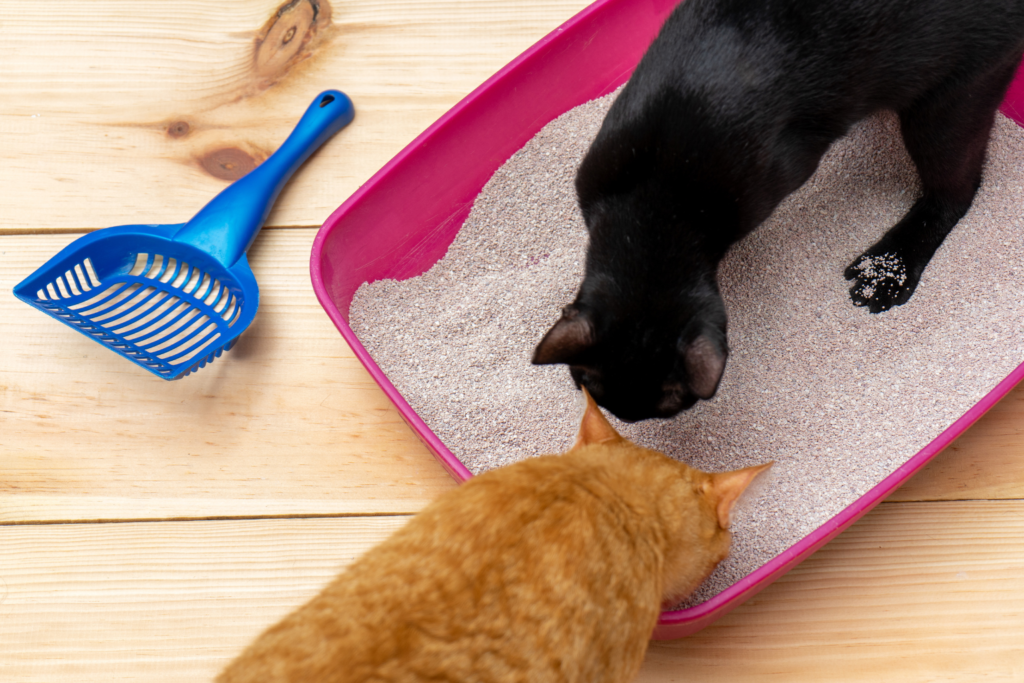
Finding litter across a freshly cleaned floor is irritating, but your cat is almost certainly not making a statement about your housekeeping. Digging, turning, eliminating, and covering are normal parts of feline toileting. Cats given more freedom may investigate and posture over a surprisingly large area before choosing a spot, and many prefer a soft substrate they can excavate and move.[2]
The mess begins when normal behavior meets an undersized pan, low walls, lightweight litter, a poorly positioned exit, or granules that cling to paws. Some cats are simply enthusiastic diggers. Others spend extra time in the box because it is dirty, uncomfortable, socially unsafe, or associated with pain.
That distinction matters. The goal is not to stop a healthy cat from digging. It is to provide a litter setup that lets the cat complete the behavior comfortably while keeping most of the substrate inside a defined zone.
This guide explains why cats kick litter, the most effective order in which to change the setup, and whether a furniture enclosure or the PetSnowy SNOW+ is worth considering. It also corrects a common misconception: a covered box is not automatically good or bad. Size, cleanliness, access, ventilation, and the individual cat matter more than the lid alone.
How We Researched This Guide
Modern Cat Society did not conduct hands-on product testing for this article. We compared feline-practice guidance, peer-reviewed litter-box preference research, manufacturer documentation, current product listings, maintenance requirements, and purchase policies available on August 25, 2026. Product benefits attributed to a seller or manufacturer are identified as claims rather than independently verified results. Prices, bundles, specifications, and availability can change, so confirm the current Amazon listing before ordering.
Quick Verdict
Editorial verdict: Most litter scatter is a containment problem, not a behavior problem. Start with a clean box approximately 1.5 times your cat’s body length, at least about 1.5 inches of litter, sufficiently high walls, and a generous exit mat.[1] For many households, that inexpensive setup will work better than putting a cramped pan inside attractive furniture.
Best for: A large, high-sided open box is the safest first choice. The ALBSL Large Litter Box Enclosure is a style-conscious option only if its interior accepts a genuinely large tray and your cat already tolerates enclosed boxes. The PetSnowy SNOW+ is the premium convenience choice for compatible cats when automatic waste removal, an integrated exit walkway, and app-based records justify its price.
Skip an enclosed or automatic model if: Your cat is very large, mobility-impaired, frightened by machinery, guarded by another pet near the entrance, or consistently chooses an open box. Do not use the SNOW+ in automatic mode for a kitten below the manufacturer’s 3.3-pound threshold.[8]
Why Cats Dig and Cover Their Waste
Digging is not merely a miniature housekeeping routine. A litter box is a sensory and communication site. Cats assess texture, depth, odor, location, and whether they can enter, turn, posture, and leave without feeling trapped. Urine and feces also carry chemical information for other cats, so covering behavior should not be reduced to the popular claim that every cat is trying to “hide from predators.”[2]
Some cats carefully dig a hole, eliminate, and cover the deposit. Some scratch the sides of the box or nearby wall without moving much litter. Others barely cover at all. These patterns can all occur in healthy cats. Temperament, early experience, substrate preference, paw sensitivity, age, social environment, and box design influence the ritual.
The forceful backward kick that sends litter over the rim usually means the cat has reached the physical boundary of the box before finishing a normal digging sequence. In other words, the behavior may be appropriate even when the container is not.
Seven Reasons Your Cat Kicks Litter Everywhere
1. The box is too small
This is the first variable to check. A cat needs room to enter, turn fully, choose a position, dig on more than one side, and cover without immediately striking a wall. FelineVMA guidance notes that many cats prefer a box about 1.5 times their body length, measured from nose to the base of the tail.[1]
A 2025 preference study also found that cats favored boxes measuring at least 50 centimeters in the tested setting and favored clumping clay over the alternatives evaluated.[5] That does not make 50 centimeters a universal ideal; a long or large-breed cat may need substantially more. Measure your cat and the usable interior, not the product’s exterior dimensions or its “XL” marketing label.
2. The walls are too low for your cat’s digging style
Low-entry pans are useful for kittens, arthritic cats, and cats with limited mobility, but low walls on every side provide no barrier to a vigorous backward kick. A high-sided box with one accessible entrance often offers the best compromise: comfortable entry in front and containment around the other three sides.
If your cat urinates high against a wall, choose a seamless high-sided pan rather than relying on a detachable shield with joints that can leak. Avoid making the entry so high that a senior cat must jump.
3. There is too much—or too little—litter
More litter does not always mean greater comfort. A very deep, unstable bed can shift under the paws and give an enthusiastic cat more material to launch. Too little litter may encourage prolonged scraping against the bottom as the cat tries to create a diggable surface.
About 1.5 inches is a useful starting point in feline-practice guidance, but individual preferences vary.[1] Mark the fill level inside the pan and adjust gradually. Do not change the box, location, and substrate simultaneously; otherwise, you will not know which change helped or caused avoidance.
4. The particles travel easily
Fine granules are often comfortable to dig in, yet lightweight particles can cling between toes, collect in long paw fur, and travel through the home. Larger or heavier granules may track less, but a sudden switch to a texture your cat dislikes can create a much more serious problem than a messy floor.
If you want to test a lower-tracking litter, place it in a second comparable box while keeping the familiar option available. Let deposits—not your aesthetic preference—show which substrate your cat accepts. Unscented litter is generally the conservative starting point because strong fragrances may be aversive to a cat’s sensitive nose.[1][3]
5. The box is not clean enough
A cat may dig longer when trying to find a clean area or cover odor in a soiled box. Scoop at least daily; twice daily is sensible for busy boxes.[1] Replace or refresh litter according to the substrate instructions, and wash the pan with mild, unscented products rather than heavily perfumed cleaners.
Automatic removal can shorten the time waste remains exposed, but it does not make a litter box maintenance-free. Sensors, screens, walkways, globes, drawers, and seals still accumulate dust and residue.
6. The location feels unsafe
In a multi-cat home, a narrow cabinet entrance or covered box can become a dead end if another cat waits outside. A dog, child, washing machine, or frequently opened door may also make the toilet area unpredictable. FelineVMA recommends quiet resource locations and, where social tension is possible, routes that do not leave a cat trapped.[1]
Provide one litter box per cat plus one, distributed in separate locations rather than lined up as a single station.[1] Three boxes side by side usually function as one resource from the cats’ perspective. Watch for staring, blocking, chasing, or one cat following another to the box.
7. Digging has become prolonged because something hurts
Extra time in the box can be mistaken for quirky excavation. Straining, repeated visits, crying, tiny urine clumps, blood, genital licking, constipation, diarrhea, or eliminating outside the box warrant veterinary attention. A cat passing little or no urine may have a urethral obstruction—an absolute emergency, particularly in males.[6]
Pain from arthritis can also make turning or stepping over a high entrance difficult. If the behavior changed suddenly, treat it as information rather than assuming the cat has become messy.
Covered vs. Open Litter Boxes: What the Evidence Actually Says
It is inaccurate to say that all covered boxes cause claustrophobia or that all open boxes are superior. In a small study of 27 indoor cats, the group showed no overall preference between large covered and uncovered boxes: 19 used both similarly, four preferred covered, and four preferred uncovered.[4]
The details matter. The boxes were unusually roomy and scooped daily. Some large cats showed a trend toward the open option, and the study did not reproduce every multi-cat social dynamic. The practical conclusion is not “covered boxes are fine for every cat.” It is that individual choice, interior space, cleanliness, and household context matter.
A cover can contain airborne scatter and provide visual privacy. It can also reduce headroom, concentrate odor when neglected, hide a waiting cat from view, and create a single entrance that another pet can guard. If you are considering a cabinet or automatic globe, offer it alongside the existing open box and observe voluntary use.
How to Stop Litter Tracking: A Step-by-Step Plan
Step 1: Watch one complete litter-box visit
Observe from a distance without hovering. Determine whether litter leaves the box during digging, when the cat jumps out, or later from the paws. These are different problems:
- Litter flies during digging: Increase usable floor space and wall height.
- Litter launches when the cat exits: Provide a lower, calmer exit and a longer landing zone.
- Litter appears throughout the home: Focus on particle weight, paw cling, long paw fur, and mat design.
- The cat digs for an unusually long time: Assess cleanliness, substrate preference, social pressure, and health.
Step 2: Upgrade the pan before buying furniture
For most healthy adult cats, try a large open storage-style box with high sides and a carefully cut, smooth lower entrance. The interior should be roughly 1.5 times the cat’s body length.[1] The cat should be able to turn without curling around the wall and cover without striking the rim at every stroke.
This solution is inexpensive, easy to inspect, and easy to compare with the current box. For seniors, retain a low entrance. For high-spraying cats, use a one-piece pan that prevents urine from reaching a seam.
Step 3: Calibrate the litter
Begin around 1.5 inches deep and adjust in small increments.[1] Keep the established substrate at first. Once the new box is accepted, a second-box trial can compare the familiar litter with a lower-tracking option.
Never force a sudden total conversion because a new litter looks cleaner. The 2025 study supports a preference for larger boxes and clumping clay in its sample, but individual cats still make the final decision.[5]
Step 4: Create a deliberate exit path
Orient the entrance toward a wall-length mat rather than an open hallway. A generous, soft, easy-to-wash mat gives the cat several steps on which particles can fall. Ridged or honeycomb mats may catch granules effectively, but the surface must not be so sharp or unstable that the cat jumps over it.
Vacuum or shake the mat frequently. A full mat simply becomes a secondary source of litter. If your cat leaps over the landing area, reposition the box so the natural route requires walking rather than jumping.
Step 5: Improve cleaning and resource distribution
Scoop at least once daily, replenish to a consistent line, and clean the full pan on a schedule appropriate to the litter.[1] In a multi-cat home, add boxes in genuinely separate locations. Litter-box optimization and meeting feline environmental needs are core recommendations when toileting behavior changes; punishment is not.[3]
Step 6: Change one variable at a time
Give each nonurgent change enough time to evaluate. Keep a simple note of box use, deposits, digging duration, scatter, and any accidents. A camera aimed at the surrounding area—not inside the box—can reveal blocking or hesitant approaches when you are away.
Do not punish, spray water, shout, or physically stop the cat from covering. Those responses can make the toileting area unsafe and risk avoidance without teaching an alternative.
The Best Containment Options for a Design-Conscious Home
| Setup | Best for | Tracking control | Main tradeoff | Maintenance |
|---|---|---|---|---|
| Large high-sided open box + long mat | Most cats; budget-first fix | Good when correctly sized | Visually exposed; still requires scooping | Scoop daily; wash pan and mat |
| ALBSL furniture enclosure + correctly sized tray | Cats already comfortable with covered boxes; décor integration | Potentially good for kicked litter | Interior space and ventilation must be verified | Open cabinet and scoop daily; clean seams |
| PetSnowy SNOW+ | Compatible adult cats; owners prioritizing automation and contained exit | Manufacturer-designed walkway may reduce tracking | High cost, large footprint, consumables, enclosed globe | Empty drawer, replenish litter, clean walkway, periodic deep cleaning |
No design guarantees a litter-free floor. Particle size, paw fur, exit speed, and the cat’s digging style still affect performance.
Product Option 1: ALBSL Large Litter Box Enclosure
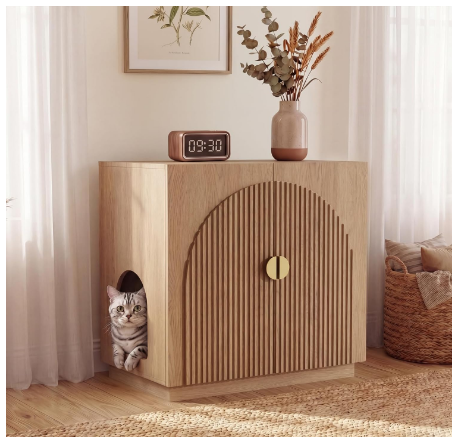
The linked ALBSL Large Litter Box Enclosure is an engineered-wood cabinet with two fluted doors and an adjustable shelf. The current listing gives external dimensions of approximately 31.5 × 19.8 × 31.1 inches.[7] Its strongest appeal is visual: it can disguise the toilet area as a compact sideboard while its walls contain litter kicked above the pan.
That does not automatically make it cat-friendly. Exterior dimensions do not tell you the usable tray footprint after accounting for panels, shelf placement, hinges, and the entry route. Before ordering, ask the seller for the exact interior compartment dimensions and compare them with a tray at least 1.5 times your cat’s body length. Also confirm that you can fully open the doors for daily scooping and cleaning.
What works
- The cabinet walls can contain litter that clears the tray rim.
- Double doors should provide better human access than a small top hatch.
- The furniture profile integrates more discreetly into a living area.
- The adjustable storage area may organize litter supplies if it does not reduce the cat’s usable space.
What to consider
- The listing’s “extra-large” label refers to marketing; measure the interior yourself.[7]
- A cabinet does not create a true anti-tracking vestibule unless the internal route forces several steps over a catching surface.
- Engineered wood needs prompt cleaning if urine or wash water reaches unfinished seams.
- A single entrance may be unsuitable in a home with intercat tension.
- The Amazon listing and seller history may change, so verify the exact model, color, assembly requirements, return terms, and recent buyer feedback at checkout.
Best for: A small-to-average adult cat that already uses a roomy covered box confidently, plus an owner willing to place a full-size pan and mat inside.
Skip it if: The interior forces you to downsize the tray, your cat is large or arthritic, the entry becomes a dead end, or daily access is inconvenient.
Product Option 2: PetSnowy SNOW+ Self-Cleaning Litter Box
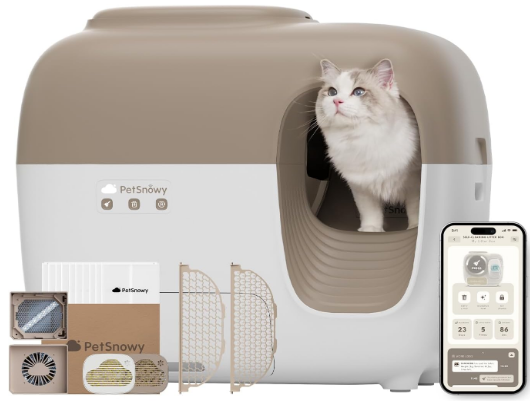
The PetSnowy SNOW+ combines a rotating sifter, enclosed waste drawer, odor-control system, app records, and curved exit walkway. According to PetSnowy, the unit waits four minutes after use before initiating a cleaning cycle; if another cat interrupts that period, the timer resets. The company says radar and weight sensors stop operation if a cat re-enters.[8]
For scatter control, the relevant feature is not the motor—it is the contained route. PetSnowy says the curved walkway and removable mat catch loose litter during the first steps out of the globe. Encouragingly, the manufacturer’s own 2026 space guide acknowledges that the system will not catch every grain.[9]
Current manufacturer specifications and policies
| Detail | Current information | Why it matters |
| External size | 29.5 × 20 × 25.6 inches, per PetSnowy[9] | Measure the complete floor area and access clearance |
| Waste drawer | 10 liters, manufacturer specification[8] | Emptying frequency still depends on cat count and output |
| Cleaning delay | Four minutes after use; resets if interrupted[8] | Waste is not removed instantly |
| Litter | Standard-weight clumping clay recommended; some screen-compatible silica or plant litters may work[8] | Non-clumping, loose-clumping, newspaper, and absorbent wood-pellet litters are listed as incompatible |
| Automatic-mode threshold | At least 3.3 pounds, per manufacturer[8] | Lighter kittens require automatic cleaning to be disabled |
| Direct-sale warranty | One-year standard warranty for the original purchaser from PetSnowy’s official site[11] | An Amazon purchase may be governed by different seller/manufacturer terms |
| Direct-sale return policy | 30 days from receipt; buyer pays return shipping for direct purchases[12] | Third-party purchases must be handled with that retailer |
Dimensions sometimes differ between retailer listings and manufacturer pages, possibly because of packaging or measurement conventions. Use the current listing for the exact bundle you receive and leave the installation clearance required by its manual.
What works
- The enclosed globe and walkway address both airborne scatter and paw tracking.
- Automatic sifting reduces the time clumps remain in the litter bed.
- A sealed drawer can reduce routine odor exposure when used and maintained correctly.
- App records may help reveal changes in visit frequency, although they do not replace examining waste or veterinary care.
- The removable walkway mat can be cleaned separately.
What to consider
- It is a large, premium-priced appliance rather than a compact pan.
- Some cats dislike enclosed globes, moving equipment, or a single entry route.
- A cat approaching 20 pounds or with a long body may find the interior less comfortable; compare the cat with the opening and globe dimensions, not merely the stated weight limit.
- Automatic sifting makes it easier to miss changes in urine-clump size, stool consistency, blood, or output unless you deliberately inspect the drawer and app records.
- It still requires litter replenishment, liner replacement, walkway cleaning, and deeper periodic cleaning. PetSnowy recommends routine checks and periodic deep maintenance rather than a hands-off setup.[10]
- Fragrance is optional according to the company; a scent-sensitive cat should be allowed to acclimate without it.[8]
Best for: A healthy, compatible adult cat that accepts enclosed boxes, and a household willing to maintain an appliance in exchange for less daily scooping and a more contained exit.
Skip it if: Your cat avoids covered boxes, exceeds the comfortable interior fit, has mobility limitations, needs close manual output monitoring, or shares a tense household where another cat could guard the entrance.
How to Introduce an Enclosed or Automatic Box Safely
Do not remove a familiar litter box on delivery day. Place the new box near the established location, leave it powered off, and keep the old box available. Add a small amount of familiar used litter to the new clean substrate. PetSnowy gives similar acclimation guidance and recommends allowing the cat to investigate before enabling automatic operation.[8]
Use this transition sequence:
- Measure first. Confirm that the cat can enter, turn, dig, posture, and exit naturally.
- Keep the old box. A new appliance is an additional choice, not an immediate replacement.
- Power it off. Let the cat use it reliably before introducing movement or sound.
- Match the substrate. Begin with a familiar, compatible litter at a familiar depth.
- Reward investigation. Place treats near the approach, never inside soiled litter.
- Run cycles at a distance. Initially trigger cleaning only when the cat is elsewhere.
- Monitor voluntary use. Hesitation, rapid retreat, perching at the opening, or holding waste indicate discomfort.
- Retain a backup. A traditional box remains useful during power failures, maintenance, illness, or temporary avoidance.
In multi-cat homes, a manufacturer’s capacity claim is not the same as behavioral resource adequacy. PetSnowy says one SNOW+ can serve up to four indoor cats, but also notes that high traffic may prevent a cycle from finishing before the next visit.[8] Feline-practice guidance still favors one box per cat plus one in separate locations.[1]
When Litter-Box Digging Needs a Veterinarian
Normal digging is purposeful and ends with an ordinary deposit. Contact your veterinarian if a new pattern accompanies:
- Repeated trips with little output
- Straining, crying, or a tense posture
- Small or absent urine clumps
- Blood in urine or stool
- Excessive genital licking
- Vomiting, lethargy, hiding, or loss of appetite
- Hard, dry stool or persistent diarrhea
- New house-soiling
- Difficulty stepping into, turning inside, or leaving the box
A cat—especially a male—straining while producing little or no urine needs emergency veterinary care. Cornell identifies urethral obstruction as an absolute emergency.[6] Do not wait for a smart-box alert, try to solve it with a new litter, or assume the cat is constipated.
Frequently Asked Questions
1. Why does my cat kick litter out of the box after pooping?
The cat is usually completing a normal covering sequence. If the rear paws reach a low wall before the cat finishes digging, litter leaves the pan. Increase usable box length and wall height, then begin with roughly 1.5 inches of litter. If digging becomes prolonged or is accompanied by straining, pain, diarrhea, or constipation, contact a veterinarian.
2. Is my cat kicking litter out on purpose?
The movement is purposeful, but the floor mess probably is not. Your cat intends to excavate or cover, not to punish you. Feline house-soiling and litter-box problems are not considered acts of spite; physical, medical, social, and environmental needs should be assessed instead.[3]
3. How deep should cat litter be?
About 1.5 inches is a practical starting point in FelineVMA guidance, with individual adjustment.[1] If your cat scrapes the bottom obsessively, add a little. If the litter shifts excessively or large amounts fly out, reduce it slightly. Maintain a consistent fill line so you can evaluate the change.
4. Do cats prefer covered or uncovered litter boxes?
There is no universal answer. A small controlled study found no overall group preference when both options were large, identical in other respects, and cleaned daily; individual cats did show preferences.[4] Offer a choice. Large cats, cats with mobility limitations, and cats worried about being ambushed may prefer an open design.
5. Will a top-entry litter box stop litter tracking?
It can reduce direct scatter because litter must clear high walls, and some granules fall as the cat climbs out. It is not appropriate for every cat. Kittens, seniors, arthritic cats, and cats uncomfortable with jumping may struggle. Paw-carried litter can still travel after exit.
6. What type of litter tracks the least?
Larger, heavier particles and pellets often travel less than very light, fine granules, but tracking is only one criterion. Comfort and acceptance come first. Research has found a preference for clumping clay in tested cats.[5] Compare a new substrate in a second box and avoid a forced overnight switch.
7. Does a litter mat really help?
Yes, if it is large enough to capture several natural steps and comfortable enough that the cat does not leap over it. Place the exit toward the long dimension, clean the mat frequently, and avoid sharp or unstable textures. A mat controls paw tracking; it cannot compensate for a small, low-sided pan that ejects litter during digging.
8. Can I put a litter box inside a cabinet?
Yes, provided the cabinet accepts a properly sized tray, stays clean and ventilated, offers easy daily access, and does not create a socially guarded dead end. Measure the internal compartment. If the cabinet forces a smaller pan or your cat begins hesitating, return to the open setup.
9. Will the PetSnowy SNOW+ eliminate litter tracking?
No product can promise that. Its curved internal walkway and removable mat are designed to contain kicked particles and capture litter from paws; PetSnowy itself says the design will not stop every grain.[9] Coat length, paw fur, litter type, and exit behavior affect results.
10. Is the PetSnowy SNOW+ safe for kittens?
PetSnowy says kittens at least 3.3 pounds may use automatic mode. Below that threshold, automatic cleaning must be disabled and a cycle started manually only after confirming the kitten is away.[8] Follow the current manual for your exact model and keep a conventional kitten-accessible box available.
11. How many litter boxes do I need for two cats?
The usual feline-practice guideline is three boxes—one per cat plus one—distributed in separate locations.[1] More important than the arithmetic is preventing one cat from controlling all access. A single automatic box advertised for multiple cats does not necessarily meet that behavioral need.
12. Why is my cat suddenly digging much longer than usual?
Check whether the litter, depth, box, location, cleaning schedule, household relationships, or mobility has changed. Then look for straining and altered urine or stool. A sudden change can reflect urinary disease, constipation, pain, or stress. Little or no urine with repeated straining is an emergency.[6]
Final Verdict
Your cat’s digging instinct is not a flaw to eliminate. The most reliable solution is to give that instinct enough room and contain its consequences: a large clean box, appropriate litter depth, high sides where mobility permits, a comfortable exit mat, and sufficient boxes in safe locations.
Choose the ALBSL enclosure only after confirming that style will not cost your cat usable space or easy escape. Choose the PetSnowy SNOW+ if a compatible cat, integrated walkway, automated sifting, and app records justify the higher price and ongoing maintenance. Neither should replace careful observation of urine, stool, comfort, or behavior.
For the right household, the SNOW+ is the more complete premium containment system; for many cats, however, a correctly sized high-sided open box remains the smarter and more affordable first move.
Read more:
Why Your Cat Tips Over Their Water Bowl (The Science of Feline Hydration)
How to Stop Your Cat From Scratching Luxury Furniture
Sources and References
- Feline Veterinary Medical Association. Client Education: Providing a Secure Feline Environment. Accessed August 25, 2026.
- Feline Veterinary Medical Association. Setting Up the Environment for Success. Accessed August 25, 2026.
- Carney HC, et al. 2014 AAFP/ISFM Guidelines for Diagnosing and Solving House-Soiling Behavior in Cats. Journal of Feline Medicine and Surgery. 2014.
- Grigg EK, Pick L, Nibblett B. Litter Box Preference in Domestic Cats: Covered Versus Uncovered. Journal of Feline Medicine and Surgery. 2013;15(4):280–284.
- Iwabuchi-Inoue Y, et al. Litter Box Size and Litter Type Preference and Their Associated Behavioral Changes in Cats. Journal of Veterinary Medical Science. 2025.
- Cornell Feline Health Center. Feline Lower Urinary Tract Disease. Accessed August 25, 2026.
- Amazon product listing. ALBSL Large Litter Box Enclosure, ASIN B0H1M8QCLM. Accessed August 25, 2026.
- PetSnowy. SNOW+ Automatic Self-Cleaning Litter Box: Product Information and FAQ. Accessed August 25, 2026.
- PetSnowy. Automatic Litter Box Space Guide for Small Homes. August 11, 2026.
- PetSnowy. A Guide to Automatic Cat Box Maintenance. February 18, 2025.
- PetSnowy. PetSnowy Warranty. Accessed August 25, 2026.
- PetSnowy. Return Policy. Accessed August 25, 2026.