Why Your Cat Tips Over Their Water Bowl (The Science of Feline Hydration)
By Demosthenes Staudinger | Updated August 25, 2026
Affiliate disclosure: This article contains affiliate links. As an Amazon Associate I earn from qualifying purchases. If you buy through one of these links, we may earn a commission at no additional cost to you. This does not affect our editorial recommendations.
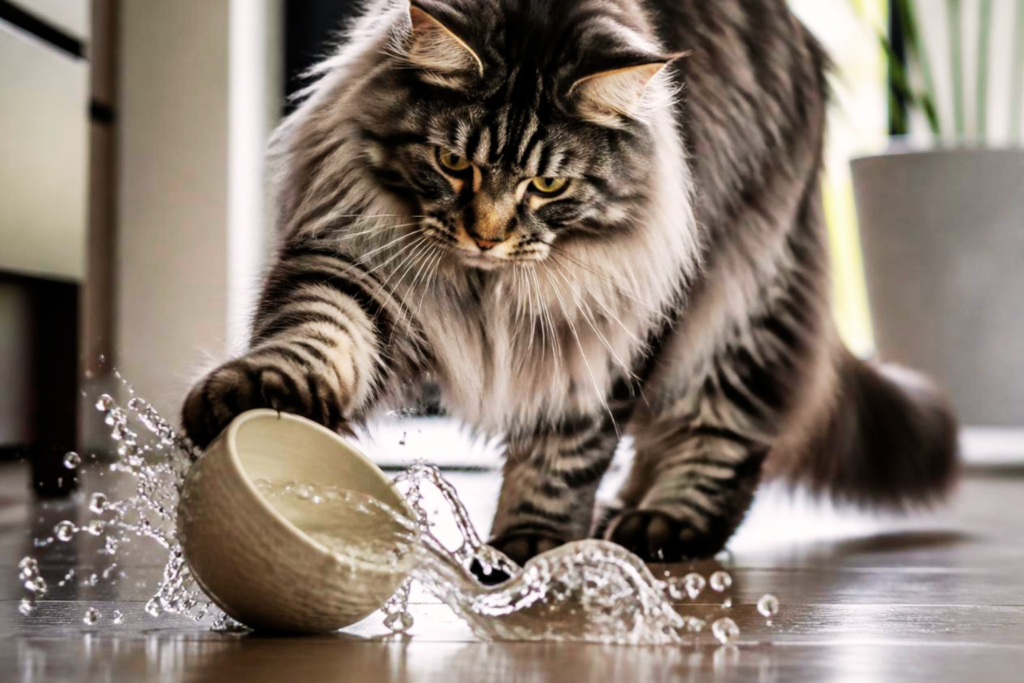
You refill your cat’s water before bed. By morning, the bowl is upside down, a cold puddle has spread across the floor, and your cat is calmly watching the cleanup. It is the familiar scene behind the question, “Why does my cat tip over the water bowl?” It can look deliberate, but a tipped water bowl is rarely revenge or spite.
Cats paw at, splash in, drag, and overturn water dishes for several possible reasons. Some are simple: the bowl is light, the water is interesting, or the resulting commotion reliably earns attention. Others involve the drinking setup itself, including an uncomfortable vessel, an inconsistent water level, an exposed location, or competition with another pet.
It is tempting to explain every spill with one dramatic theory. The evidence does not support that approach. Cats may tap still water to create visible ripples or test its level, but we cannot know that this is every cat’s motive. Likewise, “whisker fatigue” is widely discussed online, yet research has not established it as a universal painful condition.
The hydration question deserves equal care. A fountain may appeal to a cat who likes moving water, but it is not a guaranteed cure for low water intake and it does not prevent kidney disease by itself. In a small study of healthy household cats, fountain access produced only a slight increase in intake and did not significantly change urine concentration.[3]
The practical answer is therefore conditional: first identify why your cat is moving the bowl, then offer a stable, clean, well-placed drinking station that matches their preference. For many homes, a wide, heavy bowl is enough. For cats attracted to movement—or determined bowl flippers—a stable fountain can be a useful upgrade.
How we reviewed the water-bowl behavior and featured fountains: This is a research-based editorial guide, not a hands-on test. We reviewed current manufacturer specifications, official support and warranty resources, feline veterinary guidance, peer-reviewed research, and simpler alternatives. Modern Cat Society has not purchased or field-tested the PETLIBRO Dockstream 2 Smart Cordless Fountain or WOPET W03 Ceramic Wireless Fountain. Manufacturer performance claims are identified as such.
Quick Verdict
- Editorial verdict: Bowl tipping is usually a solvable behavior or setup problem. Start with a wide, heavy, non-slip bowl and a better location; consider a fountain only if your cat prefers moving water or repeatedly defeats the simpler setup.
- Best for: Playful kittens, cats that paw before drinking, multi-cat homes needing more water stations, and owners who want to reduce spills while making daily intake easier to observe.
- Skip it if: Your cat dislikes motors or moving water, you will not maintain the reservoir and filter, you need individual data for several cats, or a stable dishwasher-safe bowl already solves the problem.
The Best Fix at a Glance
| What you observe | Most likely possibilities | Best first response | When to escalate |
|---|---|---|---|
| Cat hooks a paw under a lightweight bowl | Play, leverage, attention, unstable dish | Heavy wide bowl, non-slip mat, consistent fill level | Escalate if thirst also increases suddenly |
| Cat taps the surface before drinking | Testing water level, fascination with ripples, preference for movement | Wide shallow bowl or gradual fountain trial | Veterinary advice if vision, mobility, or dental changes appear |
| Cat drinks from a wet paw | Individual preference, guarded posture, deep bowl, location concern | Wider vessel in a quiet open location | Check for neck, mouth, or joint discomfort in older cats |
| Cat splashes but barely drinks | Water play, boredom, disliked taste or placement | Refresh water, add enrichment, offer a second station | Contact a veterinarian if dehydration signs appear |
| Cat empties bowls and seems constantly thirsty | Increased water demand rather than play alone | Measure intake and litter output; provide uninterrupted access | Arrange a veterinary examination promptly |
For owners who already know their cat prefers moving water, our feature-led pick is the PETLIBRO Dockstream 2 Smart Cordless Fountain because it combines a stable base, cordless placement, a stainless-steel drinking tray, and app-based intake estimates. Its monitoring is useful for trends, not diagnosis, and it is designed to track one pet at a time.[8][9]
Why Does My Cat Tip Over the Water Bowl?
There is no single “water-bowl instinct” shared by every cat. The most reliable way to understand the behavior is to watch the sequence: what happens immediately before the pawing, what the cat gains from it, and whether their drinking or urination has changed.
Record a few episodes instead of reacting in the moment. Note the time, water level, bowl position, nearby activity, and whether your cat drinks before or after the spill. A short phone video can also help your veterinarian or a qualified feline behavior professional distinguish play from discomfort.
1. Your Cat May Be Testing the Surface or Depth
A still, transparent surface can offer few visual cues, especially in a deep, reflective, or uniformly colored vessel. Pawing creates ripples and sound. It is reasonable to interpret that movement as a way to gather information, particularly when the water level changes from day to day.
That explanation should remain a hypothesis, not a diagnosis. There is no simple test proving that a particular cat tips a bowl because they “cannot see water.” Cats may be investigating texture, temperature, reflections, or motion at the same time.
Try filling the same broad bowl to a consistent, moderate level for one week. If the preparatory tapping decreases, uncertainty about depth or access may have contributed. Avoid filling a shallow bowl to the rim, because the cat can create a spill with even gentle contact.
2. Water Is an Enrichment Activity
For a curious kitten or an energetic indoor cat, water moves, reflects light, makes sound, and changes under the paw. That makes it more interesting than many static toys. Once the cat discovers that dragging the bowl creates a moving puddle, the activity can become self-rewarding.
The clue is context. A playful cat may swat repeatedly, chase droplets, drop toys into the dish, or return to the puddle without showing unusual thirst. Increase appropriate play and problem-solving elsewhere rather than punishing the water behavior. Short wand-toy sessions, rolling toys, climbing routes, and food puzzles give curiosity a less damaging outlet.
Never restrict water as a way to stop the mess. Hydration must remain freely accessible, even while you test a different vessel.
3. The Bowl Is Too Light, Narrow, Deep, or Full
Sometimes the bowl—not the cat—is the main problem. A lightweight plastic dish slides when a paw presses the rim. A narrow base provides leverage. A high water level turns normal drinking movements into splashes, while a deep vessel may require the cat to lower the head farther than they prefer.
Cat Friendly Homes recommends wide, shallow food and water dishes and notes that some cats prefer glass or running water.[2] A broad ceramic, glass, or stainless-steel bowl with a substantial base is the least expensive experiment. Put it on a washable silicone mat with traction, but do not trap it in a tight corner.
Inspect ceramic regularly. Intact glazed ceramic can be smooth and easy to wash, but a chipped or cracked surface should be replaced. Stainless steel is durable and usually straightforward to sanitize. Material alone does not keep water hygienic; daily washing still matters.
4. Whisker Contact May Be Annoying—but “Whisker Fatigue” Is Not Settled Science
Whiskers are specialized tactile hairs connected to sensitive follicles, so it is plausible that some cats dislike repeatedly pressing them against a narrow bowl. Individual cats may visibly prefer a wide drinking surface.
However, the strongest commonly cited study examined food dishes, not water fountains. Forty indoor cats were compared using their normal dishes and a marketed whisker-friendly dish. The wider dish did not increase eating time or food intake and did not reduce dropped food, although more cats chose it when both dishes were offered.[4]
The fair conclusion is not that whisker concerns are imaginary or that they cause severe pain. It is that preference varies and the clinical evidence is limited. A wide, shallow bowl is a safe, inexpensive trial, but avoid presenting “whisker fatigue” as the proven explanation for every splash.
5. The Location Does Not Feel Safe
Drinking requires a cat to pause and lower the head. A bowl pushed against a wall, wedged beside a noisy dishwasher, or placed where another pet can block access may feel inconvenient or exposed. Paw-drinking lets some cats interact with the water while keeping the head higher and the room in view.
Feline environmental guidance emphasizes multiple, separated resources so cats can access water without competition or feeling trapped.[2] Cat Friendly Homes also recommends at least one water source on each floor, away from doors, noisy appliances, busy areas, and litter boxes.[2]
Move the station several feet from food instead of assuming water must sit beside the meal bowl. Offer more than one location in a multi-cat home. Each station should have a clear approach and exit route; placing every bowl together does not create meaningful choice.
6. Your Cat Wants Fresher Water—or Has Learned How to Request It
Cats can detect odors and changes that humans overlook. Saliva, fur, food particles, detergent residue, and dust accumulate even when water looks clear. If tipping leads you to wash the dish and provide fresh water, the behavior may have become an effective request.
This is learned behavior, not manipulation in a moral sense. Your response completes the pattern: tip, human arrives, fresh water appears. Break that loop by refreshing water on a predictable schedule before the cat needs to ask, washing the vessel daily, and responding neutrally to spills.
Do not add heavily scented cleaners, essential oils, or flavorings without veterinary guidance. Rinse every washable component thoroughly. The CDC recommends cleaning water bowls daily; a filter does not replace this hygiene step.[7]
7. The Spill Gets a Reliable Human Reaction
Attention can reinforce behavior even when the attention sounds negative. If you rush over, talk, pick up the cat, or initiate play every time the bowl moves, tipping becomes a dependable way to start an interaction.
Prevent access to the rewarding outcome instead of scolding. Use a more stable setup, clean the spill without drama, and schedule attention or play at other times. Reward calm approaches to the drinking station. Punishment can make the location feel unsafe and does not teach the cat what to do instead.
8. Increased Thirst May Be Driving the Behavior
A cat that suddenly empties, guards, or repeatedly demands refills may not be playing. Increased thirst and urination can occur with chronic kidney disease, diabetes, hyperthyroidism, vomiting, diarrhea, medication effects, and other conditions.[1] Hyperthyroidism commonly causes weight loss, increased appetite, and increased thirst and urination, especially in older cats.[6]
Look for larger or more numerous urine clumps, repeated trips to water, weight change, appetite change, vomiting, weakness, or a less well-groomed coat. A fountain’s app can reveal a trend, but it cannot determine the cause. Sudden or sustained change deserves a veterinary examination rather than a product-only solution.
The Science of Feline Hydration
Water reaches a cat through drinking, food moisture, and a smaller amount produced during metabolism. This is why the bowl level alone does not tell the whole story. A cat eating moisture-rich canned food may drink visibly less than a cat eating dry food while still consuming adequate total water.[1]
Cornell’s Feline Health Center gives a general estimate of about 4 fluid ounces of total water per 5 pounds of lean body weight per day—roughly 8 ounces for a 10-pound cat—but emphasizes that food moisture contributes to that total.[1] Actual needs vary with diet, activity, environment, body size, lactation, medication, and health status. Use the figure as context, not a home diagnostic threshold.
Higher dietary moisture can influence urinary output more consistently than changing the drinking vessel alone. In a controlled nutrition study, increasing dietary water raised urine volume and lowered urine specific gravity and the relative supersaturation of minerals associated with calcium oxalate and struvite formation.[5] That does not mean every cat should change diets without guidance, particularly one receiving a therapeutic diet or managing heart, kidney, endocrine, or gastrointestinal disease.
Do Fountains Make Cats Drink More?
Sometimes. Cornell notes that some cats increase intake with a fountain, while individual preference varies.[1] In the small household study of 13 healthy cats, one cat reacted poorly to the fountain; among the remaining cats, intake was slightly higher, but urine concentration did not change significantly.[3]
This mixed result matters. A fountain is a delivery option, not a medical treatment and not a universal upgrade. Its strongest practical advantages are providing visible movement, offering a stable structure, allowing flexible placement in cordless models, and making refilling or trend monitoring more convenient.
The best drinking system is the one your cat uses willingly and that you can keep clean. For some homes, that is a fountain. For others, several wide bowls refreshed every day will be quieter, cheaper, and easier to maintain.
Does a Fountain Prevent Kidney Disease or Urinary Problems?
No consumer fountain can promise that. Adequate water supports normal physiology, and veterinarians may use moisture strategies as part of care for some urinary or kidney conditions. But chronic kidney disease, lower urinary tract signs, stones, obstruction, and diabetes have different causes and require individualized diagnosis and management.
Do not wait for a gadget to correct straining, repeated unproductive litter-box visits, blood in the urine, crying during urination, vomiting, collapse, or severe lethargy. A cat—especially a male cat—unable to pass urine may have a life-threatening obstruction and needs emergency veterinary care.
How to Stop Your Cat From Tipping the Water Bowl
Change one variable at a time whenever possible. If you replace the bowl, move the station, add a fountain, and change the diet on the same day, you will not know which factor helped—or which one your cat disliked.
Step 1: Rule Out a Change in Thirst
Before treating the issue as a design problem, compare current behavior with your cat’s normal pattern. Track refills and litter-box output for several days. A kitchen measuring cup can help estimate how much you add, but account for evaporation, spills, multiple pets, and water obtained from food.
Call your veterinarian if the change is sudden or accompanied by larger urine clumps, weight loss, appetite changes, vomiting, diarrhea, weakness, dehydration signs, or altered behavior. Do not deliberately limit access to make measurement easier.
Step 2: Run the Low-Cost Bowl Test
Offer a wide, shallow, heavy bowl made from intact glazed ceramic, glass, or stainless steel. Choose a broad base and add a food-safe non-slip mat. Fill it below the rim and keep the level consistent.
Place the old and new vessels in separate suitable locations for several days. This gives your cat a choice and avoids forcing a rapid transition. Note which station they approach, whether they paw before drinking, and which setup remains upright.
Step 3: Improve Placement
Move water away from litter, strong odors, foot traffic, slamming doors, and vibrating appliances. Do not position it where a person or another pet can surprise the cat from behind. In a multi-cat household, distribute stations rather than clustering them.
For seniors or cats with arthritis, discuss vessel height with your veterinarian. A slightly raised, stable station may reduce bending for some cats, while an unstable pedestal may create a new tipping hazard.
Step 4: Refresh and Wash on a Schedule
Replace the water at least daily and whenever it is visibly contaminated. Wash the drinking surface daily with hot water and dish soap, rinse thoroughly, and follow the manufacturer’s instructions for dishwasher-safe parts.[7]
For a fountain, topping up is not cleaning. Biofilm and debris can collect in the reservoir, channels, rotor, seals, and filter housing. Disassemble the unit on the schedule in its manual—and sooner in warm rooms or multi-pet homes. Never immerse an electrical base unless the instructions explicitly permit it.
Step 5: Test Moving Water Without Removing the Bowl
Introduce a fountain beside, but not directly replacing, a familiar bowl. Let the cat inspect it while switched off, then use the quietest or intermittent flow mode. Do not carry the cat to it, hold their face near the stream, or remove every alternative source.
Keep a backup bowl available during charging, power failure, app problems, travel, or maintenance. A cordless fountain still depends on battery status and human refilling.
Step 6: Reduce the Reward for Splashing
Protect the floor with a large waterproof mat or low-lipped tray. Clean spills calmly and avoid turning the episode into attention or play. Provide an appropriate water-play opportunity only if your cat genuinely enjoys it—such as supervised floating toys in a shallow basin in an easy-to-clean area—while keeping drinking water separate and clean.
Recommended Hydration Upgrades
The following products solve different problems. PETLIBRO prioritizes app tracking and flexible placement. WOPET prioritizes a wide ceramic format and a heavier footprint. Neither is automatically better than a simple bowl for every cat.
PETLIBRO Dockstream 2 Smart Cordless Fountain: Best for App-Based Trend Tracking
The current cordless Dockstream 2 is model PLWF116. PETLIBRO lists a 3-liter (101-ounce) capacity, a 5,200 mAh rechargeable battery, 2.4 GHz and 5 GHz Wi-Fi compatibility, an ABS body, a stainless-steel drinking tray, and dimensions of approximately 9.6 by 7.8 by 7.7 inches. The listed net weight is 4.17 pounds.[8][9]
Its practical distinction is the combination of a sensor-activated cordless flow and app-based estimates. PETLIBRO says the app can show intake, drinking sessions, average drinking time, and maintenance alerts. It is designed to track one pet, so shared use prevents individual interpretation. The manufacturer also acknowledges that play can interfere with detection, drinks under 2 mL may not register, and approaching from behind may affect sensor detection.[8]
PETLIBRO claims up to 30 days of battery life, but that figure is based on one pet using sensor-activated mode from a full charge. Continuous flow, frequent use, Wi-Fi conditions, battery age, and household patterns may shorten real-world runtime. The company lists a 7- to 8-hour charge while not in use.[8]
The detachable tank and magnetic rotor reduce the number of submerged electrical components, but “pumpless” does not mean maintenance-free. PETLIBRO recommends refilling twice weekly for one pet and replacing the filter every two weeks, more often in multi-pet use.[8] Those filters are a recurring cost.
Best for: A single-cat household that values intake trends, cordless placement, refill reminders, and a comparatively compact footprint.
Consider another option if: Several pets share the station, you do not want app or Wi-Fi dependence, your cat splashes enough to distort readings, or recurring filters and charging would make upkeep inconsistent.
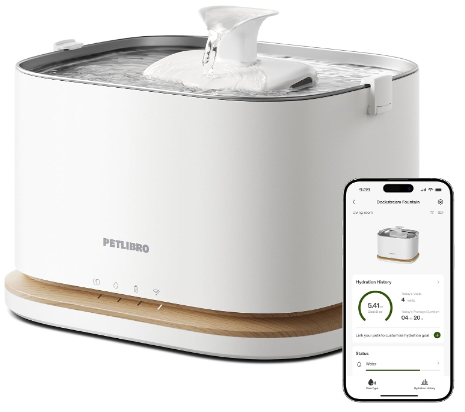
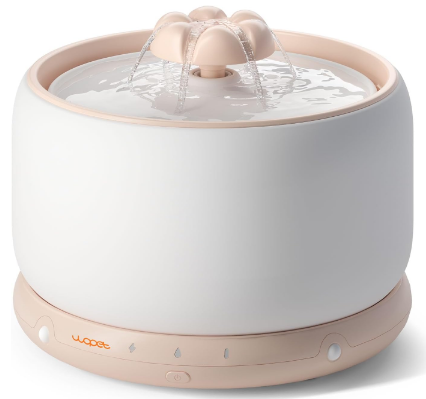
WOPET W03 Ceramic Wireless Fountain: Best for a Wide Ceramic Format
WOPET lists the W03 with a 3-liter (101-ounce) capacity, a 5,000 mAh battery, and dimensions of about 11.2 by 11.2 by 7.6 inches. The company says the ceramic bowl is dishwasher-safe and that the filtration system combines activated carbon with a sponge stage.[11]
The broad ceramic body may be attractive for cats that dislike narrow dishes and for owners who want more mass than a lightweight bowl. That can reduce casual sliding or levering, but no fountain should be described as impossible to tip. A determined cat can move many objects, and placement, floor traction, water level, and the unit’s actual center of gravity all matter.
WOPET claims noise below 25 dB and up to 30 days of use per charge.[11] Those are manufacturer-listed figures, not measurements made by Modern Cat Society. The current product page does not explain the battery-test conditions as clearly as PETLIBRO does, so buyers should treat the maximum runtime as an upper-bound claim.
Ceramic is not inherently self-sanitizing. Its advantage is a smooth, nonporous glazed surface when intact. Wash it as directed, examine it for chips or cracks, and clean the non-ceramic components and water pathways too. The filter cannot remove saliva biofilm from surfaces.
Best for: Owners who prefer a wider ceramic drinking presentation, do not need intake analytics, and are comfortable handling and cleaning a larger breakable component.
Consider another option if: You need app monitoring, want the smallest footprint, have difficulty lifting ceramic, or worry that the unit could be struck or dropped during cleaning.
PETLIBRO vs. WOPET vs. a Heavy Water Bowl
| Feature | PETLIBRO Dockstream 2 Cordless | WOPET W03 Ceramic Wireless | Heavy wide bowl |
| Water presentation | Sensor-activated or continuous moving water | Circulating fountain water | Still water |
| Listed capacity | 3 L / 101 oz | 3 L / 101 oz | Varies |
| Main drinking material | Stainless-steel tray; ABS tank/body | Glazed ceramic bowl plus fountain components | Stainless steel, glass, or glazed ceramic |
| Listed battery | 5,200 mAh | 5,000 mAh | None |
| App and Wi-Fi | Yes; 2.4/5 GHz; one-pet trend tracking | No app feature listed on current W03 page | None |
| Stability approach | 4.17-lb base and manufacturer-described anti-knockover design | Broad ceramic construction | Choose a low, broad, weighted, non-slip model |
| Cleaning burden | Daily surface care plus tank, rotor, and filter maintenance | Daily surface care plus fountain pathways and filter maintenance | Daily wash; few parts |
| Recurring cost | Replacement filters; eventual battery wear | Replacement filters; eventual battery wear | Usually none beyond replacement after damage |
| Best fit | Data-minded single-cat home | Design-focused home wanting ceramic | Budget-conscious owner or cat that prefers still water |
| Main limitation | Data can be distorted by shared use or splashing | No intake analytics; ceramic is breakable | No moving stream or automatic reminders |
A heavy bowl is the best first purchase when the problem is mechanical. PETLIBRO makes more sense when location flexibility and drinking trends are priorities. WOPET makes more sense when a wide ceramic presentation is more important than app data.
Returns, Warranty, and Ongoing Costs
Buying through Amazon means the retailer’s return terms apply. Confirm the seller, return window, condition requirements, and current listing details before checkout; do not assume the direct-store policy automatically governs an Amazon return.
PETLIBRO’s U.S. policy lists a 30-day return window for direct purchases, requires original packaging and contents, assigns non-quality return shipping to the buyer, and lists a 24-month warranty for fountains. For Amazon purchases, PETLIBRO directs returns and refunds to the retailer, while authorized-retailer warranty service may still require proof of purchase.[10]
WOPET’s official policy lists 30-day returns for undamaged fountains, with original packaging and buyer-paid shipping for non-quality returns. Its standard policy table lists a 12-month fountain warranty. Separately, WOPET promotes an activation form for a two-year extended warranty, and its product pages display “24-Month Extended Warranty.” Because those pages describe different default and extended terms, confirm whether registration is required and retain written confirmation.[12]
Both fountains require filters. PETLIBRO currently recommends replacement every two weeks for one pet.[8] WOPET sells W03 filters and advises a two- to four-week interval, adjusted for usage.[11] Also budget for cleaning tools and eventual battery or component wear; consumables and normal wear are commonly excluded from warranty coverage.[10][12]
Pros and Cons of Switching From a Bowl to a Fountain
| Pros | Cons |
| Moving water may appeal to some cats | Research does not show a universal increase in intake |
| A larger base may reduce casual tipping | A fountain can still splash, leak, or be moved |
| Flow creates visible and audible cues | Motors or flowing water can deter a cautious cat |
| Cordless models allow more flexible placement | Batteries need charging and eventually degrade |
| Filters capture hair and some debris | Filters add recurring cost and do not sanitize surfaces |
| App models can reveal drinking trends | Estimates are not veterinary measurements or diagnoses |
| Larger reservoirs can reduce emergency top-ups | A large reservoir can conceal neglected water maintenance |
| Modern designs can integrate neatly into a home | More parts create more cleaning work than a bowl |
Who Should Buy a Cat Water Fountain?
A fountain is a reasonable purchase when your cat repeatedly seeks faucets, engages more comfortably with moving water, or tips lightweight bowls despite a stable wide-bowl trial. It can also suit owners who will reliably respond to maintenance reminders and want a cordless station away from outlets or busy feeding areas.
Choose PETLIBRO when one-pet trend data and compact cordless placement matter. Choose WOPET when you prefer a wide ceramic body and do not need analytics. In either case, buy only if you are willing to clean more than the visible tray and replace consumables.
Choose a heavy bowl instead when your cat drinks well from still water, the problem disappears with better weight and traction, or you want the simplest hygienic routine. A bowl is also the safer backup for travel, charging days, internet interruptions, or a cat that distrusts mechanical sound.
If thirst has increased, skip the shopping decision until you have spoken with a veterinarian. A product may improve access, but it cannot diagnose kidney disease, diabetes, hyperthyroidism, dental pain, arthritis, or urinary illness.
How to Get the Most From a Water Fountain
Introduce It as a Choice
Set the fountain several feet from the existing bowl and initially leave it off. Add fresh water and allow voluntary investigation. Once the cat is comfortable, activate the gentlest mode. Keep the bowl available for at least one to two weeks and longer if your cat is cautious.
Protect the Floor Without Creating Instability
Use a level, water-resistant surface and a large non-slip mat. Avoid plush rugs that retain moisture or trays that make the fountain rock. Check the surrounding floor daily, especially near wood seams, cabinets, and electrical outlets.
Keep the Water Level Within the Operating Range
Low water can increase noise and interrupt flow. Overfilling invites spills. Follow the fill marks, verify the level daily, and respond to alerts promptly. Never assume a full-looking app screen replaces a visual check.
Clean the Entire Water Path
Wash the drinking surface daily. At the manufacturer’s recommended interval, disconnect or power down the unit, discard old water, remove the filter, and clean every washable reservoir, channel, rotor, and removable component. Rinse thoroughly before reassembly.[7]
Do not put the electrical base in water. Only place a component in the dishwasher when the current manual identifies that exact part as dishwasher-safe. Replace cracked ceramic, damaged cords, swollen batteries, worn seals, or parts that no longer seat correctly.
Treat App Data as a Trend, Not a Diagnosis
Smart-fountain readings can be affected by splashing, evaporation, refilling, shared use, brief drinks, and sensor position. Establish a normal baseline, then look for sustained change rather than reacting to one unusual day. Pair any trend with appetite, body weight, activity, and litter-box observations.
When Water-Bowl Behavior Needs a Veterinarian
Arrange a veterinary appointment if tipping or pawing begins suddenly, particularly in a mature or senior cat. Seek advice when the behavior occurs with increased thirst or urination, weight loss, increased or reduced appetite, vomiting, diarrhea, lethargy, weakness, bad breath, drooling, difficulty lowering the head, or signs of pain.[1][6]
Contact a veterinarian promptly for suspected dehydration, including weakness, poor appetite, dry or tacky gums, or sunken-looking eyes.[1] Skin-tent tests can be misleading in older cats, so do not use a home check to rule out a problem.
Treat straining to urinate, repeated box visits with little or no urine, vocalizing in the box, or collapse as an emergency. Do not confuse repeated attempts to urinate with constipation, and do not wait for a fountain or diet change to help.
Frequently Asked Questions
1. Why does my cat paw at the water before drinking?
Your cat may be creating ripples, testing the level, exploring reflections, or maintaining a posture that feels safer. The behavior can also be simple play. Keep the water level consistent and test a wide, shallow vessel before assuming a medical or sensory cause.
2. Is my cat unable to see still water?
That claim is too absolute. A clear, motionless surface may provide limited visual contrast in some bowls, and ripples add useful cues, but cats are not universally unable to see water. Treat surface-testing as one plausible explanation among several.
3. Is whisker fatigue real?
Whisker contact sensitivity is plausible, and some cats prefer wider dishes. However, the available controlled study did not find improved eating time, intake, or food-dropping with a whisker-friendly dish, although more cats preferred it when given a choice.[4] “Whisker fatigue” should not be presented as a proven painful diagnosis.
4. Will a fountain stop my cat from spilling water?
It may help if the cat tips a light bowl or paws because they prefer movement. It will not stop every determined splasher, and a fountain can create its own leaks if assembled incorrectly or overfilled. Stability, placement, and floor protection still matter.
5. Do cats drink more from fountains than bowls?
Some do, but not all. A small study found slightly higher intake with a fountain among most participating cats but no significant change in urine concentration, and one cat reacted negatively.[3] Offer both formats and observe your cat’s preference.
6. How much water should a cat drink each day?
Cornell provides a broad estimate of about 4 fluid ounces per 5 pounds of lean body weight per day from all sources.[1] That includes food moisture, so a wet-food-fed cat may drink less from a dish. Your veterinarian can interpret intake for your cat’s diet and health.
7. Is stainless steel better than ceramic?
Both can be good when food-safe, smooth, undamaged, and cleaned correctly. Stainless steel is durable and light to handle; ceramic adds mass and may integrate better with some interiors but can chip or crack. Neither material eliminates the need for daily washing.
8. How often should I clean a cat fountain?
Clean the drinking surface daily and refresh the water. Follow the current manual for a full disassembly schedule, cleaning more often with multiple pets, visible debris, odor, or biofilm. The CDC recommends daily cleaning for water bowls, and fountain filters are not a substitute.[7]
9. How often do fountain filters need replacing?
PETLIBRO currently recommends every two weeks for one pet, with more frequent changes for multiple pets.[8] WOPET lists roughly two to four weeks for W03 replacement filters.[11] Water quality, hair, saliva, and usage can shorten those intervals.
10. Can PETLIBRO track more than one cat?
The Dockstream 2 Smart Cordless Fountain can be shared, but its standard intake tracking is designed for one pet at a time. It cannot reliably assign shared drinking to individual cats. PETLIBRO directs multi-cat buyers needing identification to its separate RFID model.[8][9]
11. Can I leave a cordless fountain as my cat’s only water source?
It is safer to keep a clean backup bowl available, especially during charging, travel, maintenance, or equipment failure. Check water physically every day. A battery estimate, app connection, or large tank does not guarantee uninterrupted access.
12. When is tipping a sign of illness rather than play?
Concern rises when the behavior is new, intense, or paired with increased drinking, larger urine clumps, weight loss, appetite change, vomiting, weakness, pain, or poor grooming. Those patterns warrant veterinary advice; urinary straining or inability to pass urine is an emergency.
Final Verdict: The Right Hydration Setup for a Bowl-Tipping Cat
If you are asking why your cat tips over the water bowl, begin with behavior and environment—not a story about spite. The most common practical explanations include play, a light or awkward vessel, inconsistent water depth, an undesirable location, learned attention, or an individual preference for movement.
A heavy, wide, shallow bowl is the smartest first test because it is inexpensive, easy to clean, and directly addresses stability. If your cat still paws at water or consistently chooses faucets, a fountain becomes a reasonable next step.
The PETLIBRO Dockstream 2 is the stronger fit for a single-cat home that values cordless placement and app-based trends. The WOPET W03 is the more relevant option for owners who prefer a broad ceramic format without app features. Neither replaces fresh water, daily observation, wet-food discussions with a veterinarian, or medical care when thirst changes.
The real upgrade is not simply moving water. It is a drinking setup your cat willingly uses, your household can maintain, and you can monitor without losing sight of the health signals behind the spill.
<a href=”https://amzn.to/45AnbrU” rel=”sponsored nofollow”>Check the current PETLIBRO Dockstream 2 Smart Cordless Fountain listing on Amazon (paid link)</a>
Read more:
PETLIBRO Review: Are Their Smart Cat Products Worth It?
WOPET Review: Are WOPET Cat Products Worth It?
Why Your Cat Kicks Litter Everywhere?
Sources and References
- Cornell Feline Health Center — Hydration. Total water needs, food moisture, dehydration signs, disease-related water loss, and individual fountain preference. View source
- Feline Veterinary Medical Association, Cat Friendly Homes — How to Increase Your Cat’s Water Intake. Wide dishes, multiple drinking locations, placement, and household access guidance. View source
- Grant, D. C. — Effect of Water Source on Intake and Urine Concentration in Healthy Cats. Household fountain-versus-bowl study and its limitations. View source
- Slovak, J. E., and Foster, T. E. — Evaluation of Whisker Stress in Cats. Controlled comparison of normal and marketed whisker-friendly food dishes. View source
- Buckley, C. M. F., Hawthorne, A., Colyer, A., and Stevenson, A. E. — Effect of Dietary Water Intake on Urinary Output, Specific Gravity and Relative Supersaturation for Calcium Oxalate and Struvite in the Cat. Effects of dietary moisture on urine parameters. View source
- Cornell Feline Health Center — Hyperthyroidism in Cats. Increased thirst and urination, weight loss, appetite, and other warning signs. View source
- Centers for Disease Control and Prevention — About Cleaning and Disinfecting Pet Supplies. Daily cleaning guidance for pet water bowls and safe cleaning principles. View source
- PETLIBRO — Dockstream 2 Smart Fountain. Manufacturer-listed dimensions, materials, capacity, battery, connectivity, tracking limitations, maintenance intervals, and performance claims. View source
- PETLIBRO — Dockstream Series Comparison and Dockstream 2 Pre-Sale FAQ. Model number, cordless features, network compatibility, capacity, and one-pet tracking scope. View comparison and view FAQ
- PETLIBRO — Return and Refund Policy. Direct-purchase return conditions, authorized-retailer handling, 24-month fountain warranty, and exclusions. View source
- WOPET — W03 Ceramic Wireless Pet Water Fountain and Replacement Filters. Manufacturer-listed dimensions, capacity, battery, noise, cleaning claims, filtration, and filter interval. View fountain and view filters
- WOPET — Return and Refund Policy and Extended Warranty Activation. Return requirements, standard 12-month fountain warranty, exclusions, retailer handling, and separately promoted two-year activation. View policy and view activation page
Sources, specifications, prices, and policies reviewed August 25, 2026. Product features, retailer terms, warranty coverage, and manufacturer guidance may change. Verify critical details with the manufacturer or retailer before purchasing.