How to Brush Your Cat’s Teeth: A Stress-Free Guide for Healthier Smiles (2026)
By Demosthenes Staudinger · Updated August 25, 2026
Affiliate disclosure: This article contains affiliate links. As an Amazon Associate I earn from qualifying purchases. If you buy through one of these links, we may earn a commission at no additional cost to you. This does not affect our editorial recommendations.
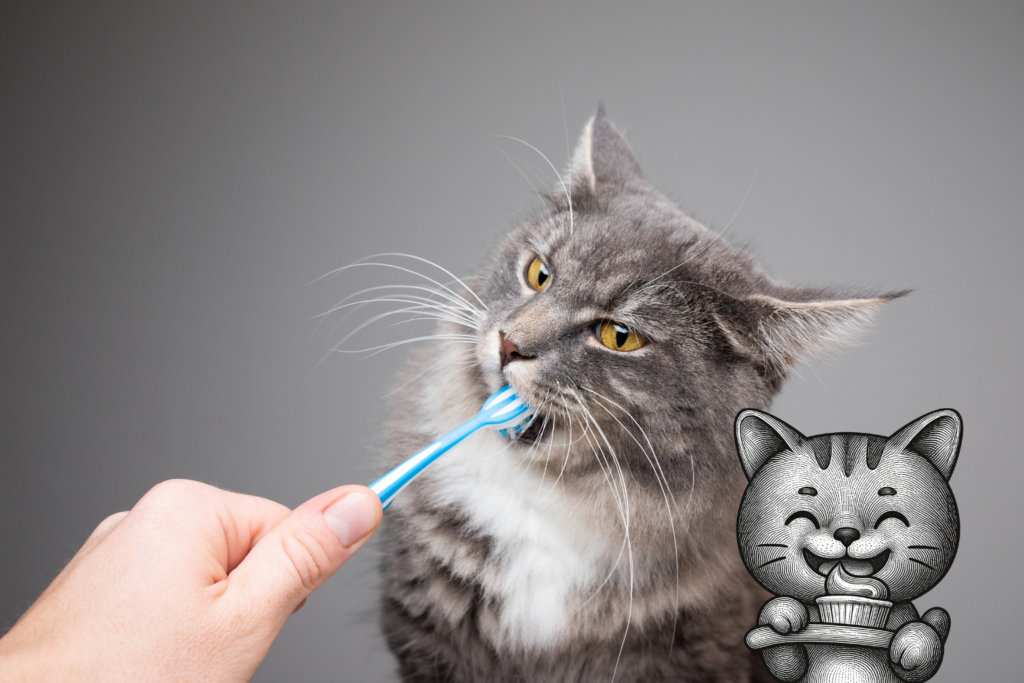
Brushing a cat’s teeth can sound less like a wellness routine and more like an invitation to be scratched. The reassuring truth is that you do not need to pry your cat’s mouth open, scrub every tooth, or complete a perfect two-minute session. The most successful routine is quiet, brief, and built gradually around your cat’s comfort.
That routine matters. Cornell University’s Feline Health Center reports that studies estimate 50% to 90% of cats older than four have some form of dental disease. Gingivitis, periodontitis, and tooth resorption can all be painful, yet cats often conceal oral discomfort remarkably well.[1]
At-home brushing is designed to remove soft plaque before it mineralizes into hard calculus, commonly called tartar. It cannot repair a damaged tooth or remove established tartar below the gumline. Those problems require a veterinary examination and, when indicated, a professional dental procedure.
The good news is that the equipment can remain beautifully simple: a small, soft brush, toothpaste formulated for pets, and a reward your cat genuinely values. No elaborate restraint system is required. In fact, force is usually the fastest way to make the next session harder.
This guide explains how to brush your cat’s teeth step by step, how often to do it, which surfaces deserve your attention, and when you should put down the brush and call your veterinarian. It also evaluates five practical products for building a realistic feline dental-care routine in 2026.
Medical note: This is a research-based educational guide, not a diagnosis or a substitute for veterinary care. Ask your veterinarian to examine your cat’s mouth before starting if your cat has bad breath, inflamed gums, eating changes, visible tartar, known dental disease, or any sign of oral pain.
How we researched this guide: We compared current guidance from Cornell, VCA, AAHA, and VOHC with official manufacturer information. Products were evaluated by intended role, specifications, evidence signals, and limitations; we did not claim hands-on testing.
Quick Answer: How Do You Brush a Cat’s Teeth?
Choose a calm moment and position yourself beside or slightly behind your cat. Place a pea-sized or smaller amount of pet toothpaste on a soft feline toothbrush. With the mouth closed, gently lift the lip, angle the bristles toward the gumline, and brush the outer surfaces of the teeth using small, gentle motions. Concentrate on the canine teeth and the large cheek teeth toward the back of the mouth.
Begin with only one or two teeth and stop while your cat is still comfortable. Build toward approximately 30 seconds per side. Daily brushing offers the greatest benefit; if daily care is not realistic, VCA advises that brushing at least three times per week is the minimum likely to help remove plaque and slow tartar formation.[2]
Do not begin with a full brushing session. First teach your cat that the toothpaste, brush, lip handling, and brief gum contact predict something pleasant. Progress only when the current step produces relaxed body language.
At a Glance
| Question | Practical answer |
|---|---|
| Best time to start | When the mouth has been examined and is comfortable; kittens often adapt quickly, but adult and senior cats can learn too |
| Ideal frequency | Once daily |
| Practical minimum | At least three times weekly, if your veterinarian agrees |
| Eventual session length | About 30 seconds per side; shorter successful sessions still count |
| Where to brush | Outer tooth surfaces, especially along the gumline and around the cheek teeth |
| What to use | A small, soft pet toothbrush and toothpaste made for pets |
| What never to use | Human toothpaste, baking soda, forceful restraint, or tools intended to scrape tartar |
| When to stop | Pain, bleeding, marked redness, drooling, struggling, breathing changes, or sudden fear |
Our Recommended Cat Dental-Care Toolkit
You do not need every product below to start. The toothbrush and pet toothpaste form the core brushing kit; the purée is a training reward. Dental treats and water additives are optional supplements for cats that tolerate them.
| Product | Role in the routine | Best for | Important limitation |
| PETHROOM Deep Point Pet Toothbrush | Small brushing tool | Precise access around feline cheek teeth | A brush cannot remove hardened tartar |
| Virbac C.E.T. Enzymatic Toothpaste | Pet toothpaste | Cats motivated by savory flavors | Not listed as a VOHC-accepted feline product as of this update |
| INABA Churu Variety Pack | High-value reward | Positive reinforcement and cooperative-care training | A reward, not a dental treatment; calories still count |
| Feline Greenies Dental Treats | Supplemental dental treat | Cats that reliably chew appropriately sized treats | Complements rather than replaces brushing |
| Oxyfresh Water Additive | Optional passive breath-care step | Cats that accept treated water without drinking less | No current VOHC seal for cats; not a substitute for brushing or veterinary care |
Best starting tool: The PETHROOM brush has a very small round head designed for precise placement, which may feel less intrusive than a full-size pet brush in a cat’s compact mouth.[6]
![PETHROOM] Pet Toothbrush for Cats and Dogs | Round Shaped Head with Ultra Soft Bristle for Deep Cleaning Dental Care, Kitten and Small Dogs, Tartar Plaque Removal (Deep Point)](https://moderncatsociety.com/wp-content/uploads/2026/07/The-Ergonomic-Microbrush.png "The Ergonomic Microbrush")
Why Brushing Your Cat’s Teeth Matters
Dental disease is not simply a cosmetic problem or a question of fresh breath. It can make eating, grooming, and normal facial contact uncomfortable. Because cats are both predators and prey animals, they may continue acting relatively normal even when their mouths hurt.
The process often begins with plaque, a sticky biofilm containing bacteria. If plaque is not disrupted regularly, minerals in saliva can harden it into calculus or tartar. The rough tartar surface gives more plaque a place to accumulate. Inflammation at the gum margin is called gingivitis; when disease damages the tissues and bone supporting the teeth, it becomes periodontitis.[1]
Cats also develop tooth resorption, a painful breakdown of tooth structure that brushing cannot diagnose or treat. Hidden lesions may require dental radiographs.[1]
Brushing mechanically disrupts plaque while it is soft; it is maintenance, not treatment for existing disease. A clean-looking crown does not guarantee a healthy root or supporting tissue.
Plaque, Tartar, and Dental Disease Are Not Interchangeable
| Term | What it means | Can home brushing help? |
| Plaque | Soft bacterial film that continually forms on teeth | Yes; regular mechanical brushing is intended to remove it |
| Tartar or calculus | Plaque that has mineralized into a hard deposit | No; do not scrape it at home |
| Gingivitis | Inflamed, often red or swollen gums | Prevention may be supported by plaque control, but painful gums need veterinary assessment first |
| Periodontitis | Irreversible damage to tooth-supporting tissues | No; requires veterinary diagnosis and treatment |
| Tooth resorption | Destruction of tooth structure, common in cats | No; may require dental radiographs and treatment under anesthesia |
Check for Dental Pain Before You Pick Up the Brush
If your cat has never had an oral examination, ask your veterinarian to check the mouth at the next visit. If you notice any warning sign, arrange the examination sooner rather than attempting to “clean away” the problem.
Watch for:
- Persistent bad breath rather than a mild food odor
- Red, swollen, receding, or bleeding gums
- Yellow-brown deposits on the teeth
- Drooling, blood-tinged saliva, or pawing at the mouth
- Dropping kibble or treats while eating
- Chewing on one side or turning the head unusually during a meal
- Suddenly preferring soft food
- Eating less, approaching food and walking away, or losing weight
- Irritability when the face is touched
- Facial swelling or a visible broken tooth
- A pink or red defect where a tooth meets the gum
Do not assume a cat is pain-free simply because they still eat. Some cats swallow dry food with limited chewing or adapt their movements to avoid a painful area. Severe gingivitis and tooth resorption can make brushing genuinely painful.[1]
When Brushing Is the Wrong First Step
Pause home brushing and contact your veterinary team if your cat has active oral pain, unexplained bleeding, a loose or fractured tooth, facial trauma, suspected mouth ulcers, or recent oral surgery. Follow post-procedure instructions precisely; the gums may need time to heal before brushing resumes.
Sudden refusal after previously comfortable brushing also deserves attention. It may reflect an unpleasant flavor or a worn brush, but it can also signal a newly painful tooth. Behavior is information, not disobedience.
What You Need to Brush Your Cat’s Teeth
The best toolkit is the one your cat accepts consistently. A polished gadget cannot compensate for an oversized head, stiff bristles, or rushed handling.
1. A Small, Soft Toothbrush
The ideal cat toothbrush has a compact head, soft bristles, and a handle you can control without blocking your view. A small cat-specific brush is usually the easiest option. Some cats prefer a very soft baby toothbrush, a finger brush, clean gauze, or a cotton swab during early training.[2]
The PETHROOM Deep Point brush is a practical precision option. The manufacturer describes a 4-millimeter round head with fine PBT bristles, a shape intended to reach small areas without filling the mouth.[6] It is still a toothbrush, not a scaler: do not try to scrub away hard tartar.
Best for: Cats that resist large brush heads and owners who want precise control.
Consider another option if: Your cat dislikes bristles even after gradual training. Begin with gauze or a cotton swab and ask your veterinarian how to transition safely.
2. Toothpaste Formulated for Pets
Never use human toothpaste. Human products are made to be spit out, while cats will swallow what enters their mouth. Use a toothpaste specifically formulated for pets and follow its label.
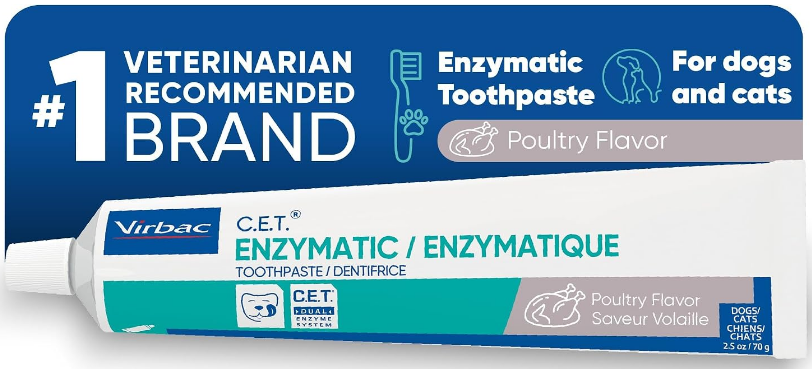
Virbac C.E.T. Enzymatic Toothpaste is formulated for dogs and cats. According to Virbac, it uses a dual-enzyme system, contains no foaming agents, is designed to be swallowed by pets, and comes in several flavors, including poultry and seafood.[7] A palatable flavor can make the brush easier to introduce.
Two accuracy notes matter here. First, enzymatic toothpaste supports the routine, but the brush’s mechanical action remains essential. It does not dissolve established tartar on contact. Second, Virbac C.E.T. toothpaste does not appear on the current VOHC accepted-products list for cats, so it should not be described as “VOHC approved” or “VOHC accepted.”[4]
Stop using any new oral product and contact your veterinarian if an unexpected reaction occurs. Cats with allergies or restricted diets may need a carefully selected flavor.
3. A Tiny, High-Value Reward
Rewards are not bribery; they are part of cooperative-care training. They teach your cat that tolerating a brief step makes something good happen. Choose a reward the cat already digests well and reserve it for dental sessions when possible.
INABA Churu purée works well because you can deliver a tiny lick immediately after the desired behavior. The referenced 50-tube variety pack contains 0.5-ounce tubes; the manufacturer lists 91% moisture and 6 calories per tube.[8] You do not need an entire tube per session. One or two small licks can mark success without turning a 20-second brushing attempt into a significant daily calorie source.
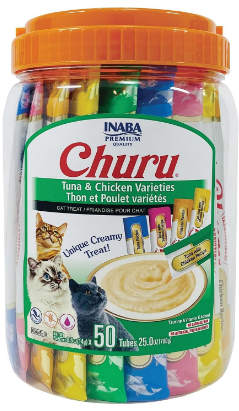
The reward’s purpose is behavioral, not dental; a creamy treat does not clean teeth.
4. Optional: A Towel or Nonslip Mat
A folded towel or silicone mat can create a predictable, nonslip station. It should never become a restraint device. Keep the setup calm: one brush, one tube, and one reward.
How to Brush Your Cat’s Teeth: The Stress-Free Training Plan
The original version of this guide divided training into fixed blocks of days. That can be too fast for one cat and needlessly slow for another. A better approach is criterion-based: repeat a stage until your cat remains comfortable, then advance by one small step.
A kitten may move through several stages quickly. A cautious adult may need days or weeks. A formerly painful cat may require professional treatment and a much slower restart. There is no prize for reaching the toothbrush on a particular date.
Read Your Cat’s Consent Signals
Continue when you see:
- A loose body, neutral ears, and normal pupils
- Willing approach to the station, toothpaste, or reward
- Acceptance of a brief touch without pulling away
Stop or simplify when you see:
- Tail lashing, flattened ears, freezing, growling, or hiding
- Repeated head turning, swatting, biting, or frantic escape
- Panting or open-mouth breathing
End on an easy success whenever possible. If your cat turns away, let them. Forcing one “complete” brushing can cost several future sessions.
Stage 1: Build a Predictable Dental Station
Choose a quiet location when your cat is relaxed but awake. Invite them onto the mat, give a tiny reward, and finish. Keep early sessions to roughly 10 to 20 seconds and also use the station for pleasant contact.
Stage 2: Introduce the Toothpaste Flavor
Offer a tiny dab of pet toothpaste for investigation and reward calm interest. If your cat dislikes the flavor, do not smear it on the mouth; try another pet-safe flavor or ask your veterinary team for options.
Stage 3: Condition Facial and Lip Handling
Touch the cheek for one second, reward, and stop. Over successive sessions, move toward the muzzle and briefly lift the upper lip. Do not open the jaw; approach from the side and keep the mouth closed.
Stage 4: Touch One Tooth
Once lip lifting is comfortable, touch a toothpaste-coated finger, gauze pad, or cotton swab to the outer surface of one canine. Reward, then gradually introduce a tiny gumline motion. Do not rub visible tartar.
Stage 5: Introduce the Brush
Let your cat lick toothpaste from the brush. Later, touch the brush to one tooth, reward, and progress to one gentle stroke. If fear appears, return to the prior stage and change only one variable at a time.
Stage 6: Expand the Brushing Area
Build from one tooth to two, then from the canine toward the premolars and molars. Add seconds gradually. Do not rush to brush every tooth in one attempt.
When both sides are comfortable, work toward roughly 30 seconds per side. Some cats will accept less. A consistent, calm 20-second session focused on the outer cheek teeth is more useful than an occasional struggle for perfect coverage.
The Correct Cat Teeth-Brushing Technique
Once your cat accepts the brush, use this sequence:
- Prepare before inviting your cat. Put a small amount of pet toothpaste on the brush, open the reward, and place both within reach.
- Position yourself beside or slightly behind the cat. Avoid looming over the face. Support the head gently without gripping the neck.
- Keep the mouth closed. Place a hand over the top of the head only if your cat already accepts this contact. Gently lift the lip from the side.
- Angle toward the gumline. VCA recommends positioning the head at roughly 45 degrees and directing the bristles where the tooth meets the gum.[2]
- Use small, gentle motions. Short circular or back-and-forth strokes can disrupt plaque. Pressure should be light enough not to traumatize the gums.
- Prioritize the outer surfaces. Focus on the canine and large cheek teeth. You generally do not need to force the mouth open to brush the tongue-facing surfaces.[1][2]
- Switch sides calmly. If your cat is finished after one side, reward and attempt the second side later. Alternating which side comes first can improve long-term coverage.
- Stop before conflict. Release the lip, offer the reward, and end the session while the experience is still manageable.
- Rinse and air-dry the brush. Store it where it cannot remain damp or be confused with a human toothbrush.
Never use a metal dental scaler, ultrasonic scraper, fingernail, or sharp tool at home. Scraping visible deposits can injure enamel or gums, and it does nothing to assess disease below the gumline.
How Often Should You Brush Your Cat’s Teeth?
Daily brushing is the goal because plaque reforms continually. Regular daily disruption gives it less opportunity to mineralize. Cornell’s preventive guidance specifically presents daily brushing, while VCA describes daily care as most beneficial.[1][2]
If daily brushing is not yet possible, aim for at least three sessions per week while continuing gradual training. An all-or-nothing mindset is counterproductive. Missing one day does not erase the habit; simply resume at the next calm opportunity.
Frequency does not compensate for force. Seven frightening sessions are not better than four cooperative ones. If your cat becomes less comfortable over time, shorten the duration, reduce pressure, check the brush, reconsider the flavor, and rule out pain.
How Long Should Each Session Last?
During training, a session may last only a few seconds. Once fully conditioned, approximately 30 seconds per side is a useful target.[2] That is a goal, not a pass-or-fail test.
The important measures are regularity, gentle gumline contact, and coverage of the outer cheek teeth. You do not need to imitate a human two-minute routine.
Common Mistakes That Make Cat Teeth Brushing Harder
Starting When the Mouth Is Already Painful
Bad breath or visible tartar can motivate an owner to brush harder. Unfortunately, those signs may indicate disease that needs veterinary care. Brushing inflamed tissue can create pain and teach the cat to fear the brush.
Using Human Toothpaste
Cats swallow toothpaste. Human formulas are not designed for that use and may contain ingredients that are inappropriate for pets. Use only a product specifically labeled for pets and recommended for your cat.
Trying to Open the Mouth Wide
Wide opening increases resistance and is unnecessary for routine plaque control. Lift the lip and work along the outer surface with the jaw closed.
Scrubbing Hardened Tartar
Tartar is mineralized. Brushing will not safely chip it away, and home scraping can injure the mouth. Professional assessment is the correct next step.
Holding the Cat Down
Scruffing, pinning, or wrapping a struggling cat tightly may get the brush into the mouth once, but it undermines cooperative care and can cause injury. A towel can provide traction or comfort; it should not be used to overpower panic.
Advancing on a Calendar
“Day four” is not evidence that a cat is ready. Advance when the cat is relaxed at the current stage. Regress when body language says the task became too difficult.
Using Too Much Toothpaste or Reward
A small smear is sufficient. Excess paste creates mess and can overwhelm a cat with flavor. Reward calories—including purées and dental treats—should fit within the daily nutritional plan.
Expecting a Product to Replace Veterinary Dentistry
No brush, toothpaste, treat, toy, or water additive can diagnose tooth resorption, probe periodontal pockets, take dental radiographs, or clean below the gumline.
What If Your Cat Will Not Accept a Toothbrush?
Some cats never accept conventional brushing. Do not force it; ask your veterinarian for a plan based on the cat’s mouth, diet, health, and tolerance.
VOHC awards its seal when submitted trial data meet defined plaque- or tartar-control standards. It is useful when comparing passive options, but not every marketed claim is independently confirmed.[4][5]
At-Home Options Compared
| Option | Likely role | Evidence cue | Does it replace brushing? |
| Toothbrushing | Direct mechanical plaque disruption | Recommended by Cornell, VCA, and AAHA | It is the at-home standard |
| Dental diet | Daily supplemental plaque or tartar control | Prefer the appropriate VOHC seal and veterinary guidance | No |
| Dental treat | Supplemental chewing-based benefit | Prefer a feline product with a VOHC seal | No |
| Water additive | Passive support for some cats | Prefer a VOHC-accepted feline formula when available | No |
| Dental wipe or gauze | Transitional mechanical contact | Ask your veterinarian about technique and product | Usually less complete than brushing |
| Professional dental procedure | Diagnosis, radiographs, scaling, polishing, and treatment under anesthesia | Veterinary standard of care when indicated | Addresses needs home care cannot |
Feline Greenies Dental Treats: The Better-Supported Treat Option
Feline Greenies Dental Treats are included on the VOHC feline accepted-products list for tartar control.[4] That makes them a more evidence-aligned supplemental choice than an ordinary crunchy treat marketed vaguely for “clean teeth.”
The linked oven-roasted chicken version is formulated for adult cats. Follow the current package’s weight-based directions, supervise your cat while treats are offered, provide fresh water, and reduce the main meal as necessary to account for treat calories.[9] Do not extrapolate feeding instructions from another package size or online listing.

Best for: Adult cats that chew the treat safely and whose veterinarian approves the added calories and ingredients.
Skip or ask first if: Your cat swallows treats whole, has a medically restricted diet, food allergies, chewing pain, or needs weight loss. Dental treats are not appropriate for every cat.
Oxyfresh Water Additive: Convenient, but Keep Expectations Modest
Oxyfresh Premium Pet Dental Care Solution is marketed as a tasteless, odorless additive for cats and dogs. The manufacturer’s current direction is to mix it into drinking water according to the label.[10] Convenience is its main appeal: there is no direct mouth handling.
However, Oxyfresh does not appear on the current VOHC accepted-products list for cats, and it should not be presented as an enzymatic substitute for brushing.[4] Consider it an optional breath-care adjunct, not the foundation of periodontal prevention.
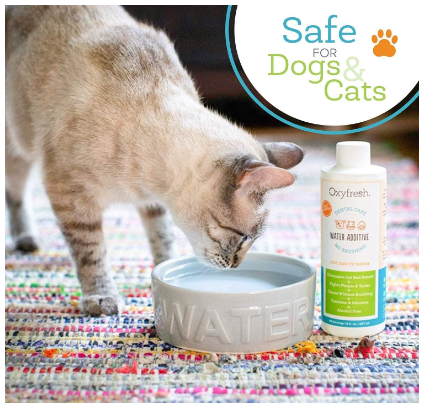
Hydration comes first. Introduce only one water change at a time. If your cat drinks less after the additive is introduced, remove it and provide plain fresh water. If you use a fountain, confirm that the additive is compatible with the pump and filter, and continue normal cleaning. An additive does not sanitize a bowl or fountain.
Why Professional Dental Cleaning Requires Anesthesia
A professional procedure is not simply stronger brushing. Under anesthesia, the team can examine and probe each tooth, take radiographs, clean above and below the gums, polish, treat disease, and protect the airway.[3]
Much of a tooth lies below the gumline. An awake cat cannot safely remain still for detailed probing, below-gum scaling, and full-mouth radiographs.[3]
Anesthesia-free cleaning may improve visible crowns but cannot deliver a complete assessment or treatment. Discuss individualized testing, monitoring, and risk with your veterinarian rather than substituting awake scraping.
When Might a Veterinary Dental Procedure Be Needed?
Your veterinarian may recommend one when there is:
- Substantial tartar accumulation
- Gingivitis, periodontal pockets, or loose teeth
- A fractured tooth
- Suspected tooth resorption
- Oral pain, bleeding, or eating difficulty
- Persistent bad breath that is not explained by food
- A need for dental radiographs or extractions
Home brushing usually works best after the mouth is healthy and the veterinarian says healing is complete. It helps maintain the result; it does not make an overdue procedure unnecessary.
Benefits and Limitations of Brushing at Home
| Benefits | Limitations |
| Directly disrupts soft plaque | Does not remove hardened tartar |
| Supports gum health when the mouth is comfortable | Cannot diagnose disease below the gumline |
| Can become a brief daily ritual | Requires gradual conditioning and consistency |
| Uses a compact, inexpensive toolkit | Some cats never accept a conventional brush |
| Lets you notice changes in the mouth sooner | Owners may not see painful resorptive lesions |
| Can strengthen cooperative-care skills | Brushing painful gums can worsen fear |
| Reduces reliance on passive products alone | Results depend on technique and frequency |
| Fits into a modern home without bulky equipment | Does not replace veterinary exams or professional dentistry |
Who Is a Good Candidate for Home Brushing?
Home brushing is best suited to a cat with a comfortable mouth and no veterinary reason to avoid it. Kittens benefit from early practice, but adults and many seniors can learn too.
Brushing May Be Especially Worth Prioritizing For
- Cats with rapid plaque accumulation
- Cats cleared to brush after professional cleaning
- Cats for whom low-calorie mechanical care is preferable to extra treats
- Owners able to maintain a brief, consistent routine
Ask for Individual Guidance For
- Cats with gingivitis, stomatitis, resorption, periodontal disease, or recent oral surgery
- Cats with bleeding disorders or immune-mediated disease
- Cats with severe fear, a bite history, or handling trauma
- Cats with dietary restrictions, allergies, or difficult facial anatomy
A veterinary technician can demonstrate positioning for your cat and help divide the behavior into smaller steps.
How to Make the Routine Easier to Maintain
Pair It With an Existing Habit
Pair brushing with a predictable event, such as evening play or a meal. Avoid waking a deeply sleeping cat.
Keep the Kit Visible but Secure
Store the kit together in a clean, secure place and let the brush dry fully. Never share brushes between cats.
Replace Worn Brushes
Rinse after use and replace splayed, stiff, or discolored bristles. VCA suggests about every three months as a general routine, sooner if worn.[2]
Track Comfort, Not Perfection
Track frequency plus any avoidance, redness, or sudden change in tolerance. Trends are more useful than chasing a perfect streak.
Keep Rewards Small
Use only a tiny lick of Churu, refrigerate opened tubes as directed, and count reward calories.[8]
Review the Plan at Wellness Visits
Show product labels to your veterinarian. Recommendations should fit your cat’s current weight, diet, history, and oral examination.
Buying Notes: Price, Availability, and Returns
Amazon prices, sellers, formulas, and availability can change. Confirm the exact product and flavor, then inspect seals and expiration information on arrival.
Return eligibility varies, especially for opened consumables. Check the live listing before purchase, and never use a damaged, leaking, unsealed, or incorrect product.
Frequently Asked Questions
1. Can I brush my cat’s teeth with human toothpaste?
No. Cats swallow what enters their mouth, so use only toothpaste formulated for pets. Do not substitute baking soda or homemade essential-oil mixtures.
2. How often should I brush my cat’s teeth?
Daily brushing offers the greatest benefit. If that is not achievable, aim for at least three times weekly unless your veterinarian advises otherwise.[2]
3. How long should I brush my cat’s teeth?
Training may begin with seconds. Once comfortable, work toward about 30 seconds per side without forcing the duration.[2]
4. Do I need to brush the inside surfaces of the teeth?
Usually not. Prioritize the outer gumline and large cheek teeth while keeping the mouth closed.[1][2]
5. Can brushing remove the brown tartar already on my cat’s teeth?
No. A toothbrush removes soft plaque, not hardened calculus. Visible tartar, inflamed gums, or bad breath warrants veterinary assessment; never scrape deposits at home.
6. What if my cat’s gums bleed during brushing?
Stop and contact your veterinarian. Bleeding may reflect inflammation, excess pressure, or dental disease; do not try to “toughen” the gums.
7. Is enzymatic toothpaste better for cats?
It can be a palatable adjunct, but it neither replaces mechanical brushing nor removes established tartar.
8. Are Greenies a replacement for brushing?
No. Their VOHC seal supports supplemental tartar control, not replacement of brushing, examinations, or professional care.[4] Follow the label and count calories.
9. Can I put a dental additive in my cat’s water fountain?
Only with veterinary approval and fountain compatibility. If your cat drinks less, return to plain water; hydration comes first.
10. Is anesthesia-free dental cleaning a safe substitute?
No. Radiographs, probing, below-gum cleaning, airway protection, and treatment cannot be completed properly in an awake cat.[3]
11. Is it too late to teach an adult or senior cat?
No. Older cats can learn, but they should first be checked for pain and may need slower training.
12. What should I do if my cat suddenly refuses brushing?
Stop and reassess the equipment, formula, and possibility of oral pain. Seek veterinary advice before resuming if the change is unexplained.
Final Verdict: The Best Routine Is Gentle, Daily, and Honest About Its Limits
Learning how to brush your cat’s teeth is about trust, not restraint. Start with a comfortable mouth, use a small soft brush and pet toothpaste, keep the jaw closed, and focus on the outer gumline.
For the core toolkit, the PETHROOM Deep Point Pet Toothbrush is a thoughtful small-head option, while Virbac C.E.T. Enzymatic Toothpaste offers pet-safe flavors that may improve cooperation. A tiny lick of INABA Churu can make the training sequence rewarding. Feline Greenies provide a VOHC-accepted supplemental tartar-control option for suitable adult cats, whereas Oxyfresh should be treated as an optional breath-care adjunct with more modest expectations.
Do not ask a toothbrush to do a veterinarian’s job. Brushing controls plaque; it does not remove hard tartar, diagnose resorption, or treat periodontal disease. Used in the right role, a short daily ritual can support a more comfortable mouth.
Read more:
Cat Hygiene 101: The Complete Guide to Keeping Your Cat Clean and Healthy
The Complete Guide to Keeping Your Indoor Cat Healthy and Happy
Signs Your Cat Is Sick: 15 Symptoms You Should Never Ignore
Best Cat Nail Clippers for Stress-Free Grooming
Sources and References
- Cornell University College of Veterinary Medicine, Feline Health Center. Feline Dental Disease. Accessed August 25, 2026.
- VCA Animal Hospitals. Brushing Your Cat’s Teeth. Accessed August 25, 2026.
- American Animal Hospital Association. Your Pet’s Dental Care. Accessed August 25, 2026.
- Veterinary Oral Health Council. Accepted Products for Cats. Accessed August 25, 2026.
- Veterinary Oral Health Council. About the VOHC Seal. Accessed August 25, 2026.
- PETHROOM. Deep Point Toothbrush Product Information. Accessed August 25, 2026.
- Virbac. C.E.T. Enzymatic Toothpastes. Accessed August 25, 2026.
- INABA Foods. Churu 50-Count Tuna and Chicken Variety Jar. Accessed August 25, 2026.
- Greenies. Feline Dental Oven Roasted Chicken Flavor Cat Treats. Accessed August 25, 2026.
- Oxyfresh. Premium Pet Dental Care Solution. Accessed August 25, 2026.