Best Cat Nail Clippers for Stress-Free Grooming in 2026
By Demosthenes Staudinger | Updated August 24, 2026
Affiliate disclosure: This article contains affiliate links. As an Amazon Associate I earn from qualifying purchases. If you buy through one of these links, we may earn a commission at no additional cost to you. This does not affect our editorial recommendations.
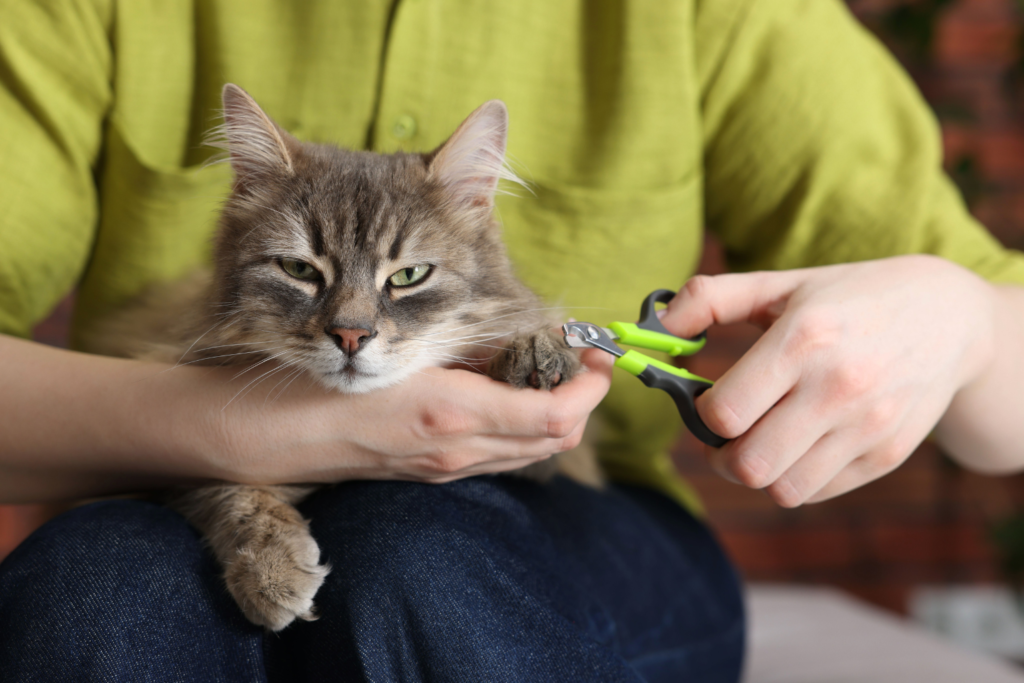
Cat nail trimming does not have to become a contest of strength. The best cat nail clippers provide a clear view and steady control; with gradual positive conditioning, many cats can learn to tolerate a few quick trims at a time.
The right tool matters because feline claws are small, curved, and partly translucent. A bulky or dull clipper can obstruct your view or leave a rough edge. A compact cat clipper usually offers better control, while an illuminated model may improve visibility on clear claws. For cats that dislike clipping, a grinder can be an alternative—provided they accept its sound and vibration.
No clipper, light, guard, or grinder can automatically locate the quick, however. The quick contains living tissue and blood vessels, so safe trimming still depends on identifying the clear hooked tip, removing only a small amount, and stopping before the pink or opaque central area.
It is also important to correct a common misconception: every cat does not need the same trimming schedule. Indoor cats, seniors, and cats that do not wear their claws effectively often need more help. Healthy, active cats may need less frequent trims, and cats with outdoor access rely on their claws for climbing and escape. The goal is comfortable, functional paws—not the shortest possible nails.[1][3][4]
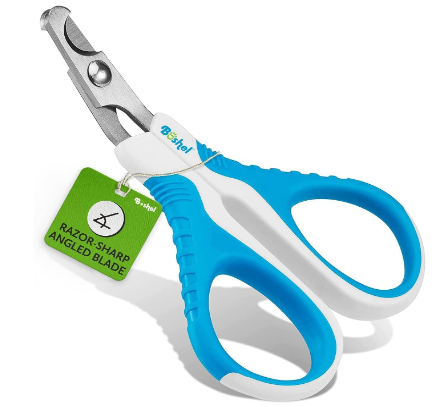
We selected four options for different cats and caregivers. Our overall pick is the BOSHEL Cat Nail Clipper because its compact angled head provides a clear working view without batteries. The PAKEWAY adds light, the Safari suits larger hands, and the LuckyTail offers a grinding alternative.
How we reviewed these cat nail clippers: This is a research-based editorial comparison, not a hands-on laboratory test. We assessed blade design, visibility, grip, size, maintenance, noise, charging requirements, and suitability for feline claws. We cross-checked safety advice with veterinary and feline-welfare sources and verified product features through current manufacturer or retailer information. Product availability, seller, packaging, and specifications can change, so confirm the live listing before purchasing.
Quick Verdict
Editorial verdict: The BOSHEL Cat Nail Clipper is the best all-around option for most indoor cats. Its small semi-circular stainless-steel blades, angled head, and rubberized grip offer the control most caregivers actually need, while the simple manual design stays ready in a drawer.
Best for: Cat parents who want a dedicated, easy-to-position scissor-style clipper for routine tip trims.
Skip it if: Your cat panics at the clipping sensation, you need extra illumination for clear claws, or the compact handles are uncomfortable for your hands. In those cases, consider the LuckyTail grinder, PAKEWAY LED clipper, or larger Safari trimmer respectively.
Best Cat Nail Clippers at a Glance
Product
Best for
Tool type
Standout feature
Main tradeoff
BOSHEL Cat Nail Clipper
Best overall
Compact scissor clipper
Angled semi-circular blades and non-slip grip
No light or physical depth stop
PAKEWAY LED Pet Nail Clipper
Best with illumination
LED scissor clipper
Rechargeable white LED may improve visibility through clear claws
Light is less useful on dark or opaque claws
Safari Cat Deluxe Nail Trimmer
Best for larger hands
Full-size scissor/plier trimmer
Larger finger opening and substantial easy-grip handle
May feel bulky around very small kitten claws
LuckyTail Pet Nail Grinder
Best clipper alternative
Cordless rotary grinder
Two speeds, two lights, and a protective grinding cap
Motor sound, vibration, and longer sessions will not suit every cat
There is no universal winner for every cat. Choose according to what you can hold steadily and what your cat can calmly tolerate—not according to the longest feature list.
Do Cats Really Need Their Nails Trimmed?
Sometimes—but not automatically on a rigid calendar.
Scratching is a normal feline behavior that helps cats maintain their claws, stretch, exercise, and leave visual and scent signals. Nail trimming does not remove the need for sturdy horizontal and vertical scratching surfaces. It may make the tips less sharp and reduce snagging, but it will not stop a cat from scratching furniture.[2][5]
Indoor cats often need more manual nail care because their environment may not wear the claws as effectively. Veterinary guidance commonly suggests checking the paws regularly and, when needed, trimming indoor cats roughly every two to four weeks. That is a starting point rather than a rule. Front claws may need attention more often than rear claws, and the dewclaws on the inside of the front legs deserve special monitoring because they do not contact the floor.[1]
Senior cats, cats with arthritis, and less active cats warrant closer observation. They may scratch less, have difficulty retracting or maintaining their claws, or develop thickened nails. An overgrown claw can curve toward—and eventually into—the paw pad, causing pain and infection. Cornell advises checking a senior cat’s claws weekly and trimming when necessary.[1][7]
Outdoor access changes the calculation. Functional claws help a cat climb and escape danger, so avoid aggressive shortening. If you are unsure whether trimming is appropriate for your cat’s lifestyle, mobility, or medical condition, ask your veterinarian for an individualized recommendation.[4]
Useful signs that a trim may be due include:
A sharp hook extending well beyond the paw when the cat is relaxed
Claws repeatedly catching on blankets, upholstery, or carpet
Clicking or altered footing on hard floors
A dewclaw beginning to curl toward the pad
Difficulty retracting a claw
Thick, misshapen, split, or overgrown claws in an older cat
A claw embedded in the pad, bleeding without a simple explanation, split near the base, producing discharge, or causing limping needs veterinary attention. Do not attempt to solve a painful or infected paw with a routine home trim.
How We Chose the Best Cat Nail Clippers
We prioritized features that improve control.
Cat-appropriate cutting geometry
Small scissor-style blades provide a better view around a cat’s curved claw than oversized dog clippers. The tool must close cleanly without twisting or crushing the claw.
Visibility around the quick
An open cutting head is valuable because it lets you see the claw from more than one angle. A white LED may help light pass through a translucent nail, but it cannot reveal the quick through every dark, thick, or opaque claw. We treated illumination as an aid—not as a safety guarantee.
Grip and hand fit
A stable grip reduces shifting at the moment of the cut. Because hands differ, we included both compact and fuller-size options.
Noise and sensory load
Manual clippers make a brief cutting sound. Grinders replace that moment with sustained motor noise and vibration. Neither experience is inherently calmer for every cat, so our lineup includes both formats.
Maintenance and readiness
Manual clippers require no charging and are easy to store. A grinder needs a charged battery and a clean, serviceable grinding head. Any cutting tool should be replaced when its blades become dull, rusty, damaged, loose, or misaligned—there is no evidence-based requirement to discard a good clipper every year.
Honest limitations
We excluded claims that could create false confidence. A safety stop is not a quick detector. An LED does not make a clipper foolproof. “Whisper quiet” is a manufacturer description, not proof that every noise-sensitive cat will accept a grinder. We also replaced the original list’s “micro-scissors” recommendation because that linked product was a powered paw-hair trimmer, not a nail clipper.
1. BOSHEL Cat Nail Clipper — Best Overall
The BOSHEL Cat Nail Clipper earns our overall recommendation by doing the fundamentals well. Its compact scissor format is designed for cats, kittens, and other small pets, and its stainless-steel cutting head uses a semi-circular opening to frame the portion of claw being trimmed.[8]
The head is angled relative to the handles. That positioning can make it easier to see the nail without sharply twisting your wrist or rotating the cat’s paw. Rubberized, non-slip handles add stability, and the entirely manual design means there is no battery to charge or motor to introduce during training.
Why it stands out
Compact blades are easier to position around feline claws than large dog clippers
Angled head supports a more natural viewing position
Semi-circular opening helps isolate the clear hooked tip
Rubberized handles improve grip
No charging, app, light, or replaceable filter is required
What to know before buying
The BOSHEL does not include an integrated light or a physical safety guard. That simplicity improves the sightline, but it places the decision entirely in your hands. If you cannot identify a safe cutting point, remove only the sharp hook or ask a veterinary professional to demonstrate.
Inspect the alignment before each session and replace the tool if it requires excess pressure, leaves ragged edges, develops rust, or no longer closes evenly. Follow the manufacturer’s cleaning guidance.
Best for: Most adult indoor cats, first-time buyers who want a simple dedicated tool, and caregivers who value an unobstructed cutting head.
Not ideal for: People who need a larger finger opening, cats that strongly fear the clipping sensation, or caregivers relying on an added light for translucent claws.
Editorial take: This is the most balanced choice in the group, not because it promises to make errors impossible, but because it gives a steady user a clear, uncomplicated way to make small cuts.
2. PAKEWAY LED Pet Nail Clipper — Best With Illumination
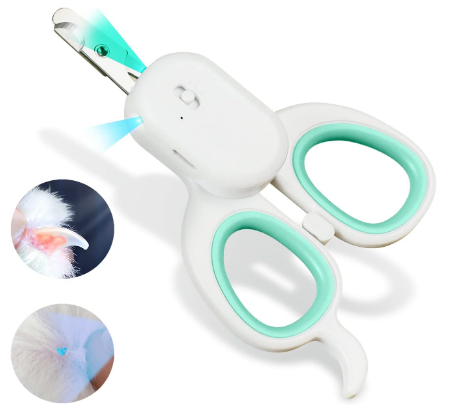
The PAKEWAY combines a manual cutting head with a rechargeable white LED. When light can pass through a pale, translucent claw, it may make the boundary between the clear tip and living tissue easier to examine. That can be genuinely useful in dim rooms or for users whose own shadow falls across the paw.[9]
Its appeal is visibility rather than automation. You still need to extend the claw gently, inspect it from the side, and decide where the nonliving hook ends. The safest default is always a conservative cut well away from the quick.
Why it stands out
Integrated white LED adds targeted light at the cutting area
Rechargeable design avoids disposable batteries
Angled cutting head may improve the working view
Useful for pale claws when ambient lighting is inadequate
What to know before buying
The light cannot reliably shine through a black, very thick, or opaque claw. Even on clear nails, treat the illuminated view as supplemental information rather than a map of exactly where to cut. Bright light can also be distracting for some cats, so switch it on during desensitization sessions before attempting a trim.
The listing also references a U-V light. We did not give that feature weight, and owners should not use it to diagnose paw conditions. A suspicious claw, lesion, odor, discharge, or painful paw needs veterinary assessment.
Recharge the clipper before a planned session and confirm that the light works, but remember that the blade performs the actual job. If the edge becomes dull or misaligned, a functioning LED does not make the tool safe to continue using.
Best for: Cats with light, translucent claws and caregivers who benefit from localized illumination.
Not ideal for: Dark-clawed cats, people who want a completely maintenance-free tool, or cats unsettled by a bright light near the paw.
Editorial take: Choose the PAKEWAY when extra light solves a real visibility problem. Do not pay for it expecting the device to detect the quick or prevent every overcut.
3. Safari Cat Deluxe Nail Trimmer — Best for Larger Hands
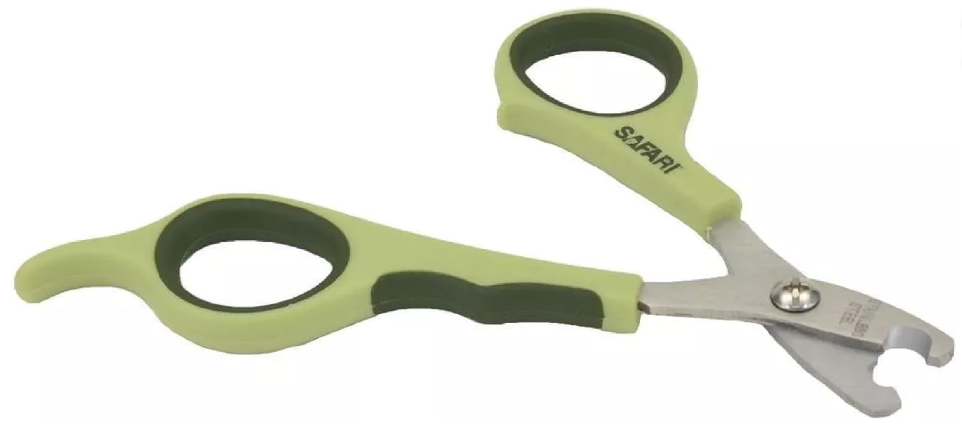
The Safari Cat Deluxe Nail Trimmer uses stainless-steel cutters in a larger, five-inch body. Coastal Pet lists an easy-grip over-molded handle, a non-slip finger rest, and a large finger opening, making this model worth considering for users who find tiny grooming scissors difficult to control.[10]
That fuller grip may reduce finger crowding and give some caregivers a more secure hold. The tradeoff is scale: a substantial handle and cutting assembly can feel less nimble beside a kitten’s tiny paw. Your own dexterity and sightline should decide whether the larger format is an advantage.
Why it stands out
Larger finger opening accommodates more hand sizes
Over-molded grip and finger rest support stable handling
Stainless-steel cutting surfaces
Manual design stays ready without charging
Established cat-specific format rather than an oversized all-purpose dog tool
What to know before buying
Some versions or listings describe a safety stop or guard. A physical stop can limit how far a claw enters the cutting area, but it cannot account for every cat’s anatomy and should never be treated as a sensor. Always look at the claw itself and cut conservatively.
Confirm that the live listing is for the cat trimmer and check its dimensions; similarly named dog models may be much larger.
Best for: Caregivers with larger hands, limited comfort with tiny finger loops, or a preference for a more substantial scissor/plier-style grip.
Not ideal for: Very small kittens, users who want the narrowest possible cutting head, or cats that react to the clip sensation.
Editorial take: The Safari is not automatically more powerful or safer than a compact clipper. Its advantage is ergonomic: if you can hold it more steadily, you may make a more controlled cut.
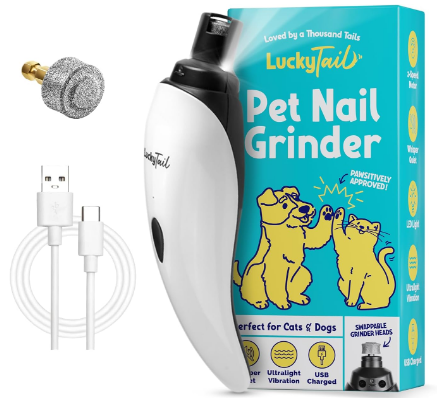
4. LuckyTail Pet Nail Grinder — Best Clipper Alternative
The LuckyTail is for cats that tolerate gradual filing better than a single clipping action. The cordless rechargeable unit offers two speed settings, two LED lights, and a protective cap with openings intended to help position different nail sizes.[11]
Grinding lets you remove very small amounts and smooth a sharp tip, which some owners find easier to control. It can also eliminate the sudden “snip” that bothers certain cats. But it replaces that brief sound with continuous motor noise, vibration transmitted through the claw, and a longer handling period. For that reason, a grinder is an alternative—not a universal upgrade.
Why it stands out
Two speeds allow a more cautious starting setting
Two LEDs illuminate the work area
Cordless, USB-rechargeable design
Protective cap helps shield the rotating surface and position the claw
Gradual removal can be useful for smoothing sharp tips
What to know before buying
LuckyTail markets the device as quiet, while retailer information has listed an approximate 30–50 dB range. Decibels do not predict feline acceptance: pitch, vibration, and prior experience also matter. Introduce the sound at a distance.
Grinding creates friction and heat. Use light pressure and brief touches, checking the nail often rather than holding it continuously against the rotating head. Keep long fur, whiskers, clothing, and your own hair away from moving parts. Stop if the claw becomes warm, the cat struggles, or you lose a clear view.
Best for: Cats already comfortable with low-level appliance sounds, caregivers who prefer incremental filing, and smoothing a freshly clipped sharp edge.
Not ideal for: Sound- or vibration-sensitive cats, impatient cats that tolerate only a few seconds of paw handling, or homes where the battery may not be kept charged.
Editorial take: The LuckyTail offers the most different experience in this roundup. It may be excellent for the right cat, but a basic sharp clipper is faster for a cat that calmly accepts a snip.
Usually slower because material is removed gradually
Sensation
Brief pressure and a sharp clipping sound
Ongoing vibration, motor noise, and friction
Precision
Excellent when making a small, visible cut
Excellent for incremental shortening and smoothing
Dark claws
Requires tiny conservative cuts
Also requires tiny conservative passes; light does not reveal every quick
Maintenance
Clean, dry, and inspect blade alignment
Charge battery and maintain the grinding head
Best match
Cats that tolerate a quick snip
Cats that accept sound and vibration better than clipping
Main risk
Cutting too far in one motion
Heat buildup or prolonged restraint
If your cat already accepts manual clipping, there is little reason to complicate the routine. A grinder becomes attractive when the clipping sensation is the specific trigger, when you want to smooth a rough tip, or when gradual removal feels more manageable. Introduce either tool as a neutral object before it ever touches a claw.
What to Look for in Cat Nail Clippers
A size designed for feline claws
Small blades improve visibility and reduce the chance of catching more nail than intended. A dog clipper is not automatically dangerous, but a large model can be awkward and imprecise on a cat. Look for a cat or small-pet designation and verify the dimensions instead of relying only on the product title.
A sharp, aligned cutting edge
Sharp blades should close smoothly and produce a clean cut without requiring a forceful squeeze. Stop using a clipper that crushes, twists, bends, or repeatedly frays the claw. Never test sharpness on your skin.
A stable grip
Choose the handle you can hold without shifting. Compact loops work well for many users, while larger openings or over-molded grips may be better for large hands, reduced finger mobility, or longer nails.
A clear sightline
Decorative housings and bulky guards are counterproductive if they block your view. You should be able to see the claw from the side and confirm that only the clear tip is entering the cutting area.
Useful—not magical—safety aids
LEDs, guards, and caps may help with positioning. None can feel the quick or adapt perfectly to every claw. Your cat’s anatomy and a conservative technique remain the real safety system.
Easy cleaning and sensible storage
Follow the manufacturer’s cleaning instructions, dry metal parts thoroughly, and store the tool where children cannot reach it. A protective sleeve or closed drawer helps prevent blade damage. Do not share a dirty tool between animals, especially when either pet has a nail or skin condition.
How to Trim Your Cat’s Nails Safely
If this is your first attempt, ask your veterinary team to demonstrate on your cat. Seeing the quick and the correct angle once is more useful than trying to learn during a struggle.
1. Prepare before bringing in your cat
Choose a quiet, well-lit room. Have the clipper, high-value treats, and styptic powder within reach. Place a nonslip towel or mat under the cat if the surface is slick. Check that the tool is clean, aligned, and functioning.
2. Position the cat without pinning them down
Work when your cat is calm and awake—not during play, immediately after a fright, or by surprising them in deep sleep. Some cats are comfortable on a lap facing away from the caregiver; others do better on a stable surface. Use the least restraint necessary. A loose towel wrap may help some cats, but forceful immobilization increases fear and injury risk.[2][6]
3. Extend one claw gently
Support the paw and apply light pressure to the toe pad and top of the toe so the claw extends. Do not squeeze hard or pull the leg away from its natural position. If your cat withdraws the paw, release rather than escalating pressure.
4. Identify the quick
On a clear claw, the quick appears as a pink central area. The sharp transparent hook beyond it is the usual trimming zone. Leave a visible margin. On a dark claw, the quick may not be visible; trim only a tiny portion of the hook and reassess. VCA recommends making multiple small cuts rather than one aggressive cut.[1]
5. Cut from top to bottom
Position scissor-style clippers so the blades cut vertically—from the top of the claw toward the bottom—rather than crushing across the sides. This orientation can reduce splintering. Remove only the sharp tip.[1]
6. Reward and stop early
Deliver a treat after one successful nail. If your cat remains relaxed, continue; if not, end the session. There is no requirement to finish all paws at once. A single calm nail today is better training than eighteen nails completed through a fight.
7. Inspect the result
Check for a clean edge, bleeding, splitting, or discomfort. Do not chase cosmetic symmetry. The objective is to remove the hook that snags or threatens to overgrow while preserving normal claw function.
A Low-Stress Training Plan
Fear-free grooming begins days or weeks before the first trim. Move to the next step only when your cat remains loose-bodied and willing to take treats.
Build a handling cue. Briefly touch a shoulder or foreleg, say a consistent word such as “paw,” reward, and release.
Touch the paw for one second. Reward before your cat pulls away. Gradually increase the duration without gripping.
Press one toe gently. Extend a claw, reward, and stop. No clipper is needed yet.
Introduce the tool visually. Place the closed clipper nearby during a positive treat session. Let the cat investigate without pushing it toward their face.
Pair the sound at a distance. Cut a dry piece of pasta away from the cat, or briefly turn on the grinder across the room, then give a treat. Skip this step if the sound creates fear and increase distance next time.
Bring the inactive tool near the paw. Touch the handle—not the blade or moving grinder—to the leg for a moment, reward, and finish.
Trim one obvious clear tip. Choose the easiest claw, make one conservative cut, reward generously, and end on success.
Increase slowly. Add another nail only when the previous session caused no avoidance or struggle.
Watch the whole cat, not just the paw. Flattened ears, tail lashing, skin twitching, freezing, growling, rapid breathing, refusal of normally valued food, or repeated attempts to leave mean the session is too difficult. Pause and make the next exposure easier.
Never punish, scruff, shout, or continue because you “only have two nails left.” Feline-friendly handling guidance favors minimal restraint, breaks, and positive reinforcement. If nail care cannot be done safely at home, a veterinarian or experienced cat-friendly groomer is the appropriate solution.[2][6]
What to Do If You Cut the Quick
Even careful caregivers can occasionally cut too far. Stay calm so your cat does not associate the event with panic.
Stop the session immediately.
Apply styptic powder with gentle pressure according to its directions.
If styptic powder is unavailable, VCA notes that flour or cornstarch may help temporarily.[1]
Keep your cat indoors and discourage intense activity while the nail settles.
Do not repeatedly wipe away a forming clot to check it.
Contact your veterinarian if bleeding does not stop promptly, is heavy, restarts, or the claw is split or damaged near its base.
Afterward, return to easy paw-touch training rather than attempting another full trim the next day. Rebuilding comfort matters more than restoring the calendar.
Common Cat Nail-Trimming Mistakes
Cutting as short as possible
Shorter is not better. Leave a generous margin before the quick and focus on removing the sharp hook.
Trusting an LED or guard instead of looking
A tool can improve visibility or limit movement, but it cannot understand every claw. Inspect from the side and cut conservatively.
Forcing all nails in one sitting
Long restraint can teach a cat that paw handling predicts entrapment. Divide the job across several calm sessions.
Using dull or damaged blades
If a clipper needs extra force or leaves ragged edges, replace it. Time alone does not determine blade condition; performance and physical inspection do.
Trimming but not providing scratchers
Clipping reduces sharpness, not the biological need to scratch. Offer stable vertical and horizontal scratchers in materials and locations your cat prefers.[5]
Surprising a sleeping cat
A relaxed moment can be useful, but secretly cutting a deeply sleeping cat’s claw risks a sudden movement and can erode trust. Let the cat notice the handling and tool.
Ignoring painful behavior
A cat that suddenly resists one paw may have arthritis, an injury, infection, or an abnormal claw. Do not assume every objection is a training problem.
Pros and Cons of Trimming Cat Nails at Home
Potential advantages
Potential limitations
Removes sharp hooks that snag fabrics
Requires the caregiver to identify a safe cutting point
Helps prevent overgrowth in cats that cannot maintain their claws
A mistake can cut the quick and cause pain or bleeding
Allows frequent paw checks
Some cats find paw handling highly stressful
May reduce accidental scratches during play
Does not stop normal scratching behavior
Can be faster and less expensive than repeated appointments
Dull or oversized tools can reduce control
Avoids travel stress for cats comfortable at home
Dark, thick, or abnormal claws can be hard to assess
Short sessions can become a positive routine
Training may take weeks rather than one session
Helps caregivers notice splits, swelling, or embedded claws early
Medical or severely overgrown claws need professional care
Who Should Trim at Home—and Who Should Get Help?
At-home trimming is a reasonable choice when the caregiver can see the nail, hold the tool steadily, and stop before the cat becomes distressed. It is especially practical for a cat conditioned to brief paw handling and for simple removal of transparent hooked tips.
Ask a veterinarian or cat-experienced groomer for help when:
You cannot identify the quick or keep your hand steady
Your cat becomes intensely fearful, aggressive, or difficult to restrain safely
A nail is embedded in or touching the paw pad
The claw is split toward the base, bleeding, infected, or unusually thick
Your cat limps, guards a paw, or suddenly resists handling
Arthritis, neurologic disease, diabetes, poor circulation, or another condition complicates foot care
Previous trimming attempts have produced escalating fear
A professional appointment is not a failure. It may be the lowest-stress and safest option for that individual cat. Your veterinary team can also show you a positioning method, recommend an appropriate schedule, or assess whether pain is driving the reaction.
Returns, Warranties, and Replacement Parts
Policies vary by brand, seller, country, and listing. Verify the order fulfiller, current return window, required return condition, and warranty before buying. For a grinder, also check whether compatible heads or caps remain available. A third-party seller may not follow the manufacturer’s direct-store policy.
Frequently Asked Questions
1. What are the best cat nail clippers for most owners?
The BOSHEL Cat Nail Clipper is our best overall pick for most indoor-cat households because it combines a compact cat-appropriate cutting head, angled semi-circular blades, and a non-slip grip without batteries or bulky features. The best option for you is still the one that fits your hand and causes the least stress for your cat.
2. How often should I trim my cat’s nails?
Inspect the paws regularly and trim according to growth and wear. VCA suggests that many indoor cats benefit from trimming about every two to four weeks, but seniors may need closer checks and active cats may need less frequent work. Front, rear, and dewclaws can grow at different rates.[1][7]
3. How can I tell where the quick is?
On a translucent claw, the quick is the pink tissue inside the nail. Trim only the clear hook and leave a margin before the pink area. If a claw is dark or opaque, remove a very small amount at a time. If you remain uncertain, have a veterinary professional demonstrate.
4. Are LED cat nail clippers safer?
An LED can improve visibility when light passes through a clear claw, but it does not detect the quick and may provide little help on dark or thick nails. LED clippers can be useful, but safe technique and conservative cuts matter more than illumination.
5. Is a nail grinder better than clippers for cats?
It depends on the cat. A grinder allows gradual removal and smoothing but produces ongoing sound, vibration, and heat. Manual clippers are faster but make a brief snipping sound. Test and condition the chosen format slowly rather than assuming one is universally less stressful.
6. Can I use human nail clippers on my cat?
VCA notes that human nail clippers can be used, with a separate pair reserved for the cat, but many caregivers find small cat-specific scissors easier to position and control.[1] Whatever the tool, it must be sharp, clean, and used in an orientation that avoids crushing the claw.
7. Can I use dog nail clippers on a cat?
A small tool designed for both cats and small pets may work, but large dog clippers can block the sightline and make precise placement difficult. Verify the dimensions and choose the smallest format you can control comfortably.
8. Does trimming stop cats from scratching furniture?
No. It can blunt the sharp tips and reduce immediate fabric damage, but scratching serves physical and communication needs. Provide stable scratchers in preferred materials and positions, protect vulnerable furniture during training, and reward use of appropriate surfaces.[5]
9. What should I do if my cat refuses nail trimming?
Stop before the interaction becomes a fight. Return to brief paw touches paired with treats, then reintroduce the inactive tool and progress one nail at a time. If fear remains intense, or if resistance is sudden or limited to one paw, consult a veterinarian or cat-friendly groomer.[2][6]
10. When should a claw problem be seen by a veterinarian?
Seek veterinary help for a claw embedded in the pad, persistent bleeding, swelling, discharge, odor, limping, a split extending toward the base, sudden pain, or repeated abnormal growth. Older cats with thick or overgrown claws may also need an examination and a tailored maintenance plan.
Final Verdict: Which Cat Nail Clipper Should You Buy in 2026?
For most cat parents, the BOSHEL Cat Nail Clipper offers the strongest balance of visibility, control, and simplicity. Its compact angled blades are well suited to small feline claws, and the manual design makes it easy to keep ready for brief, low-pressure sessions.
Choose the PAKEWAY LED Pet Nail Clipper if added light helps you examine pale, translucent claws. Select the Safari Cat Deluxe Nail Trimmer if larger finger openings and a fuller grip make your hand steadier. Consider the LuckyTail Pet Nail Grinder only if your cat accepts motor sound and vibration better than a quick clipping action.
Whichever tool you buy, the real formula for stress-free grooming is the same: condition paw handling gradually, work in good light, remove only the clear hooked tip, reward generously, and stop early. A well-tolerated one-nail session is more successful than a forced full manicure.
Source review note: Veterinary and product sources were reviewed on August 24, 2026. Manufacturer specifications, marketplace sellers, availability, and return terms may change after publication. This article is educational and does not replace individualized veterinary advice.
Cat Hygiene 101: The Complete Guide to Keeping Your Cat Clean and Healthy By Demosthenes Staudinger | Updated August 24, […]
Manage Consent
To provide the best experiences, we use technologies like cookies to store and/or access device information. Consenting to these technologies will allow us to process data such as browsing behavior or unique IDs on this site. Not consenting or withdrawing consent, may adversely affect certain features and functions.
Functional
Always active
The technical storage or access is strictly necessary for the legitimate purpose of enabling the use of a specific service explicitly requested by the subscriber or user, or for the sole purpose of carrying out the transmission of a communication over an electronic communications network.
Preferences
The technical storage or access is necessary for the legitimate purpose of storing preferences that are not requested by the subscriber or user.
Statistics
The technical storage or access that is used exclusively for statistical purposes.The technical storage or access that is used exclusively for anonymous statistical purposes. Without a subpoena, voluntary compliance on the part of your Internet Service Provider, or additional records from a third party, information stored or retrieved for this purpose alone cannot usually be used to identify you.
Marketing
The technical storage or access is required to create user profiles to send advertising, or to track the user on a website or across several websites for similar marketing purposes.