Neakasa Review (2026): Are Its Cat Products Worth It?
By Demosthenes Staudinger | Updated September 4, 2026
Automating an unpleasant cat-care chore sounds wonderful—until the machine is too small for your cat, the app adds little value, or your feline refuses to go near it. That tension sits at the center of this Neakasa review.
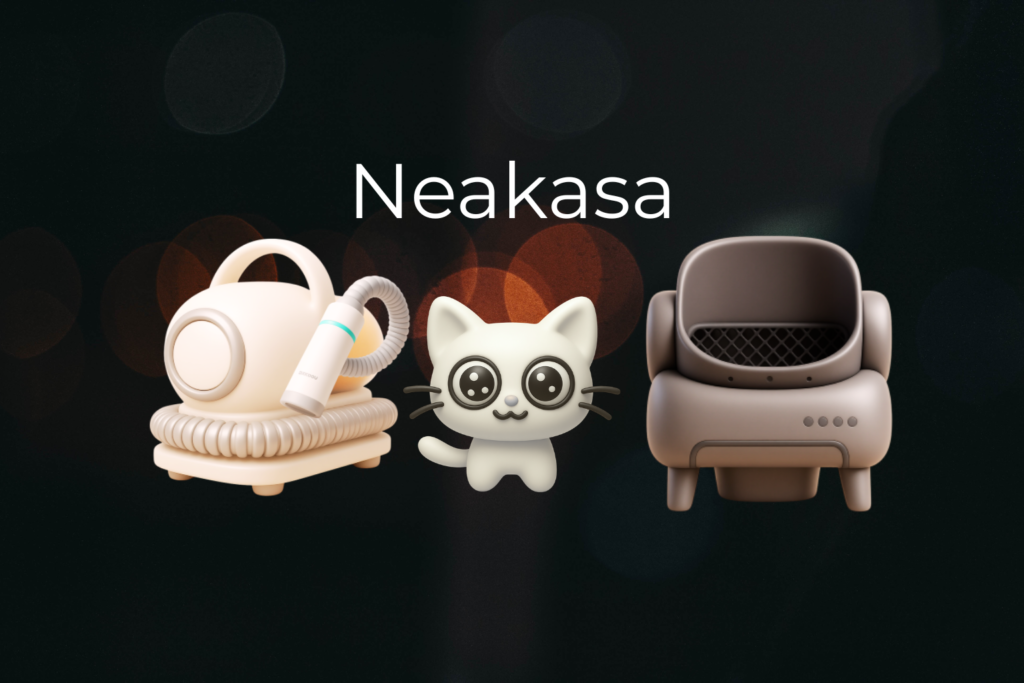
Neakasa began as the smart-cleaning brand Neabot and later expanded into pet products. Its identity still reflects those roots: the company concentrates on containing litter, loose fur, and everyday messes.
The M1 Plus open-top self-cleaning litter box is its most distinctive cat product. The M1 Lite Plus uses the same core technology in a leaner bundle, while the P2 Pro and P1 Pro combine grooming attachments with vacuum collection. The new Riko feeder moves Neakasa beyond cleaning equipment.
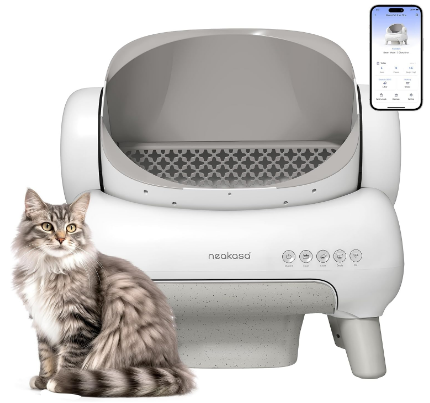
The strongest idea in the catalog is not the app. It is the M1’s open, unobstructed litter bed, which may suit large cats and cats that resist enclosed rotating globes. Its unusually broad manufacturer-recommended weight range also gives it an advantage over some automatic alternatives.
There are compromises. M1 has a high entrance, requires compatible clumping litter, still needs inspection and deep cleaning, and cannot guarantee acceptance. Grooming vacuums remain noisy from a cat’s perspective, and Riko was still a preorder product when this review was updated.
Our preliminary answer is therefore conditional: Neakasa is worth considering primarily for the M1 line. The grooming systems make sense only for cats already comfortable with brushing and motor noise, while Riko is better treated as a product to watch than a proven purchase.
How we reviewed Neakasa: This is a research-based editorial review, not a hands-on test. We evaluated current manufacturer specifications, manuals and policies, product positioning, practical ownership requirements, competing designs, and veterinary guidance relevant to litter boxes, urinary warning signs, grooming, and food safety. Modern Cat Society has not yet purchased or field-tested these products. Manufacturer performance claims are identified as such.
Affiliate disclosure: This article contains affiliate links. As an Amazon Associate I earn from qualifying purchases. If you buy through one of these links, we may earn a commission at no additional cost to you. This does not affect our editorial recommendations.
Quick Verdict
Editorial verdict: Neakasa’s M1 Plus is a compelling open-top alternative to an enclosed automatic litter box, especially for larger cats, but the brand’s other cat products are more situational.
Best for: Owners who want automated scooping without enclosing the cat inside a globe, have room for a substantial appliance, and can supervise a gradual transition.
Skip it if: Your cat needs a low-entry box, uses pellets or non-clumping litter, is frightened by moving equipment, or your priority is the longest trial period rather than an open-top design.
| Specification | Current finding |
|---|---|
| Brand focus | Automated home and pet-cleaning products |
| Best Neakasa cat product | M1 Plus open-top self-cleaning litter box |
| Value alternative | M1 Lite Plus; same core motor, sensors, sealing, and cleaning logic |
| M1 cat weight guidance | Approximately 2.2 to 33 lb; automatic cleaning should not be used below 2.2 lb |
| M1 entrance height | 13.86 in |
| M1 capacities | 11.23 L waste bin; 7.17 L litter bed |
| Compatible litter | Fast-clumping, scoopable granular litter within the stated particle limits |
| Connected features | Android and iOS app for controls, litter status, and usage trends |
| Grooming options | P2 Pro for a larger 2 L bin; P1 Pro for a smaller 1 L system |
| New 2026 product | Riko feeder for grinding and rehydrating compatible freeze-dried food |
| Required subscription | None disclosed for the core M1 app features at the time of review |
| Recurring costs | Litter, waste liners, filters, grooming filters, and product-specific cleaning supplies |
| Direct-store returns | Eligible direct purchases within 30 days; conditions and shipping costs apply |
| Warranty | One year standard; selected 2026 purchases, including M1 Plus, M1 Lite, P1, and P2, receive two years |
| Review status | Research-based; not personally field-tested by Modern Cat Society |
| Main limitation | The technology reduces routine labor but does not replace daily observation or a cat-appropriate backup plan |
What Is Neakasa?
Neakasa is the current name of a company that began as Neabot in 2017. According to the brand, it expanded from smart home-cleaning equipment into separate home and pet-care lines, with an emphasis on automated cleaning and contemporary industrial design. Existing Neabot accounts and support obligations were carried into the Neakasa identity.[1]
For cat owners, the relevant catalog falls into four groups:
- Automatic litter care: M1 Plus and M1 Lite Plus.
- Vacuum-assisted grooming: P1 Pro, P2 Pro, and the more elaborate S1 Pro, plus regional or newer variants.
- Litter-area accessories: steps, ramps, liners, filters, fences, and the powered AirStep.
- Automated feeding: the new Riko system, designed around rehydrated freeze-dried meals.
Neakasa is therefore a specialized appliance brand, not a seamless cat-tech ecosystem. The M1 app does not connect its grooming vacuums or create a unified health dashboard. Each product must earn its place independently, and the M1 Plus has the broadest case.
How Do Neakasa Products Work?
The M1 uses a rotating, open-top litter chamber. After the cat leaves and the selected delay elapses, clean litter passes through a screen while clumps move into the lower waste compartment. The chamber then returns to position. Six arrays of sweeping infrared sensors are designed to pause controlled rotation around a detected cat.[2]
With Pull & Wrap, the owner still opens the drawer, positions and closes the liner, discards it, and advances a clean section. The benefit is reduced contact, not maintenance-free ownership.
The app can report visits, weight-related trends, litter level, and device status, while also providing operating controls. Those records can help an attentive owner notice a change from an individual cat’s baseline. They are not a urine test, diagnostic instrument, or substitute for observing what is actually in the waste drawer.
With the P-series, a brush, rake, clipper, or cleaning head connects to a hose, and suction pulls loosened hair into a collection cup. The owner still performs the grooming; the vacuum cannot judge skin condition or make an anxious cat comfortable.
Riko is more unusual. It stores dry freeze-dried pieces and water separately, grinds a measured portion, adds a selected amount of room-temperature water, allows the mixture to hydrate, and presents it in a bowl. It does not refrigerate opened cans or pouches. That single distinction determines whether the feeder fits a household at all.
Neakasa Product Lineup at a Glance
| Product | Best use | Why it stands out | Main reason to hesitate |
|---|---|---|---|
| M1 Plus | Best Neakasa product overall | Open-top automatic litter bed and complete accessory bundle | High entry and substantial footprint |
| M1 Lite Plus | Best M1 value | Same core technology as M1 Plus | Fewer included liners and no mat in the standard bundle |
| P2 Pro | Heavy shedding or multiple brushable pets | 2 L collection cup and five-tool kit | Motor noise and cat tolerance determine success |
| P1 Pro | Smaller grooming sessions | More compact 1 L unit | More frequent emptying and a narrower value advantage |
| S1 Pro | Owners needing extra trimming attachments | Broader seven-tool kit | More equipment than most cat-only homes need |
| Riko | Established users of complete freeze-dried diets | Mixes food and water at serving time | New, specialized, and not a canned-wet-food feeder |
| AirStep | Optional litter-area odor and tracking support | Step, carbon filter, and fan in one accessory | Requires power and replacement filters.[2] |
Neakasa M1 Plus Performance
The M1 Plus is the reason to pay attention to Neakasa. Most competing automatic boxes rotate waste inside a partially enclosed globe. Neakasa leaves the top of the litter bed open, so a cat can see the room, turn without a ceiling overhead, and exit in more than one direction.
That does not mean every cat prefers it. Veterinary guidance emphasizes individual preference: size, location, litter, cleanliness, and open-versus-covered design can all affect acceptance.[10] M1’s defensible advantage is offering automation that feels less enclosed than a globe.
Size and access
Neakasa recommends M1 Plus for cats from approximately 2.2 to 33 lb and specifically positions the open chamber for large breeds. Its 13.86-inch entrance is the counterweight to that generous interior: a healthy adult may step or jump in easily, while a kitten, senior, short-legged cat, or cat with arthritis may need the optional ramp—or a different box altogether.[2]
Do not buy from the weight number alone. Consider toileting posture and mobility, verify the floor location, and leave clearance for the drawer and washable parts.
Cleaning and odor control
The 11.23 L waste compartment is large, and Neakasa markets it as capable of holding up to 14 days of waste under favorable conditions. Treat that as a capacity claim, not a universal emptying schedule. The real interval changes with the number and size of cats, diet, stool volume, litter performance, room temperature, and how carefully the drawer is sealed.[2]
The sealed lower drawer helps contain odor, but no automatic box makes waste or soiled plastic odorless. Check it daily, empty before it is compressed full, wipe contaminated edges, and deep-clean routinely.
M1 accepts fast-clumping, scoopable litter whose particles fit its screen—up to 3 mm in diameter and 10 mm long, according to Neakasa. Wood pellets, newspaper products, non-clumping litter, and loose clumps are excluded. This compatibility rule can eliminate the M1 immediately for cats whose medical or behavioral plan depends on another substrate.[2]
Safety system and kitten mode
The M1 Plus currently uses six sweeping infrared sensor arrays and controlled rotation intended to pause around a detected cat. Multiple detection methods are reassuring, but no consumer machine should be described as risk-free. Keep sensors clean, place the unit on a firm level floor, use the correct power adapter, install firmware updates, and investigate any unusual movement or error before restoring automatic cycles.[2]
For cats below 2.2 lb, Neakasa instructs owners to enable Kitten Mode, which prevents automatic cleaning. In practical terms, that means the unit becomes a manually operated litter box until the kitten reaches the stated threshold. Never improvise around the minimum weight guidance.
App and health trends
Usage records are most helpful when they reveal a pattern: a cat who usually visits four times daily suddenly enters repeatedly, stops appearing, or shows a sustained weight change. They are less dependable in a multi-cat household when animals have similar weights or enter close together. Use the data as a prompt to look more closely, not as a diagnosis.
The most important information may still be physical: the size of urine clumps, diarrhea, blood, straining, vocalization, or little to no urine. An automatic cycle can hide those clues sooner than a hand-scooped box, so owners must deliberately inspect the drawer and occasionally observe a visit.
M1 Plus vs. M1 Lite Plus
The naming makes these boxes sound more different than they currently are. Neakasa’s June 2026 comparison states that M1 Plus and M1 Lite Plus use identical core technology, including the motor, sensors, sealing, and cleaning logic. The practical differences are color and package contents.[3]
| Feature | M1 Plus | M1 Lite Plus |
|---|---|---|
| Core cleaning system | Same current platform | Same current platform |
| Safety sensors | Six-array current design | Six-array current design |
| Recommended cat weight | Approximately 2.2–33 lb | Approximately 2.2–33 lb |
| Waste and litter capacity | 11.2 L / 7.17 L | 11.2 L / 7.17 L |
| Standard color | Charcoal gray | White |
| Included waste bags | Two rolls, 30 bags | One roll, 15 bags |
| Anti-tracking mat | Included in stated standard bundle | Not included in stated standard bundle |
| Best buyer | Wants the complete package | Already owns a suitable mat or wants the lower-cost configuration |
Choose M1 Plus when the price difference is modest enough that you would otherwise buy the mat and extra liners separately, or when charcoal better suits the room. Choose M1 Lite Plus when it is meaningfully less expensive and you care only about the machine. Do not pay more expecting better cleaning performance from M1 Plus; Neakasa itself says the underlying platform is the same.[3]
Bundles and retailer listings can change, so compare the exact contents at checkout. “M1,” “M1 Plus,” “M1 Lite,” and “M1 Lite Plus” are easy to confuse, and an older listing may not match the current comparison.
Neakasa Grooming Vacuums
Neakasa’s grooming systems make the most sense for a cat who already accepts brushing. Suction captures loosened coat as you work, reducing airborne tufts and the pile left on the floor. It does not remove the need for gentle handling, coat-appropriate tools, or professional help with severe mats.
P2 Pro: the practical grooming pick
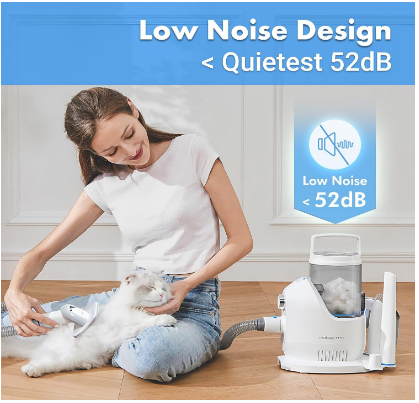
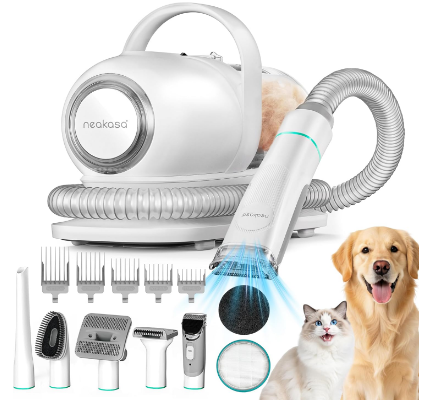
The P2 Pro is our most sensible Neakasa grooming choice for heavy shedding. It has a 2 L collection cup, five main tools, a 59-inch hose, and a stated operating range of 52–60 dBA. Neakasa says its system captures up to 99% of loosened pet hair and filters fine particles; those are manufacturer performance claims, not results verified by Modern Cat Society.[4]
The larger cup matters more than a headline suction number. Neakasa’s marketing and technical fields do not always use comparable units. Tool gentleness, hose reach, filter care, and the cat’s response to the motor are better criteria.
Introduce the machine across the room, reward calm behavior, use the brush with the motor off, and add the lowest suction only when the cat is comfortable. Stop if the cat crouches, freezes, flattens the ears, lashes the tail, swats, or flees.
P1 Pro: smaller, but not automatically better value
The P1 Pro is a more compact five-tool alternative with a 1 L bin. Neakasa lists 9,000 Pa in its feature copy, a 52–75 dB operating range in the specification table, and the same general combination of grooming, rake, clipper, and household-cleaning heads.[5]
It can suit short sessions in a small home, but a small price gap favors P2 Pro’s larger bin and narrower stated noise range. Neither suits a cat that dislikes brushing or vacuums. S1 Pro adds trimming tools that most cat-only homes do not need for shedding control.
Avoid using powered clippers or bladed dematting attachments casually. Cat skin is thin and mobile, and tight mats can sit close to it. Painful, extensive, or skin-adhered matting belongs with a veterinarian or experienced feline groomer.
Neakasa Riko: Interesting, but Not Yet a Proven Pick
Riko does not keep canned food refrigerated. It stores compatible freeze-dried food dry, grinds a portion, sprays room-temperature water, allows it to soak, and serves the rehydrated mixture.[6]
The concept may suit a household already using a compatible freeze-dried formula. Neakasa lists a 3 L food bin, 2.4 L water tank, adjustable water-to-food ratios from 1:1 to 5:1, 2.4 GHz Wi-Fi, app scheduling, 20-plus daily meals, and up to seven days from the optional battery. These are manufacturer specifications, not long-term field results.[6]
Its limitations are equally important:
- The cat must accept the texture, smell, and temperature of rehydrated freeze-dried food.
- The selected food should be labeled complete and balanced for the cat’s life stage if it will provide the primary diet; treats are not a complete meal.
- Pieces must fit the manufacturer’s compatibility limits.
- Mixed food left in the bowl remains perishable and should not sit indefinitely.
- Bowls and food-contact parts require regular washing even when the feeder is automated.
- The system adds a grinder, water pathway, seals, desiccant, app, and optional battery—more components that can require cleaning or troubleshooting.
Some freeze-dried diets contain uncooked animal ingredients. Freeze-drying does not automatically make a raw product sterile, and the FDA advises that raw pet food can expose pets and people to pathogens such as Salmonella and Listeria. Check the food’s processing instructions, wash hands, clean food-contact surfaces, and ask your veterinarian whether the diet is appropriate for your cat and household.[12]
Our Riko verdict is wait and verify. Preorder specifications cannot establish reliability, cleaning burden, or long-term acceptance. Owners of canned or pouched wet food need a feeder designed to keep prepared food at a safe temperature.
Health and Safety: What Smart Products Can and Cannot Tell You
A self-cleaning litter box can improve consistency, but it creates a paradox: the faster waste disappears, the easier it is to miss a medical clue. Make a daily habit of checking the drawer, app record, litter level, and surrounding floor. Note sustained changes rather than obsessing over one imperfect measurement.
Seek prompt veterinary advice for new house-soiling, blood, repeated trips, pain, or a major change in urine or stool. A cat—especially a male cat—straining while producing little or no urine may have a urethral obstruction. Cornell describes obstruction as an absolute emergency requiring immediate veterinary treatment.[11]
Do not let an app notification reassure you when the cat looks unwell. Conversely, a strange weight entry is not proof of disease; two cats may confuse identification, litter on the platform can affect readings, and normal day-to-day fluctuation occurs. Bring the trend and your observations to the veterinarian.
The same principle applies to grooming. Capturing loose fur may reduce mess and the amount swallowed during self-grooming, but a vacuum does not treat allergies, parasites, pain, overgrooming, skin disease, or recurrent hairballs. Sudden coat changes, bald areas, sores, or resistance to previously tolerated brushing deserve clinical attention.
Finally, automation does not justify leaving a cat without human care for days. A full drawer, stuck clump, power outage, contaminated feeder bowl, vomiting episode, or urinary emergency still requires a person. Arrange daily in-person care whenever you travel.
Physical Fit, Routine, and Cat Adoption
The best automatic box is the one a cat reliably uses. Before ordering M1, mark its intended location with painter’s tape, confirm the entry route, and check access to a grounded outlet and stable Wi-Fi. Keep it away from loud appliances, dead ends, food, and water. Do not position it where another cat can block the approach.
AAHA/AAFP guidance recommends boxes in separate, quiet, accessible locations and uses one box per cat plus one additional box as a rule of thumb. It also notes that many manufactured boxes are smaller than the suggested length of approximately one and a half times the cat from nose to tail tip.[10] One premium robot in a hallway does not automatically satisfy a multi-cat home’s resource needs.
Transition slowly:
- Place the unplugged M1 near the familiar box with the cat’s usual compatible litter.
- Let the cat investigate without being placed inside or forced toward it.
- Add a small amount of used, clean-looking litter to carry a familiar scent.
- Scoop manually while the cat establishes consistent use.
- Run a cycle only when the cat is elsewhere, then introduce movement at a distance.
- Enable automatic operation after the cat remains comfortable.
- Keep the old box available until use is reliable—and retain an accessible backup when practical.
For a grooming vacuum, apply the same desensitization logic in shorter sessions. Reward looking at the device, then accepting the unpowered brush, then hearing the motor from a distance. Progress is measured by relaxed body language, not by how quickly the owner reaches full suction.
Return Policy and Warranty
Neakasa’s direct-store policy allows eligible products purchased from neakasa.com to be returned within 30 days of receipt. The item must be clean, functional, undamaged, and complete with accessories, manuals, and packaging. For preference-based returns, the customer generally pays return shipping; Neakasa covers shipping for verified quality issues. Purchases from another retailer follow that retailer’s return process.[7]
The standard warranty is one year, but Neakasa extended selected products purchased on or after January 1, 2026 to two years. The eligible list includes M1, M1 Lite, M1 Plus, Magic 1, P0, P1, and P2. Proof of purchase and an authorized channel matter, normal wear and consumables are excluded, and a replacement does not restart the original warranty period.[8]
Riko’s product page separately states a one-year warranty. Before buying any model, save the dated receipt, confirm the seller is authorized, photograph the serial number, and read the policy that applies to the exact retailer and country. For a litter box, a long, low-risk home trial can be more valuable than a small difference in bundled accessories because feline acceptance cannot be guaranteed from specifications.
Neakasa vs. the Main Alternatives
M1 Plus vs. Litter-Robot 4
The most useful premium comparison is not “which robot is universally best?” It is open bed versus enclosed globe.
| Decision factor | Neakasa M1 Plus | Litter-Robot 4 |
|---|---|---|
| Cat area | Open-top litter chamber | Enclosed globe with front opening |
| Manufacturer weight guidance | Approximately 2.2–33 lb | Approximately 3–25 lb |
| Entry consideration | High, open edge; ramp optional | Front opening; step/ramp accessories available |
| Waste capacity claim | 11.23 L; interval varies | Large lower drawer; interval varies |
| App | Usage, weight-related trends, litter status, controls | Usage, weight, drawer level, controls, ecosystem integrations |
| Included warranty | Two years for eligible 2026 M1 Plus purchases | One year standard |
| Direct trial/return window | 30-day eligible return policy | 90-day in-home trial stated by Whisker |
| Best reason to choose | Cat resists enclosed globes or needs more open headroom | Buyer prioritizes the longer trial and established accessory ecosystem |
Whisker currently lists Litter-Robot 4 at 29.5 inches tall with a 22-by-27-inch footprint, 24-pound empty weight, 90-day trial, and one-year warranty.[9] Neakasa’s stronger differentiator is openness, not that it wins every specification. If you are unsure whether a cat will tolerate automation at all, Whisker’s longer direct trial may outweigh the M1 design advantage.
Read more: Litter-Robot 4 Review 2026: Is It Still Worth It?
M1 Plus vs. a large manual litter box
A plain, oversized open box remains the lower-cost and mechanically simplest alternative. It accepts a wider range of substrates, makes urine and stool easy to inspect, has no sensors or firmware, and can offer a lower entrance. Its disadvantages are daily scooping, exposed waste between cleanings, and no automatic visit log.
Choose manual when the cat’s accessibility, litter preference, medical monitoring, or fear of movement comes first. Choose M1 when the cat accepts its height and substrate, the household will maintain it properly, and automated scooping solves a recurring labor problem. “Traditional” is not synonymous with inferior.
Grooming vacuum vs. an ordinary brush
An ordinary cat-appropriate brush is quieter, cheaper, easier to sanitize, and more portable. A Neakasa grooming vacuum earns its footprint only when loose fur control is a major household problem and the cat calmly accepts the hose and motor. For one short-haired cat with modest shedding, the conventional brush is usually the better value.
Pros and Cons
| Pros | Cons |
|---|---|
| M1 offers a genuinely different open-top automatic format | M1’s 13.86-inch entry may be difficult for some cats |
| Broad stated cat-weight range accommodates many large adults | Automatic operation is unsuitable below the stated kitten threshold |
| M1 Plus and Lite Plus now share the same core technology | Model names and changing bundles can confuse shoppers |
| Large waste drawer can reduce daily scooping | Capacity claims do not remove the need for daily checks |
| App trends may reveal changes worth investigating | App data is not a diagnosis and can be ambiguous with similar-weight cats |
| Compatible generic clumping litter and appropriately sized bags can limit lock-in | Pellets and several non-clumping substrates are incompatible |
| Detachable litter components simplify periodic washing | Deep cleaning still takes time and cannot be automated |
| P2 Pro captures fur during active grooming | Motor noise may make the system unusable for a sensitive cat |
| P2 Pro’s 2 L cup suits heavier shedding better than P1 Pro | Marketing specifications are not always presented in directly comparable units |
| Riko presents an original approach to rehydrated meals | Riko was still a specialized preorder product at review time |
| Selected products receive a two-year warranty for eligible 2026 purchases | Direct preference returns generally require customer-paid shipping |
| No required M1 subscription was disclosed for core functions | Power, sensors, Wi-Fi, liners, filters, and moving parts add failure points |
Who Should Buy Neakasa?
Neakasa is a strong fit if:
- Your healthy adult cat dislikes enclosed litter boxes but accepts a raised open box.
- You have a large cat that needs more headroom than a globe provides.
- Daily scooping is a genuine burden, but you will still inspect waste and maintain the machine.
- Your preferred litter is a compatible fast-clumping granular formula.
- You want usage trends without paying a disclosed subscription for basic M1 features.
- Your brush-tolerant, heavy-shedding cat remains relaxed around low vacuum noise.
- You already feed an appropriate complete freeze-dried diet and are willing to evaluate Riko after independent ownership history develops.
Skip or postpone Neakasa if:
- Your cat has mobility limitations and cannot comfortably manage the M1 entrance.
- A veterinarian has recommended pellets, non-clumping litter, or a specific low-sided box.
- Your cat hides from vacuums or becomes distressed during brushing.
- You expect automation to replace a pet sitter, veterinary care, or daily observation.
- You want to load ordinary canned wet food into Riko.
- You need a risk-free trial substantially longer than the direct 30-day return window.
How to Get the Most From Neakasa Products
Measure first. Confirm the cat, entry path, appliance footprint, drawer clearance, and outlet location before purchase. A beautiful product is a poor investment if it blocks a doorway or cannot be serviced in place.
Preserve choice. Keep enough litter boxes in separate locations for the household rather than concentrating every cat around one machine. A backup also protects the routine during cleaning, outages, errors, and behavior changes.
Use compatible consumables. Choose litter that forms firm clumps within Neakasa’s particle guidance. Do not overfill. Generic liners may work when they fit correctly, but a bag that interferes with the drawer or seal defeats the convenience.
Tune the cleaning delay. A cycle that begins before the litter forms a stable clump can smear waste. Start with the litter manufacturer’s clumping time, observe the result, and adjust without allowing waste to sit unnecessarily long.
Inspect before disposal. Look at clump number and size, stool consistency, blood, and anything unusual before sealing the bag. Compare app trends with the physical evidence and the cat’s appetite, thirst, behavior, and body weight.
Clean sensors and contact areas. Follow the manual, unplug before disassembly, dry washable parts fully, and keep litter dust from building up around sensors. Never immerse the powered base or mix adapters between products.
Let the cat set the pace. For both litter automation and grooming, gradual exposure beats forced interaction. If stress persists, return to the simpler tool that the cat will actually use.
Keep receipts and packaging during the evaluation period. A clean, complete product is easier to return, and proof of purchase is essential for warranty service.
Frequently Asked Questions
Is Neakasa a legitimate company?
Yes. Neakasa is the successor brand to Neabot and sells pet and home-cleaning appliances through its own regional stores and retailers. Legitimacy does not guarantee that every product suits every cat, so verify the exact seller, warranty, return terms, and model before purchasing.[1]
Is the Neakasa M1 Plus worth it?
It can be worth it for an adult cat that accepts an open, elevated litter bed and compatible clumping litter. Its main value is automated scooping without an enclosed globe. It is less compelling for cats with mobility limitations, substrate restrictions, or strong fear of moving equipment.
What is the difference between M1 Plus and M1 Lite Plus?
Their current motor, sensors, sealing, cleaning logic, capacities, and recommended cat-weight range are the same. M1 Plus is charcoal and includes more liners plus an anti-tracking mat; Lite Plus is white and has a leaner standard bundle. Compare current retailer contents before checkout.[3]
Can a Maine Coon use the Neakasa M1 Plus?
Possibly. Neakasa recommends the M1 line for cats up to approximately 33 lb and markets the open top for large breeds. Weight alone cannot establish fit, so evaluate body length, turning posture, entrance comfort, and the individual cat’s litter-box preference.[2]
Can kittens use M1 Plus?
Kittens below 2.2 lb should not use automatic cleaning. Neakasa’s Kitten Mode disables those cycles, meaning the owner must clean manually. Even above the threshold, supervise adoption and retain a low, accessible kitten box until use is dependable.[2]
Does M1 Plus require special Neakasa litter or bags?
It does not require Neakasa-branded litter. It does require fast-clumping, scoopable granules that fit the screen; pellets, newspaper, non-clumping, and loose-clumping products are excluded. Neakasa says any waste bag that fits the drawer can be used, provided it does not obstruct operation.[2]
How often does the M1 Plus waste drawer need emptying?
There is no universal interval. Neakasa advertises up to 14 days under favorable conditions, but multiple cats, larger output, warm rooms, diet, and odor tolerance can shorten that substantially. Check daily and empty before the drawer is tightly packed or malodorous.[2]
Can the Neakasa app diagnose urinary disease?
No. It can organize device and visit trends that may prompt closer observation. Straining, repeated attempts, blood, pain, or little to no urine require veterinary attention regardless of what the app reports; inability to pass urine is an emergency.[11]
Is P2 Pro better than P1 Pro for cats?
P2 Pro is the better default for heavy shedding because its 2 L cup holds twice the P1 Pro’s stated 1 L capacity and its published noise range is narrower. P1 Pro is smaller. The best choice may still be neither if the cat dislikes motor noise or prolonged brushing.[4][5]
Does a Neakasa grooming vacuum prevent hairballs?
No product can promise that. Removing loose coat may reduce the fur available to swallow, but recurrent retching, vomiting, constipation, appetite change, or suspected obstruction requires veterinary evaluation. Grooming vacuums also do not treat the medical causes of excessive shedding or overgrooming.
Can Riko hold canned or pouched wet cat food?
No. Riko is designed to store compatible freeze-dried food and water separately, then grind and rehydrate a portion at serving time. It is not a refrigerator for prepared wet food. Test whether the cat accepts rehydrated freeze-dried texture before considering the machine.[6]
Does Neakasa offer a subscription-free experience?
Neakasa did not disclose a required subscription for core M1 app controls at the time of this review. That could change with software or future services, so confirm the current app listing and product page. Consumables and optional accessories remain recurring costs even without a digital subscription.
Final Verdict
Neakasa is not equally persuasive across its entire catalog. The M1 Plus and M1 Lite Plus are the standouts because they solve a real gap in automatic litter care: they automate scooping while leaving the cat’s upper body unenclosed. For a large adult cat or a cat that refuses a globe, that geometry may be more important than a long feature list.
Between them, buy based on bundle value and color—not expected performance. Their current core systems are the same. M1 Plus is our overall recommendation when its mat and extra liners justify the difference; M1 Lite Plus is the rational value choice when it is meaningfully cheaper.
P2 Pro is the grooming model we would shortlist for a tolerant, heavy-shedding cat, while P1 Pro is mainly a space-saving alternative. Neither deserves a purchase until the cat’s response to brushing and vacuum noise is known. Riko is the product to watch in 2026, but its specialized freeze-dried workflow and preorder status make restraint more credible than an enthusiastic endorsement.
The final answer is yes, selectively. Start with the problem, the cat’s needs, and the return risk. When those align, M1 Plus offers a clear reason to choose Neakasa over an enclosed litter robot.
Read more:
Litter-Robot 4 Review 2026: Is It Still Worth It?
PETLIBRO Review (2026): Are Its Smart Cat Products Worth It?
Sources
- <span id=”source-1″></span>Neakasa — About Us. Brand history, transition from Neabot, current product focus, and continuity of support.
- <span id=”source-2″></span>Neakasa — M1 Plus Open-Top Self-Cleaning Cat Litter Box and AirStep Cat Litter Box Step. Current M1 features, capacities, safety guidance, litter compatibility, app functions, and AirStep specifications.
- <span id=”source-3″></span>Neakasa — M1 Plus vs. M1 Lite Plus. Manufacturer comparison of shared core technology, colors, and included accessories.
- <span id=”source-4″></span>Neakasa — P2 Pro Pet Grooming Vacuum. Current tools, collection capacity, operating noise, hose, power, and manufacturer performance claims.
- <span id=”source-5″></span>Neakasa — P1 Pro Pet Grooming Vacuum. Current tools, collection capacity, dimensions, power, noise range, and manufacturer suction claim.
- <span id=”source-6″></span>Neakasa — Riko Fresh-Made Automatic Cat Feeder. Preorder status, intended food, rehydration process, capacities, scheduling, connectivity, maintenance, and warranty.
- <span id=”source-7″></span>Neakasa — Return & Refund Policy. Direct-store eligibility, 30-day window, condition requirements, exclusions, authorization process, and shipping responsibility.
- <span id=”source-8″></span>Neakasa — Warranty Policy. Standard coverage, 2026 two-year upgrade for selected products, exclusions, proof-of-purchase requirements, and replacement terms.
- <span id=”source-9″></span>Whisker — Litter-Robot 4. Current dimensions, product weight, direct trial, and included warranty used for model comparison.
- <span id=”source-10″></span>AAHA/AAFP — General Litter Box Considerations. Veterinary guidance on box number, placement, accessibility, size, litter choice, cleanliness, and open-versus-covered preference.
- <span id=”source-11″></span>Cornell Feline Health Center — Feline Lower Urinary Tract Disease. Clinical signs and emergency guidance for urethral obstruction.
- <span id=”source-12″></span>U.S. Food and Drug Administration — Raw Pet Food Diets Can Be Dangerous to You and Your Pet. Pathogen risks and handling precautions relevant when a freeze-dried product contains raw animal ingredients.
Sources and product information were checked on September 4, 2026. Specifications, bundles, software features, availability, warranty terms, and retailer policies may change after publication.