Litter-Robot 4 Review (2026): Is It Still Worth It?
By Demosthenes Staudinger | Updated September 4, 2026
The Litter-Robot 4 is no longer Whisker’s newest automatic litter box. That matters because shoppers in 2026 can also choose the smaller Litter-Robot EVO, the roomier Litter-Robot 5, or the camera-equipped Litter-Robot 5 Pro.
Yet newer does not automatically mean better for every home. The Litter-Robot 4 remains the established middle option: it automatically separates clumps from clean litter, deposits waste in a sealed drawer, monitors litter and waste levels, and connects to the Whisker app.
Its greatest advantage is still practical rather than futuristic. It can remove the repetitive job of daily scooping while offering a cleaner litter bed after each successful cycle. For one to four compatible cats, that can make the household routine substantially easier.
Its greatest limitation is equally practical. This is a large, expensive appliance that does not eliminate litter-box work. Owners must still empty the drawer, replenish litter, inspect waste, clean the globe and sensors, troubleshoot interruptions, and keep an appropriate alternative available.
The app also deserves nuance. Useful functions are available without a subscription, including weight-based identification, visit and cycle trends, device status, and basic duration information. Some deeper history and pattern features, however, sit behind the optional Whisker+ service.
So, is the Litter-Robot 4 worth it in 2026? Yes—for the right cats, home, and budget. It is harder to justify if you need the LR5’s larger capacity, the EVO’s smaller footprint, a fully open box, or a genuinely low-cost solution.
How we reviewed Litter-Robot 4: This is a research-based editorial review, not a hands-on test. We evaluated current manufacturer specifications, support documentation, warranty and return terms, model comparisons, and feline litter-box guidance from veterinary sources. Modern Cat Society has not yet purchased or field-tested this product. Manufacturer performance claims are identified as such, and real-world results can vary by cat, litter, placement, maintenance, and household routine.
Affiliate disclosure: This article contains affiliate links. As an Amazon Associate I earn from qualifying purchases. If you buy through one of these links, we may earn a commission at no additional cost to you. This does not affect our editorial recommendations.
Quick Verdict
Editorial verdict: The Litter-Robot 4 is still a compelling, mature automatic litter box, but its value now depends on how its size, app limits, and four-cat capacity compare with Whisker’s newer models.
Best for: One- to four-cat households that use compatible clumping litter, have room for a 22-by-27-inch footprint, and value reliable automatic sifting more than the newest monitoring hardware.
Skip it if: Your cat rejects enclosed spaces, weighs more than 25 pounds, needs a low-entry open box, or your budget cannot comfortably absorb the robot, accessories, filters, litter, and possible out-of-warranty repairs.
| Specification | Litter-Robot 4 |
|---|---|
| Cleaning method | Rotating globe sifts clumps into a sealed waste drawer |
| Recommended cat weight | 3–25 lb for automatic operation and intended fit |
| Household capacity | Manufacturer positions it for up to four cats |
| Exterior dimensions | 29.5 in high; 22 × 27 in footprint |
| Entry opening | 15.75 × 15.75 in |
| Empty unit weight | 24 lb |
| Compatible litter | Most firm-clumping, scoopable litter; small crystals that pass through the screen may work |
| Connectivity | Whisker app; 2.4 GHz Wi-Fi required for connected features |
| Core monitoring | Weight-based identification, weight and visit trends, cycle history, litter and waste levels |
| Safety system | Curtain lasers, weight sensing, and anti-obstruction detection |
| Standard coverage | 90-day in-home trial and one-year warranty under Whisker’s current terms |
| Best differentiator in 2026 | Established design with litter/waste sensing and optional LitterHopper compatibility |
What Is the Litter-Robot 4?
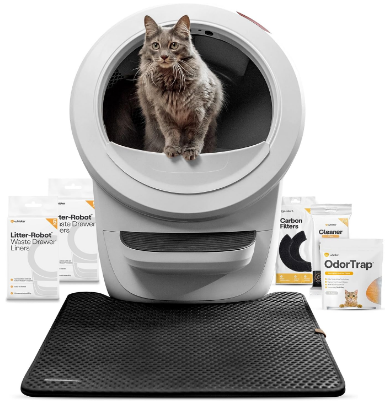
The Litter-Robot 4 is an enclosed, Wi-Fi-connected automatic litter box from Whisker. After a cat leaves, its globe rotates: clean litter passes through a screen, clumps fall into a lined drawer, and the globe returns with a refreshed litter bed.
It automates separation, not sanitation. The standard unit does not wash itself, refill litter, bag the drawer, or remove waste from the home. Owners still need to inspect, empty, replenish, and clean it.
Whisker positions the LR4 for cats from 3 to 25 pounds and households with up to four cats. It is 29.5 inches high, has a 22-by-27-inch footprint and 15.75-inch-square entry, and weighs 24 pounds empty.[1] Measure the installation area, drawer clearance, route to the opening, outlet location, and cleaning access before buying.
The feature set includes SafeCat with OmniSense detection, QuietSift, an LED panel, litter- and waste-level sensors, and the Whisker app. Optional accessories include the LitterHopper, ramp, carpet tray, mat, filters, and odor packs. The buying question is whether that combination solves your routine better than a large manual box or another robot.
How Does the Litter-Robot 4 Work?
The operating sequence is straightforward:
- A compatible cat enters the globe and uses the litter bed.
- The unit’s sensors detect the visit and wait until the cat has exited.
- A user-selected delay allows urine clumps to firm before the cycle begins.
- The globe rotates, passing clean litter through an internal screen.
- Clumps and solid waste drop through an opening into the drawer below.
- The globe rotates back and redistributes the retained litter.
- The app records the event and updates device information when connectivity is available.
The delay affects results: a cycle that starts before clumps firm can cause smearing or fragmentation. The adjustable 3-to-30-minute range lets owners balance clumping performance, odor exposure, and a cautious cat’s tolerance.[1]
Whisker says curtain lasers, weight sensors, and anti-obstruction detection prevent cycling while a cat is inside.[1] That layered design still requires correct installation and clean sensors. Investigate repeated stops or alerts; excess litter, an uneven floor, a full drawer, misplaced components, dust, or an obstruction can interrupt operation.[5][6]
What the Litter-Robot 4 Still Does Very Well
It removes the most repetitive part of litter-box care
The LR4 sifts after detected use, so clumps do not remain exposed until the next manual scooping session. This is particularly useful in multi-cat homes. Whisker says one cat may go up to eight days before the drawer needs emptying, but waste volume, litter, humidity, and drawer distribution can shorten that interval substantially.[1]
Odor is contained more effectively than in an open waste bed
Clumps collect in a closed, carbon-filtered drawer rather than on the active litter bed. That can reduce odor compared with an open box that is not scooped promptly. It cannot eliminate smell: litter quality, waste consistency, liner fit, drawer frequency, cleaning, filters, and ventilation all matter.
The cycle is designed to be relatively unobtrusive
QuietSift reduces the disruption of repeated cycles and may help some noise-sensitive cats. The rotating globe is still audible and visible, however. Leave it off during early exploration and never demonstrate movement while a nervous cat is investigating the opening.
The free app provides genuinely useful operational information
The free Whisker app currently includes weight-based identification, trends for weight, visits, and cycles, device status, daily usage, and the previous day’s visit duration. Whisker+ adds daily recaps, time-of-day and duration trends, up to two years of history, and beta behavioral patterns.[1]
Full-drawer, low-litter, and fault alerts are more useful than novelty dashboards. Still, SmartScale can confuse similarly weighted cats or capture inconsistent positioning. The robot records interaction; it cannot confirm urine volume, stool quality, or health.
Its accessory ecosystem is more developed than many competitors’
Whisker offers a Carpet Tray, ramp, mat, LitterHopper, filters, odor packs, and camera mount. The LitterHopper is the most functional add-on because it maintains the fill level, but it still needs refilling and does not replace drawer changes, cleaning, or inspection.
Where the Litter-Robot 4 Falls Short
The total ownership cost extends beyond the robot
Budget beyond checkout. Possible costs include compatible litter, liners, filters, odor packs, a mat, ramp, carpet tray, LitterHopper, Whisker+, and extended coverage. The premium may be reasonable when daily scooping is a genuine burden, but a large manual box remains far cheaper and easier to replace.
It automates scooping—not sanitation
Residue, dust, hair, and small clumps accumulate. Whisker calls for basic globe cleaning every one to three months and deep cleaning at least every three months, adjusted for use. Never submerge, spray, or soak the powered base or control panel.[4] Heavy use or soft stool demands more spot cleaning, and washing this appliance is more involved than cleaning a plastic pan.
The enclosed globe will not suit every cat
Some cats readily enter covered boxes; others want a clear view and escape route. AAHA/AAFP guidance says size and covered-versus-open design can matter and recommends a box about one and a half times the cat’s nose-to-tail length.[9] A long cat can fit the opening yet dislike turning inside. Consider body length, posture, mobility, and previous box preference—not weight alone.
Placement requirements can undermine the smart features
The LR4 needs stable power and a firm, level position. It can operate on carpet, but the Carpet Tray improves SmartScale accuracy.[3] Connected features require 2.4 GHz Wi-Fi; 5 GHz alone is unsupported.[3] Place it where doors, other pets, or appliance noise cannot block or intimidate the cat.
Some of the most detailed insights require Whisker+
Cleaning and core app functions do not require Whisker+. Buyers who want long-term duration trends, daily recaps, and expanded patterns should include the optional subscription in the cost. Check the free-versus-paid feature list when buying because software packaging can change faster than hardware.
SmartScale and Health Tracking: Helpful, but Not Diagnostic
Weight and visit trends can prompt useful observation, but the app cannot explain them. Multiple short visits may reflect urinary discomfort, constipation, diarrhea, stress, marking, duplicated readings, or exploration. A weight change may be real or measurement variability. Treat data as a prompt—not a diagnosis.
Continue inspecting actual waste for urine-clump changes, abnormal stool, blood, mucus, or foreign material, and watch for straining or vocalizing. Make this part of every drawer change.
Cornell lists painful or difficult urination, increased frequency, crying during urination, blood, urination outside the box, and frequent genital licking among common lower urinary tract signs. A cat repeatedly attempting to urinate while producing little or no urine may have a urethral obstruction, which is an immediate veterinary emergency.[10] No app notification should delay care when those signs are visible.
Confirm persistent weight changes with a reliable scale and discuss them with your veterinarian, especially when accompanied by appetite, thirst, energy, or digestive changes.
Safety: A Layered System Still Needs Responsible Use
Whisker says curtain lasers, weight sensors, and anti-obstruction technology delay cycling until a detected cat leaves and stop movement when an interruption is detected.[1][5][6] These layers are preferable to a simple timer, but responsible use remains essential:
- Keep the entry and sensor areas clean according to the manual.
- Maintain litter at the correct fill level; overfilling can create errors and poor sifting.
- Put the unit on a stable surface and use the recommended carpet solution when needed.
- Investigate recurring faults, unexpected movement, or inaccurate readings.
- Do not allow kittens under 3 pounds to use automatic mode.
- Power the unit off and contact support if its behavior raises a safety concern.
Whisker’s current guidance allows kittens under 3 pounds to use the globe only in a supervised semi-automatic routine: leave the unit off or unplugged, wait after use for clumps to form, run a cycle, and turn it off again.[3] A separate low-entry manual box is often simpler during this short life stage.
Do not let children or pets play with, climb on, or reach into a cycling robot. It is an electrical appliance, not a toy.
Will Your Cat Actually Use It?
Whisker states that more than 95% of cats acclimate, based on stated return reasons for Litter-Robot 3 and 4 over one year.[1] This is manufacturer-derived return data—not a controlled study or individual guarantee.
A low-pressure transition gives the cat the best chance:
- Assemble and position the LR4 near the familiar box, but leave it powered off.
- Add the cat’s usual compatible litter rather than changing box, litter texture, and location simultaneously.
- Transfer a small amount of used litter to provide a familiar scent.
- Allow voluntary investigation; do not place or trap the cat inside.
- Reward calm approaches with praise, play, or treats away from the opening.
- After the cat has used it reliably, run a cycle while the cat is elsewhere.
- Gradually introduce automatic operation with an appropriate delay.
- Keep the old box available until use is consistent.
Never make the old box dirty to force adoption. If refusal persists, reconsider the opening, step height, interior space, noise, litter, location, and social environment. Sudden avoidance after successful use may warrant a veterinary examination—not punishment.
Multi-Cat Homes: One Robot Is Not Always Enough
Whisker positions the LR4 for up to four cats, but processing capacity and feline resource needs differ. Heavy use fills the drawer faster, and social tension may make one shared entrance inappropriate.
AAHA/AAFP guidance recommends, as a rule of thumb, one litter box per cat plus one additional box, or one per known social group plus one, in separate accessible locations.[9] An automatic box does not erase that behavioral principle. One LR4 may replace substantial scooping labor, but it should not automatically become the household’s only toileting resource.
Keep an alternative during adoption, outages, cleaning, illness, and repairs. Extra boxes are particularly important when:
- one cat blocks the robot entrance;
- cats belong to different social groups;
- a timid cat waits for privacy;
- one cat needs a different litter or low entry;
- the robot sits on another floor;
- a cat develops diarrhea, urinary signs, or post-operative mobility limits.
Similar-weight cats can also reduce app identification accuracy. Household-level trends may remain useful, but owner observation is still necessary.
Litter Compatibility and Waste Performance
The LR4 works best with firm-clumping litter that passes through its screen without being excessively light, sticky, or slow-setting. Whisker accepts most clumping or scoopable litters and small crystals that fit through the screen, but excludes non-clumping, loose-clumping, newspaper, and wood-pellet formulas.[3] If a cat strongly prefers an incompatible substrate, reliable box use takes priority over the robot.
Performance clues can help diagnose a mismatch:
| Symptom | Possible cause | Practical response |
|---|---|---|
| Smears inside the globe | Cycle begins before clumps firm | Test a longer delay and a faster, firmer-clumping litter |
| Clean litter enters drawer | Granules or clumps are too large, or litter is overfilled | Confirm fill line and screen-compatible substrate |
| Clumps break apart | Weak clumping, shallow bed, or early cycle | Adjust litter and delay; maintain the correct level |
| Dust accumulates on sensors | High-dust litter or infrequent wiping | Use a lower-dust compatible litter and clean as directed |
| Waste sticks to liner | Soft stool, damp litter, or surface residue | Spot-clean promptly and investigate persistent abnormal stool |
| Strong odor remains | Drawer, filter, liner fit, globe, or room ventilation needs attention | Empty and clean; inspect seals and consumables; address the underlying waste issue |
Avoid additives unless Whisker confirms compatibility; extra dust, weight, or friction can affect sifting and sensing.
Cleaning and Maintenance: The Real Routine
Plan the maintenance before buying:
| Task | Sensible starting interval | What to check |
|---|---|---|
| Check app and control panel | Daily | Faults, drawer level, litter level, unusual visit pattern |
| Look into the globe and inspect waste | Daily | Smears, stool quality, urine-clump changes, foreign material |
| Top up compatible litter | As needed | Keep at the indicated fill line without overfilling |
| Empty waste drawer | Before it overfills | Liner position, leakage, odor, drawer cleanliness |
| Wipe entry and approved sensor areas | As needed | Dust, hair, adhered litter; follow official method |
| Basic globe cleaning | About every 1–3 months | Residue, odor, liner condition, accumulated clumps |
| Deep cleaning | At least every 3 months, adjusted for use | Globe, drawer, approved removable parts, full drying |
| Inspect filters and odor accessories | At each drawer change | Saturation, damage, replacement need |
| Review firmware and support notices | Periodically | Updates, repeated errors, changed instructions |
Several cats or recurrent soft stool can compress this schedule. Never submerge, spray, or soak the base or control panel.[4] Use compatible cleaning methods, rinse approved washable parts, and let them dry fully. Strong residual fragrances may deter some cats.
Litter-Robot 4 vs. EVO vs. Litter-Robot 5 and 5 Pro
Whisker’s expanded lineup places the LR4 between the compact entry model and maximum-capacity flagships.
| Model | Stated cat range | Stated household capacity | Footprint | Most relevant reason to choose it |
|---|---|---|---|---|
| Litter-Robot EVO | 3–19 lb | Up to 2 cats | 20.6 × 24.3 in | Smaller footprint and simpler entry into the lineup |
| Litter-Robot 4 | 3–25 lb | Up to 4 cats | 22 × 27 in | Established middle choice with litter/waste sensing and LitterHopper compatibility |
| Litter-Robot 5 | 3–30 lb | Up to 5 cats | 22 × 27 in | More interior room, larger/improved drawer, WasteID, LCD, and broader weight range |
| Litter-Robot 5 Pro | 3–30 lb | Up to 5 cats | 22 × 27 in | LR5 platform plus integrated dual-camera identification and insights |
These are manufacturer specifications, not independent capacity tests.[2]
Choose the Litter-Robot EVO if space and simplicity lead
The EVO suits one or two smaller cats and a tight floor plan. Its 19-pound stated ceiling and reduced capacity exclude some households.
Choose the Litter-Robot 4 for the established middle ground
The LR4 is attractive when it costs meaningfully less than an equivalent LR5, its size limits fit, and you value litter/waste sensing plus the mature accessory ecosystem.[2]
Choose the Litter-Robot 5 for capacity and the latest core hardware
The LR5 extends the range to 30 pounds and five cats while adding WasteID, a slightly larger interior, improved drawer, and LCD.[2] That can justify its premium for very large cats or heavy-use homes.
Choose the Litter-Robot 5 Pro only if cameras solve a real problem
The 5 Pro adds dual cameras and visual identification.[2] That can help with similarly weighted cats, but cameras are unnecessary for automatic sifting and add privacy and connectivity considerations.
Litter-Robot 4 vs. a Large Manual Litter Box
A large manual box remains the benchmark for accessibility, visibility, and value.
| Decision factor | Litter-Robot 4 | Large manual box |
|---|---|---|
| Daily scooping | Automated after detected visits | Owner scoops manually |
| Purchase cost | High | Low |
| Deep cleaning | More components and electronics | Simple pan is easy to wash |
| Power and Wi-Fi | Power required; Wi-Fi required for app features | Neither required |
| Cat access | Elevated entry and enclosed globe | Can be open, oversized, and low-entry |
| Waste visibility | Requires deliberate drawer inspection | Immediately visible while scooping |
| Failure mode | Errors can stop cycles | No mechanical failure |
| Monitoring | App trends and alerts | Direct owner observation only |
| Litter choice | Limited to screen-compatible clumping substrates | Much broader choice |
| Multi-location setup | Expensive to duplicate | Easy to provide several boxes |
If a cat needs an oversized open box, pellet litter, low entry, or several distributed resources, manual may be better. Many homes benefit from an LR4 as the high-use station plus a conventional box for choice and backup.
Return Policy and Warranty: Read Before Opening the Box
Whisker currently provides a 90-day home trial and one-year warranty. The customer pays return shipping, the unit must be clean, and a cleaning fee may apply if litter or waste remains.[7] Return logistics matter for a bulky appliance.
WhiskerCare can currently extend coverage from one to three years, subject to its full terms.[8] Bundle contents and coverage vary by seller, so verify the exact Amazon listing before checkout.
Save the order confirmation, serial number, packaging, and condition photos. Test key functions early:
- confirm stable cycling and sensor behavior;
- verify the cat enters voluntarily;
- check app onboarding and notification delivery;
- compare SmartScale readings with a known weight;
- evaluate litter performance and drawer odor;
- contact official support while the issue is reproducible if errors persist.
Amazon’s process may differ from Whisker’s direct policy. Keep the terms shown at checkout.
Pros and Cons
| Pros | Cons |
|---|---|
| Automatically sifts after detected use | High initial and lifetime ownership cost |
| Keeps clumps out of the active litter bed | Does not eliminate emptying, cleaning, or waste inspection |
| Sealed lower drawer can reduce exposed-waste odor | Enclosed globe may be rejected by cats that prefer open boxes |
| QuietSift cycle is less intrusive than many motorized systems | Large appliance still requires 22 × 27 inches plus usable clearance |
| Free app provides useful device and basic habit information | Some deeper trend features require optional Whisker+ |
| SmartScale can reveal useful weight trends | Similar-weight cats and unstable flooring can reduce identification accuracy |
| Litter and waste-level monitoring aids routine planning | Compatible litter choices are narrower than with a manual pan |
| Supports the optional LitterHopper | Useful accessories add cost and complexity |
| Mature support and accessory ecosystem | One-year standard warranty feels short for a premium appliance |
| 90-day home trial reduces—but does not remove—adoption risk | Buyer pays return shipping under Whisker’s current direct terms |
Who Should Buy the Litter-Robot 4?
The LR4 is a strong fit when most of these statements are true:
- You have one to four cats within the intended weight and physical fit range.
- Your cats already accept covered boxes or adapt confidently to new objects.
- You use, or can transition safely to, firm-clumping screen-compatible litter.
- Daily scooping is a meaningful burden rather than a minor inconvenience.
- You have a stable, accessible location near power and 2.4 GHz Wi-Fi.
- You are willing to inspect waste and maintain the machine on schedule.
- You value app alerts and basic trends but do not require a clinical monitor.
- The LR4 costs materially less than the LR5 configuration you would otherwise buy.
- You can keep an additional litter box available where feline needs call for one.
For an owner with physical limitations, the automatic sifting may reduce bending and repetitive scooping, but the full drawer, 24-pound unit, globe washing, and floor-level access can create other demands. Assess the complete routine, and arrange help for deep cleaning if necessary.
Who Should Skip It?
Choose another setup if any of these are decisive:
- Your cat consistently refuses enclosed boxes.
- Your cat is over 25 pounds, exceptionally long-bodied, or uncomfortable turning inside the globe.
- A kitten is under 3 pounds and you want unattended automatic operation immediately.
- Arthritis, neurologic disease, weakness, or recovery from surgery requires a very low entrance.
- Your preferred litter is non-clumping, newspaper-based, wood pellet, or otherwise incompatible.
- You lack a safe, level location or reliable power.
- You expect a robot to replace daily observation and veterinary judgment.
- Providing one shared machine would worsen conflict in a multi-cat home.
- Recurring costs and potential repairs would strain the household budget.
- The LR5’s added capacity or the EVO’s reduced footprint better matches your situation.
If house-soiling, straining, or box avoidance is already occurring, address the underlying medical and environmental question before treating technology as the solution. AAHA/AAFP guidance advises prompt veterinary help because inappropriate elimination can have medical or behavioral causes, including life-threatening urinary blockage.[9]
How to Get the Best Results From the Litter-Robot 4
Measure the cat, route, and room
Mark the 22-by-27-inch footprint on the floor and account for 29.5 inches of height, the opening, cord routing, drawer access, and your own cleaning posture.[1] Then assess whether the cat can approach without passing a dog, noisy appliance, or socially dominant cat.
Start with familiar, compatible litter
Do not combine a new robot, new substrate, new scent, and new room unless necessary. Keep the texture familiar and use the correct fill line. Once adoption is secure, change one variable at a time.
Keep the unit off during first exploration
Movement before the first successful visits can turn curiosity into avoidance. Let the cat investigate and use the stationary globe. Introduce one cycle at a calm time, then progress to automatic operation.
Choose the delay according to the litter
Start with the litter manufacturer’s clumping behavior in mind. Increase the delay if clumps smear or break; reconsider a long delay if odor remains exposed or another cat immediately follows. Observe results instead of assuming the default is ideal.
Treat alerts as action items
A full drawer, interrupted cycle, low litter level, or unusual visit pattern needs inspection. App convenience becomes a liability if notifications are habitually dismissed.
Maintain a direct observation habit
Look into the globe daily and examine drawer contents when emptying. Note clump size, stool form, blood, and marked changes. Technology should add information to feline care, not remove the owner from it.
Preserve a backup option
Power outages, cleaning days, illness, and mechanical faults happen. A clean conventional box prevents urgency from becoming inappropriate elimination or stress.
Frequently Asked Questions
Is the Litter-Robot 4 still worth it in 2026?
It can be. The LR4 remains a capable automatic sifter with an established design, app monitoring, litter and waste sensors, and LitterHopper compatibility. It is most compelling when discounted below an equivalent LR5 setup and when its 25-pound, four-cat limits cover the household. The LR5 is a better long-term buy for a cat above that range, five-cat capacity, WasteID, or the newer interior and drawer design.
Does the Litter-Robot 4 require a subscription?
No. Automatic cleaning and the core Whisker app do not require Whisker+. The free app currently includes weight-based identification, weight/visit/cycle trends, daily usage and device status, and the previous day’s visit duration. Whisker+ adds deeper recaps, time-of-day and duration trends, longer history, and beta pattern insights.[1]
How many cats can use one Litter-Robot 4?
Whisker positions it for up to four cats.[1] That is a processing claim, not a promise that four cats should share one toileting location. Veterinary guidance generally favors multiple boxes in different accessible areas, particularly for separate feline social groups.[9] Drawer-emptying frequency also rises as more cats use the robot.
Can a Maine Coon use the Litter-Robot 4?
Some can, but breed name alone cannot answer the question. Whisker’s intended range is 3–25 pounds, with a 15.75-inch-square entry and approximately 16.5 inches of interior height.[1] Consider the individual cat’s weight, body length, turning posture, mobility, and preference. The LR5’s 30-pound range and slightly larger interior may be safer for a particularly large adult.
Can kittens use the Litter-Robot 4?
Kittens at least 3 pounds can use automatic mode under the manufacturer’s current guidance. Below 3 pounds, Whisker advises leaving the unit powered off and running supervised cycles manually after the kitten leaves.[3] Always provide easy access, confirm weight accurately, and keep a low-entry alternative available.
What litter works best in the Litter-Robot 4?
A low-dust, firm-clumping, scoopable litter with granules that pass through the internal screen is the safest starting point. Small crystals may work if they pass through, but non-clumping, loose-clumping, newspaper, and wood-pellet litters are listed as incompatible.[3] Cat acceptance matters as much as mechanical performance.
Does the Litter-Robot 4 eliminate odor?
No litter box can guarantee that. The LR4 moves clumps into a sealed, carbon-filtered drawer, which can reduce exposed-waste odor. Results still depend on drawer frequency, litter quality, stool and urine, liner fit, filters, globe cleanliness, and ventilation. Persistent unusually strong waste odor deserves attention rather than additional fragrance.
How often do you clean the Litter-Robot 4?
Whisker recommends basic globe cleaning every one to three months and a deep clean at least every three months, with frequency adjusted to use.[4] Spot-cleaning and drawer care may be needed much more often. Never submerge, spray, or soak the powered base or control panel.
Does it work on carpet?
The robot can operate on carpet, but SmartScale weight accuracy benefits from a firm, level surface. Whisker recommends its Carpet Tray when the LR4 is placed on carpet and accurate weight readings are important.[3] Do not improvise an unstable platform that can rock during entry or cycling.
Does the Litter-Robot 4 support 5 GHz Wi-Fi?
No. Current support documentation specifies a 2.4 GHz Wi-Fi signal and says 5 GHz is not supported.[3] The cleaning controls remain on the unit, but app onboarding, remote status, and notifications require compatible connectivity.
What happens during a power or internet outage?
Without power, the LR4 cannot run an automatic cleaning cycle. Loss of internet removes remote updates and app control, although local hardware may continue to operate when power is present. Check the globe’s position after an outage and keep a manual box available so the cat always has an accessible option.
Can the Litter-Robot 4 detect a urinary problem?
It can record weight and visit patterns, but it cannot diagnose disease or confirm urine output. Repeated attempts, straining, pain, blood, genital licking, or little to no urine require direct observation and veterinary advice. Suspected urethral obstruction is an emergency requiring immediate care.[10]
Final Verdict: A Strong Middle Choice, Not the Automatic Winner
The Litter-Robot 4 remains worth considering in 2026 because its core job has not become obsolete. It sifts after use, moves waste into a closed drawer, supplies useful status and habit information, and supports a mature accessory ecosystem. For a compatible cat and an owner burdened by frequent scooping, those are substantial everyday benefits.
But its place in the market has changed. The EVO is smaller and positioned for one or two lighter cats. The LR5 expands the weight range and household capacity while adding WasteID, a larger interior, an improved drawer, and an LCD. The LR5 Pro adds cameras for buyers who genuinely need visual identification.[2]
That makes price separation critical. If the LR4 is only marginally less expensive than an LR5 with comparable warranty and accessories, the newer model may provide better long-term value. If the discount is meaningful and your cats fit the LR4’s range, paying extra for capacity or cameras you will not use is unnecessary.
Our editorial recommendation is conditional: buy the Litter-Robot 4 for proven automatic sifting, basic smart monitoring, and a well-developed ecosystem—not because it promises a maintenance-free home or veterinary surveillance. Measure carefully, introduce it gradually, keep another suitable box available, inspect waste, and budget for cleaning and ownership beyond checkout.
Read more:
Neakasa Review (2026): Are Its Cat Products Worth It?
PETLIBRO Review (2026): Are Its Smart Cat Products Worth It?
Sources
- Whisker. Litter-Robot 4: Product Details, App Features, Specifications, and Safety System.
- Whisker. Litter-Robot Comparison Chart: EVO vs. Litter-Robot 4 vs. 5 vs. 5 Pro.
- Whisker Support. Litter-Robot 4 Frequently Asked Questions.
- Whisker Support. Litter-Robot 4 Use and Care: Overall Cleaning Guide.
- Whisker Support. Litter-Robot 4 Sensors and Functions.
- Whisker Support. Litter-Robot 4 Safety Features.
- Whisker. Founder’s Guarantee: 90-Day In-Home Trial and Standard Warranty.
- Whisker. WhiskerCare Warranty Coverage and Extension Options.
- American Animal Hospital Association. General Litter Box Considerations from the 2021 AAHA/AAFP Feline Life Stage Guidelines.
- Cornell Feline Health Center. Feline Lower Urinary Tract Disease: Signs and Emergency Obstruction.
Source note: Product features, subscriptions, compatibility, bundle contents, warranties, and policies were checked on September 4, 2026, and may change. Confirm the current listing, seller, app terms, return policy, and manufacturer documentation before purchasing.