Cat Vaccination Schedule: The Complete Guide Every Cat Owner Needs (2026)
By Demosthenes Staudinger | Updated August 29, 2026
Affiliate disclosure: This article contains affiliate links. As an Amazon Associate I earn from qualifying purchases. If you buy through one of these links, we may earn a commission at no additional cost to you. This does not affect our editorial recommendations.
A new kitten may arrive with a vaccine sticker, an incomplete shelter record, or no medical history at all. An adult rescue may have dates that no longer make sense. Even a carefully managed indoor cat can become “overdue” because one clinic called a vaccine annual while another used a three-year product.
That confusion does not mean there is one universal calendar that someone forgot to give you. A safe cat vaccination schedule depends on age, prior doses, vaccine type, local rabies law, health status, lifestyle, and the likelihood of exposure.
The central idea is simple: kittens need a series because maternal antibodies can block early vaccines at unpredictable times. Adults need protection maintained at evidence-based intervals—not automatic injections at every visit. FeLV depends heavily on age and exposure, while rabies timing is controlled by both the product label and applicable law.
Vaccines reduce the risk of serious infectious disease, but protection is not identical for every pathogen or every cat. Some vaccines are highly effective at preventing disease; others primarily reduce severity and shedding. Vaccination also does not replace testing, exposure control, annual examinations, or prompt treatment when a cat is ill.
This guide explains the current AAHA/AAFP and WSAVA recommendations in practical language for U.S. cat owners. It is educational, not a prescription for an individual patient. Your veterinarian must build the final plan after examining your cat and reviewing the actual records.
The quick answer: most household kittens begin FVRCP at 6–8 weeks, repeat it every 3–4 weeks through at least 16 weeks—and sometimes 20 weeks—then receive a core revaccination around 6 months. FeLV can begin at 8 weeks as a two-dose series after testing, and rabies is given according to age, label, and law. Adult intervals then separate rather than moving in one annual block. [1][2][3]
How we researched this guide: This is a research-based educational article, not individualized veterinary advice. We reviewed the 2020 AAHA/AAFP Feline Vaccination Guidelines, the 2024 WSAVA Vaccination Guidelines, veterinary-school and professional resources, current disease guidance, and manufacturer documentation for the optional tracking product discussed below. Recommendations and laws can change; verify the plan with your veterinarian.
Cat Vaccination Schedule at a Glance
The table below is a planning framework for a generally healthy household cat in the United States. It is not a do-it-yourself protocol. Product type, earlier doses, shelter exposure, pregnancy, immune status, illness, and local rabies rules can change it.
Age or stage
Vaccine commonly considered
Typical timing
Critical context
6–8 weeks
FVRCP
First dose; not earlier than 6 weeks in a routine home protocol
Early doses may be blocked by maternally derived antibodies
Until 16–20 weeks
FVRCP
Repeat every 3–4 weeks
The dose at 16 weeks or older is especially important; continue to 20 weeks when risk is high
8 weeks or older
FeLV
First of two initial doses
Test for FeLV antigen before initial vaccination; follow the product’s minimum age
3–4 weeks after first FeLV dose
FeLV
Second initial dose
Both initial doses are needed for the primary series
Usually 12 weeks or older
Rabies
One initial dose
Follow the licensed product label and state or local law
About 6 months / at least 26 weeks
FVRCP
Core revaccination
Helps close the susceptibility window in kittens whose maternal antibodies blocked a late dose
12 months after initial rabies dose
Rabies
First rabies revaccination
Subsequent interval is usually based on a one- or three-year label and applicable law
12 months after final initial FeLV dose
FeLV
First FeLV revaccination
Continue only according to age, exposure risk, product, and veterinary recommendation
Adult, adequately vaccinated, lower risk
FVRCP
Often no more frequently than every 3 years for an appropriate injectable core product
Intranasal products and high-exposure situations can follow different intervals
Adult with FeLV exposure risk
FeLV
Often annually for regular exposure; some lower-frequency options exist for periodic risk
Outdoor access, fighting, or contact with FeLV-positive or unknown-status cats changes the plan
Adult or senior
Rabies
Every 1 or 3 years after the first revaccination
Product label and law take priority
AAHA/AAFP describes routine household FVRCP vaccination beginning no earlier than 6 weeks and repeating every 3–4 weeks through 16–20 weeks. WSAVA uses a broader 2–4-week interval internationally and emphasizes a final kitten dose at 16 weeks or older. High-risk shelter protocols are more intensive and should not be copied casually for a household kitten. [2][4]
Core vs. Non-Core Cat Vaccines
“Core” does not mean that every vaccine is administered to every cat at every visit. It means the disease is sufficiently serious, widespread, zoonotic, or relevant to young cats that protection belongs in the baseline risk discussion.
For U.S. pet cats, the AAHA/AAFP framework classifies these as core:
Feline panleukopenia virus (FPV)
Feline herpesvirus type 1 (FHV-1)
Feline calicivirus (FCV)
Rabies, subject to regional disease risk and legal requirements
Feline leukemia virus (FeLV) for kittens and cats younger than one year
The first three are usually combined in the FVRCP vaccine. The “R” historically refers to viral rhinotracheitis caused by herpesvirus, “C” to calicivirus, and “P” to panleukopenia.
Non-core vaccines are selected after an individual risk assessment. AAHA/AAFP includes FeLV for low-risk adults older than one year, Chlamydia felis, and Bordetella bronchiseptica in this category. Group housing, confirmed disease in a facility, outdoor contact, fostering, breeding, travel, and boarding can change what is appropriate. [1]
The useful question is not, “Does my cat receive every available vaccine?” It is, “Which preventable diseases could this cat realistically encounter, and what are the benefits and risks of protection?” That assessment should be revisited at least annually even when no vaccine is due.
Why Vaccine Type and Route Can Change the Schedule
Two cats receiving vaccines against the same diseases may legitimately receive different dose counts or intervals because the formulations are not identical.
Attenuated-live vaccines, often called modified-live vaccines, contain organisms altered so they stimulate immunity without causing disease in a healthy immunocompetent cat. They can produce a rapid, strong response, but a veterinarian may avoid particular modified-live products in pregnant or significantly immunocompromised cats. They must be handled and administered exactly as labeled. [2]
Inactivated vaccines contain killed organisms or components that cannot replicate. Their initial series often requires two properly spaced doses even in an adult because the first primes the immune response and the second strengthens it. This is why an unknown-history adult receiving an inactivated FVRCP product may need two visits when another formulation might be used differently.
Recombinant vaccines use engineered technology to present selected antigens without using the complete disease-causing organism in the conventional way. Recombinant options exist for certain feline diseases, but “recombinant” is not automatically synonymous with universally safer or more effective. AAHA/AAFP notes conflicting evidence when comparing some recombinant and inactivated FeLV and rabies products. [2]
The route also matters. Most household vaccines are injected, while some respiratory vaccines are administered intranasally. An intranasal FHV-1/FCV product may stimulate mucosal immunity and act faster in certain high-risk settings, but it can cause brief sneezing or mild respiratory signs and may not include reliable panleukopenia protection. It should never be substituted for an injectable product unless the label and veterinarian’s plan support that route.
Ask the clinic to record the exact product and route. A vaccine name written only as “FVRCP” may not contain enough information for another veterinarian to reconstruct the correct next interval.
What Does the FVRCP Vaccine Protect Against?
Feline Panleukopenia
Panleukopenia is a highly contagious, often fatal parvoviral disease, particularly dangerous for kittens. The virus can persist in favorable environments for up to a year and travel on contaminated objects, clothing, equipment, and other fomites. That environmental durability is one reason FPV remains relevant to indoor cats. [9]
FPV vaccines generally produce durable protection once maternal antibodies no longer interfere. After the kitten series and the approximately six-month revaccination, an appropriate injectable core vaccine is commonly repeated every three years rather than annually in a lower-risk adult. [2][3]
Feline Herpesvirus Type 1
FHV-1 is a major cause of feline upper respiratory and eye disease. Infection can become latent, meaning a cat may carry the virus after apparent recovery and experience later reactivation.
Vaccination is valuable, but it is not sterilizing immunity: it may reduce disease severity without fully preventing infection, clinical signs, or shedding. Stress reduction, isolation of ill cats, hygiene, and thoughtful group management therefore still matter. [5]
Feline Calicivirus
FCV can cause oral ulcers, fever, respiratory signs, and, in some cats, lameness or more serious systemic illness. Strain diversity means vaccination cannot cover every possible field variant perfectly.
As with FHV-1, the realistic benefit is reduced risk and severity, not a promise that exposure can never produce infection. This is why a boarding facility may ask about a recent respiratory-vaccine date even when a cat already has a long-term core schedule.
The Complete Kitten Vaccination Timeline
Why Kittens Need Several FVRCP Doses
Kittens receive maternally derived antibodies, mainly through colostrum shortly after birth. Those antibodies offer early protection, but they can also neutralize vaccine antigen before the kitten’s immune system responds.
The level falls at a different time in every kitten. Repeating FVRCP is therefore not simply “boosting” a response that definitely occurred after dose one. Each dose is another opportunity to immunize after maternal interference has dropped. WSAVA explicitly distinguishes these repeated primary doses from conventional boosters. [4]
Most household kittens start at 6–8 weeks and return every 3–4 weeks until at least 16 weeks old. AAHA/AAFP allows the series to continue through 20 weeks, and high-risk situations may justify the later endpoint. Starting at 8 weeks does not automatically mean that exactly three injections will be enough; the kitten’s age at the last dose matters more than a fixed dose count. [2][5]
Until the series has been completed and the veterinarian considers protection likely, avoid uncontrolled contact with unknown cats and contaminated high-risk environments. Safe social development remains important, but it should occur through carefully selected people, healthy vaccinated animals, a clean home, and veterinarian-approved experiences.
Why the Six-Month FVRCP Revaccination Matters
Older schedules commonly waited until 12 months after the kitten series. AAHA/AAFP and the 2024 WSAVA guidance support revaccinating at or after approximately 26 weeks—about six months—to close the gap for the minority of kittens whose maternal antibodies may have interfered even with a late kitten dose. [3][4]
This does not mean every vaccine becomes due at six months. FeLV is generally revaccinated 12 months after the last dose in its initial series. The first rabies revaccination also follows the product label and legal framework, commonly one year after the initial dose. Your calendar may therefore contain separate six-month and one-year visits.
FeLV During the First Year
AAHA/AAFP treats FeLV vaccination as core for kittens and cats younger than one year because young cats are more susceptible. The initial series is two doses, typically 3–4 weeks apart, beginning as early as 8 weeks under the product label. [2]
FeLV antigen testing should occur before the initial vaccination. Vaccinating a cat already infected with FeLV does not treat the infection and offers no demonstrated benefit. Vaccination also does not replace preventing contact with infected cats, and it does not make standard FeLV antigen tests falsely positive. [6][8]
Rabies Vaccination: Medical Protection and Legal Status
Rabies is fatal once clinical disease develops and can infect humans. A cat may encounter a bat indoors, escape unexpectedly, or be exposed to wildlife without living a conventional outdoor lifestyle. [7]
The initial feline rabies vaccine is often licensed from 12 weeks of age, but the exact minimum age comes from the product label. U.S. legal requirements vary by state and sometimes by county or municipality. Some jurisdictions mandate feline vaccination; others leave more discretion. Boarding, travel, bite investigations, and exposure management can also depend on documented current status.
After the initial dose, a revaccination is commonly required one year later even when a three-year-labeled product was used initially. Later doses may be due every one or three years according to the most recent product, certificate, and law. AAHA/AAFP advises following label instructions and local law and favors a three-year interval with a three-year product when law permits. [2]
A rabies antibody titer generally does not substitute for a legally required booster in the United States. Never change a rabies date based only on an internet schedule; check the certificate and ask the veterinarian which rule applies to the cat’s residence.
Adult Cat Vaccination Schedule
Fully Vaccinated, Lower-Risk Adults
After an effective kitten series and the core revaccination around six months, appropriate injectable FVRCP products are generally given no more frequently than every three years in lower-risk adults. This is not permission to skip annual wellness care. The health examination remains the place to reassess exposure, dental health, weight, behavior, parasites, and whether any vaccine is actually due. [2][4]
Rabies follows its own one- or three-year legal and label schedule. FeLV becomes non-core for a truly low-risk adult with no plausible contact with FeLV-positive or unknown-status cats.
“Indoor” must describe the whole exposure picture. A cat who lives indoors but shares a home with a roaming cat, meets foster cats, stays in boarding, visits communal spaces, or occasionally escapes may not be low risk.
Adults With Outdoor or Cat-to-Cat Exposure
FeLV remains important for cats that roam, fight, live with FeLV-positive or unknown-status cats, or share a home with cats that go outdoors. AAHA/AAFP recommends annual revaccination when regular exposure is likely. Some products and periodic-risk scenarios permit longer intervals, but that choice must follow licensure and a veterinarian’s assessment. [2]
Higher exposure to respiratory pathogens may also change FHV-1 and FCV timing, especially before boarding or entry into a group environment. The veterinarian should consider when the last respiratory vaccine was administered, which route and product were used, and the facility’s requirements.
Adults With Unknown or Incomplete Records
Do not assume an adult rescue is protected because they “must have had shots.” Written records matter. When history is unknown, core vaccination is generally approached as though protection has not been documented.
The exact catch-up regimen depends on the product. AAHA/AAFP says a lower-risk cat older than 16 weeks may receive one attenuated-live FVRCP dose or two inactivated doses about three weeks apart; WSAVA more conservatively recommends two core modified-live doses 2–4 weeks apart for an adult who may never have been vaccinated. [4][5]
That difference is a reason to let the clinic identify the formulation rather than copying a generic schedule. Rabies must be handled under local overdue rules, while FeLV requires testing and a two-dose initial series when indicated.
Do Senior Cats Still Need Vaccines?
Age alone is not a reason to stop all vaccination, and it is not a reason to vaccinate more often. AAHA/AAFP advises continuing standard protocols in seniors rather than automatically reducing or increasing frequency. Long-standing immune memory may remain effective even though aging changes immune function. [5]
The decision becomes more individualized when a senior has cancer, receives immunosuppressive medication, has an acute illness, has previously experienced a reaction, or faces limited exposure. The veterinarian weighs disease risk, likely benefit, product type, legal obligations, and current health.
An annual examination is especially valuable for older cats, but it should not be described as an “annual shot visit.” A senior may need blood pressure measurement, laboratory screening, pain assessment, weight and muscle review, or dental care on a year when no vaccine is due.
When the Vaccination Schedule Needs to Change
A table based on age assumes a generally healthy cat in a routine household. The veterinarian may delay a dose, choose another formulation, divide vaccines among visits, or use a more intensive protocol when the balance of risk changes.
Acute Illness or Immune Suppression
A cat with fever, significant systemic illness, or an unstable medical condition needs an examination before vaccination. Cancer treatment, high-dose immune-suppressing medication, congenital immune problems, and retroviral infection can affect both vaccine response and product selection. This does not mean every chronic condition prohibits vaccination; it means the benefits, timing, and formulation require medical judgment.
Vaccines are preventive, not treatment. Giving FeLV vaccine to a cat already infected with FeLV does not clear the virus, and vaccinating a clinically ill cat against an active respiratory pathogen is not a substitute for diagnosis and care. [5][6]
Pregnancy and Very Young Kittens
AAHA/AAFP advises avoiding attenuated-live FPV-containing vaccines in pregnant queens and kittens younger than four weeks because of theoretical fetal or neurologic risk. Breeding cats should ideally have their protection reviewed before mating, when a veterinarian can plan without exposing a pregnancy to an avoidable decision. [2]
Routine household vaccination before six weeks is generally ineffective or unnecessary because maternal antibodies are likely to interfere. Shelter outbreaks are different: veterinarians may begin modified-live core vaccination around four weeks and repeat it more frequently through 20 weeks because the immediate disease threat is much higher. [4]
Previous Vaccine Reaction
Provide the exact reaction, timing, product, and treatment—not merely “allergic to vaccines.” The veterinarian may separate products, choose another formulation, observe the cat longer, or use premedication when revaccination remains necessary. Never recreate a previous premedication plan without current instructions.
Boarding, Travel, Disaster, or a New Cat
Exposure can change faster than a routine reminder system. Boarding facilities may impose respiratory-vaccine windows; interstate or international travel may require certificates; evacuation can force cats into communal housing; and a new cat can bring unknown FeLV and respiratory status into the home. Discuss these events early enough for a primary series to work—one last-minute injection may not create timely protection or satisfy paperwork requirements.
Do Indoor-Only Cats Need Vaccines?
Indoor living substantially lowers many exposure risks, particularly fighting-related FeLV exposure. It does not reduce every risk to zero.
FPV can persist in the environment and travel on contaminated items. A bat can enter a home. A cat can slip through a door, be evacuated during a disaster, require boarding, or encounter other animals at a clinic. A previously indoor cat’s lifestyle can also change after a move or the arrival of another pet. [7][9]
This does not justify giving every vaccine annually. It supports maintaining appropriate core protection, meeting rabies requirements, and reassessing lifestyle each year. For a stable low-risk adult, FeLV may no longer be indicated after the first-year series, while FVRCP and rabies continue at their applicable intervals.
What About Other Non-Core Vaccines?
Vaccines against Chlamydia felis and Bordetella bronchiseptica may be considered where exposure is credible—for example, certain multi-cat facilities or a documented disease problem. They are not automatic additions for a single healthy cat in a typical home. [1][7]
The FIV vaccine has not been commercially available in North America for years. FIP vaccination is not part of the routine schedule recommended by the AAHA/AAFP framework. Availability and recommendations differ internationally, so U.S. advice should not be applied blindly in another country.
Ask what specific pathogen a suggested vaccine targets, how your cat could encounter it, how effective the product is expected to be, what adverse effects are possible, and how often revaccination is required.
Can Antibody Titers Replace Vaccines?
Sometimes—but only for a limited question. The presence of antibodies to FPV correlates strongly with protection and can help a veterinarian decide whether an FPV vaccine is needed. In-clinic tests can still produce errors, so the result must be interpreted in context. [6]
FHV-1 and FCV titers do not reliably represent full protective immunity because cell-mediated responses also matter. FeLV antibody titers should not determine vaccination; antigen testing is used to assess infection before vaccination. Rabies titers do not ordinarily replace vaccination required by law. [6]
Titers may be worth discussing for a cat with a history of reactions, uncertain records, or a medical reason to minimize unnecessary vaccination, but they are not a universal shortcut around the schedule.
Preparing for the Vaccination Visit
Bring every available record, even if it is a shelter printout, breeder sticker, foreign certificate, or photo of an old invoice. Tell the clinic about:
Previous vaccine reactions or injection-site masses
Current illness, vomiting, diarrhea, coughing, sneezing, or appetite change
Medications, chemotherapy, corticosteroids, or other immune-modifying treatment
FeLV/FIV test results and the status of other cats in the household
A coming move, flight, boarding stay, or legal deadline
Do not give an antihistamine, pain medication, or sedative unless the veterinarian specifically directed it. If travel stress is severe, ask the clinic in advance about a cat-friendly arrival plan and veterinarian-prescribed pre-visit support.
The permanent medical record should document the vaccine name, manufacturer, serial number, expiration date, administration date, injection site, route, and person administering it. Those details matter if a reaction occurs or a certificate must be reconstructed. [10]
An Optional Paper Record for Multi-Cat Homes
A paper health record can help a multi-cat household keep vaccine certificates, dates, adverse reactions, laboratory results, and upcoming reminders organized. It is a convenience, not an official certificate or substitute for the veterinary clinic’s record. Confirm that any book you buy has enough space for the vaccine manufacturer, lot number, injection location, and veterinarian’s information—not only a checkbox and date.
Cat Vaccine Side Effects: What Is Normal and What Is an Emergency?
Common, Usually Mild Reactions
The most commonly reported reactions include temporary lethargy, reduced appetite, fever, soreness, and local inflammation. They are usually brief, but “common” does not mean every change should be ignored. Call the clinic if signs are pronounced, worsening, painful, or not improving within the timeframe the veterinarian provided. [10]
Offer a quiet familiar room, normal access to water and litter, and the usual diet unless instructed otherwise. Avoid intense play or unnecessary handling of a sore injection area. Never give human pain relievers; several are dangerous to cats.
Signs That Need Immediate Veterinary Help
Allergic reactions can occur soon after vaccination and may progress rapidly. Seek urgent veterinary care for:
Difficulty breathing or respiratory distress
Facial swelling or generalized itching
Repeated vomiting or diarrhea
Collapse, profound weakness, or unresponsiveness
Pale or bluish gums
Any rapidly worsening combination of signs
Anaphylaxis is rare, but AAHA/AAFP lists vomiting, diarrhea, respiratory distress, itching, facial swelling, and collapse among its potential signs. A phone alert or wearable trend is not an appropriate reason to delay emergency care. [10]
The 3-2-1 Rule for an Injection-Site Lump
A small temporary swelling can occur after an injection. Contact the veterinarian and discuss biopsy when a mass meets any part of the 3-2-1 rule:
It remains present for 3 months after vaccination.
It is larger than 2 centimeters in diameter.
It is still increasing in size 1 month after vaccination.
Feline injection-site sarcoma is uncommon, but delayed evaluation can complicate treatment. Do not wait for all three conditions; any one is enough to contact the veterinarian. [10][11]
Can a Smart Tracker Monitor Your Cat After Vaccination?
A tracker can show location, activity, or sleep trends, depending on the exact model. It cannot examine breathing effort, gum color, facial swelling, hydration, temperature, pain, or an injection site. Tractive explicitly states that its health features are not a medical device and are not intended to diagnose disease. [12]
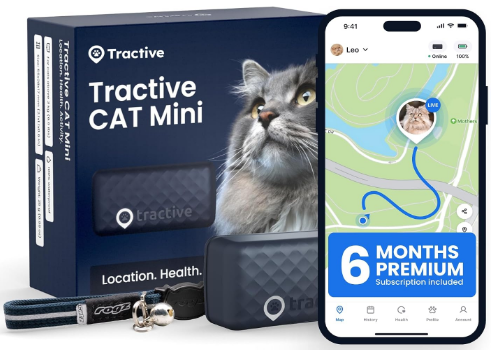
Model identification matters. The affiliate listing supplied for this article describes a cat tracker for cats around 6.5 pounds or more with up to five days of battery life. Those details align with Tractive’s CAT Mini, whose model-specific comparison lists activity and sleep monitoring. The newer CAT 6 Mini is listed with up to seven days and more comprehensive wellness features, including resting heart and respiratory trends. Tractive’s current support page contains broader language about features across available trackers, so confirm the exact hardware and app functions before buying. [12]
Even when a compatible model records vital-sign trends, it needs time and consistent wear to establish a baseline. It is not designed to certify that post-vaccine fatigue is normal or to rule out an allergic reaction. Direct observation and the veterinarian’s instructions remain more important after vaccination.
The strongest reason to use the linked tracker is location safety and longer-term activity or sleep context, not post-vaccine triage. It requires an active subscription and is intended for adult cats meeting the manufacturer’s size guidance.
One-year or three-year rabies label and certificate expiration
Route and anatomical injection site
FeLV antigen test date and result
Immediate or delayed reactions
Clinic contact information
Lifestyle changes discussed at each annual assessment
Keep the veterinarian’s official rabies certificate separate from a personal planner and store a digital photo in a secure location. Set reminders several weeks before expiration if boarding or travel is planned. A missed due date can affect legal status even when biological immunity may last longer.
If you change clinics, ask for the complete medical record rather than a one-line vaccine summary. The receiving veterinarian needs product type, dates, and adverse-event history to decide whether a dose is truly due.
Frequently Asked Questions
1. What is the standard kitten vaccination schedule?
Most household kittens begin FVRCP at 6–8 weeks and repeat it every 3–4 weeks through at least 16 weeks, sometimes 20 weeks when risk is higher. FeLV commonly starts at 8 weeks as two doses 3–4 weeks apart after testing, and rabies is generally given from the labeled minimum age under local law. [2][4]
2. How many FVRCP shots does a kitten need?
There is no correct fixed number for every kitten. The series continues until a dose is administered at 16 weeks or older; starting earlier produces more visits. A later endpoint may be selected in high-risk settings. The age at the final dose matters more than simply counting to three.
3. Is FVRCP required every year?
Usually not for a fully vaccinated, lower-risk adult receiving an appropriate injectable core product. After the kitten series and core revaccination around six months, the interval is often three years. Product route, exposure, medical history, and boarding requirements can change that plan. [2]
4. Does an indoor-only cat need vaccines?
Indoor cats still need an individualized core plan. FPV can spread through contaminated environments and objects, rabies exposure can occur through bats or escape, and emergencies can change an indoor lifestyle suddenly. Indoor status may make adult FeLV vaccination unnecessary when there is no realistic exposure.
5. Is the FeLV vaccine core or non-core?
AAHA/AAFP considers it core for kittens and cats younger than one year, then risk-based for adults. Adults with outdoor access or contact with FeLV-positive or unknown-status cats may continue revaccination; a truly low-risk adult may not need it. Test for FeLV antigen before the initial series. [1][2]
6. How often does a cat need a rabies vaccine?
After the initial dose, the first revaccination is commonly due one year later. Later intervals are generally one or three years depending on the licensed product and local law. Use the due date on the official certificate and confirm jurisdiction-specific requirements.
7. What if my adult cat has no vaccination records?
Treat undocumented history as unknown, not as proof of protection. The veterinarian will select a catch-up schedule based on the FVRCP formulation, age, environment, rabies rules, FeLV test result, and exposure. A modified-live and an inactivated product may require different dose counts. [4][5]
8. Can a sick cat be vaccinated?
The veterinarian should assess current illness and whether vaccination should be delayed. Fever, appetite loss, respiratory signs, vomiting, immune suppression, pregnancy, and ongoing treatment can influence timing or product choice. Do not make the decision solely from an online calendar.
9. Is sleepiness after a cat vaccine normal?
Brief lethargy, reduced appetite, mild fever, soreness, or local inflammation can occur. Follow the clinic’s expected timeframe and call if signs are severe, worsening, or persistent. Difficulty breathing, facial swelling, repeated vomiting or diarrhea, or collapse requires urgent care. [10]
10. What should I do if my cat develops a lump after vaccination?
Record the location and date, then monitor it as directed. Contact the veterinarian if it persists for three months, exceeds two centimeters, or grows one month after the injection—the 3-2-1 rule. Any painful, ulcerated, rapidly changing, or concerning mass deserves earlier assessment. [10]
11. Can vaccine titers replace boosters?
An FPV antibody titer can sometimes inform whether revaccination is needed. FHV-1 and FCV titers do not reliably represent protection, FeLV decisions rely on antigen testing and exposure risk, and rabies titers usually do not replace legally required vaccination. [6]
12. Should senior cats stop receiving vaccines?
Not solely because of age. AAHA/AAFP supports continuing standard, risk-based protocols without automatically vaccinating seniors more or less often. Health conditions, medications, exposure, prior reactions, product type, and rabies law should shape the plan. [5]
Final Takeaway
The best 2026 cat vaccination schedule is not the one with the most injections or the fewest. It is the one that creates timely protection during kittenhood, avoids unnecessary adult revaccination, respects FeLV exposure and rabies law, and changes when the cat’s health or lifestyle changes.
For most household kittens, remember the sequence rather than a rigid dose count: start FVRCP around 6–8 weeks, continue at 3–4-week intervals through at least 16 weeks, consider the later endpoint when risk warrants it, and return for core revaccination around six months. Start the two-dose FeLV series from the appropriate age after testing, and place rabies on its own legal and product-specific timeline.
For adults and seniors, bring records to an annual risk assessment and ask which vaccine is due, why it is due, which product will be used, and when the next dose truly expires. Keep a precise record, know the urgent reaction signs, and use technology only as a supplement to observation.
Vaccination is not an invisible guarantee. It is a carefully timed layer of protection—most effective when paired with veterinary care, exposure control, accurate documentation, and an owner who knows when something does not look right.
American Animal Hospital Association and American Association of Feline Practitioners — 2020 AAHA/AAFP Feline Vaccination Guidelines. Core and non-core classifications, lifestyle assessment, and individualized vaccine planning. View source
AAHA/AAFP — Core Vaccines for Pet Cats. FVRCP, FeLV, and rabies timing; product-dependent adult intervals; FeLV risk categories; and rabies label and legal considerations. View source
AAHA/AAFP — Vaccination Principles. Maternal antibody interference, six-month core revaccination, variable immune response, and the role of exposure reduction. View source
World Small Animal Veterinary Association — 2024 Guidelines for the Vaccination of Dogs and Cats. Primary-series intervals, final dose at 16 weeks or older, revaccination at or after 26 weeks, adult catch-up, and risk-based FeLV guidance. View source
AAHA/AAFP — Serology and Diagnostics. Appropriate use of FPV titers, limitations of FHV-1 and FCV titers, FeLV antigen testing, and rabies serology. View source
Cornell Feline Health Center — Feline Vaccines: Benefits and Risks. Vaccine function, kitten and adult risk assessment, disease summaries, indoor-cat protection, and non-core vaccine context. View source
Cornell Feline Health Center and AAFP — Feline Leukemia Virus Brochure. FeLV exposure prevention, testing, vaccine limitations, and why vaccination does not cause a positive antigen result. View source
AAHA/AAFP — Adverse Postvaccination Reactions. Common short-term reactions, anaphylaxis signs, medical-record requirements, and the 3-2-1 injection-site rule. View source
American Veterinary Medical Association — Vaccines and Sarcomas: A Concern for Cat Owners. Risk-benefit context, injection-site sarcoma awareness, and the importance of local rabies requirements. View source
Tractive Help Center — Cat Tracker Models and Health Features. CAT Mini and CAT 6 Mini size, battery, subscription, wellness-feature differences, and the non-medical purpose of tracker trends. Compare tracker models and review health-feature limitations
Sources, guidelines, product information, and policies reviewed August 29, 2026. Vaccine recommendations, product labels, local laws, and device features may change. Confirm critical decisions with your veterinarian and the applicable authority.
Cat Hygiene 101: The Complete Guide to Keeping Your Cat Clean and Healthy By Demosthenes Staudinger | Updated August 24, […]
Manage Consent
To provide the best experiences, we use technologies like cookies to store and/or access device information. Consenting to these technologies will allow us to process data such as browsing behavior or unique IDs on this site. Not consenting or withdrawing consent, may adversely affect certain features and functions.
Functional
Always active
The technical storage or access is strictly necessary for the legitimate purpose of enabling the use of a specific service explicitly requested by the subscriber or user, or for the sole purpose of carrying out the transmission of a communication over an electronic communications network.
Preferences
The technical storage or access is necessary for the legitimate purpose of storing preferences that are not requested by the subscriber or user.
Statistics
The technical storage or access that is used exclusively for statistical purposes.The technical storage or access that is used exclusively for anonymous statistical purposes. Without a subpoena, voluntary compliance on the part of your Internet Service Provider, or additional records from a third party, information stored or retrieved for this purpose alone cannot usually be used to identify you.
Marketing
The technical storage or access is required to create user profiles to send advertising, or to track the user on a website or across several websites for similar marketing purposes.