Why Indoor Cats Need Mental Stimulation (And How to Provide It)
By Demosthenes Staudinger | Updated August 24, 2026
Affiliate disclosure: This article contains affiliate links. As an Amazon Associate I earn from qualifying purchases. If you buy through one of these links, we may earn a commission at no additional cost to you. This does not affect our editorial recommendations.
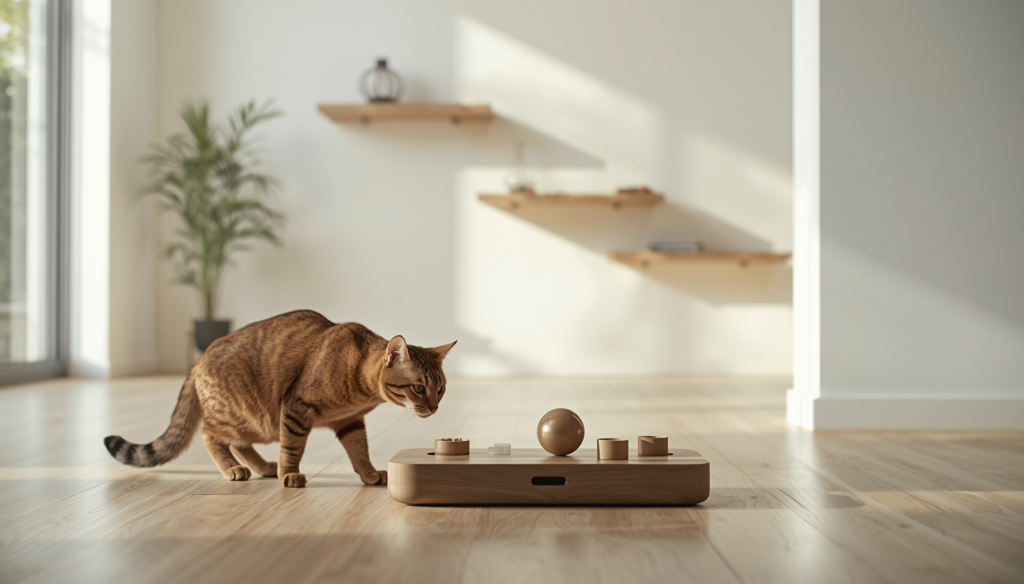
An indoor home can reduce exposure to traffic, predators, fights, poisoning, and infectious hazards. But physical safety does not automatically create a satisfying life. A quiet apartment may still offer too few opportunities to explore, stalk, climb, scratch, choose, and solve problems.
Cats are adaptable predators with strong senses, individual social preferences, and a need for environmental control. Feline welfare guidance therefore treats play, simulated hunting, safe territory, separated resources, predictable social interaction, and scent communication as essential needs.[1][2]
Mental stimulation does not require a room full of gadgets. A cardboard box, a brief training session, an easy food search, or prey-like wand play can be useful. Quality, safety, and timing matter more than price.
Enrichment can also be overcomplicated. A difficult puzzle can create frustration, an electronic toy can become background clutter, and a wobbling tower may go unused. The goal is meaningful choice and regular opportunities for normal behavior—not constant entertainment.
Nor should every quiet cat be labeled “bored.” Cats naturally sleep and rest for substantial portions of the day, and activity varies with age, health, personality, season, and household routine. Sudden withdrawal, excessive grooming, appetite change, house-soiling, aggression, or unusual vocalization may reflect pain or illness and should not be treated as an enrichment problem until medical causes are considered.
This guide explains why indoor cats need mental stimulation, how to recognize possible gaps without overdiagnosing them, and ten practical ways to build a richer home while preserving a clean, modern interior.
How we researched this article: This is a research-based editorial guide, not a veterinary diagnosis or a hands-on product test. We reviewed current Feline Veterinary Medical Association and International Cat Care guidance, peer-reviewed feline-welfare and feeding research, and current retailer documentation for the products mentioned. Modern Cat Society has not purchased or field-tested every product in this guide. Manufacturer and seller performance claims are identified as such.
Quick Answer
Indoor cats need mental stimulation because confinement removes many of the changing sights, scents, routes, decisions, and hunting opportunities they would otherwise encounter. Appropriate enrichment gives a cat safe ways to explore, forage, climb, scratch, play, learn, hide, observe, and control social contact.[1][2]
A useful enrichment plan usually includes:
- at least two short opportunities for prey-style object play each day;
- food-search or puzzle activities adapted to the cat’s ability and diet;
- stable vertical and hiding spaces;
- scratching choices in preferred orientations and materials;
- safe visual, scent, and texture variety;
- brief positive-reinforcement training;
- predictable, cat-controlled interaction; and
- quiet periods when the cat can rest without interruption.
More stimulation is not always better. Watch whether your cat approaches voluntarily, remains engaged, can succeed, and returns later. Those responses are more useful than following a universal schedule.
What Mental Stimulation Actually Means for a Cat
“Mental stimulation” is often used as shorthand for toys, but environmental enrichment is broader. It means arranging the home so a cat can express species-typical behavior, make choices, and feel some control over what happens.
The AAFP/ISFM environmental-needs framework describes five connected pillars:[2]
- A safe place: somewhere the cat can retreat, rest, and avoid interaction.
- Multiple, separated resources: food, water, litter boxes, scratching areas, sleeping places, and play opportunities positioned so access cannot easily be blocked.
- Play and predatory behavior: chances to search, stalk, chase, pounce, capture, and sometimes obtain food.
- Positive, predictable human interaction: contact suited to the individual cat and controlled by the cat whenever possible.
- Respect for scent and other senses: familiar odors, appropriate scratching and rubbing opportunities, and protection from overwhelming smells or sounds.
One robotic toy therefore cannot “solve” boredom. A cat with no safe perch, poor resource access, social conflict, or unwanted handling needs broader environmental changes.
Effective enrichment also alternates activation with recovery. Hunting-style play is naturally brief. Exploration is followed by resting. A cat should be able to leave every activity and return to a secure sleeping area without being followed by children, visitors, or other pets.
Is My Indoor Cat Bored? Signs and Look-Alikes
There is no single diagnostic test for feline boredom at home. The most useful approach is to compare current behavior with your cat’s established baseline and consider medical, social, and environmental explanations together.
| What you notice | An unmet enrichment need could contribute | Other explanations to rule out |
|---|---|---|
| Repeated attacks on ankles or hands | Insufficient appropriate chase-and-capture play | Learned hand play, pain, fear, redirected aggression |
| Persistent attention-seeking or vocalization | Too little predictable interaction or activity | Hunger, hyperthyroidism, pain, hearing loss, cognitive change |
| Destructive scratching | Inadequate scratching surfaces or poor placement | Normal marking, intercat tension, material/orientation preference |
| Overeating or rapid eating | Food is the main available activity | Incorrect ration, medication effects, diabetes, hyperthyroidism |
| Overgrooming or hair loss | Stress or lack of coping opportunities may contribute | Fleas, allergy, infection, pain, dermatologic disease |
| House-soiling | Resource competition or environmental distress | Urinary, gastrointestinal, mobility, or litter-box problems |
| Restlessness at night | Daytime inactivity or a reinforced routine | Normal schedule variation, illness, cognitive dysfunction |
| Reduced play and withdrawal | An environment with little appeal | Pain, dental disease, systemic illness, fear, aging |
Late-night running, long naps, bird watching, or suddenly abandoning an old toy can all be normal. The concern is a persistent pattern that reduces quality of life, creates conflict, or appears alongside physical changes.
If behavior changes suddenly, begin with a veterinary examination. Enrichment can support wellbeing, but it cannot diagnose or treat arthritis, urinary disease, hyperthyroidism, dental pain, skin disease, or cognitive dysfunction.
How Much Mental Stimulation Does an Indoor Cat Need?
There is no evidence-based duration that fits every cat. A kitten, active adult, shy rescue, and senior with arthritis need different activities.
FelineVMA behavior guidance recommends object play at least twice daily, using short bursts that mimic hunting.[7] That is a practical starting point, not a rigid prescription. Some cats enjoy several two- to five-minute sessions; others remain engaged longer. End while the cat is still comfortable rather than continuing until they become overstimulated or exhausted.
Use three questions to adjust the amount:
- Does the cat choose to participate? Approaching, orienting toward the activity, stalking, pawing, or waiting for another turn suggests interest.
- Can the cat succeed? The cat should catch the toy, obtain some food, reach the perch, or earn the training reward.
- Does behavior remain relaxed afterward? Frustration, panting, conflict with another cat, hiding, or frantic searching means the session needs modification.
Enrichment should be distributed across the day instead of delivered as one exhausting weekend event. Small changes embedded in feeding, room layout, and social routines are easier to sustain.
10 Ways to Provide Mental Stimulation for Indoor Cats
The following ideas address different needs. Start with two or three that fit your cat, then change one variable at a time so you can see what actually works.
1. Turn Part of Mealtime Into Foraging
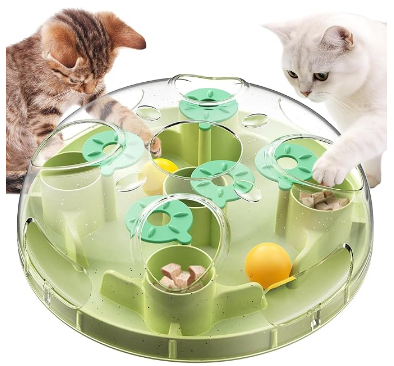
Food is a powerful enrichment resource because it already matters to the cat. You can hide a few pieces of the normal ration around one room, scatter kibble across a clean snuffle surface, use a rolling dispenser, or offer a stationary puzzle that requires pawing and searching.
Puzzle feeding can lengthen a meal and create opportunities for problem-solving. A clinical review described food puzzles as a practical way to support physical and emotional wellbeing, while emphasizing gradual introduction and individual adaptation.[5] International Cat Care likewise recommends beginning with an easy setup and increasing difficulty only after the cat succeeds.[8]
The contrafreeloading myth
Contrafreeloading means choosing to work for food when the same food is freely available. It occurs in several species, but it should not be presented as a universal feline preference. In a home study, cats ate more from a freely available tray than from a puzzle, and no cat met the study’s criterion for strong contrafreeloading.[4]
That does not make puzzle feeders useless. It means the better question is whether your cat voluntarily uses the puzzle when it is introduced at an appropriate difficulty. Do not withhold an essential meal to force participation, especially for kittens, seniors, underweight cats, cats on therapeutic diets, or cats with medical conditions.
Product option: KADTC 2-in-1 Cat Puzzle Toy & Foraging Ball
The KADTC 2-in-1 Cat Puzzle Toy & Foraging Ball combines covered food-search areas with rolling-ball play. The current Amazon listing describes a 13.2-inch board and two difficulty settings, allowing a beginner setup before making access more challenging.[9]
Best for: food-motivated adult cats that eat compatible dry kibble or firm treats and already investigate objects with their paws.
Why it may help:
- Two difficulty levels make gradual introduction more realistic than an all-or-nothing puzzle.
- Food hunting and rolling balls offer two activities in one footprint.
- Individual pieces from the cat’s measured daily ration can extend engagement without automatically adding calories.
Consider before buying: Modern Cat Society has not hands-on tested this model. Confirm dimensions, materials, cleaning instructions, and the current configuration on the listing. It is not suitable for wet food unless the seller explicitly states otherwise, and a determined chewer may damage removable or moving parts. Begin with exposed food, supervise the first sessions, and stop if the cat becomes frustrated or tries to swallow a component.
2. Use Interactive Play That Behaves Like Prey
A wand toy is one of the most versatile enrichment tools because a person can alter speed, direction, height, hiding, and pauses in response to the cat. Move the toy away from the cat rather than repeatedly pushing it toward the face. Let it disappear behind a chair, pause under paper, dart across open floor, and occasionally become easy to catch.
FelineVMA guidance specifically recommends interactive toys that mimic prey and says cats should be allowed to capture the “prey” intermittently to reduce frustration.[3] International Cat Care advises varying movement to resemble different prey types and adapting the session to the cat’s response.[6]
Keep hands and feet out of the game. Teaching a kitten that skin is a toy can become painful when adult teeth and claws arrive. Use a wand long enough to create distance, inspect strings and attachments before every session, and store string-based toys where the cat cannot access them unsupervised.
A simple sequence is:
- Locate: allow the cat to see or hear subtle movement.
- Stalk: use pauses and partial cover.
- Chase: add brief movement across a safe surface.
- Pounce and capture: let the cat physically take the toy.
- Finish: offer a small portion of the normal meal if appropriate, then put the wand away.
Not every session will include every step, and not every cat wants fast play. For a senior cat, moving a feather slowly across the edge of a bed may be a meaningful hunt.
3. Add Automated Toys—But Keep Human Play
Automated toys can create activity when you are working, but they should supplement rather than replace interactive play. The value lies in intermittent, prey-like movement and novelty. A device left running predictably for hours may be ignored, while a toy activated for a short session and then removed may remain interesting.
Choose a product the cat can physically contact. If a toy only creates an unreachable stimulus, some cats become frustrated. Observe the first several sessions to learn whether your cat chases confidently, watches calmly, avoids the device, or tries to dismantle it.
Product option: Migipaws Interactive MigiMouse Cat Toy
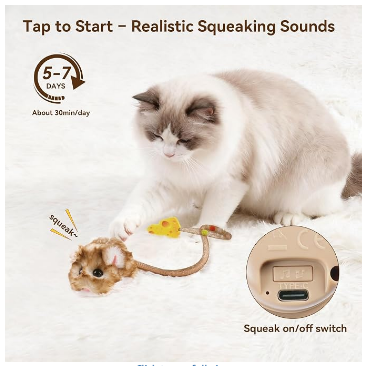
The Migipaws Interactive MigiMouse is a rechargeable plush mouse that rolls and spins, reactivates through a motion sensor, and includes a switchable squeak and replaceable catnip insert. The seller states that its 360-degree movement is designed to help it recover rather than remain overturned.[10]
Best for: confident cats that enjoy chasing small ground prey and are not prone to chewing fabric, elastic, plastic mesh, or electronic toys.
Why it may help:
- Stop-and-go movement can be more engaging than a motionless plush toy.
- Touch reactivation allows the cat to influence the next movement.
- Rechargeable operation avoids repeated disposable-battery purchases.
Consider before buying: the seller lists five to seven days of use at 30 minutes per day, but runtime is a manufacturer claim and will vary. Inspect the tail, seams, catnip pouch, charging port, and outer fabric frequently. Remove the toy if any component loosens, if the cat attempts to ingest material, or if movement causes fearful body language. Charge it away from the cat and follow the supplied electrical instructions.
4. Build Safe Vertical Territory
To a cat, usable space is three-dimensional. A perch adds an observation point, an escape route, and another resting location without consuming the same floor area as a second piece of human furniture. Vertical pathways are particularly valuable when they let a cat move through the room without passing close to a dog, child, vacuum, or socially tense housemate.
Height alone is not enrichment. A successful setup needs stable landing areas, non-slip surfaces, routes up and down, and locations the cat actually values. Position a perch near family activity or an interesting window rather than hiding it in an unused room. Provide lower steps for kittens, seniors, and cats with impaired mobility.
In multi-cat homes, avoid a single dead-end shelf that can be guarded. Where possible, create more than one route and distribute elevated resting places across the home.[2][12]
Product option: Magic Forest 90-Inch Solid-Wood Cat Tree
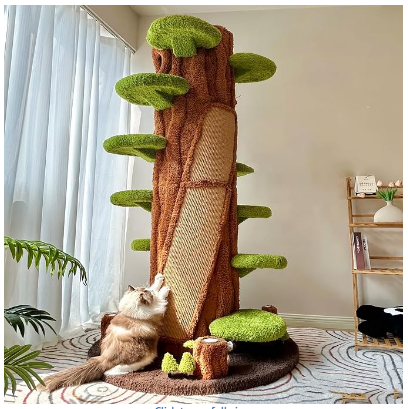
The Magic Forest Cat Tree Tower is an architectural option for households that want substantial vertical territory in one structure. The current listing describes a 90-inch height, a 40-inch-diameter base, mostly solid-wood construction, platforms, a cave, scratching posts, and hanging toys.[11]
Best for: large rooms, high ceilings, and confident adult cats that already climb and use elevated furniture.
Why it may help:
- Multiple levels combine climbing, observation, scratching, play, and rest.
- The enclosed cave adds a retreat as well as open platforms.
- A wood-forward design can integrate more naturally with modern interiors than a fully carpeted tower.
Consider before buying: at 7.5 feet tall with a 40-inch base, this is not a compact tree. Measure ceiling height, base clearance, doorways, assembly space, and every landing distance before ordering. “Mostly solid wood” is the seller’s description, not an independent materials analysis. Follow all assembly instructions, use any supplied anti-tip hardware, recheck fasteners, and keep the tower away from glass, stairs, a stove, or another fall hazard. Older or mobility-limited cats may need lower, wider steps instead.
5. Create a Window Observation Zone
A secure window can provide changing light, people, insects, leaves, birds, and weather without adding objects to the room. Place a stable perch at a comfortable height, keep blinds cords inaccessible, and confirm that screens and window hardware can withstand pressure from a cat.
Window viewing is not automatically relaxing. A cat may become agitated by an outdoor cat repeatedly entering the yard or by prey they can see but never approach. Watch for tail lashing, persistent vocalization, redirected aggression, spraying, or an inability to disengage. Frosted film on the lower portion of a window or moving the perch may be better than increasing exposure.
If you use a bird feeder outdoors, position it in a way that is safe for birds and does not invite the cat to strike fragile glass. Never open an unsecured window or balcony as an enrichment shortcut.
6. Rotate Toys Instead of Leaving Everything Out
Novelty can come from timing, not shopping. Divide safe toys into small groups and leave only a few available. Every several days, store one group and return another. A familiar toy can regain interest after an absence, especially if it appears in a new location or moves differently.
Create categories rather than buying duplicates:
- a wand or lure for social chase play;
- a lightweight object for batting;
- a kicker toy for grasping and hind-leg kicking;
- a tunnel or paper-based hiding object;
- an easy food puzzle;
- a more advanced food puzzle; and
- a quiet solo toy without string, feathers, batteries, or swallowable parts.
FelineVMA guidance recommends rotating toys to reduce habituation.[3] Rotation also makes inspection easier. Discard cracked plastic, exposed stuffing, loose bells, unraveling cord, detached eyes, damaged batteries, and any part small enough for that cat to swallow.
7. Teach Simple Behaviors With Positive Reinforcement
Training provides a clear problem, immediate feedback, and a reward. It can also make daily care easier. Useful behaviors include touching a target, stepping onto a mat, entering a carrier, moving onto a scale, offering a paw, or following a hand signal to a perch.
Keep sessions short—often one to three minutes is enough at first. Use a tiny piece of the normal food allowance, play, brushing, or petting as the reward, depending on the cat’s preference. Mark the correct moment with a consistent word or click, deliver the reward promptly, and stop before interest disappears.
Do not use training to force unwanted contact. A cat who walks away has ended the session. Fear, frustration, and pain interfere with learning, while reward-based training can strengthen the caregiver–cat relationship.[12]
Carrier training is an especially valuable enrichment project. Leave the carrier open as familiar furniture, reward looking at it, then entering, then remaining briefly with the door open. Progress over days or weeks rather than closing the door on the first success.
8. Use Scent and Search Games Safely
Cats gather information through scent, yet many enrichment plans focus only on movement. Try placing a familiar toy in a paper bag with the handles removed, hiding a few pieces of food in easy locations, or presenting a clean object that carries a safe outdoor scent such as dry leaves from a pesticide-free area.
Introduce only one scent at a time and let the cat approach. Catnip or silver vine can interest some cats, but response varies and exposure should be brief. Stop if the cat becomes agitated, aggressive, nauseated, or tries to ingest inappropriate material.
Avoid essential-oil diffusers, concentrated fragrance, and unknown plant material. “Natural” does not mean feline-safe. If you are unsure whether a plant, oil, cleaning product, or scent ingredient is safe, ask your veterinarian or a pet-poison resource before bringing it into the cat’s environment.
Scent continuity is as important as novelty. Do not wash every bed and scratcher on the same day. Familiar facial and body scents help a cat recognize territory and should not be erased unnecessarily.[2][3]
9. Offer Low-Cost Novelty and Safe Exploration
A shipping box, packing paper without tape, a tunnel, or two chairs covered by a blanket can create a temporary route at almost no cost. Move one object, not the entire home. Cats often value the option to investigate more than an elaborate permanent installation.
Safe novelty ideas include:
- an open cardboard box with two exits;
- crumpled paper large enough not to swallow;
- a treat trail leading to a familiar perch;
- a tunnel positioned differently;
- a new scratcher orientation;
- a blanket fort with stable supports; or
- access to a normally closed, cat-safe room under supervision.
Remove tape, staples, plastic film, foam, ribbon, handles, sharp edges, and anything treated with an unknown substance. Do not assume the cat understands which household objects are dangerous.
For cats who enjoy outdoor sights and scents, a properly built catio can offer controlled access. Harness walks suit some cats but are not universally enriching; training must be gradual, equipment must fit correctly, and the cat should never be dragged into an unfamiliar environment.
10. Make Social Interaction Predictable and Cat-Controlled
Human attention can be enriching when the cat wants it. Some cats prefer petting, others interactive play, grooming, conversation, lap contact, or simply sharing a room. The goal is not to maximize touching but to make interaction positive and predictable.[2][3]
Use consent checks: pause petting after a few strokes and see whether the cat reinitiates. Respect turning away, tail movement, skin twitching, ear rotation, or walking off. Children should learn that hiding and sleeping areas are not places to pursue a cat.
Another cat is not an automatic enrichment device. Cats may be affiliated, tolerant, or in subtle conflict. A second cat can increase stress when the home lacks separate resources and escape routes. In a multi-cat household, provide individual play sessions and enough distributed food, water, litter, scratching, sleeping, hiding, and elevated areas that one cat cannot control all access.[1][2]
A Simple Daily Enrichment Routine
A plan should fit real life. The following template uses short, repeatable activities rather than requiring constant supervision.
| Time | Example activity | Purpose | Typical duration |
| Morning | Wand play followed by breakfast | Chase, capture, predictable routine | 3–10 minutes |
| Late morning | Easy puzzle using part of the measured ration | Search and problem-solving | Cat controlled |
| Midday | Window perch or a short automated-toy session | Observation or independent movement | 5–15 minutes active time |
| Evening | Wand play, fetch, or hallway chase with a safe toy | Social play and physical activity | 3–10 minutes |
| After dinner | Target or carrier training | Learning and confidence | 1–3 minutes |
| Overnight | Safe resting choices and non-swallowable solo toys | Choice without sleep disruption | As chosen by the cat |
Duration is intentionally flexible. A kitten may request more frequent play; a senior may prefer two minutes of slow pawing from a warm bed. The cat’s voluntary engagement and physical comfort matter more than completing every row.
For weekly variety, change one puzzle difficulty, rotate a toy set, introduce one safe box or tunnel arrangement, and inspect all equipment. Avoid changing every resource at once, which can make the environment less predictable.
How to Adapt Enrichment to Your Cat
Kittens
Kittens often need frequent short play and close safety supervision. Use toys larger than the mouth, prevent access to cords and small parts, teach that hands are not prey, and provide low climbing options before tall structures. Their ability changes rapidly, so recheck hazards often.
Active adult cats
Confident, high-energy adults may enjoy faster wand play, more complex search routes, taller vertical pathways, and several short sessions distributed through the day. Increase complexity gradually rather than simply increasing intensity.
Senior cats
Older cats still benefit from novelty and learning, but pain, vision, hearing, and balance may change how activities should be presented. Use wide non-slip steps, low-entry puzzles, larger targets, slower toy movement, warm resting places, and rewards that fit the cat’s medical diet. A decline in play should prompt a veterinary discussion rather than an assumption that the cat is “too old.”
Cats with arthritis or limited mobility
Bring the activity to a stable, accessible surface. Move a wand horizontally instead of encouraging jumps, place food searches within easy reach, and use ramps or closely spaced steps. Ask the veterinarian about pain management; enrichment cannot compensate for untreated pain.
Overweight cats
Use food from the measured daily ration rather than adding treats. A puzzle may slow access, but it does not guarantee weight loss. Calorie targets, diet selection, safe activity, and weight monitoring should be planned with a veterinary professional.
Shy or anxious cats
Prioritize safety, control, and predictability before novelty. Begin near a hiding area, use quiet movement, maintain escape routes, and avoid surrounding the cat. Watching from cover can be participation. Never pull a cat out to “make” them play.
Multi-cat households
Offer enrichment in more than one location and supervise food puzzles if stealing or guarding occurs. Play with cats separately when one individual’s confidence or speed prevents another from participating. A camera can help reveal resource blocking, but direct observation and sufficient separated resources remain essential.
Enrichment Safety Rules
Mental stimulation should never create a new medical or household hazard.
- Supervise all first uses of a puzzle, electronic toy, tunnel, shelf, or tower.
- Store string, yarn, ribbon, feather wands, and elastic where the cat cannot access them alone.
- Remove small parts and damaged toys immediately.
- Keep batteries and charging cables inaccessible; charge electronic toys according to instructions.
- Count puzzle food within the daily ration.
- Do not use a difficult feeder as the only food source until the cat has demonstrated comfortable, reliable use.
- Secure shelves and climbing furniture to appropriate structural support and follow load limits.
- Provide more than one route on elevated structures when social blocking is possible.
- Keep play away from stairs, hot surfaces, glass, open balconies, and unsecured windows.
- Stop before panting, exhaustion, fear, conflict, or frustration develops.
- Wash food-contact products according to their instructions and discard materials that cannot be cleaned safely.
- Ask a veterinarian before changing activity for a cat with heart, respiratory, orthopedic, neurologic, metabolic, or recovery-related restrictions.
Laser pointers require particular care. Chasing a light can create movement, but the cat cannot physically capture it. If you use one, never aim at eyes, keep sessions brief, and transition to a tangible toy or food reward the cat can catch. Stop using it if the cat continues searching or appears frustrated.
When a Behavior Change Needs Veterinary Attention
Enrichment is appropriate for a healthy cat whose environment needs more opportunity. It is not the first treatment for sudden behavior change.
Contact your veterinarian if you notice:
- a rapid increase or decrease in activity;
- new hiding, aggression, clinginess, or vocalization;
- appetite, thirst, weight, or litter-box changes;
- overgrooming, hair loss, itching, or skin injury;
- stiffness, reluctance to jump, or sensitivity to touch;
- disorientation or nighttime pacing;
- vomiting, diarrhea, constipation, or urinary signs; or
- withdrawal from previously valued activities.
Bring a timeline, videos, diet information, and details about household changes. Once medical causes are assessed, your veterinarian may recommend environmental modification or referral to a qualified feline behavior professional.
Frequently Asked Questions
Do indoor cats really need mental stimulation if they seem calm?
Yes. Calm resting is normal, but it does not replace opportunities to play, explore, forage, scratch, climb, hide, and choose social contact. Enrichment should be available without forcing constant activity. A cat can sleep much of the day and still benefit from several short, voluntary activities.
How can I tell whether my cat is bored or simply relaxed?
Look at patterns rather than sleep alone. A relaxed cat usually eats, grooms, moves, explores, and interacts in a consistent way. Repetitive attention-seeking, destructive behavior, overeating, conflict, or reduced engagement may suggest unmet needs, but the same signs can reflect illness or stress. Sudden changes deserve veterinary assessment.
How many times a day should I play with my indoor cat?
At least two short object-play opportunities daily is a useful starting point, consistent with FelineVMA behavior guidance.[7] Adjust frequency, speed, and duration to age, health, and interest. Several three-minute sessions may suit a cat better than one long session.
Should every meal come from a puzzle feeder?
Not necessarily. Some cats readily use puzzles; others prefer accessible food, and research does not show that cats universally choose to work for a meal.[4] Begin with a small part of the normal ration and an easy setup. Maintain reliable access to adequate nutrition, especially for cats with medical or dietary needs.
Can I leave an automatic cat toy running while I am away?
Only if the manufacturer permits unsupervised operation and you have first observed safe use. Inspect the toy for loose fabric, tails, strings, batteries, and small parts. Many electronic toys are better used in timed sessions and stored afterward. They do not replace human play or daily welfare checks.
Are laser pointers good mental stimulation for cats?
They can trigger chasing, but the lack of physical capture may frustrate some cats. Keep the beam away from eyes, use brief sessions, and finish with a tangible toy or food item the cat can catch. Choose another activity if the cat becomes agitated or continues searching afterward.
What if my cat ignores every new toy?
Change the movement, location, time of day, and difficulty before buying more. Try play before a normal meal, move a wand away like prey, present one toy at a time, or offer a simple box. Rule out pain or illness if interest has declined across activities. Individual cats also have legitimate preferences.
Can senior cats benefit from mental stimulation?
Yes. Adapt the activity rather than removing it. Use slow movement, accessible puzzles, non-slip surfaces, low steps, familiar cues, and short training sessions. New disorientation, nighttime waking, or loss of interest may require evaluation for pain, sensory change, or cognitive dysfunction.
Is a cat tree better than wall shelves?
Neither is universally better. A cat tree is movable and may combine scratching, hiding, and resting; shelves can create a longer route while preserving floor space. The best option is stable, correctly installed, easy for that cat to access, and positioned where the cat wants to observe. Multi-cat routes should avoid dead ends.
Does getting a second cat solve boredom?
No. Some cats form close social relationships, while others merely tolerate or fear one another. A second cat adds competition for space and resources as well as possible companionship. Adopt another cat because the household can support that individual—not as a toy for the resident cat.
Final Thoughts
Understanding why indoor cats need mental stimulation changes enrichment from occasional entertainment into everyday habitat design. The objective is not a constantly busy cat. It is a cat who can choose to hunt, search, climb, scratch, learn, observe, interact, hide, and rest in ways that fit their body and personality.
Start small: use part of a measured meal in an easy search, schedule two brief play sessions, add one stable elevated resting place, and rotate rather than accumulate toys. Products can help when they match the cat and home, but they do not replace safety, observation, veterinary care, or responsive interaction.
The best enrichment plan is the one your cat voluntarily uses and your household can maintain. Watch the response, preserve choice, adjust difficulty, and let the cat show you which experiences are genuinely rewarding.
Read morre:
The Complete Guide to Keeping Your Indoor Cat Healthy and Happy
7 Best Interactive Cat Toys to Keep Your Cat Happy and Active in 2026
Sources and References
- Feline Veterinary Medical Association — Meeting the Physical and Emotional Needs of Indoor Cats. Current position statement supporting essential environmental needs, simulated hunting, safe territory, and multi-cat considerations. View source
- Ellis SLH, Rodan I, Carney HC, et al. — AAFP and ISFM Feline Environmental Needs Guidelines. Peer-reviewed five-pillar framework for safe places, separated resources, play, social interaction, and scent. View source
- Feline Veterinary Medical Association and International Cat Care — Your Cat’s Environmental Needs: Practical Tips for Cat Caregivers. 2026 guidance on play, capture, food puzzles, toy rotation, vertical space, and predictable interaction. View source
- Delgado MM, Han BSG, Bain MJ — Domestic Cats Prefer Freely Available Food Over Food That Requires Effort. Home study supporting the correction that strong contrafreeloading was not demonstrated in the tested cats. View source
- Dantas L, Delgado M, Johnson I, Buffington CT — Food Puzzles for Cats: Feeding for Physical and Emotional Wellbeing. Clinical review and case material on introducing and adapting feline food puzzles. View source
- International Cat Care — Playing With Your Cat. Current caregiver guidance on prey-like interactive play, individual preferences, and indoor stimulation. View source
- Feline Veterinary Medical Association — Training Techniques for Addressing Undesirable Behaviors. Guidance supporting short object-play sessions at least twice daily and keeping hands out of play. View source
- International Cat Care — Puzzle Feeders for Your Cat. Guidance on beginner difficulty, progressive introduction, and adaptation for cats with different abilities. View source
- Amazon — KADTC 2-in-1 Cat Puzzle Toy & Foraging Ball Listing. Seller-listed product name, board size, two difficulty levels, and current configuration. View source
- Amazon — Migipaws Interactive MigiMouse Cat Toy Listing. Seller-listed movement, sensor, squeak, rechargeable operation, catnip insert, and runtime claim. View source
- Amazon — Magic Forest 90-Inch Cat Tree Tower Listing. Seller-listed height, base diameter, materials description, platforms, cave, scratchers, and assembly claims. View source
- Feline Veterinary Medical Association — Setting Up the Environment for Success. Guidance on vertical space, safe resources, positive reinforcement, individual rewards, and environmental control. View source
Sources, specifications, prices, and policies reviewed August 24, 2026. Product features, retailer terms, warranty coverage, and manufacturer guidance may change. Verify critical details with the manufacturer or retailer before purchasing.